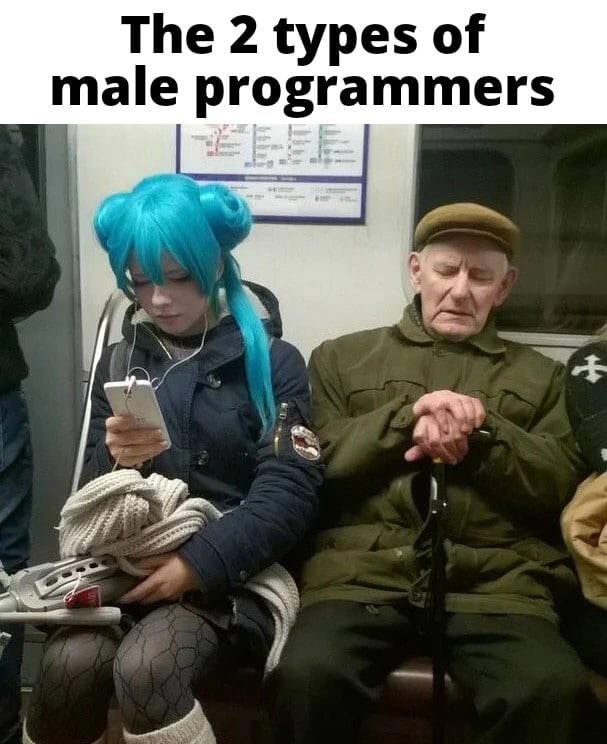
Meme contrasting the two stereotypical archetypes of male programmers on a subway
Why is this DevCommunities meme funny?
Level 1: Opposites Sitting Together
Imagine you have two friends who are both into the same hobby, like painting, but they couldn’t look more different. One friend dresses like a colorful cartoon character – bright blue hair, fun clothes, always with the latest gadget or phone in hand. The other friend dresses very plain and old-fashioned – like a grandpa wearing an army jacket, very serious and quiet, leaning on a cane. Now picture these two sitting next to each other on a bench, not talking, just side by side. It’s a funny sight because they seem like complete opposites, right?
This meme is doing the same thing but with programmers (people who write code). The top words say “The 2 types of male programmers,” joking that all male programmers are either like the super flashy guy or like the super traditional guy. It’s like saying: in a silly world, there are only two kinds of boys who code – one is a high-energy anime-loving whiz kid and the other is a calm, old-school expert. Of course, in real life, programmers are all kinds of people, not just these two types. But seeing these two extremely different men together makes us laugh. It’s as if someone said, “Look, every male coder is either this cool, futuristic dude or this quiet, old veteran. No exceptions!” We laugh because we know that’s an exaggeration — it’s not really true for everyone — but the contrast is so extreme that it’s silly and memorable.
So the funny feeling you get is like when someone says, “There are two kinds of students: those who doodle in neon colors all over their notebooks, and those who take notes with a ruler and black pen.” Showing one student with pink hair drawing anime characters and another in a uniform writing very neatly side by side would make you giggle. This meme does that with programmers, highlighting how different people in the same job can be. It’s basically celebrating and poking fun at how diverse and quirky the programmer community is, using a very simple, dramatic side-by-side picture that anyone can chuckle at.
Level 2: The Dev Dichotomy Explained
Let’s break down the meme’s joke in simpler terms. The caption “The 2 types of male programmers” sets up the expectation that we’re about to see two stereotypical examples of programmers who are men. In developer communities, people often joke about stereotypes — simplified characterizations that aren’t always true but have a grain of familiarity. Here, the meme uses a funny photo from a subway showing two men who look totally opposite to represent those stereotypes:
Left side archetype: A younger guy with bright blue anime-style hair in twin buns, dressed in a bold, modern fashion (fishnet-pattern tights, a coat with patches, etc.), absorbed in his smartphone with earbuds in. Everything about him screams tech-savvy pop culture enthusiast. The blue hair is a big AnimeReference – it looks like something out of a Japanese anime or a cosplay (costume play) of a famous character. In fact, many online commenters might joke he’s cosplaying Hatsune Miku (a virtual pop star known for her turquoise pigtails) or some anime protagonist. This immediately signals “young geek who’s into modern nerd culture.” Developer humor often portrays one “type” of programmer as the modern, gadget-loving, meme-savvy guy. This person likely loves the latest technology, perhaps works in web development or mobile apps, and has hobbies like watching anime, playing video games, or collecting geeky merchandise. The smartphone in his hand suggests he’s always connected – maybe he’s checking code on GitHub, chatting on a developer Discord, or scrolling through Reddit for tech memes. Earbuds in, he’s possibly listening to music (maybe an anime soundtrack or lo-fi coding beats) or even a programming podcast. This stereotype is basically the “cool geek”: he’s expressive (bright hair, fashion-forward), he’s into trending culture, and he brings that flair into the programming world. In many tech offices, you really can find programmers with dyed hair, unique fashion, and anime stickers on their laptops – it’s a proud part of DevCommunity culture now. Younger devs often feel free to be themselves at work, and being a fan of anime or quirky fashion is pretty common and accepted.
Right side archetype: An older man with a very traditional, utilitarian look – an olive green military-style jacket, a brown flat cap, hands resting on a black cane, sitting upright and staring forward with a neutral or stern expression. He looks like he might be retired from the army or at least from an older generation. In the programming world, this stereotype corresponds to the old-school programmer or veteran coder. People often humorously imagine older male programmers as wearing simple, no-frills clothes (maybe the same kind of outfit they’ve worn for decades), being unimpressed by the latest trends, and carrying themselves with a certain stoicism (meaning they don’t show much emotion, kind of like a strict grandfather figure). This man evokes the image of someone who might have started coding when computers filled whole rooms or when the internet was dial-up. Perhaps he wrote code in languages like C, Pascal, or COBOL on systems that seem ancient to younger devs. (To clarify: COBOL is a programming language from the 1960s used heavily in old banking systems; many younger programmers joke about it as “grandpa’s language,” while older folks actually still maintain a lot of critical COBOL code in banks and governments!). This archetype is the kind of programmer who prefers things stable and text-based: imagine him using a black-and-white terminal, editing files with
vior Emacs (classic text editors), and not really caring about fancy visuals or trendy libraries. If you ask him about JavaScript frameworks or the latest anime, he might roll his eyes or say “Back in my day, we did everything in assembly and we liked it.” He’s portrayed as the “seasoned veteran”: highly experienced, maybe a bit traditional or resistant to change, and definitely not flashy in appearance. In developer meme culture, this is sometimes affectionately called the “graybeard” (even if in the pic he’s clean-shaven) or the “Unix wizard” type of programmer.
Now, the meme’s joke is that these two look so different you’d never guess they share the same profession! By labeling them “the 2 types of male programmers,” the meme playfully suggests that if you’re a male programmer, you must be one or the other – either the colorful anime-loving coder or the old reliable warhorse. Of course, in reality, programmers (male or otherwise) come in countless varieties, not just two. But this humorous oversimplification is a common format in memes: it highlights extremes to make you laugh. It’s a way for the tech community to poke fun at itself: “Ha ha, aren’t we an odd bunch? We have guys who look like cyberpunk hackers and guys who look like retired soldiers, all writing code together.”
In DevCommunity circles online, you’ll often see this format: “There are two types of developers: [extreme example A] and [extreme example B].” It’s a quick meme formula that usually gets a chuckle because people immediately recall colleagues or famous figures who fit those extremes. Maybe you’ve heard a line like “There are 2 types of programmers: those who prefer dark mode and those who are wrong.” (That’s a joke implying everyone should love dark mode color schemes in their editors, another lighthearted stereotype). Or the classic nerd joke: “There are 10 types of people in the world: those who understand binary and those who don’t.” (In binary “10” actually means 2 in decimal – it’s a pun; don’t worry if you don’t get it at first, it’s a very programmer-y joke!). This meme follows that tradition: it’s dividing a complex spectrum (all male programmers) into just two silly categories.
Let’s connect some real-world context to each character so it’s clearer:
The left character could be akin to a modern front-end web developer or game developer in his 20s. Perhaps at work he’s known for customizing his text editor with anime themes and writing slick code with the latest JavaScript or Python features. He might say things like “I just set up a CI/CD pipeline for our app from my phone!” and he introduces coworkers to new memes or new VSCode extensions. He represents the wave of programmers who grew up with the internet, social media, and a lot of pop culture influences, making them quite open and expressive. If you’re a junior dev yourself, you might identify with him if you love customizing your PC, have a favorite anime profile pic on forums, or enjoy the casual dress code of tech (hoodies, bright sneakers, funky hair colors – all common and totally fine in many tech workplaces).
The right character resembles many senior engineers or system administrators that a junior dev might meet in more established companies. Perhaps this person has worked 30+ years in tech, so he values reliability and simplicity. He might insist on writing clean, well-documented code and might chuckle (or grumble) at some of the “new fads” in programming that younger devs get excited about. This could be the mentor figure who teaches you data structures and algorithms in depth, or who fixes a server issue by typing arcane commands into a terminal while you watch in awe. His clothing and demeanor reflect how some older generation tech folks don’t really engage in the latest pop culture or fashion – they might treat programming like a serious engineering discipline (which it is!) and less like a lifestyle. If you’ve ever had an IT teacher or a senior colleague who’s a bit old-fashioned – like they prefer email over chat, or they print out code to review it on paper – you get the idea. They’re not boring people; in fact, they often have amazing knowledge. They just show their passion differently, maybe by telling you about the history of Unix or how they optimized code when 1 MB of RAM was a luxury.
It’s important to note the meme specifically says “male programmers.” Developer humor sometimes narrow-focuses like this because historically, the “old guard” image is usually male (think of an old male engineer stereotype), and likewise the “flashy anime techie” stereotype in memes is often depicted as male (even though plenty of all genders enjoy anime and tech fashion). It’s a bit of self-deprecation in the male programmer community: acknowledging that while there’s diversity, a lot of the loud personalities often fall humorously into these two camps. It’s not saying all male programmers truly are like this, but within jokes it can feel that way. It also implicitly nods to the idea that male programmers often get categorized or categorize themselves in funny ways (like “either you drink black coffee and hate JavaScript or you drink energy drinks and make CSS art, there’s no in-between!” – another exaggeration, of course there is in-between).
So, to a newer developer or someone outside tech, this meme is basically showing two very different-looking people and saying they both write code for a living. The laugh comes from thinking about how each one would stereotypically behave at work or in a coding project:
- The anime-styled guy might have a crazy desktop setup with multiple monitors, coding at light speed while listening to game soundtracks, deploying apps to the cloud, and talking in slang or internet acronyms.
- The older gentleman might be the one who prefers a quiet environment, maybe has a single sturdy computer, possibly even hates interruptions like loud music, and writes code methodically, maybe even on paper first. He might use decades-old yet reliable software (like editing in Nano or Emacs, using email lists for communication instead of Slack).
But the awesome (and funny) thing is: they can both be excellent programmers. The developer community laughs at this extreme contrast because we’ve seen teams where the person who looks like a cosplayer and the person who looks like a conservative grandpa end up debugging an issue together, each bringing their unique approach. It highlights a kind of cultural diversity within tech that outsiders might not expect. When you think “programmer,” some might picture a nerd with glasses in a hoodie. Others might picture an older engineer in an office. This meme says, “Hey, both images are true – and here they are sitting together, possibly on their way to code the next big app or fix the subway’s signal system.”
In summary, the meme uses humorous visual contrast to explain a bit of inside humor: developer culture has a wide range of personalities, and we jokingly boil down male programmers into two opposite stereotypes to make each other laugh. It’s like saying, “In our club of programmers, look how drastically different we can be!” and that’s something the community often finds both proud and funny.
Level 3: Old Guard vs New Wave
At first glance, this meme sets up a spectral contrast between two extreme developer archetypes: a flamboyant tech enthusiast and a stoic old-school veteran. The humor kicks in because it suggests all male programmers fall into one of these two wildly opposite categories. Of course, the reality is more nuanced, but exaggerating into a binary stereotype is a classic in-joke in developer communities. Here we have the New Wave on the left — bright turquoise twin-bun hair (a nod to anime pop culture, think Hatsune Miku vibes), edgy fishnet tights, earbuds feeding some high-BPM coding music, eyes glued to a smartphone with the intensity of a dev debugging on production. On the right sits the Old Guard — olive military-style jacket, flat cap, hands resting on a trusty cane, gazing ahead as impassively as a seasoned mainframe admin waiting for a COBOL batch job to finish. This visual gag riffs on a common trope in tech culture: the flashy, cutting-edge geek vs. the no-nonsense, veteran engineer.
Why is this funny to experienced devs? Because it’s * painfully relatable*. In any large tech company or open-source project, you’ll likely encounter someone like the left character: a young programmer who might have a GitHub full of experimental projects, loves anime and meme culture, perhaps sporting a laptop decked with Neon Genesis Evangelion stickers and running the latest JavaScript framework du jour. Sitting right next to them (sometimes literally in an office or conference) could be someone like the right character: a senior engineer who’s been coding since the days of punch cards or dial-up, preferring simple text-based tools and a quiet focus, possibly with war stories of the Y2K fix or that time they optimized a C program to run on 2MB of RAM. The meme exaggerates these differences for comedic effect, implying these two could be commuting buddies on the same subway ride and yet come from entirely different worlds of programming culture.
This extreme juxtaposition hints at deeper industry patterns. The left archetype represents the "new school" developer: embracing modern open-source ecosystems, likely to have a colorful DevOps dashboard theme, frequenting Reddit or Discord, maybe even indulging in cosplay at tech conventions (yes, developer conferences sometimes have after-parties where anime cosplay isn’t out of place!). They might deploy code via container orchestration one day and binge an anime series the next — the type who writes a Python script to automate their houseplants’ watering while wearing a hoodie with RGB LED accents. The right archetype stands for the "old school" engineer: disciplined and utilitarian. This could be the colleague who still uses vi or Emacs in the terminal, values stability over hype, and reminds the team that plain text and robust algorithms matter more than flashy UIs. They might have started programming before the younger dev was born, carrying decades of context: “I remember when we had to manage memory ourselves, none of this garbage collection magic!” is something you can almost imagine him saying. Essentially, it’s the Anime Enthusiast vs. The UNIX Philosopher dynamic.
The unspoken camaraderie (and friction) between these two archetypes is what senior devs chuckle at. We’ve all been in meetings or Slack channels where generational differences pop up:
- The New Wave dev suggests adopting a cutting-edge library with a cute mascot and a GitHub star count skyrocketing overnight.
- The Old Guard raises an eyebrow and asks, “What about security and backwards compatibility? We’ve solved this problem in C ages ago.”
Both bring valuable perspectives, yet they often clash in humorous ways. The meme captures that tension with a simple subway snapshot. The younger dev’s earbuds signal he’s possibly in his own digital world (maybe reviewing code on a mobile IDE or catching up on tech tweets), whereas the older dev’s folded hands and distant stare scream been there, seen that — like a senior developer patiently awaiting the outcome of yet another all-night deployment they know could go sideways. It’s that thousand-yard stare of someone who’s handled 3 AM production outages and is mentally debugging something even while off-duty. Meanwhile, the younger one might be furiously typing a Slack message or laughing at a meme about the latest JavaScript framework breaking everything.
Shared experiences underpin this humor. Consider how developer offices or hackathons often look: you’ll see one guy with neon-dyed hair wearing a GitHub Octocat hoodie, sitting next to another guy in a plain polo shirt that’s older than the intern writing React code across the room. They might both be brilliant coders, but culturally they’re oil and water. And yet, when production goes down, they’ll both be shoulder-to-shoulder at 3 AM, one troubleshooting the cloud deployment script, the other digging through logs in vim. There’s an inside joke that tech is the great equalizer: no matter your style or age, the compiler/interpreter will judge your code without prejudice.
From an industry history angle, this dichotomy also reflects how tech has opened up and diversified over time. Decades ago, many programmers had similar backgrounds (think engineering grads in white shirts with pocket protectors or veterans from military computing units). They often adhered to formal dress codes and conventional appearances. As computing power spread and the internet birthed open-source and startup cultures, a new generation of self-taught programmers and enthusiasts emerged, bringing along their diverse hobbies (like anime, gaming, punk fashion). Today’s dev culture loves to poke fun at itself for this diversity: we have CEOs in hoodies and interns with piercings, alongside traditional folks in business casual. The meme captures that rich contrast in one frame.
To a seasoned developer, this image might also evoke tool and tech stack differences: The left might be into Rust or JavaScript with an anime-themed VS Code editor (yes, anime IDE themes exist!), pushing code from an iPhone, while the right might be maintaining a COBOL system on a mainframe or writing optimized C in a no-frills editor on a ThinkPad that’s built like a tank. It’s not that one is superior — in fact, the best teams often have both styles balancing each other. But in meme-world, you exaggerate for laughs: imagine code from these two personalities:
// Code by the "Old Guard"
#include <iostream>
int main() {
std::cout << "Hello, world from the old school!" << std::endl;
// Efficient, no-nonsense, compiled with g++ on a terminal
return 0;
}
# Code by the "New Wave"
print("Hello, world from the new school! 💻🚀")
# Possibly run on a smartphone IDE, emojis and all, pushed via cloud CI/CD pipeline
The first is straight-to-the-metal C++ with classic syntax – it echoes a time when “Hello, World” was printed on a monochrome monitor. The second is a quick Python script with an emoji flare – something you might literally run on a phone or a Raspberry Pi just for fun. These contrasting code snippets mirror the meme’s two characters and how they approach tech.
Ultimately, experienced devs laugh because they recognize a kernel of truth. We’ve worked with the “anime-haired genius who can code in any language but might forget to document it” and the “quiet veteran who writes bulletproof code but in an outdated style.” The industry needs both creativity and caution, youthful energy and seasoned wisdom. By joking that there are only two types of male programmers, the meme satirically acknowledges how broad the spectrum really is — if these two are the poles, imagine everything in between. It’s an affectionate roast of developer culture’s own diversity, highlighting that whether you come with blue hair or a brown cap, as long as you can code and collaborate, you belong on the same ride.
Description
Top text reads, "The 2 types of male programmers" in bold black lettering. Below the caption, a candid subway photo shows two sharply contrasted passengers seated side-by-side. On the left sits a person with long, bright-turquoise twin-bun hair, dark coat with a patch on the sleeve, patterned fishnet tights, a bulky cream-colored knitted scarf in their lap, earbuds in, eyes on a white smartphone; a pair of folded crutches rests against their legs. On the right sits an older man wearing an olive-green military-style jacket and brown flat cap, hands neatly folded over a black walking cane, staring forward impassively. The visual joke implies that software-engineering culture often sorts male programmers into extreme stereotypical categories - flashy, anime-inspired gadget lover versus stoic, utilitarian traditionalist - highlighting how developer communities frequently rely on such humorous binaries to poke fun at their own diversity
Comments
29Comment deleted
Left: adds 14 npm packages to animate a button; Right: still patches libc in vi - yet by Friday night they’re both chasing the same race condition
One's debugging a null pointer exception in their waifu's heart, the other's still debugging COBOL from the Cold War - both wondering why their code won't compile but for vastly different reasons
This perfectly captures the bimodal distribution of our industry: those who grew up debugging COBOL on mainframes versus those who learned to code by modding Minecraft. Both will argue passionately about their preferred text editor, though one's editor predates the other's birth year. The real question is - which one is more likely to have actually read the documentation?
Cosplay kid deploys microservices via mobile; boomer's monolith has uptime since the Apollo era
Two types of male programmers: the React dev who hot‑reloads his hair color, and the mainframe custodian whose wardrobe is LTS since Solaris - one deploys hourly, the other only after an IPL
Left ships to Vercel with 14 npm scripts, right edits crontab over SSH - both get paged at 2am when the “non‑breaking” schema change breaks everything
I'm in the middle Comment deleted
Me too lel 🚫 Comment deleted
Non-binary? Comment deleted
programmerfluid Comment deleted
web3sexual Comment deleted
Yeap, hexadecimal Comment deleted
Analog? Comment deleted
Yeah, I am json file Comment deleted
All files are technically binary. Json content is interpretation. Checkmate, non-binary persons! Comment deleted
Bruh Comment deleted
Third type of programmers work from home Comment deleted
wait male programmers? I see nothing but a senior dev and a fa.... Comment deleted
Biendian-curious. Comment deleted
Bolgarian-clowns Comment deleted
Saint-Petersburg reality Comment deleted
Saint-Petersburg reality is sending to the front-end where dead lines are tight. If you know what I mean Comment deleted
Why tf so much programmers are with anime on their avas Are u girls? I don't believe, there are not girls in programming, only trans Comment deleted
Don't try to understand, just watch Comment deleted
trans girls are still girls😌 Comment deleted
Oh, I understand: they are not binary — they are ternary, that is choosing between the two options depending on context. Comment deleted
WHERE ARE THE GODDAMNED FURRIES Comment deleted
there's two wolves inside of you 😏 Comment deleted
and more waiting in queue Comment deleted