Skip to content
DevMeme
2487 of 7435
A Project Manager's helpful solution to developer burnout
Management PMs Post #2761, on Feb 16, 2021 in TG

A Project Manager's helpful solution to developer burnout

Why is this Management PMs meme funny?

Level 1: All Work and No Play

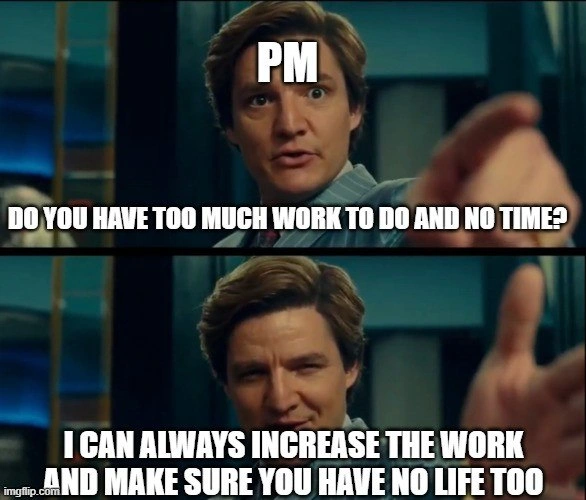
Imagine you tell your teacher, “I already have too much homework and no time to finish it all.” Instead of helping you or excusing one assignment, the teacher smiles and says, “Here, let me give you even more homework so you absolutely have no time to play or relax.” Sounds ridiculous, right? That’s exactly what this meme is joking about. In the picture, a boss asks an employee if they have too much work and no time. When the employee would obviously say “Yes, I’m overwhelmed,” the boss basically replies, “Great, I’ll give you extra work and make sure you have no life outside of work too!” It’s funny in a very silly and absurd way – kind of like a really bad joke. The reason people laugh is because it’s expressing frustration: sometimes bosses act as if the solution to being too busy is to be even busier. Of course, in real life no good teacher or boss should do that. It’s taking an extreme, unreasonable response and showing it plainly so we can all shake our heads and chuckle. The core idea is simple: all work and no play makes life miserable, and this meme pokes fun at a boss who just doesn’t understand that. It’s a way for workers (like software developers) to say, “Can you believe this?!” and find a little humor in an unfair situation.

Level 2: Welcome to Crunch Time

At first glance, this meme shows a boss (labeled “PM” for Project Manager) cheerfully asking if you’re overloaded with work and then promising to give you even more work so you have “no life.” It’s a joke about having absolutely no free time due to job demands. Let’s break down why it resonates with developers, especially what terms like Scope Creep, Crunch Time, and Deadlines mean in a software context.

Project Manager (PM) – This is the person responsible for planning and managing the project schedule and tasks. A good PM will adjust deadlines or redistribute tasks if a developer has too much on their plate. But a bad PM (like the meme character) might do the opposite: instead of helping, they increase the workload. The meme exaggerates this behavior for humor. The PM in the image is pointing dramatically, as if proudly delivering this terrible news.

Too much work and no time – In tech jobs, it’s common to sometimes feel like you have more work than can fit in a normal workday. Deadlines (due dates for projects or features) can be very tight. Deadline pressure means everyone is rushing to finish tasks before the clock runs out. When the meme asks “Do you have too much work and no time?”, it’s describing a situation many developers know: an overflowing task list and an upcoming deadline, leading to stress.

Scope Creep – This is a term for when a project keeps getting new features or requirements after work has already started. Imagine you’re building a simple app, and originally it just needs to show a list of items. But then partway through, the boss or client says, “Actually, let’s also add user logins. And a shopping cart. Oh, and can we have a chatbot too?” All without moving the deadline. That’s scope creep – the scope of the project creeps larger and larger. It’s a common headache in software development. In the meme, the manager increasing the work when you have no time is exactly scope creep (and really poor planning). They’re essentially saying, “We’re adding more to your plate, even though you’re already swamped.”

Crunch Time – This refers to a period when developers have to work extra hard and put in long hours (often evenings and weekends) to meet an urgent deadline. For example, if a game launch is next week but there are still many bugs, the team might enter “crunch time” and work late every night to fix everything. It’s called crunch because you’re getting squeezed to deliver a lot in a short time. In healthy workplaces, crunch time is rare; in bad environments, it can be constant. The meme’s line “make sure you have no life” is pointing to a worst-case scenario where crunch time never ends – you’d be working all the time, with no chance to relax or see family/friends (that’s the “no life” part). It’s poking fun at how some companies wrongly treat endless overtime as normal.

Unrealistic Deadlines – Sometimes project timelines are set without understanding how much work is involved. For instance, being asked to develop a complex feature in one week when it really needs a month – that’s unrealistic. When developers say a schedule is impossible and management’s response is to add even more work or keep the date unchanged, it feels absurd. Yet, it does happen. Newer developers quickly learn that part of the job is pushing back on unrealistic deadlines or explaining why adding features means you need to adjust the schedule. If that conversation fails, you get situations just like the meme.

So why do people find this funny? It’s a form of WorkplaceHumor – specifically ProjectManagementHumor – that highlights a serious issue in a silly way. No real boss would outright say “I’ll make sure you have no life,” but sometimes their actions feel like that’s what they expect. Developers (even juniors) might recall times when they were juggling a ton of assignments or tasks. Maybe in a college project you told your team or professor “I can’t handle more,” and the reply was “Well, figure it out because we need these extra things done.” It’s that same frustration. This meme exaggerates it: the manager character is gleefully volunteering to double your workload. It’s funny because it’s so blunt and over-the-top, yet it hints at something real – the stress of CrunchTime and endless work.

If you’re new in the industry, the meme is basically a cautionary laugh. It teaches terms through dark humor: scope creep is bad, crunch culture is unhealthy, and a manager who ignores your limits is a problem. Early in your career, you learn the importance of setting boundaries and realistic expectations. This meme resonates because it’s the opposite of best practice – it’s a caricature of what not to do. And sometimes the only way to cope with these high-pressure moments is to joke about them. When you see tags like DeadlinePressure, UnrealisticDeadlines, or DeveloperBurnout attached to this meme, it’s because constantly living in crunch time can lead to burnout (total exhaustion and loss of motivation). So developers share jokes like this as a stress relief and as a reminder: you’re not alone if you’ve dealt with crazy workloads. We’ve all been there, shaking our heads at a manager who just doesn’t get it. This meme puts that shared experience into a one-two punchline that’s easy to relate to.

Level 3: Double the Work, Zero Life

In this meme’s two-panel scene, a confident project manager (PM) character is essentially saying: “Oh, you’re already swamped and out of time? Perfect, let me pile on even more work so you definitely have no life outside the office.” It’s a darkly comedic take on classic project-management dysfunction. The image is actually Pedro Pascal’s character from Wonder Woman 1984 – known for the line “Life is good... but it can be better”. Here it’s twisted into a tech workplace joke: “Your workload is heavy... but it can be heavier!” The manager’s pointing grin signifies a perverse wish granted: more tasks, less free time. Seasoned developers immediately recognize this as satire of scope creep and crunch culture gone wild. It captures that moment when raising a concern about DeadlinePressure backfires spectacularly.

Why is this so funny (and painful) to experienced devs? Because it nails a real industry anti-pattern: instead of helping a struggling team, some managers double down on unrealistic deadlines. It’s the absurd logic of “If you’re at 100% capacity, let’s push to 200%!” Everyone in software has seen a project where the scope only ever increases while the timeline stays fixed. The meme exaggerates it to a joke conclusion: complaining that you can’t possibly do more just gets you more work. It’s like a twisted inversion of problem-solving. Rather than alleviating pressure, the manager responds with, “You think this is bad? I’ll show you worse!” — a scenario many burned-out devs will laugh cry into their coffee over.

This references a core issue in toxic CorporateCulture: ignoring human limits for the sake of promises. Under intense stakeholder pressure, managers sometimes promise new features or stricter deadlines without adjusting plans. When engineers protest that the schedule is impossible, a clueless boss might interpret it as a challenge to work harder. It’s a running joke in tech circles that saying you have no slack just convinces certain bosses you were underutilized! The humor comes with a knowing eye-roll: we’ve all heard the phrase “crunch a little more to meet the date” or the classic Phase II features sneakily pulled into Phase I. It’s ScopeCreep in action – requirements keep growing, but time and resources don’t. The result? Nights and weekends sacrificed, a.k.a. CrunchTime. This meme basically puts that on blast: bad management ensures you “have no life” outside of work.

From a senior engineer’s perspective, this is a horror story we share as comedy. The meme wouldn’t exist if it wasn’t so relatable. It echoes the lessons of the famous Mythical Man-Month – adding more workload (or people) to a late software project just makes it later and burns out your team. But here the manager is oblivious to that wisdom. They’re like Dilbert’s pointy-haired boss on steroids: more features, less sanity. The PM’s grin says, “I’m helping!” while every developer who’s survived a death march project knows it’s a one-way ticket to DeveloperBurnout. In reality, productivity drops, bugs multiply, and people quit when pushed this hard. But that grim reality is exactly why this dark humor lands: it’s cathartic to mock the absurdity. The meme exaggerates a truth – that sometimes the reward for working efficiently is… more work, with zero breathing room.

To illustrate the logic in code (because why not):

def on_engineer_complains_too_busy(engineer):
    if engineer.free_time == 0:
        # Manager's brilliant idea: clearly they can handle even more!
        extra_tasks = ["AnotherFeature", "OneMoreUrgentFix"]
        engineer.assign(extra_tasks)
        engineer.work_life_balance = None  # goodbye, personal life

In this tongue-in-cheek pseudocode, when free_time == 0 (the developer is maxed out), the manager adds extra_tasks and sets work_life_balance to None. 🤦 It’s a snarky representation of how such managers operate: seeing an overloaded developer and deciding the solution is to overload them further. The joke is equal parts hilarious and exasperating because every veteran dev remembers a project where this felt literally true. The meme perfectly captures that shared exasperation with ManagementHumor: when things are bad, some bosses manage to make it better worse. It’s a coping laugh at a very real problem in tech workplaces.

Description

This is a two-panel meme using the 'Life is good, but it can be better' format featuring actor Pedro Pascal as Maxwell Lord from Wonder Woman 1984. In the top panel, the character is labeled 'PM' in bold white text. He looks concerned and points forward, asking the viewer, 'DO YOU HAVE TOO MUCH WORK TO DO AND NO TIME?'. In the bottom panel, his expression shifts to a smug, almost villainous grin as he extends his hand, offering a twisted solution: 'I CAN ALWAYS INCREASE THE WORK AND MAKE SURE YOU HAVE NO LIFE TOO'. The meme satirizes the often-strained relationship between project managers and development teams. It highlights the stereotype of PMs who, faced with an overloaded team, contribute to the problem by piling on more tasks (scope creep), demonstrating a disconnect from the engineering reality and leading to developer burnout and poor work-life balance
Comments

7
Anonymous ★ Top Pick Our PM heard the team was drowning in technical debt, so they threw us a lifeline made of new feature requests
  1. Anonymous ★ Top Pick

    Our PM heard the team was drowning in technical debt, so they threw us a lifeline made of new feature requests

  2. Anonymous

    My manager treats my workload like Kubernetes HPA: infinite horizontal scaling on a single-node cluster - me - until personal life hits zero availability

  3. Anonymous

    The PM's superpower: solving resource constraints by converting your personal time into a fungible asset, then wondering why the team's velocity metrics show diminishing returns after sprint 47 of the 'two-week project'

  4. Anonymous

    Ah yes, the classic PM load balancing algorithm: if (developer.workload > capacity) { developer.workload *= 2; developer.personal_time = null; }. It's O(burnout) complexity, but at least it's consistent. Bonus points for the implicit assumption that developers are stateless microservices that can scale infinitely without considering memory leaks (mental health), garbage collection (recovery time), or eventual system crashes (attrition). This is what happens when you apply 'move fast and break things' to human resources - spoiler alert, the things that break are people

  5. Anonymous

    PMs: Masters of horizontal scaling - workload to infinity, developer cycles fixed at 24 hours

  6. Anonymous

    Executive solution to cycle time: misread Little’s Law, crank WIP to infinity, and rebrand burnout as “stretch OKRs.”

  7. Anonymous

    Already at 100% CPU; management fixed it by spawning more threads - now my personal life is a starved low‑priority process

Use J and K for navigation