Skip to content
DevMeme
2486 of 7435
The Deep State is real... and it's on npm
Frontend Post #2760, on Feb 16, 2021 in TG

The Deep State is real... and it's on npm

Why is this Frontend meme funny?

Level 1: Conspiracy in a Box

Imagine you always hear grown-ups whisper about a secret group that secretly runs the world – kind of a spooky idea, right? Now imagine you walk into a toy store, and on the shelf you see a little box labeled “Secret Group Controller – Easy World Domination Kit.” You’d probably giggle, because it’s taking that big, scary secret idea and turning it into a simple toy you can buy. It makes the whole thing feel less serious and kind of funny.

This meme is doing the same thing, but with coding. People talk about a “deep state” as if it’s a secret organization controlling everything. A developer found a little software tool (on a site where programmers share tools) that’s actually named “deep-state.” He jokes, “Guys, the deep state is real!” as if he found the actual secret group – but he’s really talking about the tool. It’s funny because it’s like finding out the huge mysterious monster everyone fears is actually just a cute little gadget on a website. It takes something that sounds serious and turns it into something ordinary that we can laugh about. In simple terms: a big scary secret turned into a harmless toy for your computer, and that surprise makes us smile.

Level 2: There's a Package for That

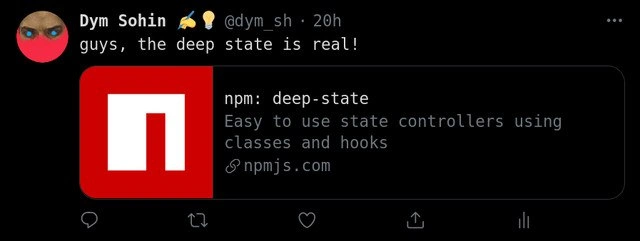
Let’s break down the joke in simpler terms. This meme is essentially a screenshot of a Twitter post where a developer excitedly says, “guys, the deep state is real!” accompanied by a preview of an npm page for a package named deep-state.

First, some definitions:

  • npm (Node Package Manager): This is like an app store for JavaScript code. Developers use npm to install libraries (also called packages or dependencies) created by others. For example, if you need to add charts to your website, instead of coding it from scratch, you might run npm install some-chart-library and use that. Npm hosts hundreds of thousands of packages – from big frameworks to tiny utilities – that anyone can publish. It’s a cornerstone of Package Management in JavaScript and NodeJS. When you see the red npm logo in the tweet’s link preview, it tells you the link is pointing to an npm package page (in this case, npmjs.com for the deep-state package).

  • “Deep State” (the phrase): Outside of programming, deep state refers to a supposed secret group that’s said to covertly run things behind the scenes (a popular conspiracy theory term). It’s the kind of thing you hear in political dramas or on conspiracy forums – an invisible hand controlling everything without people knowing.

  • State (in programming): In coding, especially in Frontend Development, state simply means the current data or status of your application or component. Think of state as all the information that determines what you see and what happens. For example, in a shopping cart app, the list of items in your cart is part of the app’s state. If you remove an item, the state changes, and the UI updates to reflect the new state. Managing state is crucial because as users interact (click buttons, type text, navigate pages), the state changes and your app needs to respond correctly.

  • State Management Libraries: These are tools or frameworks that help developers handle state, especially as apps grow complex. In small apps, you might keep state directly in each component (like a simple React component using useState). In larger apps, it gets tricky to keep everything in sync, so folks use dedicated solutions like Redux or MobX or context providers. Each solution has its own approach to organizing and updating state across many parts of an application.

Now, the package deep-state in the meme is described as “Easy to use state controllers using classes and hooks.” This indicates it’s likely a state management tool meant for React developers:

  • Classes and Hooks: In React, there are two main ways to create components:

    • Class components (the old style) – you define a class that extends React.Component. These use a state property and methods like this.setState to manage state.
    • Functional components with Hooks (the modern style) – you write functions, and use Hooks like useState and useEffect to add stateful logic. Hooks let function components “hook into” React features.

    When a library says it works with classes and hooks, it means it can integrate with both types of React components. Perhaps it provides a central state store or controller that both class-based and function-based components can tap into. This is a selling point because some older apps still use class components, while newer code is written with hooks. A tool supporting both helps during transitions – you don’t have to rewrite all your old components to use the new library.

  • Easy to use state controllers: This suggests the library provides a convenient way to define and manipulate state. For instance, it might let you define a global state object (a single source of truth for your app’s data) and then let any component access and update parts of that state through a simple API, without a ton of boilerplate. In essence, it’s probably trying to simplify patterns like Redux (which can be a bit heavy) by offering a lighter approach (maybe something akin to React’s Context but with some extras, or similar to other lightweight state libs like Zustand or Valtio).

So why is this all funny? Because of the play on words and the situation:

  • Imagine hearing people talk about a mysterious “deep state” that secretly controls everything in government. Now a developer finds a harmless JavaScript library called “deep-state” that literally helps control the state of a web app. He jokes “the deep state is real!” as if he’s discovered the actual secret conspiracy, when in reality it’s just tech jargon. It’s a classic wordplay where a serious phrase is flipped into a coding context.

  • It also pokes fun at our habit in the JavaScript world of making an npm package for just about anything. Developers sometimes exaggerate that “there’s an npm package for every little need.” Here that idea is taken to a comical extreme: even a conspiracy theory concept has an npm package named after it! The tweet humorously treats the existence of this package as proof that the conspiracy is true, which is ironic and silly. It’s like if someone doubted unicorns are real, and then you showed them a toy unicorn from a store and said, “Look, a unicorn – proof!” Obviously a toy isn’t proof of a real unicorn, and an npm module named “deep-state” isn’t proof of a real shadow government. But that absurd equivalence is what makes it a joke.

  • Dependency humor: The meme subtly jabs at Dependency Hell too. Modern projects can depend on hundreds of npm packages. Sometimes, important functionality ends up relying on a maintainer’s weekend project. (The infamous case: a tiny package called left-pad with 11 lines of code broke huge applications when it was unpublished – because so many other packages indirectly depended on it!) The idea of adding a package literally called deep-state to manage something as critical as your app’s state could be seen as inviting a secret ruler into your project. It’s funny because, in a way, large dependency trees do feel like they have a life of their own. Who’s really in charge of your app – you, or the mysterious code from npm? A junior developer might not have felt this pain yet, but many learn it quickly when a dependency update suddenly causes weird errors. It can feel like some hidden force is controlling your app’s fate.

To illustrate state in React both with classes and hooks, here’s a quick example of each:

// Using state in a React class component (old way)
class Counter extends React.Component {
  constructor(props) {
    super(props);
    this.state = { count: 0 };             // initial state
  }
  increment = () => {
    this.setState({ count: this.state.count + 1 });  // update state
  }
  render() {
    return <button onClick={this.increment}>Count: {this.state.count}</button>;
  }
}

// Using state in a React functional component with Hooks (new way)
import { useState } from 'react';
function CounterHook() {
  const [count, setCount] = useState(0);   // useState hook for state
  return (
    <button onClick={() => setCount(count + 1)}>
      Count: {count}
    </button>
  );
}

In both cases we have “state” (a count) and a way to update it (increment). A library like deep-state might let us move this state logic outside the component into a central place (for example, a state controller or store), and then both class and functional components could use that shared state. That way, if you had many components needing to know the count or modify it, they’d all be using the same source of truth. This is essentially what state management libraries do – they prevent parts of your app from each keeping their own separate deeply nested state and getting out of sync. Instead, you get a single global state (or at least a more centralized state) that acts kind of like an authoritative record.

Now, tie this back to the meme’s joke: calling that central authority the “deep-state” is a witty pun. It implies this npm package might act like a shadow government for your app’s data: powerful, unseen, and presumably making things easier (or so it claims). The developer tweeting this is having a laugh because they’re combining a pop-culture phrase with a developer reality:

  • Pop-culture: “Deep state controls everything behind the scenes!” (spooky, conspiratorial)
  • Developer world: “I found a library that controls state behind the scenes!” (actually useful, but given an ominous name)

In summary, for a newer developer: this meme is highlighting how JavaScript developers love to create and share new tools – sometimes to an extreme – and how they also love puns. It’s showing a real example of a tool with a funny name. We find it amusing because it’s a collision of a serious concept with the quirky reality of our coding culture. Plus, it’s a bit of an inside joke about how many state management tools are out there. If you ever feel overwhelmed by the number of libraries to learn, don’t worry – even experienced devs think it’s a little crazy too, and we bond over these jokes. After all, why have just one way to manage state when you can have twenty… including one named after a conspiracy? 😅

Level 3: Global State Conspiracy

At first glance, this meme shows a tweet proclaiming “guys, the deep state is real!” alongside a preview of an npm package named deep-state. For seasoned developers, this hits on multiple layers of humor. The phrase “deep state” ordinarily refers to a secretive, shadowy organization that supposedly controls a government from behind the scenes – a classic conspiracy theory. Here, it’s cheekily applied to a JavaScript context: a state-management library on npm. Essentially, a dev found an actual package called deep-state on the Node Package Manager (npm) registry and couldn’t resist the wordplay. It’s like saying “See? The Deep State does exist – it’s just another npm module!” 😜

This joke resonates with experienced devs because it merges tech culture with a tongue-in-cheek conspiracy pun. Let’s unpack why this is funny and oh-so-relatable:

  • Endless npm Packages: In modern Frontend Development, there’s an npm package for everything – from serious frameworks down to absurdly niche utilities. This has led to the running joke (and occasional frustration) that the dependency hell is real. When a tweet sports the official npm logo (that red square with white letters) next to a package called deep-state, veteran engineers immediately smirk. We’ve seen everything from a package to left-pad strings (hello, left-pad incident) to one that checks if a number is even. So why not a package for the “deep state”? The absurdity lies in taking a grandiose concept like a secret world government and finding it neatly packaged as a JavaScript library you can import. It’s a perfect poke at how Package Management sometimes borders on the ridiculous. If you can dream it (or dread it), someone has uploaded it to npm.

  • State Management Overload: The term state in programming refers to the data that determines a program’s behavior at a given time. In web apps – especially built with frameworks like React – managing state is a big deal. There’s local component state, global app state, UI state, server state... you name it. Over the years, countless libraries have tried to simplify state management: Flux, Redux, MobX, the Context API, Zustand, and now apparently deep-state. Each new library promises an easier way to handle the tangled web of variables and UI changes. A senior dev reading “Easy to use state controllers using classes and hooks” in the meme’s preview will likely chuckle: Oh great, another silver bullet for our state problems. We’ve been through the hype cycles – every few months the community discovers a “revolutionary” state tool that will supposedly solve all our woes. It’s nearly comical how often we see yet another state library pop up on Hacker News or Twitter, each with its own fancy spin. The humorous twist: naming this one deep-state, as if it’s the secret sauce controlling our entire app from the shadows. It implies this package might become the invisible hand of your application’s data flow – an ironic nod to conspiracy lore. Illuminati confirmed? 😉

  • Classes and Hooks – Bridging Eras: The package description mentions “using classes and hooks”. For a React veteran, this is meaningful. Originally, React components were primarily class components (using class MyComponent extends React.Component with an internal state). In 2019, React Hooks (useState, useEffect, etc.) arrived, allowing functional components to also manage state and side effects without classes. Many codebases now are a mix: legacy class-based components alongside modern hook-based ones. A library that works with both “classes and hooks” tries to unify state management across old and new React patterns. A senior dev knows this is a non-trivial promise. It’s like saying, “Our state controller can possess any component, be it old-school or new-age.” The phrasing “deep-state” makes it sound as if this library seeps into the depths of your app, hooking into any component type, secretly orchestrating state changes everywhere. It’s both impressive and a tad ominous – exactly the double meaning the meme plays on. We grin because we’ve witnessed past attempts at such all-in-one state solutions. Often, they either over-engineer the simple or oversimplify the complex. A grizzled dev might jokingly warn: Be careful installing something literally called deep-state – who knows what hidden influence it might wield in your app’s bowels! 😅 The dark humor is that sometimes a poorly understood dependency does feel like a shadow government in your codebase, introducing bugs or weird behavior that’s hard to trace (looking at you, mysterious event emitters and global singletons).

  • Hype vs Reality: This tweet’s tone (“guys, the deep state is real!”) mimics how conspiracy theories are breathlessly shared, but here it’s mocking the hype around a new library. In developer Twitter circles, it’s common to share exciting new tools with a similar dramatic flair – “OMG drop everything, check out X library!” Everyone loves a good shiny new toy. This meme exaggerates that enthusiasm by framing it as a revelation of a grand conspiracy. The senior perspective recognizes both the genuine excitement and the underlying satire: yeah, it’s cool, but we’ve been burned by hype before. Remember how every new state management tool is “the one truth” until the next one comes along? 🤔 The meme winks at this short attention span. It’s essentially a gentle self-own by developers: we laugh because we know we sometimes treat new libraries with almost cult-like fervor — especially in the JavaScript world. Today’s “deep-state” could be tomorrow’s forgotten package languishing in node_modules.

In short, the meme cleverly uses the conspiracy pun to highlight the sometimes absurd reality of Frontend Development: even weighty phrases like "deep state" can turn into a trivial piece of your code stack via npm. It’s a reminder that our industry has a unique talent for turning anything into a library or framework – often to humorous effect. A grinning veteran might say, “The real deep state controlling my projects is the dozens of dependencies I blindly npm-installed.” And now, hilariously, one of them is literally called deep-state. The circle is complete.

Description

A screenshot of a tweet from a user named Dym Sohin (@dym_sh) with a playful, conspiratorial tone. The tweet's text reads, 'guys, the deep state is real!'. Below this is a link preview for an npm package. The preview shows the npm logo (a red square with a white 'n'-like shape) and the package details: 'npm: deep-state', with the description 'Easy to use state controllers using classes and hooks' and a link to npmjs.com. The humor is a classic pun, conflating the political conspiracy theory of a 'deep state' (a hidden government network) with a technical term in software development, in this case, a state management library for (likely) a JavaScript application. For senior developers, it's a dry, witty observation on the sometimes-absurd naming of software packages and a nod to the in-jokes prevalent in the developer community

Comments

13
Anonymous ★ Top Pick Finally, a 'deep state' that can be managed with a simple API and uninstalled when it causes too many side effects
  1. Anonymous ★ Top Pick

    Finally, a 'deep state' that can be managed with a simple API and uninstalled when it causes too many side effects

  2. Anonymous

    Did `npm i deep-state`; now I’ve got 1,400 transitive deps, 23 high-severity CVEs, and my Redux store is marked “top secret” - pretty sure package.json is the one orchestrating releases now

  3. Anonymous

    After years of prop drilling and context hell, developers finally discovered the deep state was controlling their React components all along - and it's available on npm with semantic versioning

  4. Anonymous

    When you're debugging state management issues at 3 AM and accidentally stumble upon proof that the conspiracy theorists were right all along - turns out the deep state was just poorly documented React hooks with class-based controllers. No wonder nobody could find it; the README probably just says 'it works on my machine' and links to a Medium article from 2019

  5. Anonymous

    Turns out the deep state is just the React app’s hidden dependency that mixes classes and hooks to mutate global state five providers down - nobody admits adding it, but removing it breaks prod

  6. Anonymous

    Deep state confirmed: a lone NPM package hoisting classes into hooks, plotting infinite re-renders from the shadows

  7. Anonymous

    Confirmed: the deep state exists - it's the nine nested React providers; installing another “easy” npm state lib just adds one more layer of indirection between your button and setState

  8. @energizer91 5y

    captain obvious to the rescue!

  9. @willowfragment 5y

    this can't be real

  10. @willowfragment 5y

    human stupidity can't be that dense, can it?

  11. @GLXBX 5y

    Explanation team please

    1. @maxgraey 5y

      «deep state» is conspiracy theory

      1. @PsyDuckTape 5y

        who cares

Use J and K for navigation