Clubhouse: The original audio-only social network
Why is this IndustryTrends Hype meme funny?
Level 1: Been There, Heard That
Imagine you come up with what you think is a brand new idea for a game: you tell everyone it’s this amazing game where one person speaks and all your friends listen and take turns talking. Then your grandpa laughs and says, “We used to play that game on the radio when I was a kid!” In other words, your cool new thing isn’t actually new at all. This meme is funny for the same reason: it’s like someone took an old toy and put a new wrapper on it, claiming it’s the hottest new toy of the year.
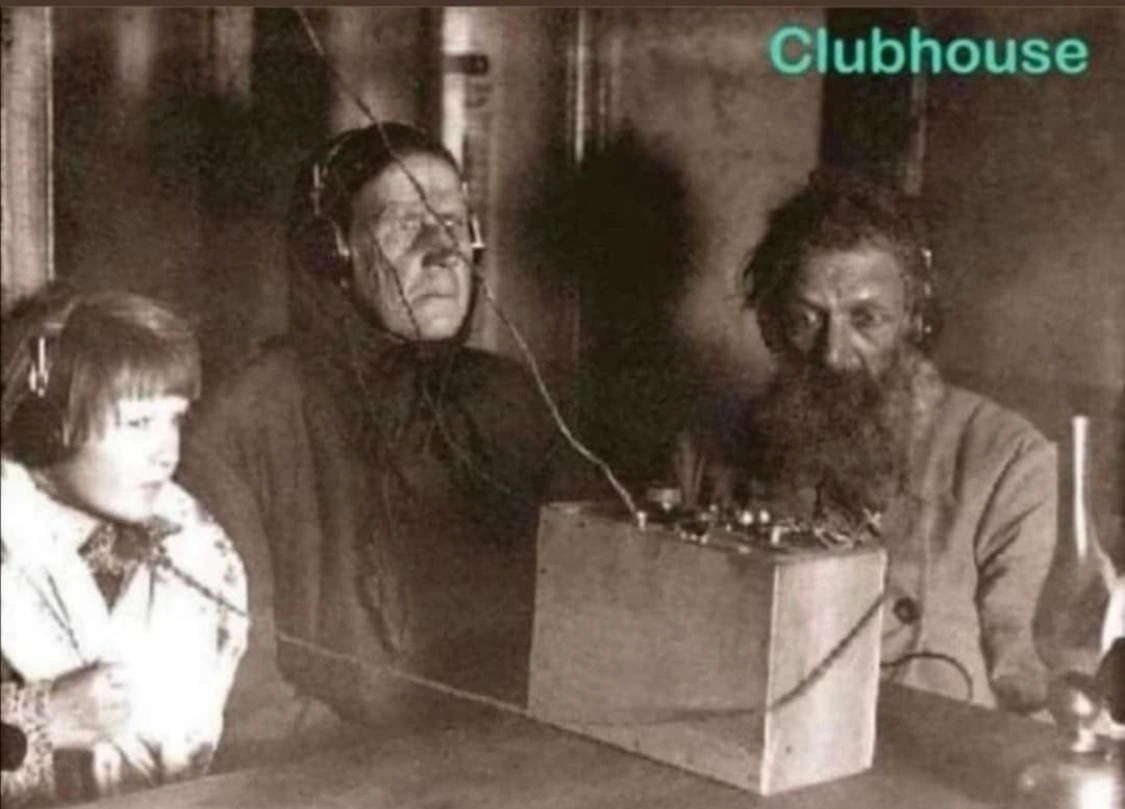
Think of it like this: if you painted an old bicycle a flashy color and started calling it the “revolutionary Personal Transport Device 3000”, people who know about bicycles would giggle. They’d say, “that’s still just a regular bike, buddy.” Here, the tech industry hyped up a new audio chat app called Clubhouse as if it was something totally groundbreaking. But people who know a bit of history could see it’s basically radio all over again – just using the internet this time. The picture in the meme literally shows great-grandma and great-grandpa’s generation using “Clubhouse,” because sitting around a radio in the 1920s and listening to a live conversation was the same idea. It makes us laugh because it reminds us that sometimes, what’s marketed as a cutting-edge invention is really an old classic in disguise. It’s a fun way of saying, “Hey, we’ve heard this one before!”
Level 2: Old Idea, New App
In plainer terms, this meme jokes that Clubhouse, the buzzworthy “audio-only” social app of 2021, is really just a modern remake of old-fashioned radio. To break it down: Clubhouse is (or was) a smartphone application where users join virtual rooms to talk or listen to others’ conversations in real-time, using voice only (no video, no text chatting). Back in early 2021 it was a hot ticket – invite-only access, lots of hype – everyone on tech Twitter and beyond was talking about it. The idea was that you could drop into these audio chat rooms and hear people discuss topics live, kind of like interactive podcasts or panel discussions you could participate in.
Now compare that to what’s in the photo: a genuine 1920s radio listening session. The photo is sepia-toned (that brownish vintage photo look) which immediately signals “this is old-timey.” The people in it are wearing heavy wired headphones because early radios often required them for clear listening. That wooden box with knobs is a radio receiver they likely built or tuned by hand. In the 1920s, families or friends would gather around such a device to hear news broadcasts, music, or even early talk shows. Radio was one of the first mass communication technologies that could stream live audio to an audience far away. It was the exciting new tech of its era – much like how Clubhouse was touted as an exciting new platform a century later.
So, what’s actually being said by the meme? It’s pointing out that social audio apps like Clubhouse are not a groundbreaking invention, but more like a reinvention of radio for the internet age. The text “Clubhouse” slapped on the old photo drives that point home bluntly. It’s as if we took a time machine to 1920, handed them a description of Clubhouse, and they’d say, “Oh, you mean like what we’re doing right now with this radio?” The humor comes from that recognition: the fancy app everyone’s raving about is doing essentially the same thing people did 100 years ago with far cruder equipment.
Let’s clarify some terms and context: “Reinventing the wheel” is an idiom meaning to needlessly create something from scratch that already exists. In tech, it’s often used when someone builds a new library or tool without realizing there’s an established one that does the job. Here, the “wheel” in question is live audio broadcasting. Clubhouse reinvented that wheel by packaging it into a mobile app with a social network twist. Sure, there are new aspects – for example, globally distributed servers and smartphone convenience – but the core concept (a group of people listening to and talking with each other remotely) is the same old wheel.
This ties into the TechHypeCycle, a concept describing how new technologies often get overhyped initially. There’s a peak where everyone thinks this innovation will change the world, then a trough of disillusionment when folks realize it wasn’t THAT revolutionary. With Clubhouse, early 2021 was the hype peak: you needed an invite to join, Elon Musk and other celebrities were making appearances in rooms, and it felt like the next evolution of social media. Fast forward a bit, and the excitement cooled off – other platforms like Twitter and Facebook rolled out their own audio-room features, and the novelty wore off. In hindsight, many realized, “Well, that was basically just radio talk shows meets conference calls, dressed up as a new app.” The meme captures this moment of clarity in a comedic way.
For a newer developer (or anyone new to tech culture), the lesson here is: a lot of “new” tech ideas have old ancestors. It helps to know some tech history. Voice chat over the internet? We’ve had it for years in various forms (think Skype, Discord voice channels, or even old-school TeamSpeak for gamers). Broadcast conversations? Radio and call-in talk shows have been around forever. The communication problems being solved are often timeless; only the implementation changes. By labeling the 1920s scene as “Clubhouse,” the meme is educating us with a wink: today’s trend might just be yesterday’s news with a fresh UI. It’s equal parts tech humor and gentle reality check.
To really see the parallel, look at a side-by-side comparison of old tech vs new tech for group audio chatting:
| 1920s Wireless Radio 🕰️ | 2021 Clubhouse App 📱 |
|---|---|
| Live audio via radio waves on a specific frequency (tune in to hear) | Live audio via internet streaming in a specific room (tap to join) |
| One-to-many broadcast: a host speaks, many listen (audience at home) | One-to-many chat: speakers on “stage,” audience listens (in-app) |
| Interaction is limited – maybe sending letters or telegrams to the station to comment | Interaction via app – raise your hand to speak, join the conversation live |
| Equipment: wooden radio box, antenna, analog knobs, big headphones | Equipment: smartphone app, Wi-Fi/data, digital controls, earbuds |
| Hype of the era: “Wireless radio will revolutionize communication!” | Hype of the moment: “Social audio is the future of networking!” |
As you can see, the format is uncannily similar. Old tech, new context. The meme uses this comparison to make us laugh and think, “Yep, we’ve basically gone full circle.” After all, technologies often evolve in spirals – we revisit ideas with better tech and sometimes act like we invented something completely new. Clubhouse was essentially vintage wine in a new bottle, and this meme makes that obvious by visually calling it out.
Level 3: Analog Disruption
In this meme, a grainy sepia photograph from the early 20th century shows three people hunched around a homemade radio receiver, wearing bulky over-ear headphones connected by thin wires to a wooden box full of knobs and dials. In the top-right corner, bright teal text reads “Clubhouse”. This jarring label is the punchline: it equates the hyped 2021 audio-only app Clubhouse with a 1920s radio setup. The contrast is both humorous and telling. It’s a witty way of saying, “Hey, this latest tech craze is basically just old technology in a new package.”
For seasoned developers and tech observers, the image hits on a classic IndustryTrend: the tendency to reinvent the wheel under the guise of innovation. Clubhouse was lauded as a disruptive new social platform, but fundamentally it repackaged a communication medium that’s been around for ages – live audio broadcasts. The meme resonates because it exposes the TechHypeCycle in action. We’ve all seen how Silicon Valley loves to proclaim something “new and revolutionary,” even when it’s eerily similar to what came before. Here, the hype of social audio in 2021 maps straight onto the original broadcast medium of the 1920s. It’s a case of TechHistory repeating itself (or as Mark Twain might quip, at least rhyming).
On a technical level, nothing about Clubhouse’s core idea was unprecedented. Radio broadcasting in the 1920s allowed a few people with mics to reach many listeners; Clubhouse allowed a few speakers in a room to reach a large audience of app users. Swap out the analog radio waves for internet packets and you’ve got the same one-to-many audio experience. In both cases the audio is live and ephemeral – if you weren't tuned in at that moment, you missed it. The meme’s juxtaposition underlines this parallel brilliantly. The folks in the photo could be listening to a fireside chat or an early radio talk show, much like modern users tuning into a Clubhouse chat room about startups or coding. Even the bulky headphones in the picture find their modern counterpart in Bluetooth earbuds – the form factor shrank, but the use case stayed the same.
A senior engineer chuckles at this because it’s industry satire that rings true. We’ve witnessed cycles where an old concept is hyped as new due to shifts in context or branding. Remember how Slack took off by offering a slick UI and integrations on top of what was essentially 1980s IRC (Internet Relay Chat)? Or how “serverless computing” is in many ways a return to the centralized mainframe model – just with less irony, more marketing? Similarly, Clubhouse felt like ham radio for the smartphone generation, complete with exclusive “invitation-only” vibes substituting for radio licensing. In the 1920s, radio amateurs needed technical skills (and often a government license) to broadcast; in 2021, early Clubhouse users needed an invite code and an iPhone. Different barriers, same outcome: a select group gets on the air.
This meme also hints at the hype vs. reality gap. Clubhouse’s meteoric rise (fueled by venture capital and FOMO) painted it as the next big thing in social media. But to a tech veteran, that narrative prompts an eyeroll and a knowing grin. The bright “Clubhouse” text pasted on a dusty old radio scene screams that we’ve seen this all before. It’s a funny and slightly cynical reminder that in technology, everything old is new again. No matter how much we innovate, we often circle back to ideas from the past—just with faster bandwidth, flashy marketing, and a fresh coat of paint. The meme cleverly delivers this lesson by literally labeling history with the buzzword of the day, and every engineer who’s been around the block can’t help but smirk at how accurate it is.
Description
A sepia-toned, vintage photograph shows three people of different ages - a small child, a middle-aged person, and an elderly man with a long beard - huddled together and listening intently through headphones connected to a primitive, boxy radio receiver. In the top right corner, the word 'Clubhouse' is superimposed in a modern, bright turquoise font, creating a stark contrast. The visual joke lies in equating the then-hyped, audio-only social media app Clubhouse with the very early days of radio broadcasting. For a senior developer, this meme is a commentary on the cyclical nature of technology and the industry's tendency to repackage old concepts as groundbreaking innovations. It humorously suggests that the core experience of Clubhouse - live, ephemeral audio conversations - is fundamentally no different from what our ancestors experienced a century ago, thus mocking the immense venture capital-fueled hype surrounding the app in early 2021
Comments
7Comment deleted
Clubhouse in 2021: proving that if you make something exclusive and put a fresh UI on a century-old technology, VCs will call it disruption
Apparently if you add OAuth and an invite code to a 1920s crystal radio, VCs call it “social audio” and hand you a $4 B valuation - RFC 1925 §11 strikes again
Remember when we all pretended Clubhouse was the future of social networking? Now it has the same DAU as our internal Jenkins server - technically still running, but only the bots are listening
Turns out Clubhouse wasn't revolutionary after all - just another case of 'we've pivoted to audio-first' meeting 'everything old is new again.' The 1920s version probably had better retention rates too, since users couldn't just mute and pretend to listen while actually debugging production issues. At least back then, when the platform went silent, you knew it was just technical difficulties, not that all the VCs had moved on to the next shiny thing
Clubhouse: Reinventing party lines with WebRTC and infinite VC, minus the reliable human operators
Clubhouse: ham radio with VC funding - synchronous comms, no logs, no search, and a waitlist pretending to be auth
Clubhouse 1909 edition: half‑duplex pub/sub over RF - no replay, no moderation queue, zero persistence; basically Kafka with the commit log ripped out and a Series A