Coping with Production Bugs, One Meme at a Time
Why is this Bugs meme funny?
Level 1: Serious vs Silly
Imagine your mom discovers that the kitchen sink is overflowing and water is getting everywhere – she’s really upset and urgently trying to stop the mess. Now, you’re the one who knows where the water shut-off valve is (you can fix the problem), but instead of helping immediately, you sit at the table drawing a funny cartoon of your mom freaking out. 😼 Your mom is yelling, “Help, shut off the water NOW!” (she’s super worried, like the project manager with the bug), and you’re just giggling and making a joke out of it (like the developer making a meme). One person thinks it’s a serious emergency, and the other person is acting completely silly about it. This contrast – someone panicking while the other goofs off – is what makes the situation funny (at least to outsiders). In real life, of course, you should help fix the problem, but the joke here is about wanting to joke around instead. The meme is basically a funny picture showing a boss who’s very worried and a programmer who is joking, which is silly because you wouldn’t expect someone to make jokes when there’s a big problem. It’s that unexpected behavior that makes people laugh.
Level 2: Memes Over Patches
This meme highlights a clash between a worried boss and a goofing-off developer in a software team. Let’s break down the elements for a newer developer or someone outside the tech bubble:
Bug in Production: A bug is a mistake or error in the code that causes the software to behave in unexpected or wrong ways. When a bug is “in production,” it means it exists in the live version of the application – the one real users or customers are currently using. This is a big deal because it can disrupt actual users. Think of it like a mistake in a live news broadcast versus a mistake in rehearsal; one is immediately visible to everyone. A ProductionBug might cause a website to crash, a feature to not work, or data to get messed up, which often leads to frantic efforts to fix it quickly (we sometimes call these urgent issues “fire drills” or “severity-1 incidents”).
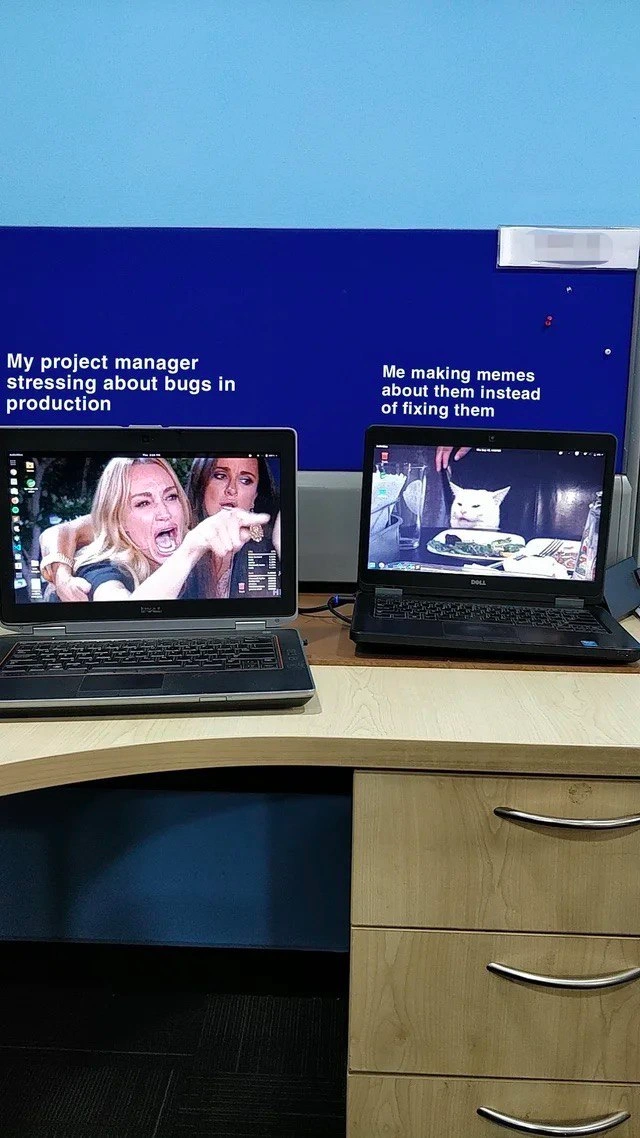
Project Manager Stressing: The text on the left laptop says “My project manager stressing about bugs in production.” A Project Manager (PM) in a tech team is the person responsible for planning, schedules, and making sure everything runs smoothly. They coordinate between the developers, the business, and sometimes the customers. So if something goes wrong in production, the PM is usually the one getting urgent phone calls from stakeholders: clients might be upset, bosses want updates, and everyone’s asking “When will this be fixed?!” Naturally, the PM gets anxious and stressed because it’s their job to get the issue resolved and keep everyone informed. In the photo, the PM’s stress is humorously shown by that famous image of a blonde woman crying and yelling angrily (from the women_yelling_at_cat_template meme). It’s as if the PM is so upset, she’s in full-on yelling mode: “How did this bug get out there? We need to fix it NOW!” This visual exaggeration conveys the PM’s panic and urgency.
Dev Making Memes Instead of Fixing: The right laptop’s text says “Me making memes about them instead of fixing them.” “Me” here represents the software developer who is supposed to fix the bug. Instead of coding a solution (often called making a patch or hotfix when it’s a quick fix for a bug), this developer is humorously depicted as procrastinating – they are creating memes about the situation. A meme is a funny image or video with text that people share online, usually referencing a common joke or cultural idea. The meme shown on the right laptop is the other half of the “woman yelling at cat” format – it’s that cute white cat sitting at a dinner table, looking indifferent or confused. In the original meme, the cat looks like it doesn’t understand why it’s being yelled at. Here, it symbolizes the developer being calm, perhaps a bit sassy, and definitely not as concerned as the PM. By making a meme about the production bug and the PM’s reaction, the developer is essentially poking fun at the whole situation instead of immediately fixing the problem.
So, what’s happening in this scenario? We have a critical software bug affecting the live site/application. The users might be seeing errors, or a key feature might be broken. The PM, whose job is to manage crises like this, is extremely worried and likely pressuring the dev team to solve it ASAP. Picture the PM hovering over the developer’s desk or flooding their phone with messages: “Have you found the issue yet? How soon until it’s fixed? The client is calling every 5 minutes!” That’s the left laptop’s vibe: pure manager_stress and panic.
Now picture the developer – maybe a bit tired or frustrated – responding not with code or a quick fix, but with a joke. This developer literally took the time to change both laptop wallpapers to a meme template and label them. That means opening an image editor or presentation, writing those captions (“stressing about bugs in production” and “making memes instead of fixing”), and then setting the wallpapers, lining up the laptops, and snapping a photo. In real terms, they diverted time that could have been used to troubleshoot the bug into making a procrastination_meme. It’s like a student fiddling with making a funny doodle about a homework problem instead of actually doing the homework. They’re prioritizing humor over the task at hand. The caption even admits it: I’m making memes about the bugs instead of fixing them. This is classic developer procrastination behavior taken to an extreme and comedic form.
For a junior developer, it’s worth knowing that in reality this is not recommended behavior when there’s a production issue! 😂 Usually, if something’s broken for users, the team enters “incident response” mode: the devs would be digging through log files, checking recent code changes (maybe that last deployment introduced a bug), writing a quick fix or rolling back to a previous stable version. The PM would be updating people on progress and maybe helping coordinate resources. The tension can be high because production bugs can harm the company’s reputation or finances (imagine if an online store’s checkout is broken – that’s lost sales every minute). Ideally, everyone treats it seriously and works together to resolve it fast. That’s why it’s inherently funny (in a cheeky way) that this developer is doing the exact opposite – goofing off with memes. It’s a form of WorkplaceHumor that tech folks share: we take a stressful situation and make a joke as if to say, “This is so absurd, might as well laugh.”
This image specifically riffs on the well-known cat_yelling_meme format. Around 2019, the Woman Yelling at Cat meme template became super popular on the internet. Devs, who are heavy internet users, love to repurpose trending memes to fit tech jokes. In this case, someone literally recreated that two-panel meme in real life using two Dell laptops side by side (that detail – two matching laptops – is the dual_laptop_setup mentioned). The left laptop shows the yelling lady (the PM), the right shows the calm cat (the developer). By placing them together, it’s just like the original meme format: one side screaming, the other side uninterested. The added twist is the text captions about bugs and fixing vs. memeing, which tie it to a programmer’s context (bugs in software projects, and developers making light of it).
For a new engineer still learning the ropes: this meme is a tongue-in-cheek reminder that while coding is fun, dealing with production issues can be stressful and is a serious responsibility. Project managers often feel accountable for any failures in production – they’re the ones who have to answer the tough questions – so they might panic or put a lot of pressure on you to fix things quickly. Engineers, on the other hand, sometimes cope with that pressure by bonding over jokes or memes. It’s a bit of a cultural thing in tech teams: we share a funny DeveloperMeme on Slack about the bug while we’re fixing it, to keep morale up. But the meme here exaggerates it to the point where the dev isn’t fixing at all, just joking. It’s poking fun at ourselves – like saying, “Ever feel like making jokes about a bug instead of dealing with it? haha, same.” It resonates because many of us have felt that temptation on a rough day, even if we wouldn’t actually do it. It’s both a form of ProjectManagementHumor (laughing at how panicky PMs can get) and self-deprecating developer humor (admitting that sometimes devs procrastinate or seem too relaxed about serious issues).
In summary, the left laptop = the stressed PM reacting to a serious software problem, and the right laptop = the chill (maybe irresponsibly chill) developer who is humorously unbothered and making a meme about the freak-out. The image is funny to developers because it captures a real tension in tech workplaces with an absurd twist: it’s basically saying, “While my boss is having a meltdown over a bug, I’m over here making viral cat memes – priorities!” It’s satire – exaggerating a bad habit (procrastination and dark humor) to get a laugh and a knowing nod from fellow devs who’ve seen similar dynamics in real life.
Level 3: Fiddling While Prod Burns
When a production bug hits and customers are impacted, it’s supposed to be all hands on deck. The project manager (PM) is likely in full fire-fighting mode: sending frantic Slack messages, scheduling an emergency call, maybe already drafting an apology email to stakeholders. In our meme, that panic is visually captured by the left laptop’s wallpaper: the famous Woman Yelling at Cat meme, with an irate woman (faces blurred, but obviously furious) pointing and shouting. That’s “My project manager stressing about bugs in production,” and any senior engineer who’s survived a Sev1 outage can practically hear the PM’s voice: “This bug is costing us money by the minute! Why aren’t we fixing it?!” The manager_stress here is palpable – you can almost see the poor PM’s blood pressure rising as they imagine all the angry emails from upper management.
Meanwhile, on the right laptop, we have the apathetic counterpart: the unimpressed white cat at the dinner table, representing the developer. The caption above it reads “Me making memes about them instead of fixing them.” This is the developer’s deadpan reaction to the crisis, basically saying: “Bugs in prod? Meh, might as well make a joke out of it.” It’s hilariously audacious. The developer isn’t just ignoring the fire; they’re pouring a glass of wine and livestreaming it. It’s like the classic Nero fiddle scenario – the system is burning, and the dev is fiddling (with meme templates) instead of grabbing a hose. In real life, this kind of developer procrastination during a live incident is career suicide (imagine the PM’s face if they caught you Photoshopping cat memes while users are screaming!). But as a piece of developer humor, it perfectly satirizes that jaded engineer mentality: “Production’s always on fire; if I panicked every time, I’d lose my mind. Might as well have a laugh.”
This dual-laptop setup is an in-your-face metaphor for a workplace dynamic many senior devs know too well. On one side, management is freaking out about a critical ProductionBug (because every minute down is lost trust or revenue). On the other side, a cynical or burnt-out dev is detached, maybe because they’ve been through this a hundred times. Perhaps the codebase is such a spaghetti mess that fixing one bug will spawn three more, so the dev’s thinking, “Why rush? This BugsInSoftware saga never ends.” Instead of writing a quick patch to get things stable, they indulge in a procrastination_meme. It’s a form of gallows humor: when you’re neck-deep in technical debt and on-call nightmares, sometimes you cope by laughing at the absurdity.
Let’s be clear: in a real incident, a responsible senior engineer would be either debugging the root cause, rolling back a faulty deploy, or at least crafting a hotfix. They’d be pairing with SREs, checking logs, maybe screaming “It’s always DNS caching issues!” into their headset. But here our developer has chosen memeing over debugging, which is hilariously dysfunctional. It’s poking fun at our worst instincts. We all know that one dev (hopefully not ourselves, right?) who would rather joke about a problem than solve it – the classic workplace humor coping mechanism. Maybe they’re overwhelmed or in denial, or maybe it’s a subtle protest: “Hey, I warned you about shipping that shaky code on Friday, but you didn’t listen. Now we have a mess. So excuse me while I respond with sarcasm.” This meme-driven response is basically the dev saying, “I could fix it, but first let me score some internet points with this banger meme.” 😜
The humor really lands for those of us in the trenches because it exaggerates a truth: developers and PMs often react very differently under pressure. The PM’s stress is about accountability – they have to answer to clients, bosses, and timelines. The dev’s nonchalance (or outright trolling via cat memes) speaks to a mix of exhaustion and culture. Dev teams often share memes in internal chats during incidents as a way to stay sane. I’ve been in war rooms at 3 AM where someone inevitably posts the “This is Fine” dog or a cat meme while half the servers are down – it’s dark humor, a brief comic relief as you’re digging through stack traces. It’s not that we don’t care; it’s that if we don’t laugh, we might cry. This meme nails that vibe: the ProjectManagementHumor of a panicked PM vs the DeveloperHumor of a jaded engineer. Both laptops literally show a battle of emotions – one frantic, one blasé – with the Woman Yelling at Cat template bridging internet culture and office reality.
In short, “PM panics over production bugs while dev crafts memes” is painfully relatable to senior devs. It lampoons the gap between urgency and apathy that emerges in high-stress situations. Every experienced engineer has stories of Production incidents where someone was either cracking jokes, or worse, completely checked out, as the PM ran around with their hair on fire. The meme is funny because it’s an exaggeration we recognize: of course we shouldn’t be making jokes instead of fixing things… but the fact that we sometimes want to is the punchline. It’s a snapshot of tech culture’s coping mechanism colliding with a manager’s worst nightmare. And yeah, it’s cheeky – as if the dev is saying, “Relax 🤏, I’ll fix the bug right after I finish perfecting this meme format.” Talk about priorities inverted! This is ProjectManagementHell from the PM’s view and MemeDrivenDevelopment from the dev’s. It’s chaos, it’s comedy, and it’s all too real.
Description
A meta-meme staged in a real-world office setting. Two laptops sit side-by-side on a desk. The laptop on the left displays the first half of the 'Woman Yelling at a Cat' meme (featuring Taylor Armstrong) under the text 'My project manager stressing about bugs in production'. The laptop on the right displays the second half of the meme (featuring Smudge the Cat) under the text 'Me making memes about them instead of fixing them'. This cleverly uses a popular meme format to illustrate a classic workplace dynamic: the pressure from management to fix urgent issues versus the developer's coping mechanism of procrastination and humor
Comments
7Comment deleted
Why ship a hotfix when you can ship a hot meme? The fix only solves one bug, but the meme boosts team morale by at least 10%, which is a far better ROI for the sprint
Prod’s on fire, PM is invoking the SEV-1 bridge, and I’m over here fine-tuning the kerning on the yelling-at-cat meme - because every root-cause doc deserves good visuals
The bug's been in production for three weeks, but we're waiting for the quarterly planning session to decide if fixing it aligns with our OKRs
The classic production incident response pattern: P0 bug reported at 2 PM, meme about it trending on internal Slack by 2:15 PM, actual fix deployed by... well, we'll get to that after this goes viral. At least when the postmortem asks 'what were you doing during the incident?', you can honestly say you were documenting team dynamics through visual storytelling - which is basically observability for human systems, right?
PM tracking MTTR; me optimizing MTTL - Mean Time To Laugh - because during a Sev1 the only thing that scales reliably is the meme pipeline
SEV-1 hits prod and the PM wants an RCA; I ship a meme to Slack that hits 99th‑percentile engagement - apparently our content pipeline has more throughput than the hotfix path through CAB
PMs demand hotfixes; we ship memes - because nothing restores prod confidence like 99.9% meme uptime