Skip to content
DevMeme
600 of 7435
iOS Development Without a Mac: A Criminal Enterprise
Apple Post #686, on Sep 20, 2019 in TG

iOS Development Without a Mac: A Criminal Enterprise

Why is this Apple meme funny?

Level 1: Breaking the Rules

Imagine you have a video game that only works on a special game console made by one company. Let’s say all your friends are playing this game, and you really want to join in, but you don’t have that expensive console. What can you do? You might try to find a way to play the game on your regular PC by downloading some unofficial program or patch — basically sneaking around the rules. The game company said “you must use our console,” but you found a hidden trick to do it without their console.

Doing this is against the rules that the game company made (you’re not supposed to copy or emulate their game), so it’s a bit like doing something naughty to get what you want. It’s not hurting anyone, but it is breaking the agreement you made when you bought the game. In everyday terms, it’s a bit of a cheat.

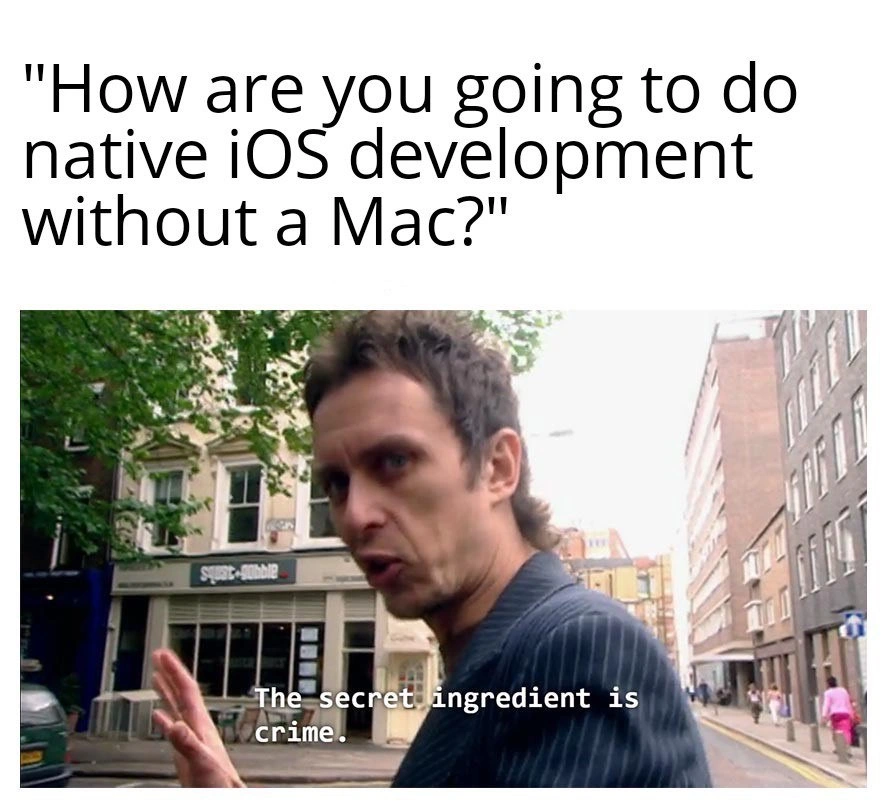
That’s exactly what this meme is joking about, but with making iPhone apps. Apple says “you have to use our computer to make apps for our phones.” Some clever people say, “Hmm, what if we secretly use a non-Apple computer and make it pretend to be an Apple?” It’s like they’re breaking the rules to bake the cake. The meme humorously calls this secret trick the “secret ingredient” and labels it “crime” (as a joke) because it’s not officially allowed.

So the feeling behind it is like when a kid proudly whispers that they found a way to get a second cookie when they were only supposed to have one. It’s mischievous and a bit cheeky. We laugh because the developer in the meme is basically winking at us and saying: “Don’t worry about the requirement… I cheated a little, and it worked!”

Level 2: Xcode on Windows (Kind of)

For those newer to the scene: the crux of this meme is that Apple doesn’t let you develop iPhone apps on anything but a Mac. Apple’s macOS (the operating system on Mac computers) is the only place you can run Xcode, which is the official program for making iOS apps. This is an example of vendor lock-in – Apple’s way of keeping everything in-house. If you have a Windows PC or Linux computer, you can’t install macOS on it legally, and thus you can’t run Xcode natively. So normally, if someone asks “How could you possibly do iOS development without a Mac?”, the straightforward answer is: you really can’t, at least not in the supported, straightforward way.

The meme’s punchline says “The secret ingredient is crime.” Why crime? It’s a joking way to say: by doing something that’s not officially allowed. Here, “crime” refers to using tricks or unauthorized methods to get around Apple’s restriction. Let’s break down what those methods are in simpler terms:

  • Hackintosh: This is when you take a regular non-Apple computer and set it up to run macOS, even though macOS is designed for Macs only. It’s like taking the engine out of a Mac and installing it in a PC chassis. To do this, people use special boot software that convinces the Mac operating system to start up on generic PC hardware. It often requires specific PC components that are compatible and a lot of tinkering (drivers, settings, patience!). Important to note: this violates Apple’s user agreement (the EULA) — essentially, Apple says “please don’t do this,” but people do it anyway. It’s not going to get you arrested, but it’s definitely against the rules Apple set. In other words, it’s a workaround born out of necessity (or frugality).

  • Virtualized macOS: Imagine running an entire computer inside your computer. That’s virtualization. You can have a window on your Windows PC that is basically a little Mac running inside it. Using programs like VirtualBox or VMware, developers can install macOS into that virtual machine. Now you technically have macOS on a non-Mac, and you can install Xcode there. This also isn’t officially allowed by Apple’s terms (they don’t want macOS running on a Dell or HP via a virtual machine either – that’s also an EULA breach). But many developers try it as a temporary fix. Performance can be slower, and setup requires finding a copy of macOS that works with the VM (often downloaded from less-than-official sources). Yet, it’s a popular answer to the question “How can I run Xcode on Windows?” – basically, by running a Mac inside Windows.

  • Mac in the Cloud: This one sticks to the letter of the law by using real Apple hardware – just not your own. There are cloud services that rent out actual Mac computers over the internet. Think of it like logging into a distant Mac. You see a Mac desktop on your screen, but it’s actually a Mac in a data center. Through this method, you’re still technically using a Mac (so no rules broken), but you didn’t have to buy one yourself. You can build and compile your iOS app on that remote Mac and then download the finished app to your local machine. The downside is you might have to pay for access time, and if your internet is slow, the experience can be laggy. Still, for many developers on PC, this is a convenient and lawful alternative. Companies even use this approach for their continuous integration servers (CI) – for example, to automate building iOS apps on Mac hardware that’s tucked away out of sight.

In simpler terms, developers without Macs get creative. The “secret ingredient” being referred to is these sneaky methods that aren’t endorsed by Apple. It’s a tongue-in-cheek way of saying, “we do some creative rule-bending to make it happen.” Everybody in development circles understands that officially, Apple wants you to buy a Mac to make iPhone apps. But not everyone is willing or able to do that, so they find a loophole. The meme is funny because the person asking the question expects a dead end (“you can’t do that!”) and instead gets a mischievous answer (“oh, we have our ways, insert evil laugh 😈”).

To put it plainly:

  • AppleEcosystem refers to how Apple’s products and software tightly work together, but also only with each other (that’s why you need a Mac for iPhone dev).
  • IOSDevelopment is making apps for iPhones/iPads. Apple provides the only official tools for it and they live on Macs.
  • MobileDevelopment in general can often be done on any computer (for example, Android apps can be built on Windows, Mac, or Linux). iOS is the big exception due to Apple’s policies.
  • VendorLockIn is what we call it when a company’s product kind of forces you to keep using their other products. Here, if you want to participate in their app ecosystem, you’re locked into owning a Mac.
  • Workarounds are alternate solutions that bypass a problem. Hackintoshes, virtualization, and cloud rentals are all workarounds to avoid buying an actual Mac.

And yes, if you search online for something like “xcode_on_windows”, you’ll indeed find lots of tutorials and forum posts about these very methods. They come with caveats and warnings (“this might break with the next update”, “technically against Apple’s rules”, etc.), but they’re out there because so many people have asked this exact question. The meme just sums it up in one memorable, comedic line.

Level 3: Walled Garden Workaround

Zooming out to a senior developer’s view, this meme hits on the classic Apple ecosystem lock-in and the crafty workarounds devs use to escape it. Apple famously maintains a walled garden – controlling everything from the hardware you run to the software tools you use. In MobileDevelopment, that means if you want to build a native iPhone app (an integral part of IOSDevelopment), Apple insists you do it on a Mac with Xcode. So when someone skeptically asks, “How are you going to do native iOS development without a Mac?”, experienced devs smirk because we’ve heard this challenge before. The official answer is: “You can’t.” But the meme’s answer – “The secret ingredient is crime” – captures our tongue-in-cheek real answer: “We’ll find a way, even if it’s not exactly legal.” 💻🔐

What makes this funny is the shared understanding of vendor lock-in absurdity. It’s like Apple built a fancy kitchen but only lets you cook if you also bought their stove. Many of us have been in a bind where a project demands iOS builds but all we have are Windows/Linux machines. Senior devs remember that slight twinge of guilt (or thrill) setting up a Hackintosh in the middle of the night because the boss wouldn’t buy a Mac for the team. The phrase “secret ingredient is crime” perfectly dramatizes that feeling — as if we’re adding a pinch of illicit spice to our development process. Pssst, don’t tell Apple, but we got that iOS app compiled on a Franken-PC running macOS.

This meme also pokes at the lengths we go for a workaround. We’re talking about:

  • Hackintosh builds: turning a generic PC into a pseudo-Mac. It’s the tech equivalent of dressing your PC in an Apple costume and hoping the security guard (macOS’s hardware check) doesn’t notice. Seasoned devs trade tips on which PC parts are most “Mac-compatible” and share horror stories of OS updates that suddenly broke their fake Mac.
  • Virtualized macOS: running macOS in a VM on a Windows box. Slightly less fickle than a full hackintosh, but still sketchy. It often involves downloading a modified macOS image from not-so-official sources and dealing with slow performance. The cloud of EULA violation hangs over it, but hey, the build got done!
  • Cloud Macs: renting time on a real Mac accessed over the internet (services like MacStadium or AWS Mac instances). This is actually legit (real Apple hardware is involved) but it’s a workaround born purely from need. Companies literally pay by the hour for a Mac in a data center because they have lots of Windows developers who occasionally need to compile an iPhone app. It’s a whole cottage industry created by Apple’s policy.

Experienced developers find humor (and commiseration) in this because it’s so common yet so absurd. The situation epitomizes DeveloperHumor: everyone knows the rules are there, and everyone quietly acknowledges that breaking them is sometimes the only pragmatic solution. It’s a shared secret. We’ve all sat in planning meetings where someone asks, “Do we really need to buy a Mac for this?” and another person coughs and says, “Well, there’s… other ways,” prompting grins around the table. It’s a bit of an inside joke, and the meme captures it in one perfect line.

From an industry perspective, this highlights how VendorLockIn can backfire. Apple gains hardware sales and control, but also spawns a rebel subculture of developers finding cracks in the wall. Historically, Apple had a brief era of licensed Mac clones in the mid-90s, which they killed off to maintain their hardware exclusivity. Fast forward to the iPhone age, and they’ve continued that tradition: Xcode only on Macs, iOS apps only built via the Apple toolchain. Senior devs who know this history appreciate the irony that the more Apple says “you must use our box,” the more clever folks find ways to think outside the box. The Workarounds become nearly as legendary as the official tools!

So the humor really lands with those who’ve been there: yes, it’s ridiculous that in 2019 (or any year) a developer might feel like a digital outlaw just to compile an app for the App Store. Yet here we are, smuggling our builds out of a VM like we’re escaping Alcatraz, and joking about our “life of crime.” It’s a cathartic laugh at the tech giant’s expense, and a nod to the scrappy ingenuity of devs who just get the job done, rules be damned.

Level 4: Hypervisor Heist

At the deepest technical level, native iOS development without a Mac means bending both software and hardware rules. Apple’s build chain for iOS (including Xcode, xcodebuild, and the App Store signing tools) is tightly coupled with macOS – which normally runs only on Apple’s own hardware. Under the hood, macOS expects to find certain hardware identifiers and firmware environments unique to Macs. To run it elsewhere, developers pull off a high-tech heist using virtualization and low-level OS tweaks. A hypervisor (like VirtualBox or VMware) can create a pretend Mac environment on a Windows/Linux PC. It’s the equivalent of forging credentials at the operating system level: the hypervisor presents virtual hardware that masquerades as a Mac, tricking macOS into booting on a machine it was never meant to.

This is where things get hardcore. Hackers in the hackintosh community craft custom bootloaders (e.g. Clover, OpenCore) that inject the right firmware signatures and device IDs so macOS doesn’t panic. They patch the Darwin XNU kernel on-the-fly to accept non-Apple CPU configurations and third-party drivers. For instance, Apple’s macOS might not include drivers (called kexts – kernel extensions) for your PC’s exact Wi-Fi chip or GPU. A hackintosh bootloader can slip in community-built kexts, effectively impersonating Apple-approved hardware. It’s like a cyber disguise: your plain PC wears a fake mustache and says, “I’m a Mac, let me in.”

Of course, this entire setup lives in a legal grey zone. Apple’s EULA (End User License Agreement) explicitly forbids running macOS on non-Apple hardware – a rule most developers interpret as “Don’t get caught.” 🙃 In practical terms, though, once you’ve virtualized or dual-booted into a counterfeit Mac environment, you can run Xcode and compile iOS apps as if on a real Mac. Even advanced tasks like device emulation and codesign (the cryptographic signing of iOS apps) will work, because under the hood the software genuinely is macOS – just on “borrowed” hardware. It’s a testament to how robust Apple’s ecosystem is: you have to recreate an entire Mac virtually to dodge the hardware requirement.

// MacOS boot process (figuratively speaking) 
if (hardware.vendor != APPLE) {
    printf("Hey, this isn't a Mac!\n");
    exit(1);  // refuse to run on non-Apple hardware
}

The punchline “the secret ingredient is crime” isn’t literal felony, but from a low-level perspective it’s pointing at these unauthorized hypervisor hacks. We’re essentially talking about software piracy (using macOS against its license) and hardware bluffing. The fundamental computing concepts here involve OS kernel tricks, virtualization technology, and the rigid trust chain Apple built (which we’re deliberately subverting). It’s a beautiful irony: to get around Apple’s closed garden, developers delve into operating system internals and virtualization magic, doing in software what Apple’s business model forbids in principle.

Description

A two-panel meme addressing the challenge of developing for Apple's iOS platform without their proprietary hardware. The top panel features white background with black text asking, "How are you going to do native iOS development without a Mac?". The bottom panel is a well-known image macro from the British sitcom 'Peep Show,' featuring the character Super Hans on a city street, looking towards the camera and confessing, "The secret ingredient is crime." The humor stems from the technical reality that native iOS development tools, like Xcode, are exclusively available on macOS. The "crime" referenced is the common developer workaround of building a "Hackintosh" - installing macOS on non-Apple hardware - which violates Apple's End User License Agreement (EULA). This meme resonates with developers frustrated by Apple's expensive and restrictive 'walled garden' ecosystem
Comments

7
Anonymous ★ Top Pick The fastest way to get a C&D letter from Apple isn't shipping a buggy app, it's successfully compiling one on a Ryzen-based Hackintosh
  1. Anonymous ★ Top Pick

    The fastest way to get a C&D letter from Apple isn't shipping a buggy app, it's successfully compiling one on a Ryzen-based Hackintosh

  2. Anonymous

    Our iOS CI farm is twenty headless Hackintoshes in a Kubernetes node pool called “legal-greyzone”; delivery lead time’s down 30%, procurement still thinks they’re space heaters

  3. Anonymous

    The real crime is Apple charging $2000 for the privilege of developing apps for their platform when all you really need is a $300 Linux box and the willingness to live dangerously in the gray areas of software licensing

  4. Anonymous

    Ah yes, the classic iOS development dilemma: spend $2000 on a Mac Mini just to compile Swift, or embrace the dark arts of Hackintosh and pray your kernel extensions survive the next macOS update. Apple's ecosystem is so secure, even legitimate developers feel like they're committing crimes just trying to afford the entry fee

  5. Anonymous

    Native iOS on Windows is just an RPC to a sacrificial Mac runner where Fastlane, notarization, and ever-expiring provisioning profiles conspire to remind you what vendor lock-in looks like

  6. Anonymous

    Hackintosh: the only distributed system where CAP theorem means 'Caught As Per Tim Cook'

  7. Anonymous

    Native iOS without a Mac? KVM says sure, the EULA says absolutely not, and CI says green

Use J and K for navigation