Skip to content
DevMeme
602 of 7435
The New Standard Unit for Computational Cost
DataFormats Post #688, on Sep 20, 2019 in TG

The New Standard Unit for Computational Cost

Why is this DataFormats meme funny?

Level 1: Cow Farts for Scale

Imagine you ran around the playground really hard until you were super tired. Then your friend jokes, “Wow, all that running used as much energy as a cow fart!” 😄 That comparison sounds really silly, right? We usually talk about big tasks by saying how long they took or how hard they felt, not by comparing them to cow farts. The reason this joke is funny is because it takes something serious (a computer doing a lot of work, kind of like you running a lot) and compares it to something completely goofy and unexpected (a cow passing gas!). It’s the surprise of connecting those two things that makes people laugh. Even though it’s nonsense, it also sneakily reminds us that when we work hard (or when a computer works hard), it uses energy — but saying “energy” as “cow farts” is just a playful way to tease about that. In short, it’s funny because it’s a crazy, smelly twist on explaining hard work!

Level 2: Flat JSON Flatulence

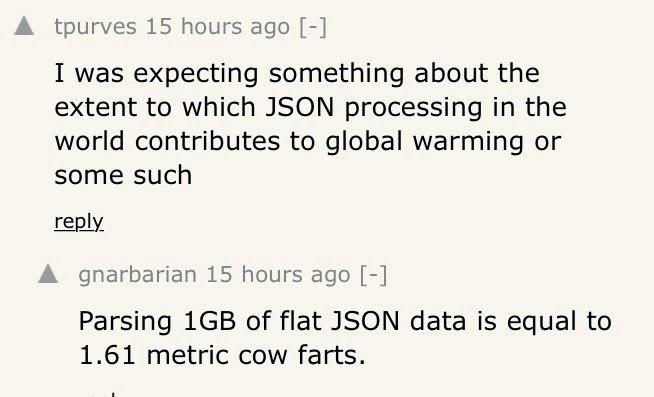
Let’s break down what’s happening here in simpler terms. The image is a screenshot of a tech forum conversation (it has that Hacker News look: plain text, user names, little arrows for upvotes). In the first comment, a user jokes that they expected the discussion to be about how JSON processing might contribute to global warming or some such. In other words, they thought someone would calculate how all the computer work done to handle JSON data could be warming the planet. The second comment runs with that joke and replies with a very specific (and very silly) “measurement”: “Parsing 1GB of flat JSON data is equal to 1.61 metric cow farts.”

Now, what is JSON, and why 1GB of it? JSON (JavaScript Object Notation) is a super common text-based format for storing and sending data. It’s basically how computers often exchange information, especially in web applications. For example, a JSON string might look like {"name": "Alice", "age": 25} – kind of like a structured sentence a computer can read. Parsing JSON means taking that big chunk of text and converting it into a data structure in memory (so the program can work with it, like turning the text into objects or dictionaries). When the comment says “flat JSON data,” it just implies a large, straightforward JSON file (not something fancy or nested – just a whole lot of raw data in one place). 1GB of JSON is huge – that’s roughly one billion characters of text! To a computer, processing that is a lot of work. We’d call it computationally expensive (meaning it requires a lot of processing power and time). If you tried to load a 1GB JSON file, you might be waiting several seconds (or more, depending on your hardware) for the computer to chug through it all. The CPU (the computer’s brain) would be running hot, using a ton of cycles to interpret every byte. And when a CPU works hard, it draws more electricity. Using more electricity is where energy consumption and the environment come into play – more electricity means more demand from power plants, and if those are using fossil fuels, that means more carbon dioxide in the air.

So, the first commenter half-jokingly alludes to this idea: does all our JSON crunching contribute to climate change? It’s a tongue-in-cheek way to connect a coding topic (JSON parsing) with a big global issue (climate warming). The second commenter then humorously “answers” that musing with a fake unit of measurement. They claim that parsing a 1GB JSON blob equals 1.61 “metric cow farts.” Why cow farts? Here’s the background: Cows are famously gassy creatures – when they digest food, they produce methane gas (through burps and farts). Methane is a greenhouse gas that can trap heat in the atmosphere, contributing to global warming. In environmental science, people often talk about cow emissions (it’s actually a serious issue in agriculture and climate discussions). But of course, nobody actually measures anything in “cow farts” on a day-to-day basis – that’s purely for laughs. By saying “metric cow farts,” the commenter is pretending that “cow fart” is some official unit like meters or kilograms. It’s as if a scientist decided to express the energy used by a computer in terms of how much methane a cow produces. The number 1.61 is intentionally very specific, which makes the joke even funnier. It sounds like they did some elaborate calculation to get that exact figure. In reality, they likely picked 1.61 as a humorous nod to unit conversion (1.61 is about the number of kilometers in a mile). It suggests that maybe there’s an “imperial cow fart” vs a “metric cow fart,” as if we needed a conversion rate for something so silly. This layer of nerdiness — mixing up measurement systems — is classic tech humor. It’s similar to how we sometimes joke, “this code runs at 88 miles per hour” just to be goofy with units.

So, essentially, the second comment is mock-seriously answering the first: “You want to know the global warming impact of JSON? Sure, it’s about 1.61 cow farts per gigabyte.” Both people in this thread are being facetious. This is developer humor at its finest: they’re taking a mundane technical thing (how fast or costly it is to parse data) and giving it a wild, off-the-wall twist. It’s funny to developers because it’s unexpected and frankly ridiculous. On forums like Hacker News, folks often make these dry jokes while still discussing real tech topics. It lightens the mood. Here, everyone knows that parsing data probably isn’t actually measured in barnyard gas – but framing it that way is poking fun at both the obsession with performance benchmarks and the concerns about software’s environmental impact. It’s like saying, “Haha, look, our code is so important it can be measured in climate change units!” It’s a playful reminder that even serious topics (like optimizing code or saving the planet) can be approached with a bit of silliness.

Level 3: Cowculating JSON Emissions

At first glance, this looks like a throwaway gag, but it's grounded in performance pain points every seasoned dev knows. The meme shows a witty exchange (likely on Hacker News or a similar forum) where one commenter jokes about measuring JSON parsing in terms of global warming. Instead of a normal benchmark result, we get an off-the-wall metric: “Parsing 1GB of flat JSON data is equal to 1.61 metric cow farts.” Why is this funny? Because it’s a perfect cocktail of developer humor, combining serious topics like code efficiency and energy consumption with an absurd unit of measure. The joke lands so well precisely because it exaggerates a real concern—our code has a carbon footprint—in the most ridiculous way possible. It pokes fun at how we sometimes dramatize the impact of software (contributing to global warming or some such, as the first commenter says) by expressing it in bizarre everyday terms. In short, it's parodying both our fixation on micro-optimizations and the trendy habit of quantifying tech’s environmental impact in anything but the usual units.

Dig deeper, and there’s some truth underlying the silliness. JSON (JavaScript Object Notation) is a text-based data format beloved for its simplicity and ubiquity in web APIs, config files, and logs. But ask any experienced engineer about performance, and they'll smirk: parsing huge JSON blobs can be painful. Reading a 1GB JSON file means your poor CPU has to plow through roughly a billion characters, interpreting every {, } and : to reconstruct data structures in memory. That’s an O(n) operation on a massive n – essentially billions of low-level steps. Even on modern hardware, that’s non-trivial: it can take seconds of CPU time, stress memory with large allocations, and even spin up the cooling fans. In real terms, that translates to using a noticeable chunk of electricity just to chew through text. Seasoned devs have been bitten by this – perhaps processing gigantic JSON log files or responses – and know that while JSON is convenient, it’s not the most efficient format. (There’s a reason why alternatives like binary protocols or streaming parsers exist for heavy-duty scenarios.) So when someone facetiously quantifies that cost as “1.61 metric cow farts,” it’s hilarious because it dramatizes a familiar scenario: that innocuous call to JSON.parse(hugeData) might as well be your machine passing gas from the effort! It’s a comedic way to say, “hey, this JSON parsing isn’t free – it’s making the computer work so hard it’s as if we’re releasing bovine emissions into the air.”

Now, about those cow farts (yes, we’re going there). Believe it or not, this joke riffs on real discussions about the environmental impact of code. When a processor works harder, it draws more power; more power means more fuel burned (at the power plant) and thus more CO₂ emitted. Developers have started jokingly – and sometimes seriously – asking, “How much CO₂ does my code emit?” Cows enter the picture because they’re infamous in climate science: cattle emit methane (CH₄) from their digestive processes (technically more from burps than farts, but the meme opts for the funnier end). Methane is a potent greenhouse gas, so cow emissions are often cited in global warming debates. Here, the first commenter quips about expecting a grand calculation of JSON processing worldwide contributing to global warming. The reply delivers exactly that kind of calculation, but with tongue firmly in cheek: equating computational work to “metric cow farts.” It’s absurd, but the reason it tickles techies is that it’s just plausible enough. On a planetary scale, all our code does suck down a lot of power – data centers already account for a significant slice of global electricity use (some estimates compare the IT industry's footprint to the airline industry’s emissions!). So if you really wanted, you could express the energy to parse 1GB of data in terms of methane released by livestock. It would be an infinitesimal fraction of a single cow’s daily gas output, but hey, you could do the math. By using such a silly equivalence, the meme both satirizes and celebrates these kinds of back-of-the-napkin “green tech” calculations. It’s saying, in effect, our code uses energy and maybe warms the planet a bit – here’s that idea taken to a comical extreme!

This brings us to the delightful nerdiness of the presentation. The comment thread format is plain and minimalistic, strongly resembling a Hacker News discussion – user handles, tiny upvote arrows, and all. HN readers are known for their dry wit and one-upmanship. The first user’s sly remark (“I expected something about JSON and global warming”) is a setup, and the second user’s response is a deadpan punchline delivered with mock seriousness. The use of a very specific number, 1.61, makes it satire gold. Experienced devs recognize that faux-precision as a comedic device: by providing a decimal answer in “cow farts,” the commenter parodies those overly precise tech reports and benchmarks that imply scientific rigor. There’s also likely an inside-joke with “metric cow farts.” Normally, we talk about metric vs imperial units (kilometers vs miles, kilograms vs pounds). By prefacing cow farts with metric, the commenter hints at an utterly nonsensical conversion system (indeed, 1.61 is suspiciously close to the ratio of a mile to a kilometer, as if 1 imperial cow fart = 1.61 metric cow farts). This extra layer – imagining a standardized unit of flatulence – is exactly the kind of clever silliness senior developers adore. It mocks our penchant for inventing units (like computing power in “horsepower” or storage in “Libraries of Congress”) and combines it with that archetypal tech cynicism: Sure, we can optimize JSON… but have you considered the cow fart implications? 😂 In the end, what makes this meme so grin-worthy for an experienced coder is the contrast between the mundane and the ludicrous. It reminds us that behind every innocuous JSON.parse, there’s a real machine doing real work (maybe even heating a room slightly), and someone out there is crazy enough to measure that in bovine flatulence. It’s a shared wink that says, “We take our work seriously—but not so seriously that we can’t laugh at the idea of our code tooting up the environment.”

Description

A screenshot of a comment thread from a developer forum, likely Hacker News, with a light cream background. The first comment, by user 'tpurves', reads: 'I was expecting something about the extent to which JSON processing in the world contributes to global warming or some such'. Below it, a reply from user 'gnarbarian' delivers the punchline: 'Parsing 1GB of flat JSON data is equal to 1.61 metric cow farts.'. The humor lies in the absurd yet oddly specific quantification of a computational task's environmental impact using a completely unscientific and comical unit of measurement. This resonates with engineers who are familiar with complex performance benchmarks and the sometimes over-the-top discussions about the macro effects of micro-optimizations

Comments

7
Anonymous ★ Top Pick Our new CI/CD pipeline now reports performance regressions in metric cow farts. It's done wonders for prioritizing optimization work; nobody wants to be the engineer who single-handedly caused a stampede
  1. Anonymous ★ Top Pick

    Our new CI/CD pipeline now reports performance regressions in metric cow farts. It's done wonders for prioritizing optimization work; nobody wants to be the engineer who single-handedly caused a stampede

  2. Anonymous

    Q4 sustainability OKR: migrate our REST payloads from JSON to Protobuf to save 0.7 metric cow farts per request - now if only we could offset the methane from the bikeshedding over field names

  3. Anonymous

    Finally, a unit of measurement that makes our carbon footprint calculations as reliable as our sprint estimates

  4. Anonymous

    Finally, a performance metric that makes sense to both DevOps and sustainability teams. Now we just need to convince management that optimizing our JSON parsers isn't just about latency - it's about reducing our bovine flatulence equivalent. Next sprint: migrate to Protocol Buffers and save 0.8 cow farts per request. The real question is whether this accounts for the methane produced during code reviews of nested JSON schemas

  5. Anonymous

    If your carbon budget is denominated in cow farts, deserializing 1GB of flat JSON is scope-3; switch to Parquet and your P99 and methane both drop

  6. Anonymous

    At scale, JSON isn’t human-readable - it’s EC2-fan-readable; protobuf is cheaper on both the bill and the methane budget

  7. Anonymous

    Flat JSON? Still burns more cycles than a nested nightmare - offsetting with Protobuf credits since nobody else will

Use J and K for navigation