Skip to content
DevMeme
4137 of 7435
Please Do Not Google Half Byte
CS Fundamentals Post #4514, on Jun 21, 2022 in TG

Please Do Not Google Half Byte

Why is this CS Fundamentals meme funny?

Level 1: Tiny Bite

A byte is like a small cookie made of 8 tiny pieces. If you take half of it, you have 4 pieces. Computer people call that half a byte a "nibble," which sounds like taking a tiny bite. The joke is funny because the serious computer answer is also a silly food word.

Level 2: Four Little Bits

A bit is the smallest common unit of data in computing. It can be 0 or 1. A byte is usually 8 bits. A nibble is 4 bits, so it is half a byte.

This matters because computers store and transmit data in binary, but humans do not enjoy reading long strings of 0s and 1s. Hexadecimal helps by representing every 4-bit nibble as one character: 0 through 9, then A through F. That is why programmers see values like 0xFF, 0x0A, or color codes such as #FFAA00.

The meme is funny because it frames a harmless technical term as something scandalous. The anxious face makes it feel like the answer is cursed knowledge, but it is just a goofy old computing word. Many beginners first encounter terms like this while learning DataTypes, binary, memory, or low-level programming, and the names can feel less formal than expected.

Level 3: Forbidden Nibble Knowledge

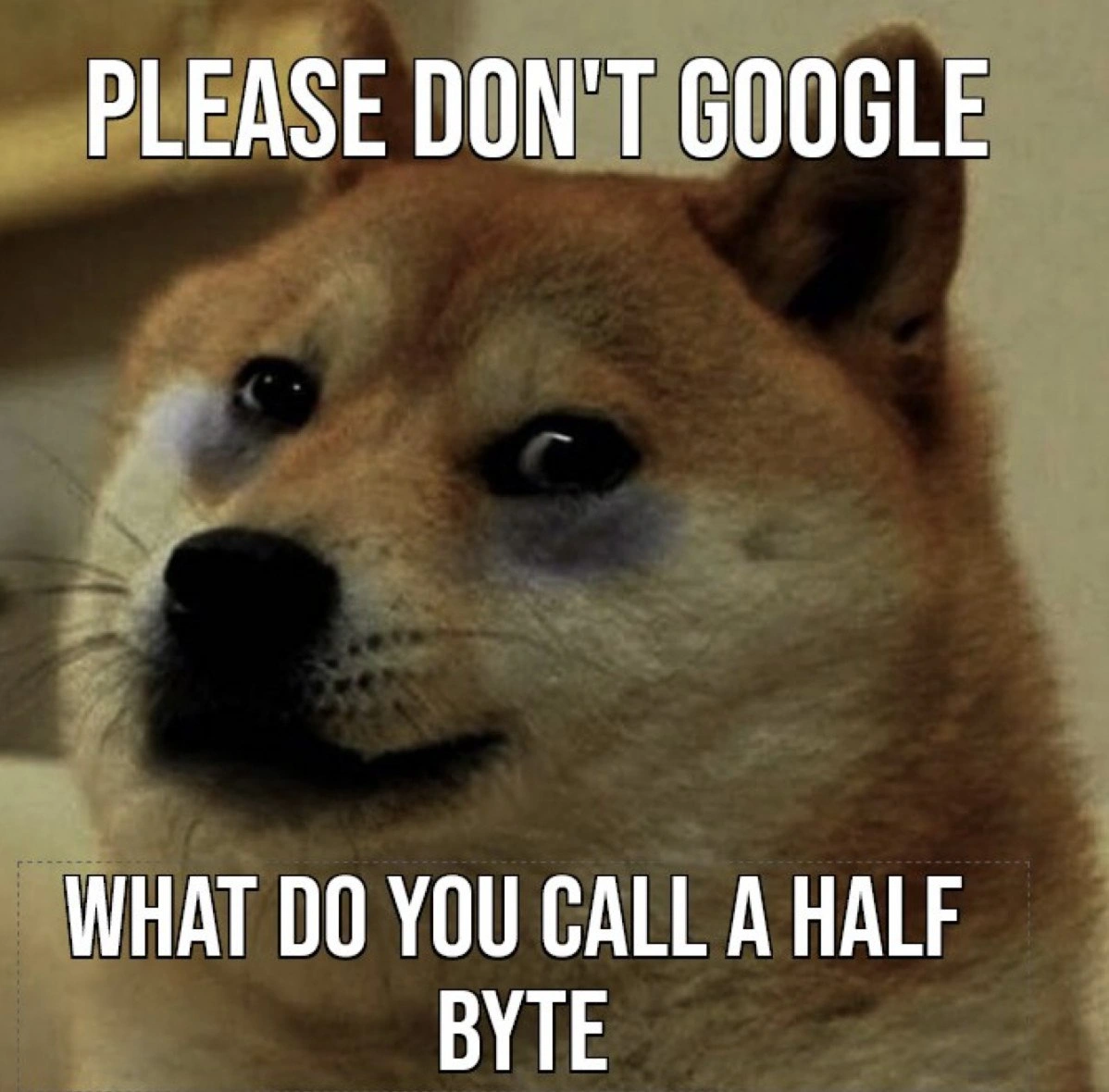
The meme shows a worried Doge-style reaction face with the visible caption:

PLEASE DON'T GOOGLE

WHAT DO YOU CALL A HALF BYTE

The forbidden answer is nibble: in modern computing vocabulary, a byte is conventionally 8 bits, and half of that is 4 bits. The post message, "This is 4-bitten," layers another pun on top: a 4-bit value is a nibble, and nibbling is a small bite. This is the rare CS_Fundamentals joke where the entire payload is technically correct and still deserves groaning in a code review.

The reason the pun works is that low-level terminology often sounds unserious until it becomes foundational. A bit is a binary digit, either 0 or 1. A byte is the standard unit programmers usually think of when dealing with memory, files, encodings, buffers, and binary protocols. A nibble is four bits, which can represent values from 0000 to 1111, or decimal 0 through 15. That range maps perfectly to one hexadecimal digit, which is why nibbles show up naturally when reading hex dumps, color values, bytecode, network payloads, and binary file formats.

The image's "please don't Google" setup pretends the answer is embarrassing or unsafe to search, but the actual embarrassment is that computing history really did give us terms like byte, nibble, and "word" with a straight face. The vocabulary grew out of practical hardware and data-representation needs, then stuck because engineers love names that are short, memorable, and just silly enough to survive standards meetings.

For low-level developers, the useful part is not the pun but the mental model. Splitting a byte into two nibbles is exactly how hexadecimal notation becomes readable:

byte:    1010 1111
high:    1010      = A
low:          1111 = F
hex:        0xAF

That tiny conversion sits underneath debuggers, file signatures, machine instructions, color channels, bit masks, and serialized data. So yes, the meme is childish wordplay. Unfortunately, it is also a vocabulary lesson.

Description

A close-up Doge-style reaction image shows a worried-looking Shiba Inu with large white Impact-style caption text. The top caption says: "PLEASE DON'T GOOGLE" and the bottom caption says: "WHAT DO YOU CALL A HALF BYTE". The joke relies on the computer-science term for four bits, a nibble, while pretending the answer is embarrassing enough to avoid searching. It is simple but technically grounded wordplay around binary data units and old-school computing vocabulary.

Comments

19
Anonymous ★ Top Pick A nibble is what happens when binary gets hungry, which is still more precise than most sprint estimates.
  1. Anonymous ★ Top Pick

    A nibble is what happens when binary gets hungry, which is still more precise than most sprint estimates.

  2. @NoCountryForOldBuffet 4y

    It’s a nibble and it’s cute and I’m tired of pretending it’s not

    1. @MedjayBayek 4y

      Lmfao

  3. @q_rsqrt 4y

    NI-

    1. @RiedleroD 4y

      Nintendo.

      1. @q_rsqrt 4y

        H. P. Lovecraft's cat

  4. dev_meme 4y

    🤣🤣🤣🤣🤣🤣🤣🤣🤣🤣🤣🤣🤣🤣🤣🤣🤣🤣🤣🤣🤣🤣🤣🤣🤣🤣🤣🤣

  5. dev_meme 4y

    btw, its bb not pp

  6. dev_meme 4y

    pp🤤💋

  7. @SamsonovAnton 4y

    - How do they call nibble in Europe? - "Half a byte, with cheese". - Ah, metric system...

  8. @ZgGPuo8dZef58K6hxxGVj3Z2 4y

    Loooooool four bits and half a byte is the same

    1. @SamsonovAnton 4y

      Not necessarily. Just like a byte was not always a 8-bit unit of information. The exact terms there coined therefore to represent fixed-size data: 8 bits are called "octet", 4 bits are called "tetrade". They are treated synonymously with "byte" and "nibble" nowadays, but that was not always true.

      1. @ZgGPuo8dZef58K6hxxGVj3Z2 4y

        What is with the 6 bit thing that almost was decided to be the standard

      2. @RiedleroD 4y

        just like it depends on the architecture what exactly a 'word' is, right?

        1. @SamsonovAnton 4y

          As well as syllable (used in VLIW).

          1. @RiedleroD 4y

            what is VLIW and what is a syllable in its context?

            1. @SamsonovAnton 4y

              Syllable in VLIW means a sub-division of instruction word (which may be of variable length), and is of course architecture dependent, too.

  9. @LineDiscipline 4y

    Come for memes, got a lecture

  10. @callofvoid0 4y

    it had to be something like bybble or byby

Use J and K for navigation