The infinite loop that forever postpones code cleanup and refactoring
Why is this CodeQuality meme funny?
Level 1: I’ll Do It Later
This meme is basically a funny way of showing procrastination with cleaning up code. It’s like when someone always says, “I’ll do it later,” and then later says, “Well, no need to do it now.” Think of it like a child keeping their room messy with a loop of excuses:
- Before: A kid is playing with all their toys scattered around. The parent says, “Clean your room.” The kid thinks, “No point cleaning up now, I’m still playing. I’ll tidy up once I’m done.” They continue playing, leaving the toys everywhere.
- After: Now playtime is over and toys are all out, but the child is tired. The parent says, “Time to clean up your toys.” The kid looks at the room and says, “Everything is quiet now, I’m not playing anymore, so why clean up? I’ll do it later.” They go to bed without cleaning up.
The result: the room stays messy forever because the child found an excuse both before and after that “proper time” to clean. We find it funny because the reasoning is so obviously circular and silly. It’s the same with the code in the meme: the developer always finds a reason to delay the “chore” of tidying the code. It’s a bit like someone saying they won’t fix a leaky roof when it’s raining (“too wet to fix now”), and when the sun comes out they say they don’t need to fix the roof (“it’s not leaking when it’s sunny”). Of course, that means the roof never gets fixed! 😅
The emotional core of the joke is that feeling of avoiding a task and justifying it to ourselves. Everyone can recognize a time they procrastinated on something important but unpleasant. We laugh at this meme because we see a truth about ourselves in it — it’s poking fun at how we can talk ourselves out of doing necessary clean-up with excuses that end up making sure the clean-up never happens. It’s a simple cartoon showing a loop with arrows, and you don’t even need to be a programmer to get the gist: it’s funny in the same way as a person endlessly saying, “I’ll do it soon… well, now it’s a bit late, so I’ll do it some other time.” It captures that forever-postponing feeling. In plain terms, the meme is a reminder that if you keep saying “I’ll do it later” every time, you might never get around to cleaning up — whether it’s your code, your room, or anything else. And that little truth, presented in a goofy loop, makes us smirk and nod in recognition.
Level 2: Better Ugly Than Broken
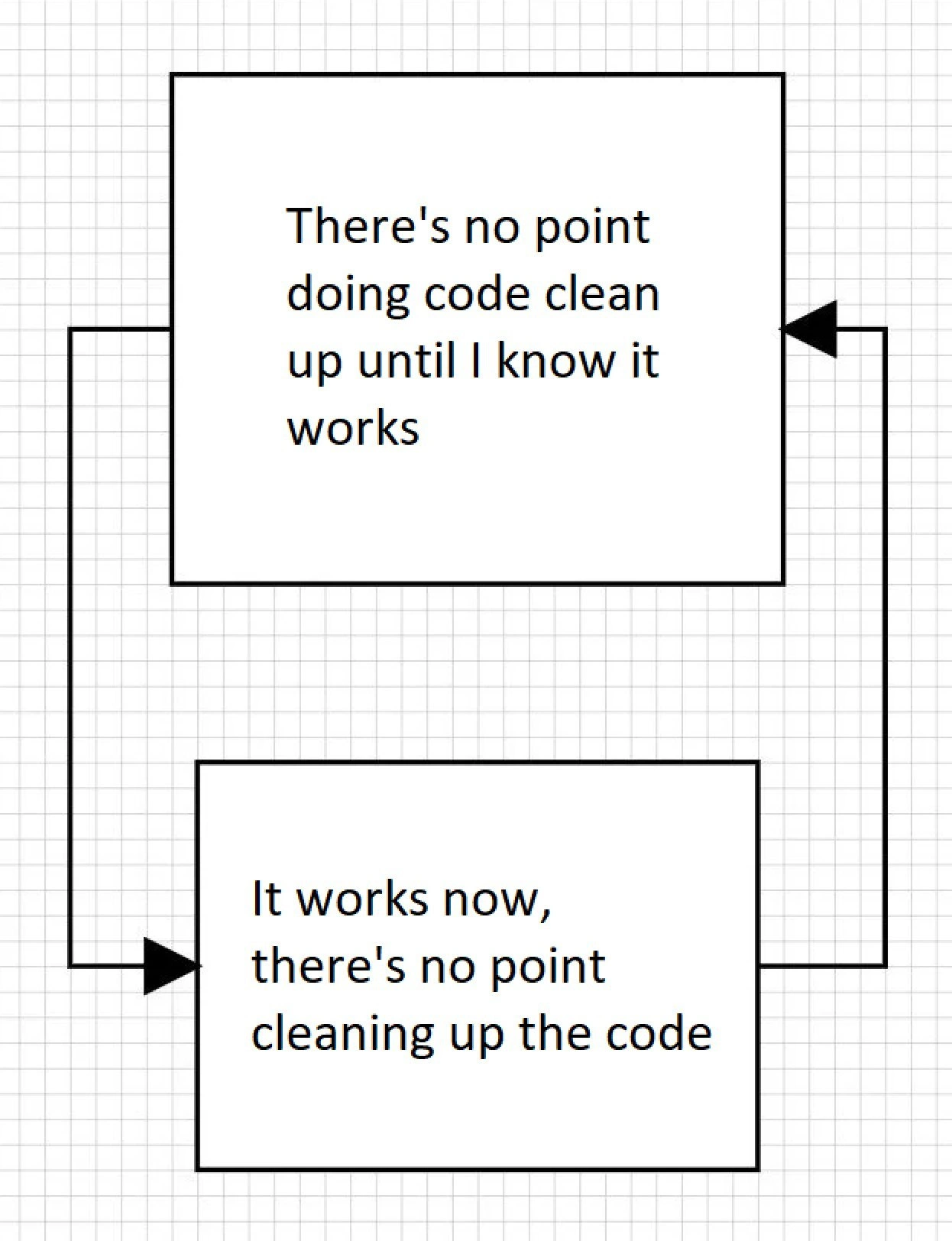
At its core, this meme highlights a conflict between getting things working and keeping the code clean. The flowchart shows two phases that feed into each other:
- Before it works: “There’s no point doing code clean up until I know it works.” In other words, get the feature or program working first, even if the code is a bit messy. Here the developer is saying they won’t spend time on code quality or tidying up until they have a working result.
- After it works: “It works now, there’s no point cleaning up the code.” That means since the code is doing its job, why bother improving it? The developer decides not to refactor because everything appears fine.
These two statements feed into each other with arrows, forming a circular flowchart. This visual literally depicts a loop – the process goes from “don’t clean yet” to “won’t clean now” and back around, indefinitely. In programming, a loop that never ends (because its condition is always true or it never breaks out) is called an infinite loop. This meme is a flowchart_meme version of an infinite loop in real life: the self-justifying cycle of delaying code cleanup every time. There’s never a good time to refactor, so refactoring never happens.
Let’s break down some terms:
- Refactoring: This means improving the internal structure of the code without changing its external behavior. For example, renaming variables to clearer names, splitting a giant function into smaller functions, or removing duplicate code – all without altering what the program actually does for the user. Refactoring is done to enhance code maintainability and readability. The meme’s joke is that the developer perpetually postpones this step.
- Code Quality: This refers to how well-written and maintainable the code is. High-quality code is clean, organized, and easy to understand or modify. Low-quality code might work, but it’s disorganized, hard to read, and fragile. The meme highlights a hit to code quality: by never doing “code cleanup,” the code stays in a sloppy state.
- Technical Debt: This is a metaphor in software for the extra work we have to do later because we chose a quick-and-dirty solution now. It’s like borrowing time — you get a feature faster, but you “owe” cleanup work. If you don’t pay back this debt (by refactoring and improving the code later), the interest “accumulates” as the codebase becomes harder to work with or more bug-prone. In the meme, each time the developer says “no point cleaning,” they are essentially letting the technical debt ride. It’s called TechnicalDebt because, similar to financial debt, if you never pay it off, it can eventually bankrupt your project (in terms of time and complexity).
- Developer Procrastination: Procrastination means delaying or putting off a task. Here, it’s the developer putting off the chore of code cleanup. It’s portrayed in a humorous way: the developer always finds a reason to push the task to a later time. This is why the meme is tagged as DeveloperProcrastination – it’s a relatable scenario of a developer saying “I’ll do it later” again and again.
To illustrate the logic in a code-like way, imagine a snippet of Python pseudo-code reflecting this behavior:
works = False
while True:
if not works:
print("No cleanup until it works")
# ... developer writes quick, messy code to make it work ...
works = True # now the code works (functionally)
if works:
print("It works now, skip cleanup")
# ... developer chooses not to refactor since it works ...
# no break here means this loop will run again, forever
In this pseudo-code, the loop never breaks out. Initially works is False, so it prints “No cleanup until it works” and then we simulate that the developer makes the program work (but leaves the code messy). Then works becomes True. The next if sees works is True, prints “It works now, skip cleanup” and then (because we intentionally didn’t put any break in the loop) it goes back to the start of the while True. Now on the next iteration, works is still True, so it will again skip cleanup, and so on infinitely. This is a coding analogy for the human behavior: the developer never enters a step where they clean up the code. They continuously cycle between “not yet” and “too late” for cleaning.
For a junior developer or someone new to these ideas, the meme is pointing out a common anti-pattern (a bad practice). When writing code, it’s very tempting to say:
- “Let me just get this working first. I’ll ignore the messy parts or the bad variable names for now.” (That’s often okay initially — getting it working is indeed crucial.)
- But then after it works: “Well, it works, so maybe I shouldn’t touch it now. What if I break it? Plus, I have other tasks to do. I’ll clean it up later.”
The problem is “later” keeps being pushed further out, and sometimes it never comes. Early-career developers often experience this when working under tight deadlines or when they lack confidence in making changes. It feels safer to leave a working (though messy) piece of code as-is, rather than refactor and risk causing a bug. However, over time, these choices accumulate and can make the codebase very hard to understand. That’s why understanding CodeQuality is important: clean code with good structure is easier for you (and others) to modify in the future.
A relatable example might be the first time you wrote a school project or simple app. You might have hard-coded some values or written one huge function that does everything, just to make sure the program runs. You think, “I’ll reorganize it later.” But once it worked, maybe you turned it in or moved on to the next assignment, and never actually went back to refactor that code. When you or someone else look at it later, it’s confusing – that’s the cost of not cleaning it up. Most developers can recall a time they wrote code that “just barely works” and promised to tidy it up but got sidetracked.
In professional projects, teams try to avoid this infinite postponement by doing things like code reviews (where colleagues review your code and might comment “this works, but it’s hard to read – please refactor it now before we merge”) or by having a rule to always leave the code better than you found it. There’s even something called the “Boy Scout Rule” in coding: always clean up a little mess whenever you see it, so the codebase stays tidy. The meme exists because, despite these ideals, RefactoringNeeded tasks often fall by the wayside. Business deadlines, new feature requests, or sheer relief at having something work can make us push cleanup to the back burner.
So why is this meme funny to developers? It’s because it exaggerates a real struggle in a simple way. We recognize the code_cleanup_paradox instantly: it’s a loop we have caught ourselves in. The diagram is almost like a comic strip for the inner voice of a programmer rationalizing laziness or fear. It’s labeled with very direct quotes that we might even say out loud during a crunch time. The humor has an “ouch, that’s true” factor — it’s uncomfortable but in a light-hearted way. We laugh because we know this exact loop can happen in our own projects if we’re not careful. It’s both a joke and a little cautionary tale about prioritizing CodeQuality.
In summary, the meme uses a simple flowchart to show a paradox of refactoring: by always finding a reason to defer code cleanup (before and after a feature works), the developer ends up never doing it. It’s highlighting the concept of TechnicalDebt in a snappy way. For a newer developer, the take-home message is: don’t let this happen to you! Try to break out of the loop by scheduling that cleanup when it’s due, writing some tests to feel safe about refactoring, or at least acknowledging that “later” should not be “never.” It’s a relatable little piece of DeveloperHumor that also carries a grain of truth about good software engineering practices.
Level 3: Refactoring Catch-22
In this meme’s flowchart, we see an infinite loop of excuses that engineers use to dodge code cleanup, creating a perfect Catch-22 of technical debt. The top box says essentially, “No refactor until it works,” and the bottom box retorts, “It works now, so why refactor?” Individually, each statement sounds reasonable, but together they form a self-perpetuating cycle — an Ouroboros of tech debt eating its own tail. This darkly comedic loop highlights a classic reality of software development: if you always wait for a “better time” to refactor and improve code quality, that time never comes.
Seasoned developers know this pattern all too well. It’s the self-justifying cycle that breeds ever-growing technical debt in real codebases. First, a developer hacks together a solution under pressure, thinking “let’s make sure it works before we polish anything.” That’s not entirely wrong — functionality often comes first. But then, as soon as the code does work, the mentality shifts to “it’s working, better not touch it now.” This second excuse is basically the infamous “if it ain’t broke, don’t fix it” mantra. Combine the two excuses and voila: no cleanup ever happens. The messy code gets merged, deployed, and forgotten… until it blows up in production months later. 😈
This clean_up_excuse_loop is funny because it’s painfully true. It’s a cornerstone of CodingHumor precisely because almost every developer has lived it. We’ve all seen that monstrous function or spaghetti-coded module that everyone is afraid to refactor because “hey, it somehow works.” The meme nails the absurd logic: on Monday you say, “No point tidying until feature X is done.” By Friday, you’re saying, “Feature X is done and works, let’s not risk breaking it by tidying.” Rinse and repeat. It’s a refactoring paradox that can persist for the entire lifespan of a project.
Why does this happen beyond just individual procrastination? It often comes down to systemic tech debt behavior in teams. Tight deadlines and feature pressure push code cleanup to “later.” Managers rarely allocate a full sprint to refactoring, because new features and bug fixes have more tangible immediate value. Over time, this attitude calcifies into a technical debt spiral: the codebase becomes harder to change because previous cleanup was skipped, which in turn makes each subsequent refactoring even more daunting. Eventually, you end up with fragile legacy code held together by duct tape and fear. As the cynical saying goes, “Later equals never.” In the trenches, veteran engineers learn that CodeMaintainability should be addressed continuously, not postponed indefinitely. If you don’t pay off the debt, interest accumulates – meaning future development slows down and bugs become harder to fix due to the convoluted code.
The humor here also lies in the absurd rationalization. Each excuse sounds logical in isolation:
- Before it works: “Why bother refactoring if it might all change? Let’s get it working first.”
- After it works: “Why bother refactoring if it’s already working? Don’t fix what isn’t broken.”
Together, these create a logical deadlock. It’s essentially an agile anti-pattern: skipping the “refine and clean” step every time. In agile/XP lore there’s a mantra: “Make it work, make it right, make it fast.” The developer in this meme stops at “make it work” and never makes it right. It’s a direct slap at how we often ignore the RefactoringNeeded stage. The result is ever-cruftier code. As codebase entropy increases, so do the late-night emergencies and hair-pulling debugging sessions. The TechDebt you accrue will eventually demand payment — often at the worst possible time (like right before a big release or at 3 AM when you’re on call, as every Cynical Veteran knows).
Crucially, this cycle is a relatable developer experience because it highlights human nature as much as technology. Cleaning up code isn’t glamorous; it’s like cleaning the garage — easy to postpone. Developers often prefer building new features (creation) over scrubbing through old code to improve it (maintenance). The meme exposes that cognitive dissonance with a wink: we keep justifying procrastination with logic that undermines itself. The visual of the closed-loop arrow is perfect: it’s literally an endless loop drawn out, a flowchart with no escape condition. Just as an infinite loop in code will run forever, this loop of reasoning means the code cleanup is postponed forever. In more dire terms, it’s a code cleanup paradox: the precondition for cleanup (working code) and the postcondition (no need to clean since it works) are in direct conflict. And unlike a well-designed loop, there’s no break statement to exit this cycle of developer procrastination.
Ultimately, the meme’s dark joke is a warning: letting “it works” be the final word on your code is how you accumulate unpayable technical debt. It’s a gentle nod-and-wink among experienced devs – we laugh because we’ve been trapped in that loop, even as we know better. The flowchart encapsulates the eternal tug-of-war between shipping now and code maintainability later. It’s saying, “Clean your code up, or you’ll be stuck in this loop forever,” with the knowing irony that, in practice, many of us are stuck in it. The next time you hear “we’ll refactor later” in a meeting, remember this meme and ask: will “later” ever arrive, or are we just adding another lap to the infinite loop? 🚧🔄
Description
The image is a simple two-box flowchart drawn on a light grey, graph-paper grid background. The top rectangle contains the black text: "There's no point doing code clean up until I know it works." A right-pointing arrow exits that box, bends downward, and connects to a lower rectangle. The lower rectangle reads: "It works now, there's no point cleaning up the code." A left-pointing arrow leaves the lower box, travels upward, and reconnects to the side of the first box, forming a closed cycle. Visually the diagram humorously illustrates a developer’s self-justifying loop that delays refactoring, highlighting how technical debt and poor code quality perpetuate themselves in real projects
Comments
6Comment deleted
Refactoring is on our roadmap the same way full GC is in production: it only runs when the heap (of hacks) pauses the entire system - until then we just keep allocating excuses
This flowchart is basically a distributed system with perfect consistency - both nodes always agree that refactoring should never happen
This flowchart perfectly captures the 'Schrödinger's Refactoring' paradox that every senior engineer knows intimately: the code exists in a superposition state where it's simultaneously too broken to clean and too functional to touch. It's the architectural equivalent of technical debt compounding at venture capital rates - you know the interest will eventually bankrupt the codebase, but the quarterly delivery pressure makes it rational to keep kicking that can down the road. The real genius move? Convincing yourself this circular reasoning is actually 'pragmatic engineering' rather than what it truly is: a self-sustaining perpetual motion machine of code rot
Our refactoring policy is a two-state FSM: “don’t clean until it works” -> “don’t clean because it works”; tech debt is the invariant and the only exit transition is “rewrite.”
Refactoring budgets: allocated post-next-pivot, executed never
Our refactoring policy is a two-state FSM with a closed loop and 24.99% APR on technical debt