Skip to content
DevMeme
4138 of 7435
Merge Conflict Mayhem
VersionControl Post #4516, on Jun 22, 2022 in TG

Merge Conflict Mayhem

Why is this VersionControl meme funny?

Level 1: All the Toys vs One Favorite

Imagine two kids playing. One kid walks into a playroom filled with hundreds of toys of every kind. The parents tell them they should play with all the toys – action figures, puzzles, video games, blocks, dolls, everything! Pretty soon the child is totally overwhelmed, trying to juggle too many toys at once and not sure which one to focus on. Meanwhile, another kid in the next room has just one favorite teddy bear. They hug their teddy tightly and play happily with that one toy all day. 😄

This meme is like that. The full-stack developer is like the first kid surrounded by countless toys (each toy representing a different programming language or tool), feeling the pressure to handle them all. The embedded engineer is like the second kid who has one trusty toy (the C language) and sticks with it, feeling cozy and content. It’s funny because of how crazy the first situation is compared to the simple happiness of the second. Even without knowing anything about programming, you can giggle at the idea: one person has way too much on their plate, and the other is just enjoying their one beloved thing in peace.

Level 2: Jack of All Stacks

Let’s break down the joke for a newer developer. A full-stack developer is someone who works on all parts of a software application, from the stuff you see on the screen (front-end) to the logic on the server and even the database behind the scenes (back-end). Because of this, full-stack devs often end up using many different programming and scripting languages (and other tech tools) at once. For example, if you build a modern web application, you might use:

  • HTML – a markup language to define the structure of web pages (the headings, paragraphs, buttons, etc.).
  • CSS – a style sheet language to describe how those pages look (fonts, colors, layout).
  • JavaScript (or TypeScript) – a scripting/programming language to add interactivity in the browser (making buttons do things, updating content dynamically).
  • A back-end language like Python, Java, JavaScript (Node.js), C#, or Ruby – to handle the server-side logic (processing requests, talking to the database, running the application behind the scenes).
  • SQL – a specialized language for querying and managing the database (for example, fetching user data or saving a new record).
  • JSON or YAML – data formats / languages for configuration files or data exchange (for example, an API might send information in JSON, or you configure your app’s settings in a YAML file).
  • Bash (shell scripting) – to automate tasks or manage servers (writing scripts to deploy code, for instance).
  • Plus possibly others: you might encounter XML (another data description language), Markdown (for documentation), GraphQL (a query language for APIs), etc., depending on the project’s needs.

That’s a lot of different syntax and rules to juggle! Each of these is considered a "language" in the meme’s terms (whether it's a full programming language, a scripting language, or a descriptive/configuration language). So when the meme shows "a ton of programming, scripting and description languages" stacked as a giant burger pyramid, it’s referencing how a full-stack dev’s work involves an entire buffet of technologies. Full-stack devs often have to be a “Jack of all trades”: they might not write every language perfectly, but they know enough of each to make all the parts work together. For instance, in a single day a full-stack dev might write an SQL query in the morning to get some data, then fix a CSS layout issue before lunch, then debug a JavaScript function in the afternoon. Constantly switching between different languages is just part of their routine.

Now, an embedded software engineer is quite different. "Embedded" means coding for specialized devices or machines – think of the software running inside a fitness tracker, a microwave oven, a car’s engine control unit, or a smart light bulb. These devices often have very limited resources (a small processor, a few kilobytes of memory, maybe no traditional operating system at all). For such constrained environments, developers typically use the C language (and sometimes C++, with an occasional sprinkle of assembly) to program everything. C is a powerful, low-level programming language that lets you manipulate hardware directly with very little overhead. It’s compiled straight into machine code that the device’s processor can run. In simpler terms, C lets you tell the computer’s hardware what to do very efficiently, which is crucial for small devices.

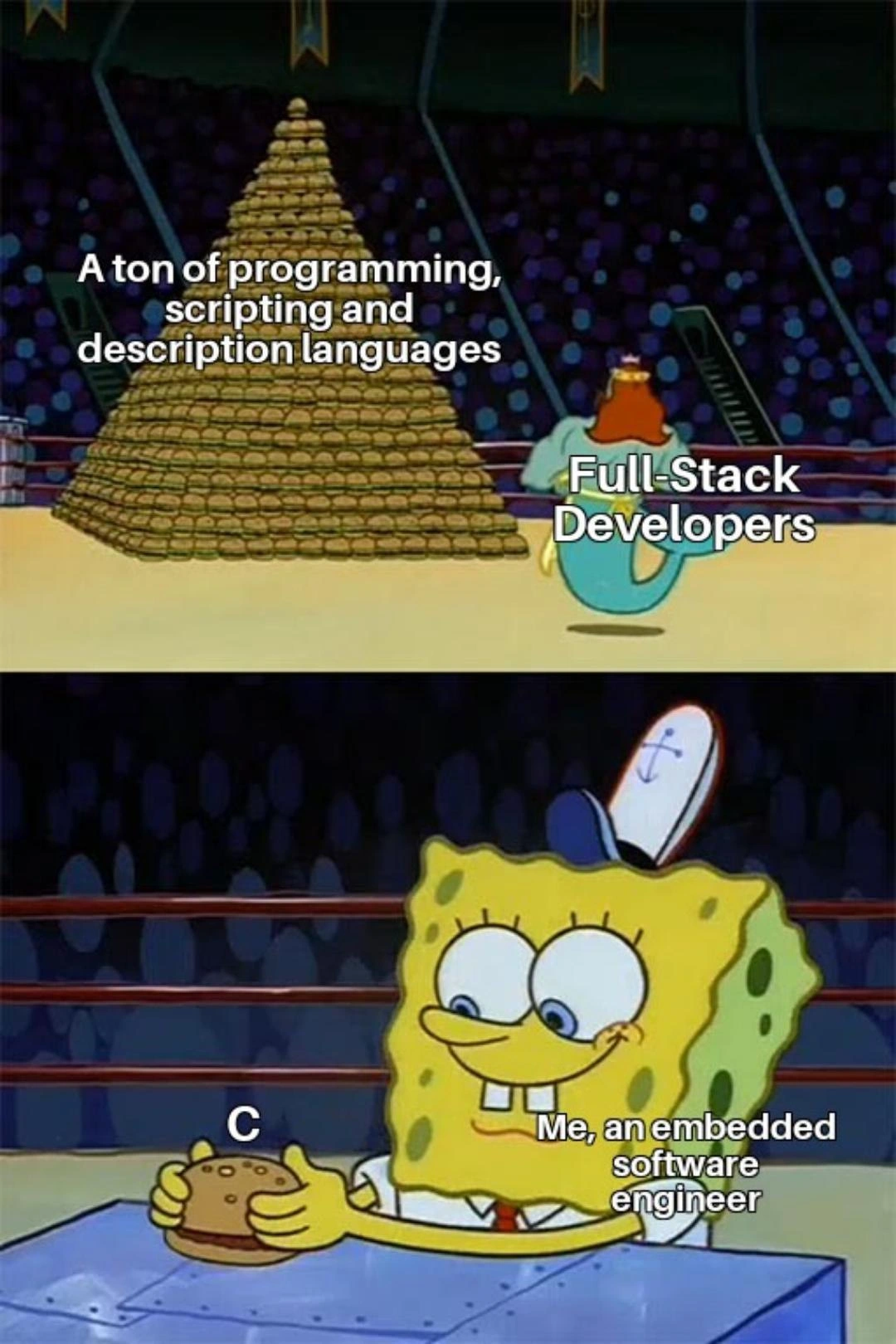
The meme’s bottom panel shows SpongeBob (labeled "Me, an embedded software engineer") holding a single patty labeled "C". That represents the embedded dev’s world: mostly just one programming language to worry about (C). And that one burger goes a long way – with C, an embedded dev can do pretty much everything needed on the device: read sensors, control motors, handle communication protocols, you name it, all in one language. They aren’t dealing with HTML or SQL or other high-level web tools; their code is usually running directly on the device’s hardware (this is often called bare-metal programming when there’s no operating system in between, or running on a tiny embedded OS).

So the key difference highlighted by the meme is:

  • Full-stack developers use a wide variety of languages and tools for different tasks in building a software application (lots of layers = lots of patties in that tower).
  • Embedded developers use mostly one core language (C) to directly program devices (one patty that they cherish).

The humor comes from this extreme contrast. Full-stack folks might feel overwhelmed by all the technologies they need to know ("Why do I need to learn eight different languages just to make one app?!"). In job postings, a full-stack position might list a dozen required skills. Meanwhile, embedded folks have a reputation for sticking to the classic single language that runs on practically any hardware. It’s like the meme is saying: the full-stack dev’s plate is overflowing with different cuisines, while the embedded dev has one simple, satisfying meal that never changes. Each role has its own challenges (writing firmware in C is no cakewalk either!), but from a newbie’s perspective you can clearly see how one role requires you to be a generalist wearing many hats, whereas the other lets you be a specialist focusing deeply on one primary tool.

Level 3: Babel Burger Tower

In the top panel of this meme, a full-stack developer is depicted facing a towering pyramid of Krabby Patties, each patty labeled with some programming, scripting, or description language. It's a SpongeBob-style exaggeration of a very real programming_language_overload. Modern FullStackDevelopment often means juggling a stack so tall it feels like a comically large burger tower. Think about all the layers and languages a web dev might encounter in one day: writing front-end logic in JavaScript or TypeScript, styling with CSS, structuring content with HTML, querying data in SQL, configuring servers or CI pipelines in YAML or JSON, maybe scripting deployment with Bash, and then there’s that one feature on the backend written in Python or Java. Each layer introduces a new "flavor" of syntax. The meme visualizes this as an absurd Krabby Patty pyramid – a giant stack of different technologies that a full-stack dev has to devour (or do battle with) regularly. It's like a Tower of Babel in code form: so many languages in play that keeping them straight is a challenge. No wonder the mermaid referee (representing the full-stack dev) looks tiny next to that mountain of burgers — it captures how a full-stack engineer might feel when facing a job description that expects expertise in about 10 different languages and frameworks all at once.

Now contrast that with the bottom panel: SpongeBob (lovingly) cradling a single Krabby Patty labeled "C". This is the happy embedded software engineer who largely lives in a one-language world. In the realm of embedded systems, especially low-level firmware, C is the undisputed king – it's the trusty language that’s been around since the 1970s and still runs on tiny microcontrollers inside your appliances, IoT gadgets, and vehicles. Notice how SpongeBob is smiling contently; he's essentially hugging that C burger like it's his precious. This reflects the almost comfort food status of C for embedded developers. While full-stack folks chase the latest front-end framework or new server-side language every few years, embedded devs often stick with plain old C (and maybe a dash of assembly or C++ when feeling fancy). There's a strong sense of c_language_loyalty in that field – if it ain’t broke (and C rarely breaks in the embedded world), why fix it? The meme taps into this single_language_focus: the embedded engineer’s toolbox is simpler (one patty) but very specialized and deeply understood, whereas the full-stack developer's toolbox is broad (a whole buffet of patties) but each individual piece might not be as deeply mastered.

The humor here plays on the stereotype of full_stack_vs_embedded career paths. Full-stack devs are expected to be Jack of all trades (or as the meme jokingly shows, juggling countless flavors of tech burgers) by building everything from the user interface down to the database. This polyglot pyramid can be overwhelming — it's a pyramid scheme where the reward for learning one technology is finding out you need to learn another ten! Many developers nod knowingly at this kind of "language bloat": new templating languages, new JavaScript frameworks, new API description DSLs, all piling up like endless burger layers. Meanwhile, the embedded engineer’s experience is the opposite: low-level programming tends to happen in a close-to-hardware environment where C covers most needs, from toggling hardware registers to implementing application logic, all in one language. It's almost serene by comparison. The SpongeBob part of the meme shows that serenity: he's not in the ring fighting multiple opponents; he's ringside cuddling his one burger happily, as if to say, "I have all I need right here in C, thank you very much."

This contrast is funny because it's so true in the industry. A web or cloud developer's résumé might list a buffet of technologies (like a grocery list: React, Angular, Node.js, Django, SQL, GraphQL, Docker, and on and on), whereas an embedded dev’s résumé might emphasize deep expertise in C, C++, and knowledge of a specific chip or RTOS (and that’s usually enough!). The meme cleverly uses SpongeBob’s world to poke fun at this divide. If you squint, that Krabby Patty pyramid could represent the ever-growing JavaScript ecosystem or the plethora of new tools a full-stack dev is supposed to keep up with. It’s a bit overwhelming, right? The embedded dev is basically saying, “I’ll just be over here with my tried-and-true C burger,” which resonates with anyone who’s felt fatigued by the constant change in the software world.

On a deeper level, the meme highlights a classic language wars dynamic but in a lighthearted way: the sheer programming_language_overload of being a generalist vs. the focused specialization of being a low-level/firmware programmer. Each path has its own challenges and rewards. Sure, that full-stack dev might have the shiny tools and high-level conveniences (no manual memory management when you're writing Python, for example), but they also have to keep up with a dizzying array of technologies. And the embedded dev might be dealing with tricky hardware bugs and pointers, but at least they’re not also wrestling with CSS layouts and database migrations on the same day! The meme exaggerates the scenario to get a laugh from developers: whether you’re wrestling with a stack as tall as a Krabby Patty pyramid or chilling with one beloved "C" burger, you likely recognize the absurdity in expecting one person to know it all. And if you’re an embedded dev, you might just be grinning like SpongeBob, because sometimes less is more when it comes to the tools on your plate.

Description

This meme likely illustrates the pain of dealing with a major merge conflict in Git. It might use a format like a character trying to untangle a massive knot of wires, or a scene of a chaotic battle. The two branches being merged could be personified as two opposing armies. This is a universally relatable experience for developers working in teams. The humor comes from the shared frustration of spending hours resolving conflicts, and the sinking feeling when you realize you've overwritten someone else's work

Comments

7
Anonymous ★ Top Pick Resolving a merge conflict is like being a hostage negotiator, but you're negotiating with a past version of yourself who had very different opinions
  1. Anonymous ★ Top Pick

    Resolving a merge conflict is like being a hostage negotiator, but you're negotiating with a past version of yourself who had very different opinions

  2. Anonymous

    Full-stack build: TypeScript → Babel → Webpack → Docker → Kubernetes → YAML group therapy. Embedded build: gcc -Os main.c && flash 32 KB - same burger, no condiments, still running when your pods restart

  3. Anonymous

    Full-stack devs debug their 47-layer abstraction stack while I'm over here debugging why this pointer is off by one byte and taking down an entire satellite constellation

  4. Anonymous

    While full-stack developers are busy debating whether to add yet another JavaScript framework to their already towering stack of languages, libraries, and DSLs, embedded engineers are still writing rock-solid C code that will outlive the next three generations of web frameworks - and probably the heat death of the universe. Sure, we only know one language, but when your code runs on a chip with 2KB of RAM and no operating system, you don't need TypeScript's type gymnastics or YAML's indentation anxiety. We're too busy ensuring our pointer arithmetic doesn't cause a satellite to fall out of orbit

  5. Anonymous

    Full-stacks scale the Babel of frameworks; embedded engineers etch empires in C's 64KB kingdom, where malloc is a luxury

  6. Anonymous

    Full‑stack collects languages; embedded keeps C - our stack is 4KB, our GC is the watchdog, and one missing volatile will reboot the product faster than any YAML pipeline

  7. Anonymous

    Full‑stack ships twelve languages; embedded ships one - plus a linker script, DMA coherency, and an “API” that’s literally a register map

Use J and K for navigation