Skip to content
DevMeme
2228 of 7435
The Overly Eager PHP Detector
Languages Post #2482, on Dec 20, 2020 in TG

The Overly Eager PHP Detector

Why is this Languages meme funny?

Level 1: Mistaken Identity

It’s like when a little kid sees an old man with a big white beard and yells, “Is that Santa?!” The child is excited and identifies the person as Santa just from one detail (the beard) even though it’s probably just a regular man. We find that cute and funny because the kid made a quick, innocent assumption. In this meme, the programmer is doing the same thing. They see one obvious sign – the $ symbol on a variable – and immediately assume, “This must be PHP!” It’s amusing for the same reason: a quick guess from a single clue that ends up being a bit misguided. The humor comes from that goofy leap to conclusion, just like mistaking a butterfly for a pigeon (or a bearded stranger for Santa) because of one familiar feature.

Level 2: Dollar Sign Variables

In programming, a variable is like a little container that holds a value (a number, a word, etc.) and has a name. Different programming languages have different naming conventions (rules or styles for naming things). In PHP, the rule is that every variable’s name must start with the $ symbol. Think of the $ as part of the variable’s spelling in PHP. For example, if you want a variable for a user’s name in PHP code, you’d do:

<?php
$userName = "Alice";
echo $userName;
?>

Here, $userName is a variable holding the text "Alice". The dollar sign doesn’t mean money or anything arithmetic – it’s just a required prefix in PHP syntax to mark a variable. This $ prefix is a quirky feature of PHP’s syntax that isn’t common in many other languages. It’s a bit of a language quirk that PHP is famous for.

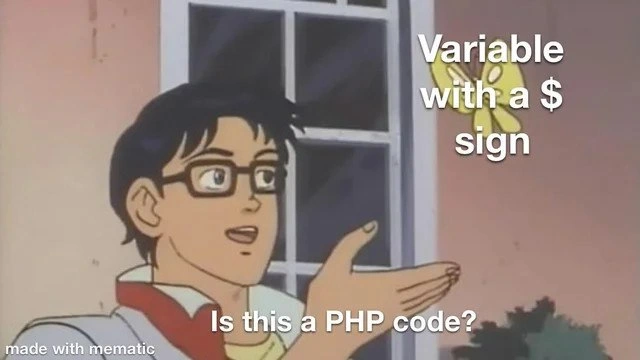
Now, what’s the meme showing? It uses an anime image where a character is pointing at a butterfly and calling it something else. (Fun fact: in the original show, the character genuinely believes a butterfly might be a pigeon – hence the meme’s origin as the “Is this a pigeon?” meme template for anything that’s being misidentified.) In our developer version of the meme, the butterfly is labeled “Variable with a $ sign,” and the character is asking, “Is this a PHP code?” This is a humorous way to say: “I see a $ in this code, so I immediately think it must be PHP.” It’s making fun of how programmers (especially if they’re only familiar with a few languages) can jump to conclusions about code just from one symbol.

Let’s break down why someone would ask “Is this PHP code?” upon seeing a $variable. PHP is indeed the most well-known language that uses $ in front of every variable. So if you learned PHP first (or mainly see code from PHP), your brain pairs $ with “PHP code” automatically. It’s a bit like an identifying stamp. However, not every $ in code is PHP! For example, consider a shell script (for Linux or Mac command line, often called a Bash script). In Bash, you might see:

NAME="Alice"      # set a variable (no $ when defining it)
echo $NAME        # use the variable (prefix with $ to get the value)

In that Bash example, $NAME is how we insert or use the value of the variable NAME. So a snippet from a Bash script can also have $ in front of words, even though it’s not PHP at all. Another case: Perl, an older language that influenced PHP, also uses $ for its variables. And PowerShell on Windows does too (every PowerShell variable, like $PSVersionTable, starts with $). Even in JavaScript you might see a $ in something like ${name} inside template literals (or as a convention in libraries like jQuery where $ is used as a function). So $ is a common symbol in code, but each language uses it differently. The key is that in PHP, it’s part of every single variable name, which is why it stands out so much.

Because PHP is so prevalent on the web (it powers a lot of sites, WordPress, etc.), many developers have seen or written PHP at some point. The moment they see a variable with that $, it triggers the memory of PHP code. This meme jokingly portrays a dev who doesn’t double-check context and just goes “Hey, that’s got a $, it must be PHP!” — much like the meme character confidently calling a butterfly a pigeon without a second thought. It’s a form of developer humor or syntax humor: we’re joking about the superficial way we sometimes identify code. It’s funny to us because it’s a little exaggerated but grounded in truth. We’ve all had moments of confusion or quick assumptions with code. Maybe you opened a file and saw <script> and thought “Is this JavaScript?” when it was actually an HTML template, or saw lots of SELECT * and thought “Is this SQL?” even if it was embedded in another language. Those guess-and-check moments are common in a coder’s life.

The text “Is this a PHP code?” itself is phrased in a slightly goofy way (you’d normally say “Is this PHP code?” without the “a”). That hints the meme isn’t to be taken seriously – it’s intentionally a bit over-the-top. And within the developer community, PHP sometimes gets teased due to historical quirks and the chaotic code found in older PHP projects. This meme gently pokes at that culture: one little $ and people immediately think of PHP, maybe rolling their eyes or laughing, even if it might be something else. It’s a playful stereotype. If you’re new to coding, the takeaway is: PHP = $variable syntax, so much that it’s a running joke. But also, don’t literally assume any $ means PHP, or you might end up like the guy in the meme, pointing at a butterfly and calling it the wrong thing!

Level 3: Not All $ Are PHP

This meme riffs on a classic programmer instinct: seeing a $ in code and instantly thinking “this must be PHP.” In the image (a repurposed “Is this a pigeon?” anime frame), the butterfly is labeled “Variable with a $ sign,” and the confused guy blurts out, “Is this a PHP code?” For seasoned devs, this scenario is hilariously relatable. We’ve been conditioned to associate the dollar-sign prefix with PHP so strongly that it’s almost Pavlovian. One glimpse of a $variable and our brain raises a little PHP flag. It’s like a code-scent: one whiff of $ and you smell PHP.

Why does this reflex exist? PHP is one of the few popular languages where every variable name starts with $. That quirky naming convention makes PHP variables stick out like a sore thumb (or an overly enthusiastic butterfly 🦋). Over years of coding, developers internalize these visual cues. It’s similar to how seeing curly braces { } might scream “JavaScript or C-style language,” or seeing def with strict indentation hints “Python.” In PHP’s case, the $ is so iconic that it’s basically the language’s mascot in code. So when a developer quickly eyeballs some snippet and sees $foo or $bar, the knee-jerk reaction is “oh, that’s PHP code” – even though that might be a misidentification. The meme exaggerates this habit by having the character earnestly mistake any $ for PHP, just as in the original cartoon he mistakes a butterfly for a pigeon. It’s poking fun at our tendency to jump to conclusions from a single symbol.

This touches on a bit of language wars and communal lore in programming. PHP has historically been both wildly successful and widely mocked. Many experienced devs have war stories of wrangling messy legacy PHP scripts (full of $variables everywhere) or debugging strange PHP behaviors at 3 AM. 😅 The moment we spot a $ in code, some of us get flashbacks of $conn, $row, $result variable soup from old PHP 5 days. It’s a mix of nostalgia and “uh-oh” humor. The joke here is self-aware: we know not every $ means PHP, but our brain still goes there. It’s the same comedic exaggeration as the running gag “It’s always DNS” — here, “It’s always PHP” whenever a dollar sign appears. The humor lands because the audience (developers) collectively recognizes this flawed pattern-matching in themselves. We’re laughing at how a tiny syntax quirk can trigger such a strong association. In reality, that $ could belong to Perl, Bash, or PowerShell syntax too, but PHP has dominated our mental map of dollar-signed code.

There’s some legit technical history behind this as well. The $ is what’s called a sigil – a special prefix symbol on identifiers. PHP inherited sigils from Perl, which uses $ for scalar variables, @ for arrays, % for hashes, etc. The original idea was to make variables obvious and help the parser (and programmer) immediately know it’s a variable and even its type or context. In fact, having $ prepend variables can allow variable names that would clash with keywords (e.g., you could have $class even if “class” is a keyword). It also makes string interpolation easier – "Hello, $name" can instantly inject the variable’s value. These are practical reasons that PHP (and Perl before it) adopted sigils. However, most modern languages dropped this style for cleaner-looking code, so nowadays a $ in code is an unusual sight outside of certain contexts. That rarity is exactly why the $ screams PHP to so many devs. It’s a bit like an accent in human language: if only one region uses a particular slang, you can guess where a speaker is from after one catchphrase. Developer experience plays into this: if you’ve hopped between languages, you build a mental catalogue of such telltale syntax. Seeing a dollar sign is like hearing that one distinct slang word – you instantly think of the place (or language) you heard it from first.

Ultimately, this meme gets a chuckle from veteran programmers because it’s true enough to hurt (or to laugh at). We’ve all seen someone on a forum or in the office point at code with a $ and say, “Is that PHP?” with a smirk – or we’ve done it ourselves. It humorously highlights our bias: a single character leads us to confidently categorize code, right or wrong. The anime meme format (guy pointing at butterfly) is the perfect vehicle for this joke, because it’s all about mistaken identity. The dev in us is the guy with glasses, the $variable is the butterfly, and we’re collectively chuckling at ourselves asking, “Is this PHP code?” when sometimes it’s not. It’s a lighthearted reflection on how programming languages develop strong identities (and stereotypes) around their syntax. Not all $ are PHP… but we just can’t help the impulse to think so!

Description

A popular meme using the 'Is this a pigeon?' format, which features a male anime character with glasses gesturing towards a butterfly. In this version, the butterfly is labeled 'Variable with a $ sign'. The character is asking, 'Is this a PHP code?'. A 'made with mematic' watermark is visible in the bottom-left corner. The joke satirizes the strong and immediate association developers have between the dollar sign ($) prefix for variables and the PHP programming language. While PHP famously uses this syntax, the humor resonates with experienced engineers because the '$' symbol has many other uses in the tech world, such as in shell scripts for environment variables, as the primary function/selector in jQuery, in JavaScript template literals, or as an anchor in regular expressions. The meme playfully mocks the narrow perspective of someone who only associates the symbol with PHP
Comments

30
Anonymous ★ Top Pick A junior dev sees a '$' and thinks 'PHP variable.' A senior dev sees a '$' and asks 'jQuery selector, shell variable, end-of-line regex anchor, or are we just talking about our budget again?'
  1. Anonymous ★ Top Pick

    A junior dev sees a '$' and thinks 'PHP variable.' A senior dev sees a '$' and asks 'jQuery selector, shell variable, end-of-line regex anchor, or are we just talking about our budget again?'

  2. Anonymous

    Even after ripping out every last PHP monolith, a stray $ENV_VAR in Terraform still makes my IDE whisper “<?php”… legacy autocomplete is the real haunted dependency

  3. Anonymous

    After 20 years in the industry, I still can't decide if PHP's dollar signs are a feature that prevents variable name collisions or just Stockholm syndrome from maintaining legacy e-commerce platforms that somehow still process billions in transactions despite being held together by mod_rewrite rules and prayer

  4. Anonymous

    After 25 years, PHP developers still get asked 'why the dollar signs?' at every conference. The real answer? Perl influence and the need to distinguish variables from barewords. But the meme captures a deeper truth: in a world of let, const, var, and type annotations, PHP's sigil-based syntax remains instantly recognizable - like spotting a butterfly in a sea of modern language design. It's not a bug, it's a $feature

  5. Anonymous

    Seeing $var and yelling "PHP" is like seeing YAML and yelling "Kubernetes" - the real tell is $var being concatenated into a SQL query

  6. Anonymous

    Relying on a leading $ to identify PHP is the same heuristic that made our static analyzer label half the ops scripts as web tier - precision feels great until Perl, Bash, and PowerShell destroy your recall

  7. Anonymous

    PHP devs' sixth sense: every $ is a variable until proven a currency

  8. @ImJmik 5y

    No, it's bash

    1. @AmindaEU 5y

      my thoughts exactly

    2. @bit69tream 5y

      no it's zsh

  9. @pyproman 5y

    No it's PowerShell

    1. Deleted Account 5y

      *posix shell

  10. @ledzz1994 5y

    no, its jquery

    1. dev_meme 5y

      In Europe we use €

      1. @RiedleroD 5y

        can confirm, we also use printc instead of printf.

  11. @mityabb 5y

    Atmel assembler

  12. @Daler_XYZ 5y

    It's a string in kotlin

    1. Deleted Account 5y

      kgay

      1. Deleted Account 5y

        Kotlin is godly

        1. Deleted Account 5y

          Man I tried it

    2. Deleted Account 5y

      Wtf?

    3. Deleted Account 5y

      You are so wrong

      1. @Daler_XYZ 5y

        I mean val str = "some string" val newstr ="str data $str" And result of newstr will "str data some string"

        1. Deleted Account 5y

          Well yes?

  13. Deleted Account 5y

    It's a global variable in Ruby

  14. @serghei_k 5y

    No, it is Perl

  15. @Daler_XYZ 5y

    Thanks, didn't know that

  16. @Phones24 5y

    No, it's SASS

  17. @nepalymiynik 5y

    Ruby global variable

  18. @georgiyp 5y

    JS Observables

Use J and K for navigation