Skip to content
DevMeme
2227 of 7435
Polyglot Programmer or Multilingual Print Statements?
Languages Post #2481, on Dec 20, 2020 in TG

Polyglot Programmer or Multilingual Print Statements?

Why is this Languages meme funny?

Level 1: All Hello, No Conversation

Imagine your friend boasts, “I can speak five different languages!” You get excited and ask them to say something in each. Then your friend goes: “Hello!” in English, “Hola!” in Spanish, “Bonjour!” in French, “Hallo!” in German, and “Ciao!” in Italian. That’s it. They can’t actually have a conversation beyond saying “hello” in those languages. You’d probably giggle, right? They kind of told the truth – they did say hello in five languages – but it wasn’t what you imagined when they said they could speak those languages.

This meme is the programming version of that joke. Someone claims “I can code in a lot of different languages,” which sounds like they’re a super-skilled programmer. But really, all they did was learn how to make the computer say “Hello, World!” in each one. It’s like only learning the word “hello” in multiple languages and nothing more. It’s funny because saying hello is very easy, and it doesn’t mean you truly know the language. In the same way, making a computer print out a simple greeting is the very first baby step in coding. So the person is bragging about something really small as if it’s a big deal. We laugh because we understand the difference: knowing a few words (or a few lines of code) isn’t the same as being fluent in a language. The meme playfully reminds us that everyone starts somewhere – saying “Hello” is great, but there’s a lot more to learn after that!

Level 2: Hello World Tourist

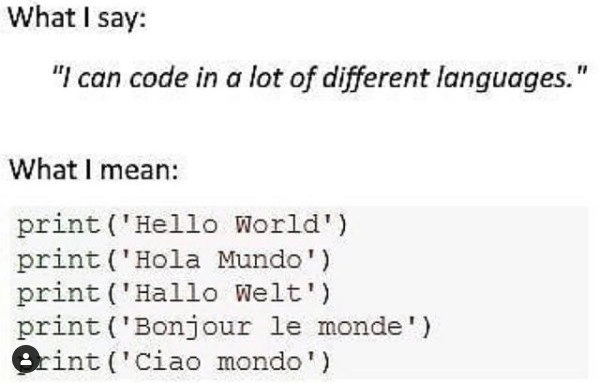
Let’s break down why this meme is funny, especially if you’re newer to coding. The setup is a classic misunderstanding around the word “languages.” In tech, when someone says “I can code in many languages,” they usually mean programming languages like Python, Java, or JavaScript. But here the person’s secret meaning is literally human languages (English, Spanish, German, French, Italian) – they’re just printing "Hello World" translated into each of those! The meme shows a small terminal-style snippet with a series of nearly identical lines:

print('Hello World')
print('Hola Mundo')
print('Hallo Welt')
print('Bonjour le monde')
print('Ciao mondo')

All five lines use Python’s print() function, which simply outputs text to the screen. The only thing that changes in each line is the greeting inside the quotes:

  • "Hello World" is English
  • "Hola Mundo" is Spanish
  • "Hallo Welt" is German
  • "Bonjour le monde" is French
  • "Ciao mondo" is Italian

So, despite the claim “I can code in a lot of different languages,” this code isn’t demonstrating different programming languages at all – it’s the same small Python program printing five greetings. Essentially, the person wrote one program that says hello in five spoken languages, not five different coding languages. It’s as if they conflated being a coding polyglot with being a translator for HelloWorld messages.

Now, why is that humorous in a developer context? There’s a long-standing tradition that the first program you write when learning a new programming language is one that outputs “Hello, World!” It's a simple test to make sure everything is set up correctly and to see the basic syntax. Because of this tradition, saying you wrote a Hello World in a language is kind of like saying “I tried the absolute basics.” In fact, many programming books and tutorials start with a Hello World example. It’s a rite of passage when picking up any new language, from C to Go to Rust. But it’s only the first baby step.

This meme capitalizes on that idea. The person’s boast implies they’ve done something impressive (coding in many languages), but the reality is they’ve done the easiest exercise in each. It’s similar to someone bragging, “I’m fluent in French, German, and Italian,” when all they really know is how to say “hello” and “goodbye” in each of those languages. In programming terms, knowing how to print “Hello World” in multiple languages doesn’t mean you understand how to actually build programs in them. Each programming language has its own syntax and features. For example:

  • In Python, you’d write print("Hello World") (as shown above).
  • In JavaScript, you’d write console.log("Hello World");
  • In Java, you’d write System.out.println("Hello World");
  • In C, you might write printf("Hello World"); (after setting up a whole #include and main function).

See how each language uses different keywords and punctuation? A true LanguageComparison would show different code for each case. But in the meme’s snippet, all the lines look the same except for the text, which tells us the programmer probably stuck to one language (Python) and just changed the output string. It’s a bit like copying the same template and only swapping one word.

The categories here are Languages and Learning, which is spot on. The meme is poking fun at the learning stage where a newcomer might get overconfident after doing a few tutorials. It’s not unusual for an excited beginner to try out “Hello World” in several languages — that’s a fun way to dip your toes in and see basic syntax differences. The joke arises when that beginner mistake is thinking that equates to being proficient in all those languages. There’s even a tongue-in-cheek term for fluffing up your skill set this way: resume overstatement. This means exaggerating your abilities on your résumé or in conversation. For instance, a junior developer might list 5 or 6 languages under “Skills,” when in reality they’ve only written very simple programs (like a Hello World or a basic loop) in most of them. If an interviewer dug deeper, asking, “So you know JavaScript — can you explain how closures work?” or “You used C++ — what’s the difference between a pointer and a reference?”, the person might get stuck. That’s the gap between familiarity vs. real proficiency the meme is highlighting.

Another relevant concept is programming_languages_vs_spoken_languages. The meme’s humor literally comes from mixing these up. Saying “I know many languages” without clarifying can mean two different things to different people. In everyday life, it often means spoken languages (like English, Spanish, Chinese). In coding, it means programming languages (like Python, Java, C#). This meme joke plays on that double meaning. The top caption (“What I say”) uses the coding interpretation to sound impressive to fellow developers. The bottom (“What I mean”) reveals it was really just about spoken language phrases, implying the speaker was being a bit cheeky or misleading. It’s funny because no programmer actually thinks printing foreign words is coding in a foreign programming language – it’s a silly mix-up that exposes the lack of actual coding substance.

For many developers, this is relatable humor. Almost everyone has gone through a phase of being a newbie programmer excited to mention every new thing they learn. There’s a bit of DeveloperSelfDeprecation here too: experienced devs laugh because we remember doing stuff like this. Maybe you added HTML after one basic webpage or claimed to “know SQL” after a single database query. It’s not malicious, it’s just enthusiasm. But it is amusing in hindsight! This meme gently teases that behavior. It suggests that saying you “know” a programming language when you’ve only seen its simplest example is like claiming you’re an author because you learned to write your name. The bottom line: knowing how to print "Hello World" (or "Hola Mundo" or "Hallo Welt"…) is a great start in any language, but it’s just the beginning of learning, not the end.

Level 3: One-Trick Polyglot

At first glance, this meme calls out a developer’s humblebrag: “I can code in a lot of different languages.” Any seasoned engineer immediately reads between the lines. The punchline reveals that this boast is painfully hollow – our so-called polyglot is just printing “Hello World” in different spoken languages, all using the exact same print() statement. In other words, they haven’t actually mastered multiple programming languages at all; they’ve merely swapped out string literals like 'Hola Mundo' and 'Bonjour le monde' in what looks like a single Python script. This is classic developer humor: the phrase “many languages” is deliberately misconstrued to expose a resume padding tactic. It’s poking fun at that all-too-relatable scenario in tech where someone lists a dozen programming languages on their CV, but if you scratch the surface you’ll find their knowledge barely goes beyond the introductory Hello World example in each. The meme format – “What I say” vs. “What I mean” – perfectly encapsulates this gap between bravado and reality.

For a senior developer, the humor cuts close to the bone. We’ve all encountered the enthusiastic junior (or read the inflated LinkedIn bio) claiming proficiency in Python, Java, C++, JavaScript, Ruby, Go, and whatever else is trendy. In practice, this often means they’ve dabbled with each just enough to display “Hello, World!” on the screen. It’s a form of junior_dev_bravado that many of us recognize – perhaps with a mix of amusement and secondhand embarrassment – because we remember being there ourselves. The industry has a term for this kind of overstatement: “knowing just enough to be dangerous.” In this case, the “danger” is only to the person’s credibility. Printing a greeting doesn’t equate to understanding data structures in C++ or closures in JavaScript. An experienced engineer knows that true proficiency in a programming language involves far more than basic syntax; it requires fluency with its idioms, libraries, and real-world problem solving. That’s why this meme strikes a chord: it satirizes the gulf between familiarity and fluency.

The code snippet itself is a clever detail. Every line is print('<greeting>') in identical syntax, just with different human-language text. If the speaker genuinely “coded in many languages,” we’d expect to see different language syntaxes – e.g. System.out.println("Hello World"); in Java, or console.log("Hello World"); in JavaScript, or printf("Hello World"); in C. Instead, the meme shows a monotony of print(...) calls, implying the person hasn’t left the comfy confines of one programming language (likely Python) at all. It’s a HelloWorld gag taken to the extreme: our proud coder is essentially a tourist in programming, collecting souvenir phrases but never learning the local customs of each language. Seasoned devs find this hilarious because it’s a gentle roast of that early-career enthusiasm where quantity of languages seemed more impressive than quality of skill. After you’ve debugged a gnarly production issue or optimized code for performance, you realize that knowing one language deeply beats claiming superficial knowledge of ten. The meme draws on DeveloperSelfDeprecation too – it’s the kind of joke developers make about themselves, reflecting on how far they’ve come since the days of thinking printing “Hola Mundo” meant they were practically bilingual in code.

Beyond the individual, there’s also an inside joke about the futility of LanguageWars. Developers love to argue about which programming language is superior, but at the end of the day, every language can produce the same “Hello World” output. Seeing print('Hello World') in five variants of natural language underscores how trivial these differences are at the beginner level. It’s implicitly mocking those superficial comparisons: if your entire basis for “I know X language” is that you can make it display text on the screen, then sure – by that metric, even Google Translate can code in 100+ languages! 😜 The real laugh for experienced folks is recognizing the relatable humor: we all have known someone (or been someone) who proudly wears the polyglot badge without having written a single meaningful program in any of those languages. This meme condenses that truth into one screenshot, roasting the tendency with a knowing smirk. It reminds us that in software, as in spoken linguistics, saying “Hello” is just the beginning – real conversation (or real software) starts after the greetings.

Description

A two-part, text-based meme on a plain white background. The first part is labeled 'What I say:' followed by the sentence, '"I can code in a lot of different languages."'. The second part, labeled 'What I mean:', displays five lines of code. Each line uses a Python-style print function to output a greeting in a different human language: 'print(\'Hello World\')', 'print(\'Hola Mundo\')', 'print(\'Hallo Welt\')', 'print(\'Bonjour le monde\')', and 'print(\'Ciao mondo\')'. The humor stems from the ambiguity of the word 'languages'. The speaker claims proficiency in multiple programming languages, but the reality shown is proficiency in a single, very basic command ('print') in one programming language, merely using strings from different human languages. This joke satirizes the tendency to exaggerate technical skills, a behavior often seen in junior developers trying to impress recruiters or colleagues. It cleverly contrasts the impressive-sounding claim with a trivial, foundational example that requires no diverse coding knowledge
Comments

10
Anonymous ★ Top Pick That's not a polyglot programmer; that's just a localized 'Hello World' service. The latency is great, but the feature set is a little limited
  1. Anonymous ★ Top Pick

    That's not a polyglot programmer; that's just a localized 'Hello World' service. The latency is great, but the feature set is a little limited

  2. Anonymous

    I’m officially polyglot: I run the same Hello World in five runtimes behind an API gateway and call it a federated service mesh - works great until someone asks for a second endpoint

  3. Anonymous

    After 15 years of polyglot programming across JVM, CLR, and native ecosystems, I've mastered the art of writing the same bugs with different syntax - though I must admit, my i18n implementation still consists primarily of hardcoded strings in various Romance languages

  4. Anonymous

    The classic polyglot programmer paradox: fluent in Python, JavaScript, Go, Rust, and C++, but only because they all have a print() function that works exactly the same way. It's like claiming to be multilingual because you can order coffee in five countries by pointing at the menu - technically true, but the hiring manager probably expected you to know more than 'Hello World' in each stack

  5. Anonymous

    “I code in many languages.” Translation: one Python file with Hello World in five locales. The real polyglot is prod - Node, Java, Go, Python - five build systems, six package managers, twelve CVEs

  6. Anonymous

    Senior polyglot badge: Hello World deploys to prod across 12 langs without a single vendor lock-in regret

  7. Anonymous

    When someone says 'polyglot,' ask if they mean JVM+V8+CPython - or five hardcoded strings with no gettext, ICU, or locale fallback

  8. @sainthamster 5y

    Привет, мир😎

  9. @alexolexo 5y

    context.getString(R.string.hello_world), and you can have even more languages

  10. @Picross3D 5y

    Czesc

Use J and K for navigation