Technical reality arm-wrestles with the client's paid demand in project discussions
Why is this Stakeholders Clients meme funny?
Level 1: Money Can’t Buy Magic
Imagine you’re trying to do something really impossible in everyday life. Let’s say your friend wants a big fancy cake that normally takes 2 hours to bake, but they demand it in 15 minutes. You’re the baker, and you tell them, “Sorry, that’s not possible – cakes need time to bake.” But your friend waves some money and says, “I’ll pay you double if you do it in 15 minutes.” Now, no matter how much they pay, you can’t magically make the cake bake that fast. If you crank the oven heat way up or rush it, the cake will be raw or burnt.
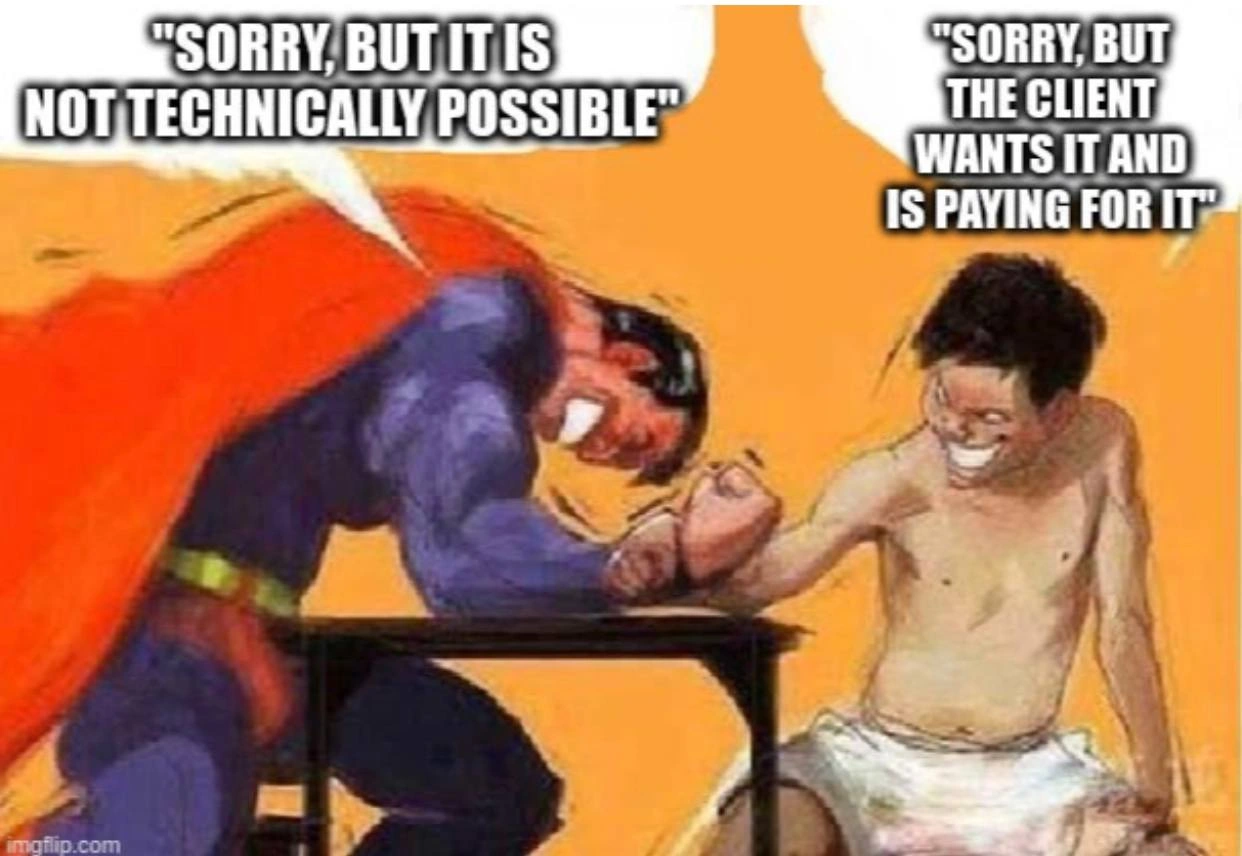
This meme is making the same kind of joke, but with a software project. The developer is like the baker saying, “I can’t do that thing so fast or in that way – it just won’t work.” The client (who wants the software feature) is like the friend saying, “But I really want it now, and I have money!” It’s funny (and a little silly) because it’s a tug-of-war between reality and wishful thinking. We all know money is important, but it can’t make impossible things happen on command, just like paying extra won’t bake the cake instantly. The picture showing a superhero arm-wrestling a tiny kid exaggerates this idea: usually a superhero would win easily (just like real facts should win an argument), but in the joke the little kid (the one with the money and wishes) is somehow holding his own. That makes us laugh, because it shouldn’t be that way – unless we’re joking about how, in real life, people sometimes foolishly ignore reality when they really want something. The emotional core here is a mix of frustration and comedy: we laugh because we’ve all felt that frustration when someone just won’t listen to reason, and the meme lets us nod and say, “Yep, been there – if only being stubborn actually made the impossible possible!”
Level 2: Expectations vs Reality 101
In simpler terms, this meme jokes about a client vs. developer showdown that many in software encounter early in their careers. We have two characters:
- The Superhero in the picture stands for the developer or tech team, armed with actual facts and limitations (our technical reality). He’s saying, “It’s not technically possible.” That’s a formal way of saying: “We just can’t do that, at least not the way you imagine.”
- The Scrawny kid represents the client or a manager speaking for the client. He’s saying, “But the client wants it and is paying for it.” In plain terms: “We already promised this (and maybe took their money), so we have to deliver it, possible or not.”
It’s a comical communication gap scenario. The developer uses technical reasoning, while the client side uses business reasoning. Let’s break down some terms and why this situation happens:
Stakeholder/Client: This is the person or company paying for the project – the one with the StakeholderExpectations. They often focus on what they want (features, changes, results) and the fact that they’re funding the work. In the meme, the client (through the manager) is basically saying, “We must have this feature because we paid for it.”
“Not technically possible”: This phrase is the developer’s way of saying there’s a technical limitation or a constraint. For example, maybe the client asked for an app feature that would require faster hardware than exists, or software to do something that breaks the rules of our programming platform. Saying something is technically impossible can mean:
- Impossible given current technology: e.g. “We can’t have a 1-second search across the entire internet – nobody can, not even Google.”
- Impossible in the timeframe or budget: e.g. “We can’t build a whole new payment system in one week – we’d need months and a bigger team.”
- Impossible due to system constraints: e.g. “Our database can’t handle that many users at once without crashing. It wasn’t designed for that scale.”
Often, when a developer says this, they are trying to set a realistic boundary. They’re waving a red flag that the request would violate requirements vs reality – meaning the requirement (what the client wants) just doesn’t line up with reality (what can actually be done with the time and tech available).
“Client wants it and is paying for it”: This line encapsulates StakeholderPressure. It’s basically management saying, “I know it sounds impossible, but we have no choice, the client is demanding it.” In many companies, especially service or consulting firms, there is a belief that “the customer is always right.” So even if the engineering team has good reasons to say no, the company’s leadership might say yes because they don’t want to lose the client’s money or trust. This leads to MisalignedExpectations: the client expects to get everything they ask for (since they’re paying), but the developer expects the client to respect technical boundaries. They’re not aligned in understanding each other.
Scope Creep: This is a term every junior developer eventually learns, often the hard way. It refers to the project’s scope (the list of features and work to be done) growing larger and larger beyond the original plan. It “creeps” in little by little. For example, imagine you started building a simple website for a client that initially was just 3 pages. Then the client says, “Actually, can we also have a login system?” Then, “We should add a shopping cart too.” Then, “What about a mobile app to go with it?” This continuous adding of new requests is scope creep. In our meme, the client’s demand might be something that wasn’t agreed on initially, or that changes the game. The developer is pushing back (“we can’t do that now”), but the client insists (“we want it anyway”). If the team caves to this, the project scope blows up. For a newcomer, scope creep often means late nights and a project that feels like a moving target. Good ProjectManagement tries to control this by documenting requirements and saying “not now” to extra requests, or by reprioritizing tasks. But here, project management is basically arm-wrestling with technical reality too, and if management sides with the paying client, the scope creep wins.
Communication Gap: This refers to a failure in understanding between the technical team and the client/stakeholders. In simple terms, the developer might not be explaining the problem in a way the client understands, or the client might not be listening or taking it seriously. Early in your career, you might see a senior engineer try to explain, “If we try to force this feature in, the whole system might become unstable,” but a business manager rephrases it to the client as, “The team is concerned, but we’ll do our best anyway.” The true severity might not get across. Improving communication means using language the client grasps (avoiding too much jargon) and also clients being willing to trust the experts. When that doesn’t happen, you get these standoffs. The meme’s two captions are both saying “Sorry, but...” yet they imply neither side truly accepts the other’s point. The client side likely doesn’t believe “technically impossible” really means impossible; they think the dev team might be overreacting or not trying hard enough. Meanwhile, the dev team hears “the client wants it” as an order to perform magic or work themselves to death, and they feel frustrated.
Developer Frustration and Humor: If you’re a junior dev, witnessing this can be frustrating and a bit confusing. You might think, “Why won’t the client understand it can’t be done?” or, “Why is my manager still saying we’ll try to do it if we just said it’s not feasible?” This is where a lot of DeveloperHumor and CorporateHumor comes from – joking about these situations is a way to vent. Around the water cooler (or on internet forums), developers swap stories like, “Remember when client X demanded we re-engineer the whole product in a week? Haha, that was wild.” It’s funny after the fact (or in a meme) because everyone in the field recognizes how ridiculous and common it is. It’s a tech satire of workplace reality. The superhero vs. kid image is a playful metaphor: developers often feel they need superhuman strength to hold the line on sanity, but even a superhero struggles when a high-paying client is on the other side of the table.
For someone new to software development, the takeaway is: these conflicts between client expectations and technical limitations happen a lot. You’ll hear terms like “we have to manage the client” or “set expectations early.” That’s to avoid exactly this scenario. If you set the expectation from day one that certain things aren’t possible or would require major compromises, you might prevent the arm-wrestling match. But if not, you could find yourself in a late-night sprint trying to do the “impossible” or in tough meetings where you have to justify why you weren’t just being difficult. It’s practically a rite of passage in tech to have a moment where you think, “They want what by when?!?” and then experience the scramble that follows. This meme resonates because it captures that moment in a single, exaggerated image.
Level 3: Unstoppable Demand vs Immovable Reality
Engineer (Superhero): "Sorry, but it is not technically possible."
Project Manager (Scrawny kid): "Sorry, but the client wants it and is paying for it."
On the surface, this cartoonish showdown looks absurd: a brawny caped Superhero straining against a skinny kid in an arm-wrestling match. In project terms, it’s the engineer’s solid technical reality vs the stakeholder’s unyielding business demand. This arm_wrestling_meme perfectly illustrates a classic stakeholder_vs_engineer confrontation over a practically technically_impossible request. It's essentially a scope_conflict turned into a physical contest – a bit of tech satire that makes seasoned developers both laugh and cringe. The humor comes from the exaggerated mismatch: the developer’s argument (“we literally can’t do that”) is as mighty as Superman, while the client’s stance (“we pay, so you’ll do it”) is as feeble as a scrawny kid. Logically, the stronger side should win. But in real-life corporate power dynamics, the scrawny kid (money and StakeholderPressure) often pins the superhero (technical reasoning) to the table. It’s a prime example of MisalignedExpectations where business wants overpower what engineering deems feasible.
This scenario highlights the pain of RequirementsVsReality. The engineer’s sorry is an apologetic truth bomb: some things are impossible given the current tech stack, timeline, or laws of physics. The manager’s sorry is a polite way of saying “reality be damned, we promised the client.” Every experienced developer knows this tension. It’s the meeting where you explain why a feature can’t be done (“this violates the API’s security model” or “this would require rewriting the entire app from scratch”) only to hear, “Well, the client insists – make it happen.” The meme’s text captures that deadlock: both sides saying “sorry” while neither yields. This polite phrasing barely hides an impending collision of StakeholderExpectations against hard technical limits.
Why is this funny to those in the trenches? Because it’s too real. It satirizes the DeveloperFrustration that comes when non-technical stakeholders assume money can override engineering reality. There’s an old joke in project management: “Nine women can’t make a baby in one month.” In other words, some things just take what they take, no matter how much you pay or how many people you throw at it. Here, the client’s side believes throwing money at the problem will magically compress timelines or break through technical barriers. The developer (or tech lead) knows better – you can’t negotiate with the laws of computation or nature. This disconnect is the breeding ground for ScopeCreep: the client keeps adding “just one more thing” thinking the team will somehow stretch to do it. Meanwhile, the dev team is left holding the bag, wondering which fundamental constraint they’re expected to defy this time.
In practice, these arm-wrestling matches lead to famous industry anti-patterns. Perhaps the sales team promised a feature that doesn’t actually exist in the product, or a client paid for a software integration that turns out to be technically impossible without months of R&D. Instead of renegotiating the contract, upper management comes to engineering with that dreaded phrase: *“We already took the money, just find a way.**” The result? Either the team hacks together a fragile workaround (incurring massive technical debt), or they crunch day and night in a futile attempt to deliver miracles. It’s corporate insanity, and we joke about it because the alternative is to cry. Seasoned devs have scars from these battles: emergency patches at 3 AM, on-call nightmares, and post-mortems that conclude with “we should have pushed back.” The CommunicationGap between what clients expect and what developers can realistically do often comes from lack of technical understanding on the client side, or over-promising on the sales side. The meme nails this absurdism: one side flexes facts, the other flexes cash. DeveloperHumor like this resonates because it’s a coping mechanism – if we can laugh at the sheer ridiculousness of a client expecting a performance bottleneck fix by “doubling the budget,” maybe we won’t rage as much when it happens for real.
This arm-wrestle image is relatable corporate humor. In many organizations, saying “No, that’s impossible” is almost taboo when a big client is on the line. Engineers learn to couch it in softer terms, like “not feasible within the timeframe” or “requires significant trade-offs,” hoping management will back them up. But often the response is like the skinny kid’s: “Sorry, the client wants it.” That sorry isn’t remorse – it’s a command to bend reality. The absurdity (and thus the comedy) lies in watching an unstoppable business demand crash into an immovable technical constraint. Just as Superman struggling against a kid makes us chuckle at the inversion, developers chuckle (or groan) at how often sound engineering loses arm-wrestling matches to money and politics. This meme is a satirical snapshot of StakeholderExpectations arm-twisting technical reality – a struggle that every dev, from fresh hires to cynical veterans, has witnessed. And while we laugh, we also nod knowingly, recalling all the times a “technically impossible” flag was steamrolled by “client is king.” In the end, gravity, physics, and CPU cycles don’t budge – so either the client adjusts their expectation, or the project falls off a cliff. The meme’s dark little punchline is that in many real cases, the impossible is attempted anyway. When that happens, the only thing stronger than Superman is the inevitable production outage that proves him right. “Sorry, but I told you so,” thinks the engineer as the dust settles.
Description
The meme is a stylized cartoon of a muscular, caped superhero (resembling Superman) straining in an arm-wrestling match against a skinny, shirtless boy at a small black table. Above the superhero, bold white text with a black outline reads: "SORRY, BUT IT IS NOT TECHNICALLY POSSIBLE". Above the boy, matching text says: "SORRY, BUT THE CLIENT WANTS IT AND IS PAYING FOR IT". The exaggerated mismatch of strength visualizes the classic engineering dilemma where sound technical reasoning battles stakeholder insistence, highlighting scope-creep, misaligned expectations, and the communication gap between developers and paying clients
Comments
6Comment deleted
Client: “Budget’s approved - just make globally distributed writes ACID in 5 ms.” Architect: “Perfect, I’ll open a JIRA to patch the speed of light.”
Twenty years in, and I've finally figured out that "technically impossible" is just management speak for "technically possible with infinite time, zero testing, and a post-incident review that'll make great conference talk material."
The real technical impossibility here isn't the feature request - it's explaining to a client why their 'simple change' requires refactoring three microservices, updating four APIs, and migrating a legacy database schema that predates the company's current CTO. But sure, we'll add it to the sprint because the check cleared
Every org has two schedulers: the physics scheduler and the invoice scheduler - guess which one preempts
CAP theorem says pick two; Sales theorem says we already sold all three - fixed-bid, “real-time” multi-region - so please be pragmatic with physics
Superman's kryptonite? A client PO proving 'impossible' just means unbillable