PHP's Unlikely Pivot to Native App Development
Why is this Languages meme funny?
Level 1: Old Tool, New Trick
Imagine you have an old favorite toy that everyone else says can only do one simple thing. Let’s say it’s a building block set, and people insist you can only build small houses with it. But you decide to get creative and build a working boat out of those same blocks. Everyone is shocked – “You made that with regular blocks? No way!” – and they all want to see it. In fact, it’s so cool that people are even buying tickets to ride your little toy block boat. This situation is funny and joyful because something familiar did something totally unexpected and awesome. In the same way, this meme is laughing (in a good way) about a programmer using an old, ordinary tool (the PHP language) to do a big new job (make real apps for computers and phones) that nobody thought it could do. And just like our toy boat that started making money, his surprise invention became a big success and earned him a lot of money. It’s a feel-good, “bet you didn’t see that coming!” kind of story.
Level 2: Not Just Websites
At its core, this meme is highlighting a surprising tech achievement in simple terms: a programmer found a way to use PHP (a programming language mainly known for making websites) to create actual desktop and mobile apps. Let’s break that down. PHP is traditionally a server-side language – meaning it runs on a web server (in the classic LAMP stack of Linux servers with Apache, MySQL, and PHP) and is used to generate web pages or APIs. Think of PHP as the engine behind popular web software like WordPress or Facebook’s early code; it’s usually never seen by users directly, only the web pages it produces. On the other hand, a desktop app is a program you install on your computer (like a text editor, game, or music player), and a mobile app is what you install on your phone (like the Instagram app or a chat app). Typically, to build desktop apps you might use languages like C# or C++ or Java, and for mobile apps you’d use Swift/Objective-C (for iPhones) or Java/Kotlin (for Android), or you might use cross-platform tools and frameworks like Electron (which uses web tech under the hood) or React Native, Flutter, etc. Using PHP to do this job is highly unusual – it’s a bit like using a kitchen spatula to write a letter; not the first tool you’d grab! That’s why in the post they literally said it was something “no one thought could be built.”
The key player here is a new framework called NativePHP. A framework is basically a collection of tools or libraries that make building certain kinds of applications easier by handling a lot of the hard work for you. NativePHP was built by Simon Hamp (the developer in the story) to let PHP developers create native applications – meaning programs that run directly on the operating system (your Windows, Mac, iOS, or Android) with a proper user interface, not just in a web browser. To make this happen, NativePHP likely includes a PHP interpreter packaged with the app and provides a way for PHP code to talk to the native interface elements (like windows, buttons, and phone features). For example, instead of PHP just generating HTML for a web page, it might create a window with a button on your desktop, or it could show a form on your phone’s screen – all using PHP code logic. This is a big deal because it lets developers who only know PHP (and perhaps don’t want to learn a whole new programming language) expand their reach to other platforms. It’s an unexpected language use case, and those tend to get developers excited or curious.
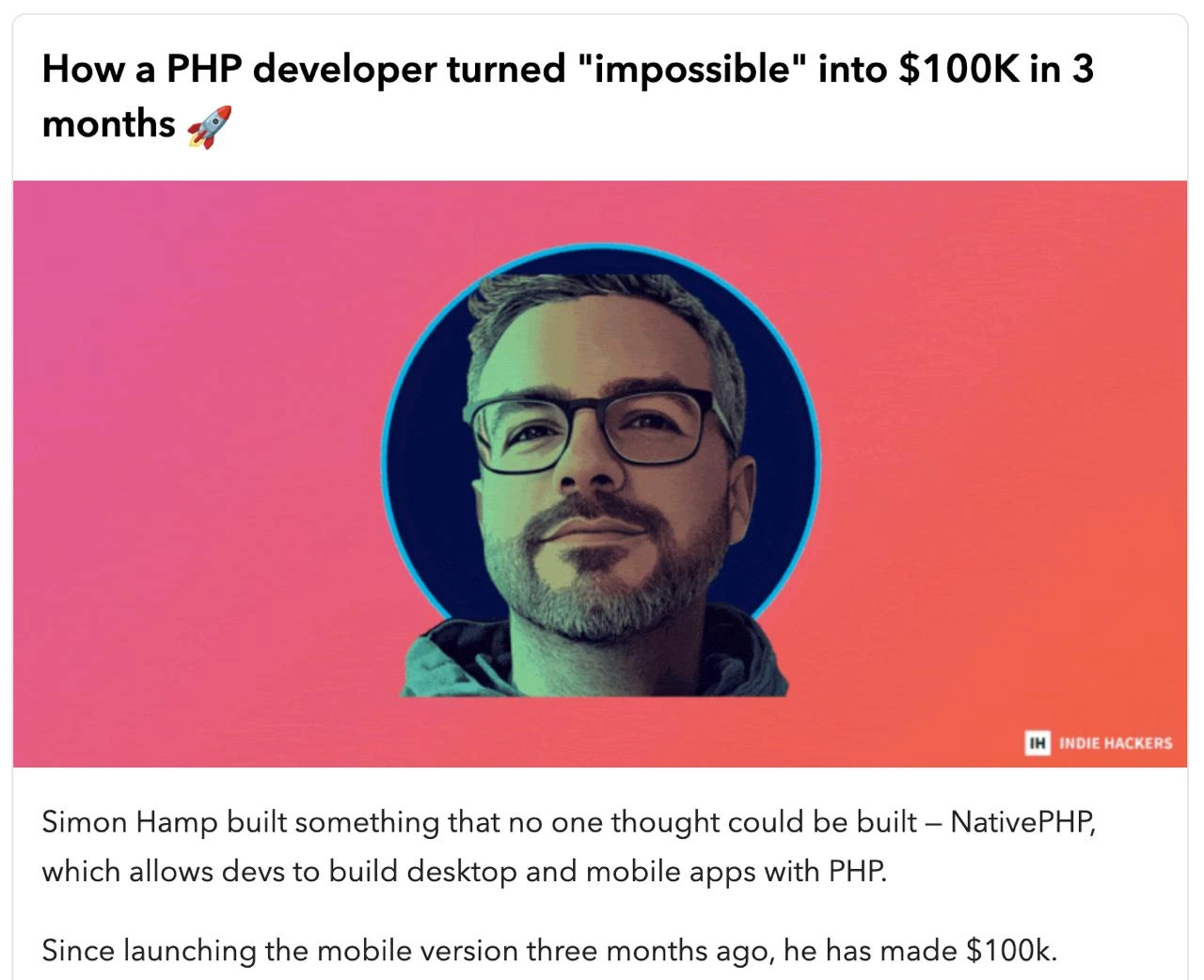
Now, the social media card format of the meme tells a mini success story common in startup life circles. It’s actually an image from a post on Indie Hackers (note the “IH” logo) – a community where indie developers and entrepreneurs share the story of how they built something and often how much money it’s making. The headline says someone turned “impossible” into $100K in 3 months, which immediately screams “startup success” with a dash of clickbait. The 🚀 rocket emoji reinforces that this project really “took off” quickly. The text explains Simon built something nobody thought possible – allowing PHP to make desktop and mobile apps – and that since launching the mobile version three months ago, it earned him $100k. Earning that much in just a few months, especially as a solo creator, is huge in the StartupCulture and SideProjects world. It means his project went from an idea to a revenue-generating product very fast. That’s why it’s highlighted; it motivates other indie developers and is a bit of a humblebrag in the community.
For a junior developer or someone new to this, here’s why this is notable: PHP is easy to start with (one reason it was so popular for web development), but it’s not the trendiest skill if you want to make mobile apps or fancy modern GUIs. People might have even told you “forget PHP, you can’t use it for mobile apps.” Simon’s framework basically challenges that notion. It demonstrates LanguageEvolution in a way – taking an older, stable language and extending it to new frontiers. The whole thing shows that in tech, there’s constant FrameworkChurn and shifting ideas of the “right” stack to use. Today’s hype might say “use JavaScript for everything” or “learn Swift for mobile,” but here we see someone sticking with PHP and still achieving what he needs. And not only did he make it technically work, he found a bunch of fellow developers or companies willing to pay for this solution (perhaps through licenses, subscriptions, or consulting – making $100k suggests a real business model, not just a hobby). So the meme is both a tech curiosity (PHP doing something cool and unusual) and an entrepreneurial highlight (a bootstrapper success story turning a niche idea into income). It resonates with anyone who’s learning that sometimes ModernTechStack ideas can come from unlikely places, and that being creative with the tools you know can literally pay off.
Level 3: Beyond LAMP Boundaries
Seasoned developers can’t help but smirk at the audacity and ingenuity in this story. It’s the tale of PHP – that stalwart of the LAMP stack (Linux, Apache, MySQL, PHP) – escaping its traditional web server cage and running wild on desktops and even smartphones. In other words, PHP on mobile and desktop apps with PHP are now a thing, thanks to a framework aptly named NativePHP. The meme’s headline, “turned ‘impossible’ into $100K in 3 months 🚀,” reads like an Indie Hacker’s fairy tale: a solo developer (Simon Hamp) defied conventional wisdom and cashed in big. For veteran coders, there’s humor in this unexpected_language_use. We’ve all heard jokes about running unexpected tech in strange places (like “Will it run Doom?” or writing a device driver in JavaScript). Here the punchline is real: someone actually built a ModernTechStack twist where PHP – often scoffed at as “just for old-school web sites” – is powering full-fledged native apps and making serious money.
Why is this so eyebrow-raising? Because for years the industry trend has been to add more tools and new languages for each platform: Swift/Objective-C for iOS, Kotlin/Java for Android, maybe JavaScript with Electron for desktop, etc. Meanwhile, PHP was seen as a relic of the early web era, important for WordPress and backend APIs but not exactly part of the mobile revolution. To see PHP ship beyond the web feels like seeing the family station wagon win a Formula 1 race. Experienced devs chuckle at the irony: while everyone else chases the latest hyped languages and FrameworkChurn of JavaScript frameworks, here comes a supposedly “uncool” technology quietly outflanking the trend. It’s a bit of a gotcha to tech snobbery — proof that in software, creativity trumps fashion. You can almost imagine the chorus of comments: “Wait, you built a desktop UI in PHP? And it actually works? AND people are paying for it?!”
On a technical level, there’s some genuine wizardry (and hackery) to appreciate. NativePHP presumably bundles a PHP runtime with a desktop or mobile app, acting somewhat like an Electron-for-PHP. Instead of serving HTML to a browser, the PHP code might directly render UI components or drive a local web view packaged inside the app. Seasoned engineers know this isn’t trivial: mobile OSes (especially iOS) sandbox apps heavily, and historically, getting a scripting language interpreter approved in an App Store was tricky. The fact that Simon pulled it off means he navigated around these OS limitations – perhaps by pre-packaging all code (to satisfy Apple’s rules) or by leveraging something like WebAssembly or a custom PHP-to-native bridge. It’s the kind of clever engineering that turns “that’ll never work” into “hey, it actually works!”. Long-time PHP devs might recall older experiments like PHP-GTK (for desktop GUIs) or project “HipHop” (compiling PHP at Facebook). Those never went mainstream, but here timing and execution were key. Modern PHP 8 has a JIT compiler, devices now are crazy powerful, and the demand for cross-platform simplicity is high. In a way, LanguageEvolution and brute hardware progress converged to make the “impossible” possible.
There’s also a layer of startup pragmatism here that every senior dev who’s been through product launches will appreciate. The meme highlights an Entrepreneurship win: a solo bootstrapper_success_story where an individual turned a niche idea into revenue quickly. It taps into the StartupCulture vibe – the rocket emoji 🚀, the social media card style, the Indie Hackers logo – all signaling “big startup win on a shoestring budget”. For a grizzled engineer who’s seen startups burn millions chasing trends, there’s something satisfying (and frankly amusing) about someone making a tidy $100k in three months with PHP, of all things. The humor has a bit of the “playing Jazz with a kazoo” feel: using an unfashionable instrument and still bringing the house down. It underlines a classic dev truth: StartupLife rewards solving real problems for an audience, even if the tech isn’t what the cool kids are talking about. Here, the real problem was that countless PHP developers wished they could build native apps without climbing the steep hill of new languages or stacks. Simon’s NativePHP framework scratched that itch. The result? Devs get to leverage their comfy PHP skills in new arenas, and Simon gets a flood of license purchases or subscriptions – enough to literally pay his bills.
In short, this meme strikes a chord with experienced programmers because it showcases a perfect storm of LanguageAdoption judo, framework creativity, and entrepreneurial hustle. It’s both funny and inspiring: funny because it upends the “proper” order of the tech world (who puts PHP in a mobile app?!), and inspiring because it reminds us that innovation sometimes comes from looking at a “boring” old tool in a bold new way. And as any battle-worn dev will tell you, the best technology is the one that delivers – hype be damned. PHP went on a little adventure outside its natural habitat, and not only survived, it thrived. That’s a geeky punchline we can all appreciate.
Description
A screenshot of an article from the publication 'Indie Hackers'. The headline reads, 'How a PHP developer turned "impossible" into $100K in 3 months 🚀'. Below the title is a stylized portrait of a man with glasses, Simon Hamp, against a pink and orange gradient background. The article text explains that Simon Hamp created NativePHP, a framework that allows developers to build native desktop and mobile applications using PHP. It notes that he has earned $100,000 in the three months since launching the mobile version. The technical humor stems from the long-standing reputation of PHP as a language strictly for web backends, often criticized for its design. The idea of using it for native UI applications is so contrary to industry norms that it's considered 'impossible,' making this success story both surprising and ironically amusing to experienced developers who have witnessed decades of language wars
Comments
52Comment deleted
A developer making $100k with a PHP framework for native apps is the tech equivalent of finding out your grandpa's old ham radio can now stream 4K video. You're not sure how, you're deeply suspicious, but you can't argue with the results
Some of us spent a decade arguing whether PHP even counts as a language - turns out it’s a cross-platform revenue framework if you add a Stripe key and a Product Hunt launch
Turns out the real 'impossible' was convincing developers that PHP could do something other than generate HTML with mysql_real_escape_string() - though I'm sure the $100k helped silence the 'PHP is dead' crowd faster than any benchmark ever could
Finally, a PHP developer who found a way to make desktop apps crash in a language traditionally reserved for crashing web servers. But seriously, building native apps with PHP is like convincing your CTO that MongoDB is a good fit for financial transactions - theoretically possible, surprisingly successful, and it makes everyone question their assumptions about technology constraints. The real achievement here isn't the $100k; it's getting developers to willingly choose PHP for something other than WordPress plugins
NativePHP: Finally letting PHP escape the LAMP stack to segfault natively on your phone
The real trick isn’t PHP on mobile - it’s monetizing the world’s largest “we’re not rewriting this” budget
Turns out the fastest cross‑platform runtime is revenue: while architects debate a Go rewrite, NativePHP bundles a runtime, ships, and hits $100k before procurement schedules kickoff
he deserves 100k if he promises to never touch keyboard again /lh Comment deleted
how a PHP developer turned "impossible" into useless Comment deleted
I once compiled a TypeScript code base with V8 engine into native DLL/SO library. Comment deleted
Another case of really shit idea Comment deleted
top Comment deleted
oy no need to say that over a library you dont like Comment deleted
kiss? Comment deleted
got it thx Comment deleted
wait a second.... Comment deleted
https://encrypted-tbn0.gstatic.com/images?q=tbn:ANd9GcTQpx0dmaStfDM1sH9toH0g0hheTQ_pru9q2AlhOZ0_BRBLl5ND8u_uaTNglTH_s1muXNhm Comment deleted
that's actually pretty sick ngl. Just imagine how useful PHP can get Comment deleted
Php is ok, there are more then enough shitty compiled languages, what's wrong with getting PHP too. What's more interesting is the question is it just PHP VM bundled with source code or byte code in one executable or is it really natively compiled in tru native binary to run on "bare metal" Comment deleted
People saying it's bad... My brothers, there's already tons of "native" apps that are just chrome running sanboxed js... Comment deleted
Electron desktop apps are also shit lol Comment deleted
That's my point :) Comment deleted
I made the equivalent of Chef out of PHP before Chef existed and managed thousands of Windows workstations with it. It was… okay. Comment deleted
mobile app for what? Comment deleted
Desktop apps? PhpGTK greets you from the far 2005 Comment deleted
i would accept to make javascript the only programming language in the world if it meant deleting php from history. that's how much I hate it Comment deleted
but why? PHP is a good language. Comment deleted
way better than Java Comment deleted
not even close Comment deleted
to being the worst and most useless language? sure Comment deleted
for being the most used language in the world in the last 30 years Comment deleted
things I can do in PHP with 1 line of code, in Java will require a software architect and a CS degree. Comment deleted
skill issue Comment deleted
no I just don't like bdsm. i worked with Java for 6 years Comment deleted
use python then Comment deleted
I use python. Comment deleted
i use c,cpp the python owner Comment deleted
yes, use C / C++ / Rust instead of Java if you need performance. but actually many libraries on python are so well optimized, that it will take a lot of time to get to that speed using raw C++ directly. I looked into some fuzzy search lib on python, and wanted to actually just steal 1 function from it, to avoid dependency. well. it was in C++ where they detected specific SIMD processor features on initialization and injected ASM code to get the maximum perf. ended up keeping this as a dep. Comment deleted
good talks, noted ✍️ Comment deleted
never ever going back to it. I will better cook burgers and sell beer. or clean the streets Comment deleted
Ah, so trauma from shitty enterprise spaghetti Java Comment deleted
5M lines, half year work of team of 200 engineers to change 1 column name in database Comment deleted
Practical examples? Comment deleted
copy($url, $filename) Comment deleted
Could tell you from the top of my head. This is simpler in PHP because it's made for web tho, no? Comment deleted
it's just download a file. it's a common backend task Comment deleted
in Java you need to open a stream, read it step by step, assemble it together, open file stream, close the streams. and so on. but it's such a common task — that I don't understand, why isn't there just a function for that Comment deleted
Apache Commons IO Comment deleted
the code in PHP will literally be 1 line only with perfect abstraction function — 2 params nothing else Comment deleted
Yeah but then you have to use PHP Comment deleted
yes. and write 1 line of code Comment deleted
although it sucks for big projects Comment deleted