Skip to content
DevMeme
6210 of 7435
The Analog Rickroll: A Post-Apocalyptic Classic
DevCommunities Post #6808, on May 23, 2025 in TG

The Analog Rickroll: A Post-Apocalyptic Classic

Why is this DevCommunities meme funny?

Level 1: Pranks Never Die

Imagine all the computers and internet in the world suddenly stopped working. Scary, right? In this picture story, two friends are sitting in that world with nothing digital to do. One friend really misses watching videos and fun stuff online. So, the other friend decides to cheer him up with a surprise. He gives him a piece of paper with a picture of a singer doing a funny dance. It turns out to be a trick – kind of like hiding a whoopee cushion on someone’s chair. The first friend was hoping for something helpful, but gets a silly prank instead! He’s so annoyed he even says a bad word at his buddy. But deep down, this is what makes it funny: even when everything seems broken and sad, friends will still play jokes on each other. It’s like if the power went out and you drew a goofy cartoon by candlelight to make your sibling laugh. No matter how bad things get, people will always find a way to share a laugh – some jokes just never quit, even at the end of the world.

Level 2: Offline Rickroll 101

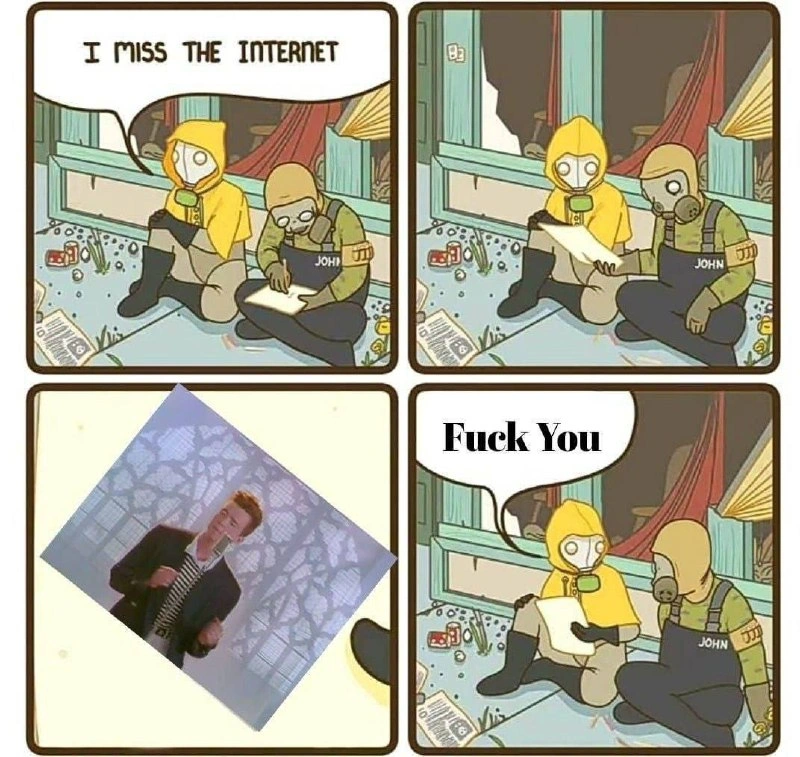
Let’s break down what’s happening in this comic for those new to these tech jokes. We have two characters wearing yellow hazmat suits (those big protective outfits you see in movies when there’s toxic waste or a virus around). They’re sitting in a destroyed room with gadgets and soda cans laying around – it’s a visual cue that something bad happened to the world’s technology. In the first panel, one character says “I miss the Internet.” That alone sets the stage: imagine all the computers, Wi-Fi, and phone networks have stopped working (an “internet apocalypse”). For people like us who are used to being online 24/7, that’s a scary thought! “Always-on networks” means we usually have internet available all the time – like how your home Wi-Fi or phone data is just on and connected. Here, it’s all gone. No Google, no social media, no online games, nothing. So of course the first thing our tech-savvy survivor misses is the Internet itself.

Now, in panel two, they find a folded sheet of paper and look at it hopefully. Why paper? Because with no online connection, the only way to share information or memes (funny pictures/jokes) is the old-fashioned way: offline. This is jokingly called a “sneakernet”. In real life, Sneakernet is an ironic term for when you transfer files by literally walking them to someone on a USB drive or, as in this case, handing them a printout. It’s what you do when electronic networks are down or too slow – you sneak over in your sneakers (shoes) carrying the data. Here the “data” is on a piece of paper. We see the characters hoping this paper might be something useful or uplifting since they miss what the internet used to provide.

Then comes the reveal in panel three: instead of some useful news or heartfelt message, it’s a photo of Rick Astley from his famous 1987 music video “Never Gonna Give You Up.” This is a huge wink to meme culture. Rickrolling is a well-known internet prank. It works like this: someone shares a link or file that they claim is super interesting or important, but when you click it, surprise! You get Rick Astley’s cheesy 80s dance and song instead. It’s called “Rickrolling” because you’ve been “rolled” (tricked) into watching Rick. It became a classic InternetCulture joke in tech and gaming circles – basically a friendly troll. In this comic, since there are no links to click, one friend literally printed out a picture of Rick Astley to prank the other. We can call it a rickroll_printout: the same joke delivered on paper. It’s an offline meme – humor without any need for an actual internet connection. They’ve turned a digital joke into a physical one.

Finally, panel four shows the first character’s reaction. He’s glaring and saying “Fuck you” to his buddy. That’s a very strong, rude way of expressing frustration. (In tech memes and casual settings, profanity sometimes pops out to emphasize a feeling – here it’s shock and annoyance). Why is he so mad? Imagine thinking you found a precious internet relic or something hopeful, only to realize your friend just pranked you with the oldest trick in the online book. It’s the same mix of irritation and begrudging laughter you get when a coworker or friend Rickrolls you after you fell for it. The empty soda cans and busted electronics around them add to the dark comedy – like they’re in the ruins of modern technology, and this is how they use one of their last pieces of printer paper. It underlines how TechHumor persists: even with no real tech left, techies gonna tech (and troll).

Let’s clarify a few terms that popped up: TCP/IP was mentioned – that’s basically the language of the Internet (a set of rules/protocols that allow all computers to connect and share data). If TCP/IP is gone, it means the internet as we know it is completely dead. And “dead-tree” just humorously means paper (since paper comes from trees that are now “dead”). So a “dead-tree sneakernet” is a double joke: using paper to do what the network used to do. Ultimately, what’s happening is the friend in the John-labeled suit found a way to say, “Ha! Gotcha!” using only analog tools. This resonates with a lot of DevCommunity folks because it’s super relatable humor: many of us have that friend who will prank us in any situation. Even without an internet connection, the jokes don’t stop – they just go old-school. This comic is pointing out in a silly way that memes (and trolls) will adapt to any infrastructure failures. No internet? No problem. Humans will share memes via carrier pigeon, USB stick, or in this case, plain old paper. The delivery method changes, but the punchline is the same.

Level 3: Rickrolling in Ruins

For seasoned developers and sysadmins, this comic hits close to home in a hilariously dark way. It imagines the ultimate outage – the internet apocalypse – and asks, what do we do now? The first character mourns, “I miss the Internet,” capturing the despair any of us feel when the Wi-Fi is out for 5 minutes, let alone for good. The setting has all the hallmarks of collapsed infrastructure: broken windows, discarded circuit boards, empties of that last caffeinated soda. It’s a scene any Networking veteran would call a nightmare scenario (total downtime), yet here it’s played for laughs. Why? Because even in a world where TCP/IP is just a fond memory, our instinct to share stupid TechHumor persists. The duo resorts to a paper_sneakernet — passing a folded piece of paper — as if reverting to an ancient form of packet transfer. And what vital information does this makeshift packet contain? The most iconic InternetCulture gag of all time: a Rick Astley photo, aka a classic rickroll_printout. It’s the ultimate proof that MemeCulture will survive the end of the world.

The punchline lands when character A unfolds that paper expecting maybe a map or a precious piece of news, only to find Rick Astley’s 1980s grin beaming back. In one frame (literally a single image “frame” of the music video), all hope for meaningful content is dashed – they’ve been Rickrolled, old-school style. This is HumorInTech at its purest: mixing a developer in-joke with a doomsday scenario. The second character doesn’t even need an internet connection to troll his buddy; he’s effectively saying, “No network? No problem. I’ll deliver the meme manually.” It’s funny because it rings true – we’ve all worked with that one colleague who will find a way to slip a joke into the most serious situation. In developer communities (DevCommunities), Rickrolling is a time-honored prank. We usually do it via a disguised URL or a cheeky Slack message, but here John (as labeled on his hazmat suit) found a way to keep the tradition alive on paper. It’s a bit of NetworkHumor that senior engineers find painfully relatable: after spending careers building resilient systems and backup routes, in the end, sharing memes might come down to a guy in a gas mask handing you a printout.

That final panel, with the speech bubble “Fuck You,” is the exasperated cherry on top – an equally timeless response from the prank’s victim. It’s the same reaction you’d give a coworker who pop-ups Rick Astley on the big screen during your serious presentation, just transposed to end-of-days banter. The vulgarity might be jarring, but it’s part of the dark comedy: even civil norms have decayed a bit in the apocalypse, and honestly, who wouldn’t drop an F-bomb after being Rickrolled when you thought the world’s last Wi-Fi password was on that paper? The humor works on multiple levels: it satirizes our dependence on always-on networks (we’re so lost without Internet that we’ll grasp at any scrap of information), and it lampoons the persistence of relatable humor among tech folks (we carry our trolls and memes into every environment, no matter how absurd). For a senior engineer who’s perhaps been on call during a major outage, the scenario is comically exaggerated but oddly cathartic – at least our outages don’t require hazmat suits… yet. The meme says: no matter how bad it gets, someone will find a way to inject a bit of classic tech prankery. The internet might be gone, but the spirit of the internet – that mix of HumorInTech and irreverence – is never truly offline.

Level 4: Eventually Consistent Trolling

Even when the entire digital infrastructure has crumbled, networking fundamentals sneak into the joke. In this apocalyptic scene, we witness the ultimate fallback protocol: Sneakernet. That’s the tongue-in-cheek term for physically transferring data – here it’s a literal sheet of paper carrying a meme. In networking terms, the survivors created an offline mesh with one hop: person-to-person packet delivery (paper being the “packet”). The bandwidth of this method is laughably low (one picture per trip) and the latency is through the roof (who knows how long it took John to dig up and hand over that Rick Astley photo), but it works. This highlights a classic trade-off in distributed systems: you can still achieve eventual consistency if you’re willing to tolerate extreme delays.

The meme even drops the phrase “eventual consistency” in the description, which is a nod to distributed database theory – the idea that, given enough time and no new disruptions, all nodes will hold the same data. Here the “data” is a Rick Astley pic, and the two hazmat-clad humans are the nodes. With the internet down (a total network partition in CAP theorem terms), our choices are limited: either give up on sharing entirely, or accept weaker consistency and find another path. Partition tolerance is forced upon them (the network is literally broken), so they opt for availability of humor over immediate consistency. The result? The meme is delivered out-of-band via a dead-tree protocol (paper!), eventually synchronizing both people to the same laugh (or groan). It’s a brilliant, geeky illustration of how Infrastructure might fail, but information replication can still occur through unconventional means. Remember the famous adage: “Never underestimate the bandwidth of a station wagon full of tapes.” In this case it’s a sheet of paper in a wasteland, but the principle stands – when conventional links go dark, clever engineers will hand-copy packets if they must. They effectively implemented a physical layer workaround, proving that even in a radioactive dustbowl of an Internet apocalypse, our InternetCulture of trolling is fault-tolerant. The system may be in ruins, but the MemeCulture achieves consistency in the end – Never Gonna Give You Up becomes Never Gonna Let a Network Down.

Description

A four-panel comic depicting two figures in hazmat suits sitting amidst rubble in what appears to be a post-apocalyptic setting. In the first panel, one character in a yellow suit says, 'I MISS THE INTERNET' via a speech bubble. In the second panel, the other character (in overalls with 'JOHN' on the chest) shows the first a piece of paper. The third panel is a close-up revealing the paper is a printed, tilted image of Rick Astley from his music video 'Never Gonna Give You Up.' The final panel shows the first character's reaction, a simple speech bubble containing the words 'Fuck You'. This meme cleverly translates the classic internet prank of 'Rickrolling' - tricking someone into watching the Rick Astley video - into a physical, offline format. The humor derives from the idea that this iconic piece of internet culture is so ingrained that it would survive the end of the internet itself, becoming a timeless, analog method of trolling

Comments

8
Anonymous ★ Top Pick The post-apocalyptic internet has terrible latency, but 100% availability for its single-node, paper-based Rickroll service. It's the ultimate edge computing
  1. Anonymous ★ Top Pick

    The post-apocalyptic internet has terrible latency, but 100% availability for its single-node, paper-based Rickroll service. It's the ultimate edge computing

  2. Anonymous

    If your DR plan includes printing static copies of production dashboards, congratulations - you’ve basically invented the paper-based Rickroll protocol

  3. Anonymous

    The ultimate irony: surviving the apocalypse only to discover that even without DNS servers, load balancers, or CDNs, someone still found a way to implement a zero-latency, offline rickroll using nothing but physical media. Some legacy systems truly are immortal

  4. Anonymous

    When your senior architect says 'I miss the internet' during a complete infrastructure meltdown, you know they're really just upset about losing their Stack Overflow access. The real disaster isn't the apocalypse - it's trying to remember how to implement a binary search tree without Googling it first

  5. Anonymous

    Juniors hoard Twinkies for the apocalypse; seniors grep their man pages offline

  6. Anonymous

    Postmortem note: even with egress blocked, the rickroll service hit five-nines via a Sneakernet CDN - RPO “never,” RTO “gonna give you up.”

  7. Anonymous

    We air‑gapped the network and locked down egress, but forgot the oldest vector: a rickroll compiled to paper - CSP: none, Layer‑8 P0 with 100% repro

  8. @SheepGod 1y

    yeah that sums up the internet

Use J and K for navigation