Skip to content
DevMeme
6212 of 7435
When a NASA Legend Casually Congratulates You
Career HR Post #6810, on May 24, 2025 in TG

When a NASA Legend Casually Congratulates You

Why is this Career HR meme funny?

Level 1: Bragging Backfires

Imagine you’re at school and you just won a special prize. You’re so excited that you run into the hallway and shout, “I won! I’m going to do something amazing!” In your excitement, you accidentally use a bad word while bragging. Now, picture that one of the teachers (maybe even the principal) is standing right behind you when you do this. Uh-oh! Instead of being happy for you, the teacher looks upset because of the rude word and the yelling. Suddenly, you’re in trouble, and you might even lose that prize because you didn’t show good behavior. This meme is similar. A girl was very happy because she got a super cool opportunity – an internship at NASA, which is like getting to help out at the space agency. She told everyone on the internet about it in a loud, excited way. But she didn’t realize that an important person from NASA was listening online. That important person saw how she said it and didn’t like the rude parts. So what should have been a happy, celebratory moment quickly turned into a problem. The funny-yet-serious lesson: it’s great to be proud and excited, but always be polite and careful about how you share your big news, because you never know who might be listening.

Level 2: Twitter Etiquette 101

This meme is a snapshot of a real-life Twitter mix-up that became a big lesson about online manners. Twitter is a social media platform where people (including developers) share news and chat in public. Tech Twitter, in particular, is like a giant open hallway for programmers and tech professionals – everyone from interns to famous engineers can see each other’s posts. When someone tweets in all caps, “I GOT ACCEPTED FOR A NASA INTERNSHIP,” they're basically shouting their excitement to the world. It’s easy to understand why Naomi (the intern) was so excited: a NASA internship is a dream opportunity for someone starting out in science or engineering. NASA (the U.S. space agency) is a prestigious place known for space missions and rockets, so getting an internship there is a big deal. Naturally, she wanted all her friends and followers to know the good news.

The funny (and then not-so-funny) twist comes with the “wrong follower” part. On Twitter, a follower is someone who subscribes to see your posts. Naomi expected her followers to be supportive friends or fellow young techies. But one of those followers turned out to be Homer Hickam – a former NASA engineer and an accomplished author. In simple terms, he’s a person with strong ties to NASA and a respected figure in the space community. When he replied “Congrats,” it wasn’t just some random person being nice; it was someone important essentially saying, “I see this.” Naomi excitedly replied “Wow, thank you so much,” because getting a pat on the back from a NASA-related person felt special to her. Up to that point, everything still looked normal – a young person shares great news, an experienced person congratulates her, and she politely thanks him. If the story stopped there, it’d be a heartwarming little social media moment.

However, the backstory (which many people in the tech community knew) had a bit more drama. In the real incident that inspired this meme, Naomi’s first tweet included a not-so-polite word – she was extremely excited and wrote something like “EVERYONE SHUT UP, I got accepted for a NASA internship!” (She used a swear word in that sentence out of excitement.) Homer Hickam responded with a gentle scolding, simply posting “Language.” By saying that, he meant “please watch your language.” At the time, Naomi didn’t realize who he was – she just saw a stranger correcting her, and she snapped back with an even ruder comment. Basically, she told him to buzz off, in very crude terms, without knowing she was talking to someone who had connections at NASA. This was a major oops moment.

What’s the big deal? Well, this is where Twitter etiquette (the polite way to behave on Twitter) comes in. One unspoken rule of professional communication is to be respectful, especially in public. That means if someone who looks senior or important comments on your post, it’s wise to stay polite or at least check their profile before reacting defensively. Naomi broke that rule. She was so caught up in her excitement that she didn’t pause to consider that Homer Hickam might be more than just a random commenter.

Now, from a career perspective, this became a serious lesson. HR (short for Human Resources, the department that hires and manages employees and interns) at NASA got wind of this exchange. Companies like NASA care a lot about their public image. If an intern publicly uses foul language and argues online in a way that associates poorly with the company’s name, it can reflect badly on the organization. In this case, people on Twitter started tagging NASA and making a fuss, so NASA’s management found out quickly. As a result, NASA officials reached out and, for a short time, they actually withdrew her internship offer. In simple terms, she lost that dream opportunity, all because of a couple of tweets. (The story has a bit of a silver lining: it was reported later that Homer Hickam himself didn’t want her to lose the internship and helped behind the scenes to repair the situation, but the damage was done for a while.)

So why do developers find this meme amusing (in a cautionary way)? Because it shows just how fast a celebratory moment can turn into a nightmare on social media. It’s a classic “humblebrag gone wrong” scenario. A humblebrag is when someone brags about an achievement but tries to sound humble or casual about it. Here, Naomi was openly bragging (not much humility there), and it went wrong because of how she did it. The meme is essentially telling newcomers: celebrate your achievements, but be careful on public platforms. Tech Twitter is a public space – you never know who might read your tweets. It could be your friends, or it could be someone high up in the industry. In this case, it was literally someone connected to her new employer.

In summary, the meme and the story behind it teach an important lesson in communication for young developers: by all means, share your good news, but do it respectfully. Don’t use offensive language or shout like you’re in a locker room, especially not in the same breath as the word “NASA” (or any company you’re joining). Imagine you’re in a big conference hall full of professionals – that’s what posting on Twitter is like. If you wouldn’t scream or curse on stage at a professional event, it’s best not to do it online either. This tweet saga became famous in the developer community because it was such a dramatic example of what not to do. Now, whenever someone new lands a cool job or internship and is about to tweet about it, their friends might jokingly remind them, “Hey, remember the NASA intern story!” It’s a gentle nudge to share excitement in a classy way, since the tech world is smaller than it seems and word (or a tweet) travels fast.

Level 3: Launch Aborted

In the DevCommunities of tech Twitter, this meme highlights a career cautionary tale that veteran engineers immediately recognize. It references an infamous incident where an exuberant new developer flexed about landing a NASA internship in a very public way, only to have that victory lap cut short by a stakeholder surprise. The humor (tinged with horror) comes from the collision of youthful online bravado with the harsh reality of public reputation risk and unwritten professional norms.

Let’s set the stage: a freshly accepted intern posts in all caps, “EVERYONE LISTEN I GOT ACCEPTED FOR A NASA INTERNSHIP!” To a seasoned dev, those all-caps are a red flag – it’s basically shouting on a public timeline. And when you shout on the internet, sometimes everyone really does listen. In this case, “everyone” included a former NASA engineer and notable author named Homer Hickam, who just happened to scroll by. This is the “wrong follower” the title warns about: not a peer or friend, but a high-profile figure with ties to the very organization she’s celebrating. Talk about an unexpected stakeholder dropping into your mentions!

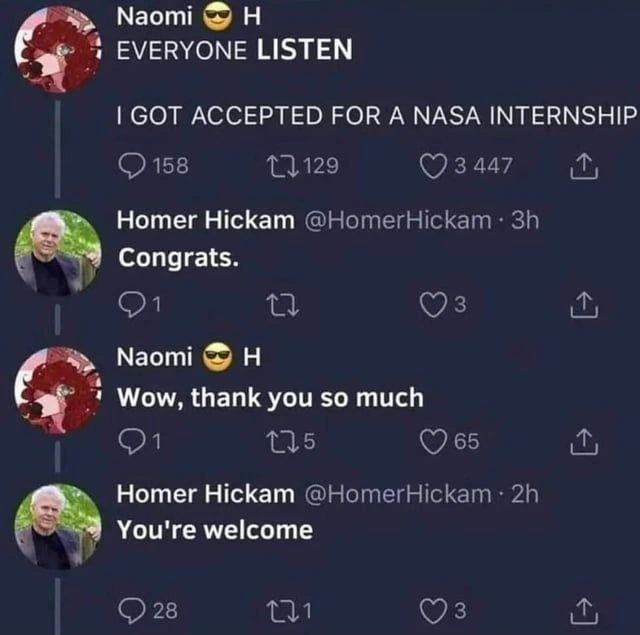
The thread unfolds like a slow-motion train wreck familiar to anyone who’s seen online enthusiasm backfire. Hickam replies with a polite one-word “Congrats.” On the surface it’s supportive, but to those in the know, that single word is loaded. It’s akin to a gentle tap on the shoulder saying “I see you (and I actually matter).” It’s not every day that a NASA legend casually drops into your reply thread. For onlookers (and presumably for Naomi 😎 H, our intern protagonist), this was the moment a little alarm bell should have gone off. But our excited intern, basking in the Twitter spotlight of thousands of likes (3,447 and climbing), doesn’t recognize the handle or the significance. She replies “Wow, thank you so much,” as innocently as if a random well-wisher had congratulated her. The meme’s screenshot shows this cordial back-and-forth, but beneath that veneer lay a ticking time bomb of Twitter etiquette failure.

Here’s where those of us with battle scars in online communities start cringing. In the real saga (which the meme alludes to), our intern’s initial tweet wasn’t just excited – it was laced with an F-bomb and a brash “EVERYONE SHUT UP” tone. Enter Homer Hickam, who reportedly replied with a polite correction: “Language.” That one-word reply was a courteous rebuke from an older professional who values decorum (especially given NASA’s reputation). The intern, not realizing she was being chided by someone with serious clout, clapped back with an even more inappropriate response – essentially telling him off in crude terms. If there was ever a humblebrag gone wrong, this was it. Within hours, the internet (read: the ever-vigilant social media horde) alerted her to the fact that the man she just told to buzz off was actually a prominent NASA veteran with influence. Oops.

The meme doesn’t show the profanity or the meltdown – it gives us a toned-down version (“Congrats” / “You’re welcome”) – but seasoned engineers immediately recall the full drama. The humor here is dark and painfully real: it’s a mix of schadenfreude and empathy. We laugh (or more accurately, wince) because many of us have learned that communication can make or break opportunities. Announce your win to the world? Sure. Do it with a dash of arrogance or without checking who might be listening? Good luck. In tech circles, it’s common for junior developers to rub digital shoulders with industry legends without realizing it. This meme satirizes the naïve confidence of a newcomer colliding head-on with the invisible hierarchy of the tech community.

Notice those little reply/retweet/like counters under each tweet in the image. They tell a story of their own:

  • The intern’s boast got 3,447 likes – it went viral, amplifying her excitement and visibility.
  • Hickam’s “Congrats” shows only 3 likes (and 1 reply). He wasn’t there for internet points; he was there as a quiet, authoritative presence.
  • After Naomi’s “thank you,” Hickam’s final “You’re welcome” reply has 28 replies but just 3 likes. On Twitter, that’s a bad sign – a ratio skewed towards replies. It means people were far more interested in responding (likely to gasp or scold) than clicking like. Those 28 replies were probably a flurry of folks saying “Uh, do you realize who that is?!” and others facepalming at the unfolding disaster. When replies massively outweigh likes, the Twitterverse is usually in uproar.

From an experienced engineer’s perspective, this scenario is a perfect storm of public folly. It highlights how a moment of unchecked exuberance on a public platform can trigger real Career fallout. It’s funny in the way a cautionary office story is funny – we chuckle because it’s true and because it could have happened to any of us in our younger days. It’s also a story of culture clash: the casual, hype-fueled style of a newcomer versus the reserved, image-conscious expectations of an established professional. The intern saw Twitter as her personal celebratory space; the NASA old-timer viewed it as an extension of the professional world where reputation matters.

For the older, battle-scarred engineers, there’s an extra layer of irony. We spend years telling juniors to network and celebrate their wins, yet here’s an example where doing exactly that (but without tact) ended in flames. It underscores a hard-earned truth – the internet is a public stage, and a poorly phrased flex can torch your opportunity before it even begins. Just like a bad code deploy can crash production at 3 AM, a bad tweet can crash your career before lift-off. The whole ordeal became legendary in dev circles, a tale passed around whenever someone new excitedly tweets “I got the job!” without a filter. It’s a modern fable of tech Twitter: part CareerHumor, part horror story, and now basically an item of DeveloperHumor lore illustrating the importance of humility and awareness in our community. The meme encapsulates that tale in one cringe-inducing screenshot, reminding everyone that in our interconnected OnlineCommunities, you never know who’s reading your celebratory tweet – it might just be the person in charge of your dream.

Description

A screenshot of a Twitter exchange that became a wholesome meme. The first tweet, from a user named Naomi H, excitedly announces in all caps, 'EVERYONE LISTEN I GOT ACCEPTED FOR A NASA INTERNSHIP'. This is followed by a simple, one-word reply from Homer Hickam (@HomerHickam), a well-known former NASA engineer, which reads, 'Congrats.'. Naomi H replies enthusiastically, 'Wow, thank you so much', to which Hickam responds, 'You're welcome'. The humor and significance of this interaction lie in the status of Homer Hickam, author of 'Rocket Boys' (the basis for the film 'October Sky'). An intern's huge career moment is acknowledged by a legendary figure in the aerospace community in a very understated and humble way, creating a heartwarming and slightly surreal moment that resonated with many in the engineering and tech fields
Comments

13
Anonymous ★ Top Pick Getting a 'Congrats' from Homer Hickam is the aerospace equivalent of your 'Hello, World!' pull request being approved by Dennis Ritchie. It's a sign you're on the right trajectory
  1. Anonymous ★ Top Pick

    Getting a 'Congrats' from Homer Hickam is the aerospace equivalent of your 'Hello, World!' pull request being approved by Dennis Ritchie. It's a sign you're on the right trajectory

  2. Anonymous

    Pro-tip: before brag-pushing to prod-Twitter, run `git blame` on your follower list - there’s always a senior architect with merge rights to your career

  3. Anonymous

    When your git commit message is 'EVERYONE LISTEN: Fixed the bug!!!' and Linus Torvalds himself shows up in the PR comments - sometimes the universe has a way of reminding you that your public enthusiasm might be reviewed by the very people who wrote the frameworks you're using

  4. Anonymous

    This is the engineering equivalent of submitting a 500-line PR that refactors the entire authentication system and getting a code review comment that just says 'LGTM.' The engagement metrics tell the real story: junior devs celebrate with exclamation points and emojis, while the senior engineer who literally wrote the book (October Sky) responds with the emotional range of a well-formatted log statement. It's the perfect encapsulation of how communication styles evolve from 'EVERYONE LISTEN' to 'Acknowledged' as you gain experience - though in this case, Homer Hickam's deadpan 'You're welcome' probably generated more watercooler discussion than the original announcement

  5. Anonymous

    Announcing “I GOT ACCEPTED FOR A NASA INTERNSHIP” on Twitter is the engineering equivalent of a Friday deploy - looks harmless until Mission Control replies and your comms policy enters incident response

  6. Anonymous

    Viewed like systems traffic, this is the human TCP handshake: SYN (EVERYONE LISTEN), SYN‑ACK (“Congrats.”), ACK (“Wow, thank you so much”) - plus a “You’re welcome” keep‑alive from a node you pray isn’t HR

  7. Anonymous

    Homer Hickam just LGTM'd Naomi's NASA career PR - ultimate code review prestige unlocked

  8. bur del lago 1y

    good ending

  9. @qwnick 1y

    can somebody explain?

    1. @kitbot256 1y

      Homer Hickam is a very well-known author and a former NASA engineer

      1. dev_meme 1y

        And probably he had accepted his interview 😕

  10. @alexeiman800 1y

    Greatest example of digital footprint

  11. @diman4ous 1y

    it was all just a dream

Use J and K for navigation