The 'JavaScript Everywhere' Philosophy
Why is this Languages meme funny?
Level 1: One Tool for Everything
Imagine you have a favorite tool or toy that you absolutely love and trust. Let’s say it’s a super cool Swiss Army knife – you know, one of those pocket tools that has a little knife, scissors, a toothpick, and so on. Now, because you love it so much, you start thinking you can fix or do anything with it. Need to cut your sandwich? Use the pocket knife! Need to tighten a screw on your bike? Try to use the knife blade as a screwdriver! Have to brush your hair? Well… maybe the toothpick could work as a comb? 🤔
Of course, in real life, some jobs need a special tool – you’d normally use a screwdriver for screws or a comb for your hair. If a friend saw you trying to use your one beloved tool for everything, they might giggle and say, “Hey, you can’t use that pocket knife for every task!” But if you’re really determined (and maybe being a little silly), you might put on a big confident grin and respond, “That’s where you’re wrong, kiddo – watch me!” Then you’d proceed to try anyway, just to prove your point. It’s funny because you’re being a bit over-confident and playful, insisting your one tool is all you’ll ever need.
In this meme, JavaScript is like that favorite tool. JavaScript is a programming language, and the developer loves it so much they want to use it for absolutely everything, even for tasks where people usually pick other languages or tools. When someone tells them “You can’t just use JavaScript for everything,” the developer does the finger-gun pose (like a playful “aha!” gesture) and basically says, “Oh yes I can!” It’s a joke showing a mix of determination and silliness – the developer is so in love with their one tool (JavaScript) that they act as if it’s the magic answer to every problem. Even if it’s a bit exaggerated, it makes us laugh because we all know someone who thinks their favorite thing can do it all. It’s like a kid insisting their one crayon is enough to draw the whole rainbow; it’s cute, a little absurd, but also kind of endearing.
Level 2: JavaScript All the Things
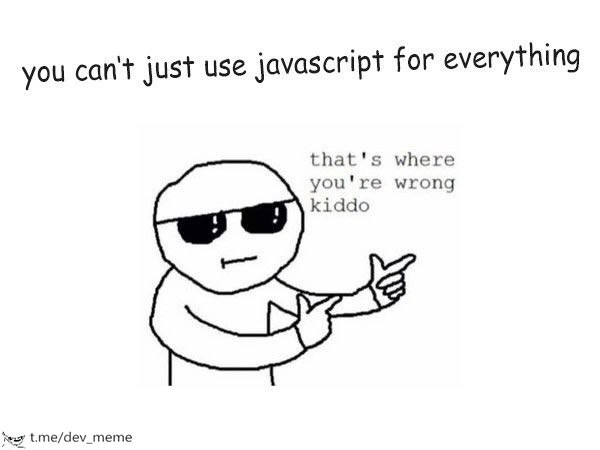
At first glance, this meme shows a simple comic-like figure and some text, but it’s loaded with developer humor. The top text reads:
Skeptic: "you can't just use javascript for everything."
JavaScript Dev: "that's where you're wrong kiddo."
In plainer terms, someone is telling a JavaScript fan, “Hey, JavaScript isn’t the right tool for every task.” And the JavaScript-loving developer (the stick figure in sunglasses doing finger-guns) basically replies, “Ha! Watch me prove you wrong.” The phrase “that’s where you’re wrong, kiddo” is a popular meme comeback, used here to show the dev’s cheeky confidence. Now, why is this funny to programmers? Let’s break it down without too much jargon.
JavaScript is a programming language that originally was used just to make web pages interactive (things like buttons reacting when you click them, or forms checking input). For a long time, JavaScript ran only in web browsers. But in the last 10-15 years, there’s been a huge movement to use JavaScript in every area of software development. This movement is sometimes jokingly called "JavaScript All the Things," meaning people try to apply JavaScript to any and all programming problems. The meme is poking fun at that mentality.
Here are some key terms and concepts to know from the meme and its tags:
JavaScript Everywhere: This reflects the idea that JavaScript can run in many places beyond the browser. Thanks to new tools, you can use JS on servers, desktops, and more. There’s even a saying in the community, “JavaScript is everywhere.”
Node.js: Node.js is a technology (a runtime environment) that lets you run JavaScript code outside of a browser, most commonly on a server. Before Node, if you wanted to write server-side code (like the backend of a website, handling databases or files), you’d typically use languages like PHP, Python, Java, or C#. But Node changed the game around 2009 by allowing web developers to use the same language (JavaScript) on the server as on the client. This helped kick off the full-stack JavaScript trend – meaning a developer could write both the front-end and back-end of a web application in JavaScript.
Full-stack JavaScript: This means using JavaScript for everything in a web application, from the user interface in the browser (front-end) to the server logic and database calls (back-end). Frameworks like Express (for Node.js) made it easy to create web servers in JS, while libraries like React, Angular, or Vue power the web front-end. Suddenly, one person with JavaScript knowledge could build an entire app top to bottom. This was very exciting for a lot of developers and companies – it meant faster development and using one common language.
Language Evangelism: In tech, an “evangelist” is someone who is extremely enthusiastic about a technology or language and promotes it everywhere. Language evangelism refers to developers who so strongly prefer one language that they advocate using it for almost any task (often downplaying its drawbacks). In this meme, the JavaScript developer is portrayed as a language evangelist for JavaScript — they’re basically saying “Why would I use anything else? JavaScript is the best for everything!” The tags like
language_evangelist_memeand LanguageWars hint at friendly battles between fans of different programming languages. Each group has its hardcore fans: for example, some people swear by Python for all tasks, others love C++ for its performance, and here we have a JavaScript fan insisting JS is the answer to all questions.JavaScript Ecosystem: This phrase denotes all the tools, libraries, and frameworks available for JavaScript. JavaScript’s ecosystem is huge. For almost any problem, there’s likely an NPM package (Node’s package manager is called npm, which hosts hundreds of thousands of free libraries). Need to send emails? There’s a JavaScript library for that. Want to do machine learning? There’s TensorFlow.js for running neural networks in JS. Building a mobile app? You can use React Native or Ionic to write mobile apps in JS. Making a desktop application? Use Electron to build cross-platform desktop apps with JavaScript (fun fact: apps like Skype, Slack, and Visual Studio Code use this). There’s even ways to control hardware and IoT devices using JS – for example, using Node on a Raspberry Pi, or libraries like Johnny-Five to control Arduino robots with JavaScript. This enormous ecosystem is why some developers feel JavaScript has a solution for everything.
Now, the meme is funny because it exaggerates this mindset. In reality, while JavaScript can be used in many places, it’s not always the optimal choice. For instance, if you’re writing an operating system kernel or a device driver (very low-level software), you’d typically use C or Rust for direct hardware control and performance – JavaScript wouldn’t be practical there (it runs on engines that abstract away direct memory access). If you’re doing heavy scientific computing with lots of matrix math, Python with optimized C libraries (or languages like Julia) might be easier or faster. So when someone says, “you can’t just use JavaScript for everything,” they mean some tasks are better suited to other languages.
However, the developer in the meme cheekily refuses to accept that. There’s a joke among developers that if all you know is JavaScript, you tend to try to solve every problem with JavaScript – sometimes even shoehorning it where it doesn’t quite fit. It’s like the saying, “if all you have is a hammer, everything looks like a nail.” Here, JavaScript is the hammer. The tags JavaScriptEverywhere and js_all_the_things reflect this idea of using JS in all scenarios.
To a junior developer or someone new to the industry, this highlights a couple of things. First, JavaScript’s popularity and versatility are real – knowing JS means you actually can build a lot of different kinds of applications. You could be a web developer and then, using that same skill set, code part of a server or script some automated task on your machine. That’s pretty empowering! It’s why people get so excited about JavaScript; it opens many doors with one language. Second, it’s a gentle warning: be aware of hype. Just because a language is popular doesn’t mean it’s the best tool in every situation. The meme uses humor to make that point – the developer in it is portrayed as a bit comically overconfident. We laugh because many of us have met someone like that (or been that person as a newbie) who says “Why learn or use anything else? JavaScript can do it all!”
So, in summary, the meme leverages a familiar internet image (the “that’s where you’re wrong, kiddo” stick figure) to poke fun at JavaScript hype. It highlights the trend of using one language for every task (which is very much a JavaScript thing in recent years) and the sometimes fanatical enthusiasm behind it. Even if you’re relatively new to coding, you might have already seen how JavaScript shows up in many places. This meme is basically a community in-joke: we love how far JavaScript has come… but we also find it funny when someone pretends other languages don’t exist. After all, even if JavaScript can run everywhere, it doesn’t mean it’s always the easiest or most efficient choice – but don’t tell that to the guy in the sunglasses, he’s on a mission to write everything in JS! 😎🤘
Level 3: One Language to Rule All
In this meme, a confident developer embodies the "JavaScript Everywhere" mantra, playfully rejecting the idea that any task is off-limits for their favorite language. Seasoned engineers recognize this as a commentary on language evangelism – the almost zealous belief that one programming language (here, JavaScript) can and should be used for every problem. The humor cuts close to reality: over the past decade, JavaScript’s reach has exploded. Originally a humble browser scripting tool, it evolved into a full-stack powerhouse. With the rise of Node.js (running JavaScript on the server) and frameworks like Node-RED for IoT or Electron for desktop apps, developers really have started using JavaScript for everything. Need to build a web server? Spin it up in Node. Writing a desktop app? Wrap your code in Electron, shipping a whole Chromium browser just to run your JS (we’ve all joked about Slack or VS Code being essentially Chrome-in-disguise). Want to script network hardware or a drone? Libraries like Johnny-Five let you write robot logic in JavaScript. The meme exaggerates this trend to comic effect, but any veteran dev knows it’s only slightly an exaggeration.
From a senior perspective, the IndustryTrends_Hype being poked at is the “JavaScriptAllTheThings” movement. We’ve seen waves of this before – one technology becomes so hyped that devotees try to apply it everywhere. Here, the stick-figure in sunglasses represents the full-stack JavaScript developer swagger. They’ve got Node.js on the backend, React or Angular on the frontend, maybe even React Native for mobile, and they’re unafraid to use JavaScript in places it traditionally doesn’t belong. The phrase “that’s where you’re wrong, kiddo” perfectly captures a veteran finger-guns moment: it’s the dev saying, “Think I can’t do X in JS? Challenge accepted!” It satirizes a real mindset in tech where a team might, for instance, write their build scripts, server code, and client-side logic all in one language – sometimes out of convenience, sometimes out of sheer enthusiasm. Experienced devs chuckle because they’ve witnessed how language wars and enthusiasm can lead to incredible hacks: like running a Python scientific computation library by wrapping it in a Node module, or using WebAssembly to bring C++ code into the JavaScript world. If there’s a will, there’s a way (and probably an NPM package) to do it in JS.
Yet under the humor lies a gentle reminder: just because you can use JavaScript for everything doesn’t always mean you should. Senior engineers have been around long enough to know the pitfalls. They recall when JavaScript was slow and clunky for heavy tasks, and even now they know a C++ module or a Go service might better handle certain performance-critical jobs. The meme gets a knowing nod because it highlights that familiar scenario: a JavaScript evangelist refuses to concede any weakness of their beloved language. It’s funny in part because it’s relatable – we’ve all met that dev (or been that dev) who has a one-size-fits-all solution in their toolkit. The sunglasses-wearing stick figure exudes the kind of overconfidence that makes senior devs smirk: “Heh, I remember my first framework love affair. Good luck using Node to write a device driver or solve real-time embedded constraints!” But who knows – with projects like Espruino (a JavaScript interpreter for microcontrollers) or even NodeOS (an operating system written in Node.js), the community keeps pushing the boundaries of where JS can go. The result is a tech culture joke: JavaScript, the paragon of flexibility, is both amazing and a bit ridiculous when taken to extremes.
Ultimately, this meme resonates on multiple levels. It mocks the unabashed confidence of a developer who’s “drank the JavaScript Kool-Aid,” while winking at the real-world trend of JavaScript becoming the default choice for many. The LanguageWars angle is clear: someone off-frame insists JavaScript isn’t the answer to every problem (perhaps a back-end engineer scoffing “Use the right tool for the job!”), and our JS champion responds with a meme-famous retort, finger-guns blazing. The senior dev laughter comes from recognition – we’ve all witnessed technology hype cycles where an enthusiastic crowd believes one language to rule them all is nigh. JavaScript’s rise from a simple scripting language to a ubiquitous runtime for just about anything is a defining tale of the 2010s. This meme playfully encapsulates that tale in one image, with a stick figure essentially saying: “Browser, server, desktop, toaster – watch me use JavaScript in all of them.” It’s absurd, it’s bold, and it’s exactly the kind of inside joke that makes developers smirk and say, “classic JavaScript evangelist.”
Description
A minimalist, black-and-white line drawing meme on a plain white background, featuring the 'that's where you're wrong, kiddo' meme format. A simple cartoon character wearing sunglasses points with both index fingers. Above the character, text reads, 'you can't just use javascript for everything'. A speech bubble originating from the character retorts, 'that's where you're wrong kiddo'. In the bottom-left corner, a small watermark for 't.me/dev_meme' is visible. This meme humorously captures the persistent 'JavaScript everywhere' trend in the software industry. With the advent of Node.js for servers, Electron for desktop apps, and React Native for mobile, JavaScript has expanded far beyond its browser origins. The meme reflects the confident, often zealous, attitude of its proponents, while also serving as a commentary on the ongoing debate about whether a single language is truly suitable for every task, a conversation very familiar to experienced engineers who have seen technologies come and go
Comments
7Comment deleted
Some say you can't use JavaScript for everything. But after writing a backend in Node, a frontend in React, a mobile app in React Native, and a desktop app in Electron, my therapist says I can be anything I want to be, as long as it transpiles to JavaScript
“You can’t use JavaScript for everything?” Hold my bundler - our last sprint delivered a Kubernetes CRD, the finance team’s Excel macros, and the office coffee-machine firmware in TypeScript. Next up: converting incident post-mortems into React components so they’ll finally get read
Twenty years ago we mocked Java for "write once, run anywhere." Now we're shipping 80MB Electron apps that are just Chrome wearing a trench coat, and somehow JavaScript won
The JavaScript ecosystem has truly achieved what no other language could: convincing developers that the same language responsible for `'1' + 1 === '11'` and `typeof null === 'object'` should absolutely power their IoT toaster, desktop IDE, mobile app, backend API, machine learning pipeline, and probably their car's firmware. At this point, we're one npm package away from JavaScript running the Mars rover - though it would probably need 47 polyfills and a 500MB node_modules folder just to calculate trajectory
ADR-0001: "Use the best tool for the job." Annex: a 300‑line package.json proving the best tool is JavaScript in five runtimes and one Electron memory leak
“JS everywhere” was supposed to reduce complexity; now we have one language, seven runtimes, twelve bundlers, infra in CDK - and node_modules bigger than prod. We didn’t simplify, we just migrated the chaos to package.json
JS everywhere shines until your 'unified stack' polyglot regret hits during that Rust microservice handoff