Skip to content
DevMeme
3281 of 7435
Unraveling the Alien Origins of Perl's Cryptic Syntax
Languages Post #3605, on Aug 28, 2021 in TG

Unraveling the Alien Origins of Perl's Cryptic Syntax

Why is this Languages meme funny?

Level 1: Alien Code

Imagine you wrote a quick message or instruction using every shortcut and symbol you could think of – no real words, just a jumble of signs and emojis – and at first you felt super proud of how clever it was. But when you show it to your friends (or even look at it yourself later), it just looks like alien language. Nobody can tell what it means, and it almost doesn’t even look like writing anymore! That’s what happened here, but with computer code. The person tried to do something fancy in one line of Perl (a programming language) and ended up with something that looks totally bizarre, like a secret code or ancient writing. It’s funny because the person in the picture is super excited, waving his hands as if he’s discovered something amazing, but all we see is a bunch of gibberish characters. It’s as if he’s proudly saying, “Look at my masterpiece!” while everyone else sees only nonsense. In simple terms, the joke is: the code has become so overly complicated and cryptic that it might as well have been written by aliens. It makes us laugh because we all understand the feeling of something getting too complicated, to the point where even the creator goes, “Huh? What did I do there?”

Level 2: Shell Spell Gone Wrong

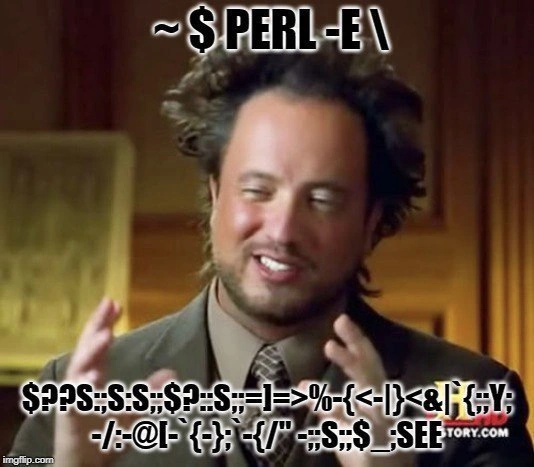
Let’s break down what’s happening in this meme. The top line ~ $ perl -E \ looks like something you’d see in a terminal (command prompt). The ~ is a common shorthand for the home directory in a Unix shell, and $ is the shell prompt symbol for a regular user. So ~ $ just means “at the command line, in your home folder.” Next, perl -E is how you tell the computer to run a quick Perl script provided right in the command. Perl has a command-line option -e (and the similar -E) that lets you execute code in quotes without needing a separate file. It’s often used for what we call a Perl one-liner – a short script written and run as a single line. Think of it as a speedy way to tell Perl “Hey, do this one small thing for me real quick.” For example, you might write:

$ perl -E 'say "Hello, world!"'

This would immediately print “Hello, world!” to your terminal. The -E flag specifically enables some extra modern features (like the say function) while running your one-liner.

Now, in the meme, instead of a friendly "Hello, world!", the one-liner is a chaotic jumble of symbols:

$??S;;S;$?::S;;=|=>%{<-I}<&[;Y; -/-:@I-{ }; </"::S;;$_.SEE

This isn’t meant to be actual useful code – it’s exaggerated ASCII chaos to illustrate how Perl one-liners feel when they get out of hand. Perl’s syntax is very rich with punctuation. For instance, in Perl:

  • $ denotes a scalar variable (like a single value).
  • @ denotes an array.
  • % denotes a hash (key-value pairs).
  • $_ is a default variable that holds the current input or string if you don’t specify another variable.
  • Many special read-only variables use punctuation, like $? which holds the exit status of the last command, or $$ which is the current process ID.

Because of these sigils (the term for these funny prefix symbols) and special variables, a real Perl one-liner can look bewildering to the uninitiated. For example:

# Some real Perl special variables for illustration:
$?;   # returns the status code of the last executed external command
$_;   # default variable for the current topic in loops or regex matches
$.;   # current line number of the last filehandle read
$@;   # error message from the last eval (exception handling)
$$;   # process ID of the running Perl script

In a simple, well-formatted Perl script, you might hardly notice these. But in a one-liner, people often lean on them to keep the code short. They’ll omit needless syntax and let Perl’s defaults do the work, which saves typing at the cost of clarity. Overuse of this feature can make the code look like line noise. This is why Perl has a tongue-in-cheek reputation as a “write-only language” – meaning you can write it easily, but reading it later is so hard that it’s almost like the code was never meant to be read by humans (only written and executed). It’s a joking way to warn about CodeReadability problems.

So, the meme humorously shows a scenario: “When your Perl one-liner turns into hieroglyphics at the command line.” You started with good intentions to write a quick, handy command in Perl. But as you kept adding to it – maybe a regex here, an if-condition there, a fancy $_. default variable usage – it snowballed into a monstrosity of symbols. Now the one-liner on your screen looks more like an encrypted password or an ancient script than code. The phrase "hieroglyphics" is used because hieroglyphs are ancient Egyptian symbols that are hard to decipher without a key; similarly, this Perl code is hard to decipher without expert knowledge.

The image of the curly-haired guy gesturing wildly is a famous meme format known as the “Ancient Aliens” meme. It comes from a TV show where this host often credits aliens for inexplicable ancient phenomena. Meme culture adopted his dramatic pose and expression to humorously explain anything baffling or absurd (”I’m not saying it’s aliens... but it’s aliens”). In our context, the baffling thing is that Perl command. The meme implies: “I’m not saying this code was written by aliens... but look at it!” It’s a playful jab at how foreign PerlScripting can appear, even to other programmers.

For a junior developer or someone not familiar with Perl, seeing $??S;;S;$?::S;;... on a terminal must be truly bewildering. Let’s clarify: normally, code is written to be understandable to others – that’s part of good CodeQuality. But one-liners are often written for convenience, maybe executed ad-hoc in a CommandLineInterface to process some data quickly. They might not be saved in a file or shown to others, so the author isn’t thinking about readability or maintainability. They just want a quick result. Over time, though, a one-liner might get copied into a script or a cron job, or shared in a team chat, and suddenly other people have to figure it out. That’s when the trouble (and the humor) starts.

This meme resonates with programmers because it exaggerates a real feeling: “Oh no, what have I created? Can even I read this now?” It highlights the importance of balancing clever shortcuts with clarity. Yes, Perl can do amazing text-processing in one line, using defaults and terse syntax. But if you overdo it, you get CodeObfuscation – code that’s effectively obfuscated (like those puzzles where code is intentionally made hard to read). There’s even a tradition of obfuscated code contests where people show off creatively unreadable programs. Perl’s flexibility made it a popular choice for such challenges, since you can often achieve the same result in a dozen different, quirky ways. However, outside of a friendly contest or a personal script, obfuscation is usually not a good practice! This meme playfully reminds us of that by showing a scenario where a Perl user accidentally wrote something that looks like gibberish.

In simpler terms: the top text is the command being run, the bottom text is the “output” or the content of that command – which in this case is just nonsense symbols, for comedic effect. The curly-haired man image communicates the emotion: he’s excited and gesticulating as if explaining a brilliant idea, yet what we see is essentially indecipherable. This contrast is the core of the joke. It’s a mix of SyntaxHumor (making fun of Perl’s complex syntax) and situational humor (a developer’s proud moment turning into confusion).

So, if you’re a newer developer: don’t worry if that Perl code on the meme looks totally alien – that’s the whole point! Even experienced devs sometimes create things that look absurd later on. The meme is a lighthearted caution: be mindful of CodeReadability. It’s okay to use powerful language features, but remember that code is read more often than it’s written. If your one-liner starts to look like line-noise or secret code, maybe it’s time to refactor it into a neat, multi-line script with comments. Otherwise, you’ll have your coworkers (or future yourself) acting like archaeologists, trying to interpret your code as if it were an ancient riddle. And as this meme illustrates, that scenario, while funny in a picture, can be pretty painful in real life!

Level 3: Archaeology of Code

In the depths of the command line, a Perl one-liner can feel like an archaeological artifact. Seasoned developers have unearthed scripts so cryptic that deciphering them is akin to decoding ancient hieroglyphics. Perl, created by Larry Wall in 1987, earned the nickname "the Swiss Army chainsaw" of scripting languages – powerful and a bit dangerous. Its philosophy “There's more than one way to do it” (TMTOWTDI) encouraged creative, compact solutions. Over time this led to a culture of code golf and CodeObfuscation where wizards of Perl compete to do the most in the fewest characters. The result? One-liners that look like punctuation soup, loaded with Perl’s notorious sigils ($ @ %) and magical default variables.

In this meme, the top banner ~ $ perl -E \ indicates a shell prompt kicking off a Perl one-liner. The bottom text is a deliberately inscrutable maze of symbols: $??S;;S;$?::S;;=|=>%{<-I}<&[;Y; -/-:@I-{ }; </\"::S;;$_.SEE. It’s a tongue-in-cheek exaggeration of what happens when a “quick” Perl one-liner spirals into an indecipherable mess. This is CodingHumor at its finest, poking fun at Perl’s reputation as a “write-only” language – one where you can write code fast, but reading it later (even by the author) is a nightmare. Seasoned devs chuckle (or shudder) because many have been there: a one-liner that started simple, then grew into a monster as you tacked on feature after feature with line-noise syntax. It’s all fun and games until someone has to debug it in production at 3 AM.

Why is this so hilarious (and traumatic) to experienced programmers? Because it satirizes a real trade-off in programming: CodeQuality vs. clever conciseness. Perl gives you tremendous power in a single line – reading from files, regex matches, implicit loop variables like $_ – but that power can be abused. The meme captures the moment when even the author stares at their terminal, squinting at a jumble of $ and @ signs, and wonders, “What on earth did I create?” It’s a shared industry joke that Perl’s expressive syntax can quickly turn into an alien language if you’re not careful. In terms of code archaeology, stumbling on such a script is like discovering an ancient scroll written in code glyphs: you might need a Rosetta Stone (or the original author’s comments) to decipher it.

Note the image choice: the ecstatic curly-haired man gesturing wildly is Giorgio A. Tsoukalos from the History Channel’s Ancient Aliens – a meme figure famed for suggesting “I’m not saying it was aliens... but it was aliens!”. Pairing him with an obfuscated Perl command is perfect irony. He looks passionately convinced of an explanation no one else understands, just as a Perl guru might insist their one-liner is brilliance while colleagues see gibberish. The visual humor is that he could just as well be claiming "It was Perl!" to explain a phenomenon. This nod to the ancient_aliens_meme_format reinforces the idea that the code is as cryptic as extraterrestrial hieroglyphs. It’s a clever multi-layer joke: one layer about Perl’s SyntaxHumor, another about the absurd confidence of someone defending indecipherable work.

Historically, Perl one-liners were a staple of sysadmin life – doing in one line what might take dozens in other languages. That prowess came with the price of CodeReadability. There’s an old joke: “Perl is the only language that looks the same before and after RSA encryption.” 😏 Indeed, as Perl scripts accumulate special variables like $? (last exit status) or $$ (current process ID), they start to resemble line noise. Veteran devs recall maintaining legacy Perl CGI scripts or cron jobs, feeling like code-breakers trying to understand ancient code incantations. The humor has a tinge of PTSD: we’ve seen things, horrifying beautiful things, in one-liners that cannot be unseen. The meme perfectly encapsulates this shared memory.

Underneath the laughter is a gentle lesson about CodeQuality: just because you can compress something into a single liner with arcane syntax doesn’t mean you should. readability suffers. Modern best practices urge clarity over cleverness. But the temptation of a one-liner is strong – it’s a quick high, a brief moment of feeling like a command-line sorcerer. As Larry Wall wrote, one of the virtues of a programmer is laziness (getting things done with minimal effort) and another is hubris (the pride that makes you write code others will admire). This one-liner embodies both: laziness by cramming it all into one invocation, and hubris in thinking “I’ll totally remember how this works.” The day after, that hubris melts into “What have I done?” when the code on the screen looks stranger than Egyptian text.

In summary, the meme strikes a chord with experienced developers by humorously illustrating a well-known pitfall: PerlScripting power used to the point of CodeObfuscation. It’s the Ancient Aliens of programming jokes – a wild explanation for unreadable code. Anyone who’s ever tried to debug a gnarly Perl regex or a dense one-liner will laugh (or groan) in recognition. This is a celebration and a caution wrapped in one: Perl can do magic on the CommandLineInterface, but sometimes that “magic” reads like an inscrutable spell book.

Description

This meme uses the well-known 'Ancient Aliens' format, featuring a picture of Giorgio A. Tsoukalos, the show's main proponent, with his characteristic wild hair and gesturing hands. The text overlay is structured like a shell command. The top line reads '~ $ PERL -E \', initiating a Perl one-liner command. The bottom line is a long, almost unintelligible string of symbols and punctuation: '$?PS:;S:S;;$?:S;;=>%-(<-|}<&|{;Y;-/:-@|-{-};-`{-/''-;;S;;$_SEE'. The humor stems from using the 'Ancient Aliens' guy to propose an outlandish theory for a real-world phenomenon. In this case, the phenomenon is the notoriously dense and cryptic syntax of the Perl programming language, often referred to as 'line noise.' For experienced programmers, especially those with a history in systems administration or web development from the late 90s/early 2000s, Perl's 'write-only' nature is a legendary source of jokes. The meme hilariously suggests that the only logical explanation for such an unreadable syntax is that it wasn't created by humans, but by aliens
Comments

19
Anonymous ★ Top Pick I had a problem, so I decided to solve it with a Perl one-liner. Now I have two problems and an open ticket with the SETI program
  1. Anonymous ★ Top Pick

    I had a problem, so I decided to solve it with a Perl one-liner. Now I have two problems and an open ticket with the SETI program

  2. Anonymous

    Inheriting a mission-critical cron that’s a 200-char Perl -e feels less like maintenance and more like carbon-dating the CTO’s grad-school phase

  3. Anonymous

    The only regex more cryptic than this Perl one-liner is the one you wrote six months ago that's now in production and nobody, including you, remembers what it actually does

  4. Anonymous

    Perl: the only language where '$??$:.$.,$?P' is valid syntax and 'aliens did it' is actually a more plausible explanation than the actual documentation. Senior engineers who've maintained legacy Perl codebases know that deciphering these regex incantations requires either a PhD in cryptography or a direct line to Larry Wall himself - and even then, you're just guessing what Past You was thinking at 3 AM when they committed this masterpiece of write-only code

  5. Anonymous

    Perl one‑liners are the only code where the AST is indistinguishable from line noise - and ownership transfers to whoever can explain a single sigil in the postmortem

  6. Anonymous

    Every mature org eventually discovers its core service is a Perl -e one‑liner in cron - 99.99% uptime, 0% comprehension, infinite blast radius

  7. Anonymous

    Perl one-liners: solving problems in 47 chars while dooming the next dev to a lifetime of 'what sorcery is this?'

  8. @qtsmolcat 4y

    I call forkbomb

    1. @kitbot256 4y

      As if. It is "rm -rf /"

  9. @insan3d 4y

    Perl is soooo obscure. Just use shell for common tasks. For example, :(){ :|:& };:

  10. @insan3d 4y

    anyway, stop using root and you'll be safe from barmin patch

    1. @TERASKULL 4y

      mind your own damn business, root is life

    2. @kitbot256 4y

      Even without root access you will lose at least your home directory.

      1. @insan3d 4y

        Well, then you deserve it

  11. @lexore 4y

    In post-docker era you can do whatever you want inside container. Boring life, no challenges.

    1. @Agent1378 4y

      I run everything on bare metal, that way I feel alive!

  12. Deleted Account 4y

    NO. That fork bomb is NOT POSIX compliant. _(){ _&_; };_

  13. @callofvoid0 4y

    what the heck is this? I prefer RegEx than these brainfucking perl code

    1. @p4vook 4y

      I prefer proper parser combinators than those unreadable regexes

Use J and K for navigation