The Ultimate Downgrade: M1 MacBook Air's Secret Anti-Theft Device
Why is this Hardware meme funny?
Level 1: Boring Outside, Cool Inside
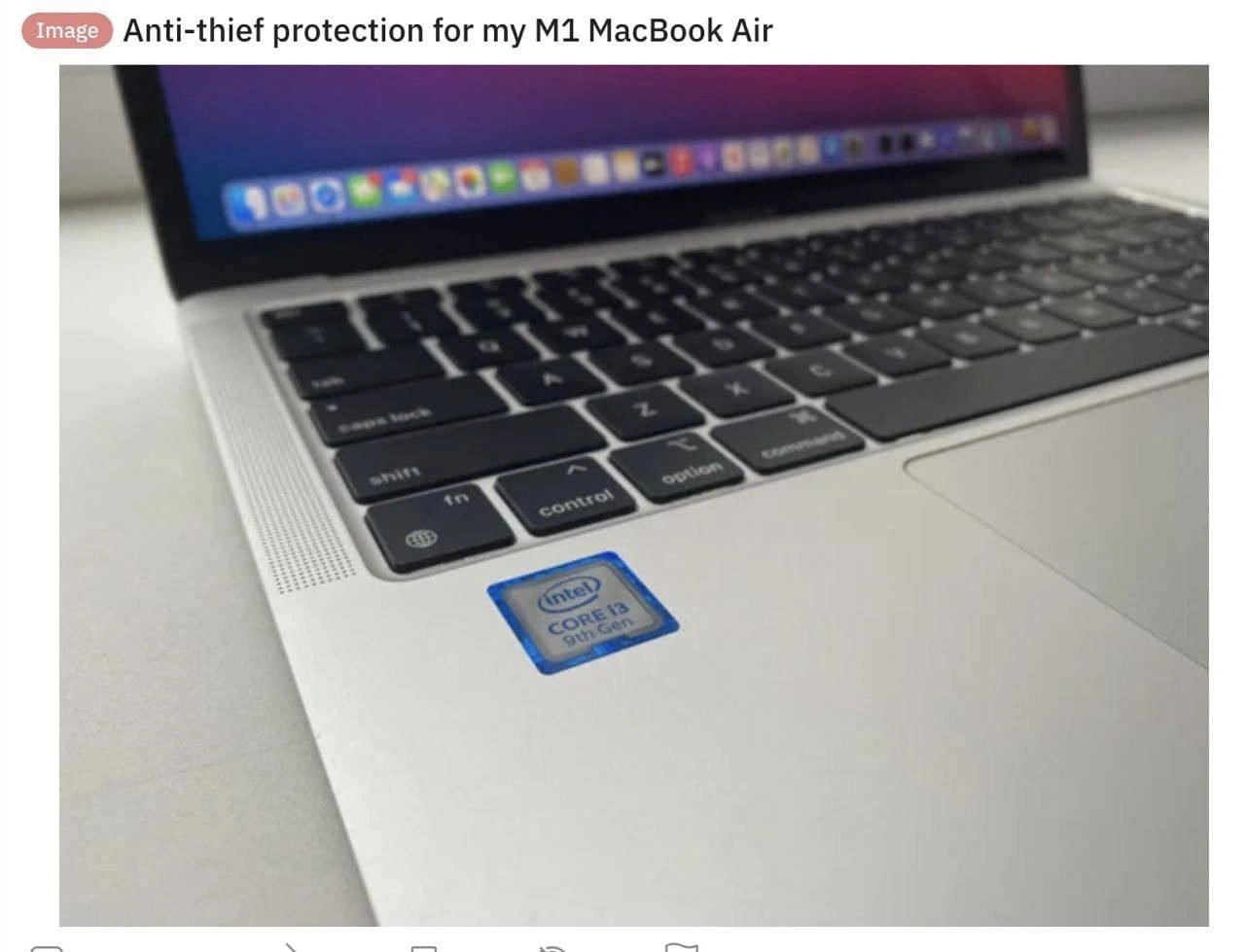
Imagine you have a really awesome new toy, but you don’t want anyone to steal it. What do you do? You make it look like an old boring toy so that nobody else gets jealous or interested. That’s exactly what’s happening here with the laptop! The owner has a super cool Apple MacBook with a super-fast brain (the M1 chip), but they put a sticker on it that basically says “hey, this is just a plain old computer.” It’s like putting a broccoli label on a box of candy – a trick to keep others from wanting it. The funny part is seeing something so fancy dressed up in a “cheap” costume. It makes us laugh because we know the laptop is secretly amazing on the inside, even though the outside sticker says “nothing special here.” It’s a silly hide-and-seek kind of protection: hide the treasure by making it look ordinary, so hopefully no one will seek to take it.
Level 2: Apple Silicon vs Intel Inside
Let’s break down the basics of why this is funny. Apple’s M1 MacBook Air is a laptop that uses Apple’s own M1 chip – part of what Apple calls Apple Silicon. This chip is very powerful and efficient, essentially the same kind of chip architecture (ARM-based) that iPhones and iPads use, but supercharged for laptops. In late 2020, when the M1 MacBook Air came out, it wowed everyone: it could run apps really fast, stay cool (no loud fan sound, because there’s actually no fan at all), and its battery lasts a long time. In short, it’s a premium, high-performance machine in the Mac world.
Now, the sticker in the photo – the blue label that says Intel CORE i3 9th Gen – is something you’d normally find on a Windows PC laptop from a few years ago. Intel’s “Core i3” is an entry-level processor from their Core series (which ranges from i3 at the low end, to i5 mid-range, i7 high-end, and i9 extreme). A 9th Gen Core i3 is an older model (Intel has newer generations now), and it’s generally not very powerful. It usually has fewer cores (the “brains” that do the computing) and is found in cheaper or basic laptops meant for simple tasks (web browsing, office work). By comparison, the Apple M1 chip in that MacBook Air is more like an Intel Core i7 or better in terms of performance – it’s far above a humble i3. So the sticker is misleading on purpose.
Think of it this way: the owner has a top-of-the-line MacBook that would normally attract a lot of attention (Apple products are expensive, and the M1 MacBook Air was a hot item). But by putting an Intel i3 sticker on it, they are basically labeling this shiny new laptop as if it were a run-of-the-mill older laptop. It’s like if you took a brand new PlayStation 5 and stuck a “PlayStation 2” logo on it – trying to make it look older and less valuable than it really is. The meme caption jokes that this is “Anti-thief protection.” The idea is that a thief or someone up to no good might see that sticker and assume, “Oh, this is just a cheap old laptop, not worth stealing,” and then move on. It’s a form of decoy or disguise.
Some context: Apple used Intel’s processors in MacBooks for about 15 years (2006 through 2020), but Apple never put those Intel Inside stickers on their MacBook cases. Those stickers are mostly a PC thing, used as a marketing badge. Apple always kept their laptops clean and sleek-looking. So seeing an Intel sticker on a MacBook is unusual – that’s a big part of why it’s instantly chuckle-worthy for techies. It’s an obvious fake, but that’s the joke. The owner is deliberately violating Apple’s pristine aesthetic for the sake of this sneaky trick. In everyday terms, Apple’s new M1 chip is like a revolutionary engine under the hood of this laptop, whereas an Intel Core i3 is more like an older, low-horsepower engine. By mislabeling the MacBook Air with the Intel i3 badge, the owner humorously suggests the laptop has “inferior hardware” – when in reality it’s a beast.
To summarize the key points in simple terms:
- Apple M1 MacBook Air – A fast, modern Mac laptop with Apple’s own M1 processor (very high performance, long battery life, no fan noise). A really nice computer.
- Intel Core i3 (9th Gen) – A label from an older, budget-friendly PC processor. Decent for basic tasks but considered low-end by today’s standards. Often found on inexpensive Windows laptops.
- The Sticker Trick – The owner put the Intel i3 sticker on the MacBook as a form of disguise. It’s like putting a “nothing to see here” sign on something valuable. They’re joking that this is their clever anti-theft measure – make the Mac look less desirable so maybe thieves ignore it.
It’s a playful idea. Of course, it’s not a serious security solution (any savvy thief might recognize the MacBook’s distinctive design or Apple logo anyway), but it’s a funny techie way to express how proud the owner is of the M1 MacBook’s superiority. In a way, it’s also poking fun at Intel: saying that an “Intel inside” sticker actually devalues the laptop in the eyes of crooks. Among tech folks, that’s a cheeky wink at how much better Apple’s M1 has proven to be.
Level 3: Security by Sticker
For the seasoned developer or hardware aficionado, this image hits on multiple levels of tech humor. First, it’s poking fun at the Apple vs. Intel saga. In 2020, Apple’s M1 chip stunned the computing world, making Intel’s processors (even some Core i7s and i9s) look power-hungry and sluggish in comparison. The MacBook Air with M1 had no fan, insane battery life, and performance rivaling much beefier Intel-based laptops. It quickly became a prized tool for developers – you could compile code, run Docker containers (eventually), and juggle Chrome tabs without the machine breaking a sweat. Meanwhile, an Intel Core i3 – especially a 9th Gen model – is synonymous with bare minimum performance. We’re talking about a chip often found in bargain PCs or the lowest-end configs. So the meme’s author is tongue-in-cheek “downplaying” their very shiny, actually quite expensive MacBook Air by tagging it with a badge of mediocrity. It’s as if a supercar owner stuck a “1.3L Base Model” emblem on the back of their Ferrari to deter car thieves.
This is a classic developer humor trope: using technical knowledge in an absurd way. Here, the owner assumes a thief has just enough tech savvy to recognize an Intel sticker but not enough to know the twist – that an M1 MacBook would never actually contain a 9th-gen i3. If someone truly knows laptops, the ruse is obvious (Apple never put 9th-gen i3 chips in MacBook Airs – their last Intel Air used a 10th-gen chip, and Apple never sullied their cases with Intel stickers!). But the joke leans on the idea of an “average thief persona”: someone who might glance at that blue Core i3 logo and think, “meh, just an old budget laptop.” After all, petty thieves target value. And in tech, branding and specs are proxies for value. An Apple logo screams “$$$”, but tack on a lame spec sticker and suddenly the narrative is “Grandma’s entry-level office laptop, not worth it.” It’s the same psychology as disguising your new phone with a cracked case to avoid attracting attention.
There’s also an inside joke about stickers on laptops. Many developers love decking out their machines with stickers (framework logos, conference swag, memes). But Apple’s aesthetic was always sticker-free elegance. Seeing a cheesy Intel Inside sticker on a MacBook is hilariously sacrilegious to an Apple purist. It’s like seeing a luxury car with a bumper sticker that says “I heart my minivan.” For veteran tech folks, there’s historic irony: back in the mid-2000s, Apple ran ads mocking Intel-based PCs (the old “I’m a Mac, I’m a PC” commercials) even while they themselves used Intel chips under the hood. Now after Apple’s divorce from Intel, the pendulum swung so much that an Intel sticker has become a mark of inferiority – a deterrent rather than a selling point. Ouch. Intel’s marketing department probably never imagined their precious sticker would become a tongue-in-cheek anti-theft device.
In practical senior-engineer terms, this resonates as a commentary on perceived vs actual performance. We’ve all seen scenarios where marketing labels and numbers mislead people about tech quality. (How many non-techies think more GHz or more cores automatically mean a faster computer?) Here the thief is the ultimate non-discerning user: likely to be fooled by a misleading label. The experienced dev chuckles because they know this MacBook Air is a beast in disguise – a wolf in sheep’s clothing. The “sheep’s clothing” is that Intel Core i3 sticker, a symbol of meh performance. The “wolf” is Apple’s M1 Silicon humming underneath, ready to outperform expectations. In an era where device theft is a concern (and a MacBook is a juicy target), this nerdy solution is both comic and oddly relatable. It’s a gentle reminder that sometimes downgrading the perceived spec can upgrade your peace of mind. It won’t stop a determined thief, of course, but it might make an opportunist swipe left on your laptop. And as any battle-hardened dev knows, sometimes the simplest hack – even a physical sticker – can be elegantly effective (or at least hilarious) in solving a modern problem.
Level 4: CISC Camouflage
At the deepest level, this joke plays with CPU architecture warfare and a dash of deception. An Apple M1 MacBook Air is powered by Apple’s M1 chip, a custom Arm-based RISC architecture (Reduced Instruction Set Computer) system-on-chip. By slapping on an “Intel Core i3 9th Gen” sticker – a label from a completely different CISC (Complex Instruction Set Computer) architecture – the owner creates a nerdy form of misinformation. Fundamentally, ARM and x86 (Intel’s architecture) speak different machine languages: one streamlined and efficient, the other historically more complex and legacy-laden. The 9th Gen Intel Core i3 represented Intel’s lower-tier, budget CPU circa ~2018, built on an older 14nm process, often with just 2-4 cores and modest clocks. In stark contrast, the Apple M1 is a cutting-edge 5nm chip with 8 cores (4 high-performance “Firestorm” cores and 4 energy-efficient “Icestorm” cores), large unified caches, an integrated GPU, and specialized neural engines. It’s a system-on-chip tour de force that can run circles around that old Core i3 in both speed and battery life. In fact, thanks to Apple’s Rosetta 2 binary translation, this M1 MacBook can emulate x86 code so efficiently that it often runs Intel-based applications faster than a real Intel i3 would run them natively. Talk about irony – the sticker advertises an x86 Intel Inside®, yet beneath the aluminum shell lurks a blazing-fast ARM chip that could probably simulate that “inferior” Intel so well it wouldn’t break a sweat.
From a theoretical lens, this sticker trick is like a real-world application of “security through obscurity” or even a social engineering ploy: it exploits assumptions. A would-be thief might recognize the proud blue Intel sticker and subconsciously recall that Core i3 is entry-level hardware. The miscreant expects lackluster performance and a cheap machine – not worth the trouble compared to a high-end MacBook. This is essentially camouflage at the silicon level: a powerful predator (M1 laptop) masquerading as commonplace prey (i3 laptop). It’s reminiscent of how some animals use mimicry or how cybersecurity pros set up honeypots and decoys. Here, the owner creates a kind of “anti-honeypot”: a valuable target made to look technically unappealing. There’s also a historical wink here. For decades, “Intel Inside” stickers were a bragging rights seal on Windows laptops, assuring buyers of quality. But Apple famously never let Intel stickers spoil their minimalist aesthetic when they used Intel CPUs – those stickers were banished like unwanted ads. Now we have a rogue Intel sticker on an Apple Silicon Mac, a topsy-turvy tech timeline moment. It’s a playful nod to the epochal shift from Intel’s x86 to Apple’s ARM-based chips: the sticker is false metadata, deliberately mislabeling the machine’s true architecture. In summary, this meme’s humor operates on an architectural in-joke and a clever security ruse – the M1’s RISC cores hide in plain sight behind a shiny CISC badge. Sun Tzu would be proud: appear weak when you are strong, even at the CPU level.
Description
A close-up photograph of a silver M1 MacBook Air's keyboard and palm rest area. Prominently placed on the palm rest is a blue sticker that reads 'Intel CORE i3 9th Gen'. Above the image, a caption states, 'Anti-theft protection for my M1 MacBook Air'. The background shows the blurred macOS dock on the laptop screen. The humor is derived from the deliberate misrepresentation of the laptop's hardware. The Apple M1 chip is known for its high performance, representing a significant technological shift away from the Intel processors Apple previously used. In contrast, an Intel Core i3 is a much lower-end, budget-tier processor. The joke is that by placing an i3 sticker on a powerful and desirable M1 machine, a potential thief who is even moderately tech-savvy might see the sticker and assume the laptop is old, slow, and not worth stealing, thus acting as a clever, low-tech 'anti-theft' measure
Comments
13Comment deleted
The best part of this anti-theft system is that it also doubles as a performance filter; if a thief is fooled by the sticker, they probably weren't smart enough to get past the password anyway
Stuck an “Intel Core i3” badge on my M1 MacBook - hardware equivalent of naming your mission-critical Kubernetes cluster “legacy-poc” so nobody dares touch, let alone steal it
The ultimate security through obscurity: convincing thieves your blazing-fast ARM-based M1 chip with unified memory architecture is actually a budget Intel Core i3 from 2017. It's like putting a 'My other car is a Corolla' sticker on your Tesla - technically incorrect, architecturally impossible, but psychologically brilliant
The ultimate security through obscurity: making your cutting-edge ARM-based M1 MacBook look like a deprecated x86 machine. It's like putting a 'Powered by PHP 5.3' sticker on your Rust microservices cluster - thieves will assume the technical debt isn't worth the effort. Bonus points: this also serves as an excellent litmus test for identifying which of your colleagues actually understand the Apple Silicon transition versus those who just read the marketing materials
Intel i3 sticker on an M1 is the hardware equivalent of prefixing a repo with “legacy-”: instantly unsexy, nobody wants to inherit it - not even thieves
Security by obscurity, but at the ISA: slap a Core i3 badge on ARM64 and your laptop instantly looks like a legacy migration project - nobody wants to steal that backlog
Apple Silicon garnished with Intel badge: hardware cargo-culting that repels thieves like deprecated APIs in a modern codebase
Would just steal it out of curiosity Comment deleted
I think Intel Atom or Pentium would work better Comment deleted
my pentium doesn't even require a fan to run & it runs pretty fine if I do say so myself Comment deleted
ofc 3D games are basically off-limits, but everything else works nicely Comment deleted
Same for my tablet lool Comment deleted
💙 Comment deleted