Skip to content
DevMeme
2741 of 7435
The Hidden Influence of Perl in Command-Line Tools
Languages Post #3029, on Apr 30, 2021 in TG

The Hidden Influence of Perl in Command-Line Tools

Why is this Languages meme funny?

Level 1: Secret Ingredient

Imagine you have a friend who hates a certain ingredient – say they insist, “I don’t eat onions, they’re gross and too strong!” But then, every time you cook stew or soup (which secretly has onions diced up inside for flavor), your friend eats it and says, “Yum, this is delicious!” 😋 In this situation, the onion is the secret ingredient making the food tasty, even though your friend thinks they don’t like it.

This meme is just like that but with computer tools. The developer (Patrick) says he doesn’t like Perl because it’s “too complicated.” That’s like saying “I don’t like onions.” But then when the developer works on the command line, he secretly uses tools that have Perl’s special power inside (kind of like eating the stew with onions in it). Using grep -P or a perl -pe one-liner is like sneaking the “onion” into the meal – it’s Perl’s capability hidden inside other commands. It’s funny because the developer is basically enjoying the benefits of Perl after all, just not openly. Just like the friend unknowingly enjoying onions, the developer actually uses Perl when it helps, even after saying they wouldn’t. The humor comes from that little bit of “gotcha!” – the thing they claimed to avoid was there all along, helping out in secret.

Level 2: Perl in Disguise

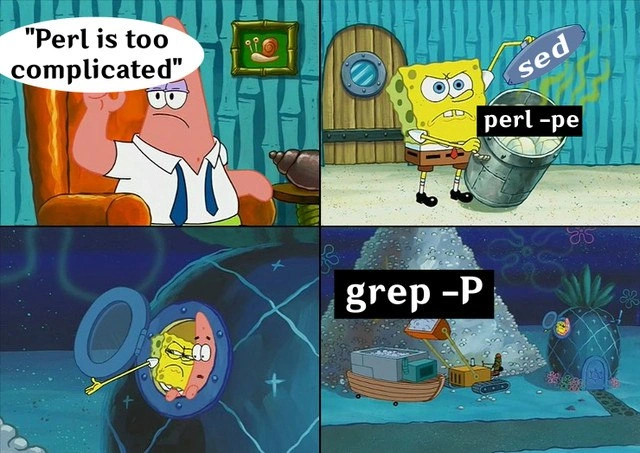
Let’s break down the meme in simpler terms. The characters (SpongeBob and Patrick) are acting out a scenario many developers will find familiar. Patrick starts by saying, “Perl is too complicated,” expressing a common sentiment among programmers who find the Perl language intimidating or messy. Perl is a scripting language famous for its powerful text manipulation and PerlScripting one-liners, but it has a quirky syntax that some newcomers find hard to read. It’s often described as looking like “cartoon swearing” because of all the punctuation (for instance, $@% in code). So, Patrick represents a developer who claims to avoid Perl because it’s confusing.

Now, SpongeBob in panel 2 shows what that same developer might actually do when working in the CommandLineInterface. SpongeBob is throwing away a metal lid labeled “sed” into a trash can labeled “perl -pe”. Here’s the significance:

  • sed: This is a classic Unix command-line tool, short for “stream editor.” Developers use sed to find and replace text in a stream (like a file or input) using regex (RegularExpressions). It’s been around forever and is known for doing simple text substitutions efficiently. For example, you might run sed 's/cat/dog/g' file.txt to replace “cat” with “dog” in a file.
  • perl -pe: This is actually invoking the Perl interpreter in a special mode. -e lets you provide a snippet of Perl code right in the command line, and -p wraps that code in a loop that processes each line of input and prints it. Essentially, perl -pe 's/cat/dog/g' file.txt does the same substitution as the sed example above. It’s like telling Perl, “Pretend you’re sed for a moment and apply this regex substitution to every line.” The meme uses the trash can labeled perl -pe to imply that when SpongeBob throws away sed, he’s really just tossing it into Perl. In other words, the developer might say they’re done with sed, but only because they’ve handed the job over to Perl running in one-liner mode!

Moving to panel 3 and 4, the focus shifts to grep.

  • grep: another fundamental Unix command, which searches for patterns in text. By default, grep uses a more modest regex engine (POSIX extended regex). It’s great for simple searches like finding lines that contain “error” or matching basic patterns.
  • grep -P: The -P option is less commonly known to beginners. It stands for “Perl-regex” mode. This tells grep to use the PCRE (Perl Compatible Regular Expressions) engine. PCRE is a much more powerful regex system originally based on Perl’s capabilities. It supports advanced features like lookahead, lookbehind, non-greedy quantifiers (.*?), and more, which basic grep can’t do. For example, a pattern with lookahead foo(?=bar) (match “foo” only if it’s followed by “bar”) won’t work with normal grep, but will work with grep -P because of PCRE.

In the meme’s last panel, SpongeBob is peeking out from under Patrick’s rock at night while heavy construction equipment labeled “grep -P” is outside. The idea here is that even though Patrick (the developer) said he wouldn’t use Perl (too complicated!), SpongeBob (representing that developer’s actions) is secretly using the Perl-powered version of grep when no one’s looking. The heavy machinery imagery is used because bringing in PCRE is like bringing a bulldozer – it’s a lot more power (and complexity) than the basic grep tool. It’s overkill for simple tasks, but sometimes you need that power for hard problems. So SpongeBob is using grep -P on the sly, meaning the developer is relying on Perl’s regex engine despite swearing off Perl.

The overall joke for a junior developer to grasp is: sometimes people say they don’t like a certain programming language or tool, but they’ll still use parts of it indirectly because it’s useful. This meme uses CLI examples: a person says “I don’t use Perl,” yet they use perl -pe one-liners and grep -P for advanced regex under the hood – basically using Perl in disguise! It highlights a bit of silliness in developer behavior: dismissing a tool as “too much,” while quietly using that tool’s features via other Tooling. If you’ve ever used shell commands to manipulate text and found yourself using complex sed or grep -P patterns, you were tapping into Perl-like power without outright writing a Perl script. The meme playfully points out that Perl never really left – it’s hiding inside our favorite commands.

Level 3: PCRE Paradox

At first glance, this meme skewers the hypocrisy_in_tooling that seasoned CLI users will recognize. The senior engineers among us know that Perl has a notorious reputation for being write-only code – a language of unmatched text-processing power but criticized as arcane “line noise.” So here’s Patrick declaring, “Perl is too complicated,” capturing that common stance in the LanguageWars. Yet, right in our everyday shell work, we quietly invoke Perl’s power via other tools.

In panel 2, SpongeBob is tossing sed (a classic Unix CommandLineInterface utility) into a trash can labeled perl -pe. This is a sly nod to how many of us replace multi-step sed commands with a single perl one-liner. The perl -pe flag combination essentially wraps a user-supplied code snippet in a while(<>) { ...; print $_ } loop – meaning Perl will print each line after applying an expression. It’s a quick way to do stream edits just like sed, but using Perl’s full regex engine and scripting abilities. In other words, sed’s job is being done by a stealth Perl script! The meme humorously visualizes sed being thrown away into a “Perl -pe” bin because under the hood, that’s exactly what’s happening when you swap out sed for a Perl one-liner. This is the shell_utils_comparison that senior devs smirk at – you avoid Perl the language, yet you’re literally running Perl in your shell.

Panel 4 cranks the irony up to 11. The caption grep -P looms over heavy construction machinery outside Patrick’s rock, illustrating how calling grep with the -P flag brings in the “big guns” – the Perl-compatible regex engine. Normally, grep is a lightweight tool using POSIX regex (limited syntax, no fancy lookaheads, etc.). But grep -P leverages PCRE (Perl Compatible Regular Expressions), pulling in all of Perl’s regex superpowers – and its complexity. It’s like summoning a giant excavator (Perl’s regex engine) to do a digging job that plain grep (a shovel) can’t handle. The experienced developer knows this trade-off well: grep -P enables advanced patterns (lookaround assertions, non-greedy matches, backreferences beyond basic capture groups) that vanilla grep or sed simply cannot do. For example, need to use a lookahead (?=...) or a lookbehind (?<=...) in your search? grep -P to the rescue! The meme’s RegularExpressions angle lies in the absurdity that the moment you use those powerful regex features, you’re effectively riding on Perl’s back – after swearing Perl was unwelcome.

This PCRE paradox speaks to a broader LanguageComparison saga in tech culture. Perl, sed, and grep have a shared lineage in Unix history. sed (stream editor) and grep (global regex print) hail from the early Unix toolbox (1970s), offering simple, consistent text processing. Perl, created by Larry Wall in 1987, was partly intended to replace or augment those very tools (its name even jokingly stands for “Practical Extraction and Report Language”). Over time, Perl’s regex engine became the gold standard for powerful pattern matching – so much so that other tools and languages adopted “Perl-compatible” regex flavors. grep -P exists because developers clamored for those Perl regex features in grep; it’s literally Perl’s regex bolted onto grep. The meme’s humor isn’t just that one developer contradicts himself – it’s poking fun at an entire generation of CLI users who loudly decry Perl’s complexity, even as they embed its DNA into their everyday workflows.

In practice, seasoned devs get the joke because we’ve all seen it: someone claims to only use “clean” Unix utilities, yet their .bash_history is full of perl -e ... or grep -P commands. 🙃 It’s a commentary on how Tooling choices are rarely pure – we often wrap one tool inside another for convenience. The hypocrisy is usually tongue-in-cheek: Perl’s syntax may be quirky and its scripts hard to maintain at scale, but when wrestling with text or RegularExpressions on the command line, nothing beats its quick-and-dirty efficacy. You might say “I hate Perl” in principle, only to furtively embrace it when a gnarly text-processing task arises. The meme cleverly visualizes this as SpongeBob (the developer) sneaking under Patrick’s rock at night with an earth mover labeled grep -P – deploying Perl’s heavy machinery under cover of darkness. The senior perspective sees a relatable truth: developers often disown a “complicated” tool publicly, while privately relying on it when CLI reality hits. The Perl paradox is real, and it’s hilariously captured in this SpongeBob scene.

Description

A four-panel meme using the 'SpongeBob Trash' format to satirize developers who criticize Perl for its complexity while unknowingly using its features. In the first panel, Patrick Star sits dismissively, stating, '"Perl is too complicated"'. The second panel shows an angry SpongeBob taking out a smelly trash can labeled 'perl -pe', with the lid labeled 'sed', implying that the common tool 'sed' is just a less capable part of Perl's one-liner functionality. The third panel shows SpongeBob kicking Patrick out of his house. The final panel reveals a massive pile of work being processed by a bulldozer labeled 'grep -P'. The punchline is that the '-P' flag in 'grep' stands for Perl-Compatible Regular Expressions (PCRE), meaning the powerful tool being used to handle the heavy lifting relies on the very engine from the language being criticized. This meme is a deep cut for experienced developers and sysadmins who appreciate the history and pervasive influence of Perl on the entire ecosystem of command-line text processing


Comments

8
Anonymous ★ Top Pick Saying Perl is too complex while using `grep -P` is the sysadmin equivalent of saying you hate Latin while speaking fluent Italian
  1. Anonymous ★ Top Pick

    Saying Perl is too complex while using `grep -P` is the sysadmin equivalent of saying you hate Latin while speaking fluent Italian

  2. Anonymous

    “We don’t run Perl in prod,” insists the engineer whose deploy script is just sed | grep -P | perl -pe - Perl with three context switches for plausible deniability

  3. Anonymous

    The beautiful irony of dismissing Perl as 'too complicated' while religiously using sed and grep with flags that literally invoke Perl's regex engine - it's like complaining about Java verbosity while writing AbstractSingletonProxyFactoryBean in your Spring config

  4. Anonymous

    The real enlightenment isn't realizing Perl is simple - it's discovering that `perl -pe` can replace your entire sed/awk/grep pipeline with a single regex that only you and the Perl gods can decipher six months later. Bonus points when you realize `grep -P` is just Perl's regex engine doing the heavy lifting anyway, making the 'Perl is too complicated' crowd unknowingly dependent on the very complexity they feared

  5. Anonymous

    Me: 'Perl regex is write-only code.' Also me: grep -P '^(?=.*error)(?=.*timeout)(?=.*user42).*' /var/log/prod.log | head -20

  6. Anonymous

    “Perl is too complicated,” says the engineer whose build only runs on GNU tools because the ‘portable’ pipeline quietly swapped sed for perl -pe and sprinkled in grep -P lookbehinds

  7. Anonymous

    “We banned Perl for readability; now prod runs on grep -P | sed | perl -pe - a Strings-Oriented Architecture where complexity is just distributed.”

  8. @princeofcanaan 5y

    Perl is awesome

Use J and K for navigation