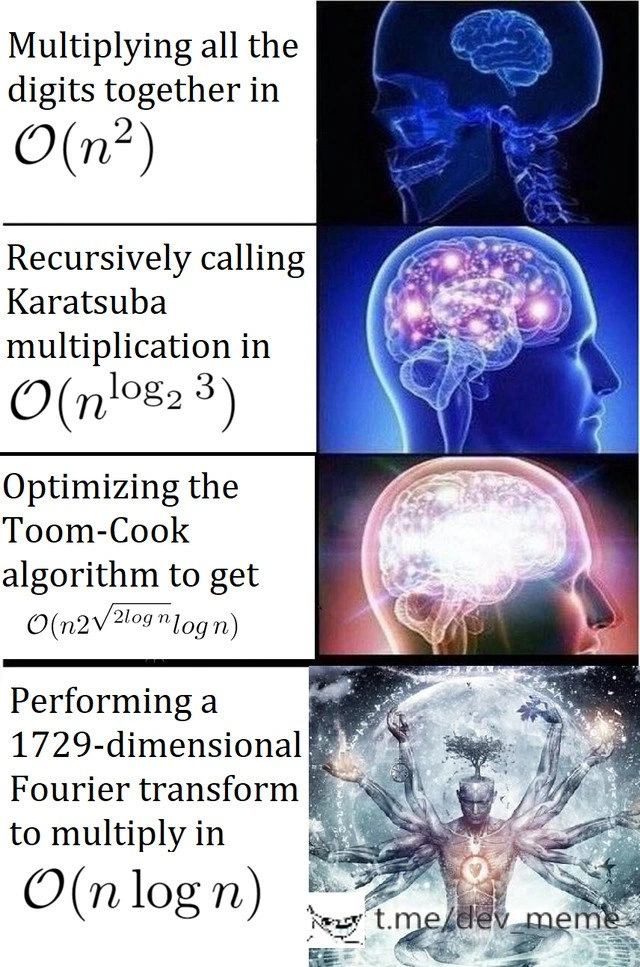
Integer Multiplication Reaches Enlightenment
Why is this CS Fundamentals meme funny?
Level 1: The Biggest Calculator
Imagine you need to multiply two numbers. First you use the normal school method. Then someone shows you a clever shortcut. Then someone shows you an even stranger shortcut with lots of steps. Finally, someone says the fastest way is to build a giant magical math machine that only helps when the numbers are unbelievably huge. That is why the meme is funny: each brain gets brighter because the method is smarter, but the final answer is so complicated that using it for normal numbers would be silly.
Level 2: Big-O Brain Glow
Big-O notation describes how an algorithm's running time grows as the input size grows. If multiplying numbers with n digits takes $O(n^2)$, doubling the number of digits can make the work grow by about four times. That does not tell you the exact runtime, but it describes the shape of the cost.
The meme's four techniques are increasingly advanced ways to multiply very large numbers:
- Schoolbook multiplication checks many digit pairs, like the method taught in school.
- Karatsuba splits numbers apart and uses algebra to reduce the number of recursive multiplications.
- Toom-Cook splits numbers into even more parts and uses evaluation/interpolation tricks.
- Fourier-transform multiplication turns the problem into a fast convolution problem.
A Fourier transform is a mathematical tool that rewrites data in terms of frequencies. For multiplication, the useful idea is that a hard "combine every chunk with every other chunk" operation can become easier after transforming the data, doing simpler multiplications, and transforming back.
For junior developers, the practical takeaway is that faster-looking complexity is not automatically better. A complicated algorithm may have setup costs that make it slower for ordinary inputs. That is why performance work usually starts with measurement. If your numbers fit in normal machine integers, none of these glowing-brain strategies matter; the CPU already knows what to do. If you are building a serious big-number library, then this ladder becomes relevant, and suddenly the cosmic final panel starts looking less like a joke and more like an ominous onboarding document.
Level 3: Asymptotic Enlightenment
The four panels work because each step is genuinely smarter and also increasingly ridiculous as practical advice. The first panel, schoolbook multiplication, is the thing everyone learns: multiply each digit of one number by each digit of the other. That gives roughly $O(n^2)$ work, because every part of one input interacts with every part of the other.
Karatsuba multiplication is the first real upgrade. It uses divide-and-conquer to multiply two-part numbers with three recursive multiplications instead of four. That drops the exponent from 2 to approximately log_2 3, or about 1.585. It is one of those algorithms that feels like a magic trick the first time you see it: rearrange the algebra, do less work, pay some extra additions, win for large enough inputs.
Toom-Cook generalizes that idea. Instead of splitting numbers into two chunks, split them into more chunks, evaluate at points, multiply smaller pieces, then interpolate. The meme's third panel wraps this in a dense asymptotic expression to signal "we have left normal code review." This is real algorithmic territory, but it also introduces the central trade-off of performance engineering: fewer recursive multiplications can mean more overhead, more complicated implementation, and thresholds where the fancy method only wins after the input gets big.
The final panel jumps from divide-and-conquer arithmetic to Fourier-transform machinery. That is why the brain image goes full cosmic. Fast multiplication at this level is not about shaving a loop; it is about choosing rings, roots of unity, transform dimensions, coefficient growth, carry handling, and machine models carefully enough that the complexity proof closes. The code one would write for this is not "optimize the hot path"; it is "become a small research group."
Experienced developers laugh because they have seen the lower-stakes version of this everywhere. Someone reaches for the most advanced algorithm because the asymptotic line on a chart is prettier, while the real workload has small inputs, bad locality, and a profiler pointing somewhere else. Big integer libraries are successful precisely because they do not worship one method. They switch among schoolbook, Karatsuba, Toom-Cook, FFT-like methods, and other variants depending on operand size and architecture. The meme compresses that nuanced threshold engineering into four enlightenment panels, because nothing says wisdom like solving a practical multiplication problem by opening a portal to high-dimensional harmonic analysis.
Level 4: Galactic Multiplication
The meme climbs the integer-multiplication complexity ladder until it reaches the kind of algorithm that exists less as a thing you deploy and more as a proof that the universe permits it. The visible escalation is:
Multiplying all the digits together in O(n^2)
Recursively calling Karatsuba multiplication in O(n^log_2 3)
Optimizing the Toom-Cook algorithm to get O(n 2^{sqrt(2log n)} log n)
Performing a 1729-dimensional Fourier transform to multiply in O(n log n)
This is not random technobabble. Multiplying two large integers can be reduced to something like multiplying polynomials: split the digits into chunks, treat those chunks as coefficients, multiply the resulting polynomials, then carry the result back into an integer representation. The hard part is doing the convolution quickly. Fourier transforms are powerful because they turn convolution into pointwise multiplication in a transformed domain. That is the same broad mathematical trick behind many fast multiplication algorithms: do a clever transform, multiply easier pieces, invert the transform, clean up the carries.
The theoretical holy grail is $O(n \log n)$ bit complexity for multiplying n-bit integers. That bound is close to the lower limit one would intuitively hope for, because the output itself has linear size and the algorithm must at least inspect enough input to know what it is multiplying. The famous modern result associated with David Harvey and Joris van der Hoeven reaches $O(n \log n)$, but the constants and thresholds are so immense that it is a classic galactic algorithm: asymptotically beautiful, practically unreachable for normal workloads.
The 1729-dimensional Fourier transform line is the meme's final enlightenment stage because it sounds deranged and is also pointedly mathematical. 1729 is already a number with nerd folklore attached to it, and pairing it with a high-dimensional transform makes the final panel feel like a monk discovering compiler optimization by transcending Euclidean space. The joke is that the best asymptotic answer to "how do I multiply two integers faster?" can involve machinery so elaborate that it will lose badly to simpler methods until the inputs are absurdly large.
That is the deep lesson behind the glowing-brain format: Big-O is about growth rates, not lunch plans. An algorithm can be asymptotically superior and still be the wrong implementation choice for every integer a production service will ever see. Complexity theory tells you what happens as n approaches infinity. Engineering asks whether your cache misses, memory allocations, constant factors, and maintenance budget will approach infinity first.
Description
An expanding-brain meme has four rows, with increasingly intense glowing brain images on the right and algorithmic multiplication strategies on the left. The visible text reads: "Multiplying all the digits together in O(n^2)," "Recursively calling Karatsuba multiplication in O(n^log_2 3)," "Optimizing the Toom-Cook algorithm to get O(n 2^{sqrt(2log n)} log n)," and "Performing a 1729-dimensional Fourier transform to multiply in O(n log n)," with a small "t.me/dev_meme" watermark at the bottom. The meme escalates from grade-school multiplication to Karatsuba, Toom-Cook-style asymptotic optimization, and finally the famously impractical O(n log n) integer multiplication result using extremely high-dimensional Fourier machinery. It is funny because each theoretical improvement is more mathematically glorious and less likely to be the thing you should implement before lunch.

Comments
7Comment deleted
The fastest multiplication algorithm is perfect for the common production workload of multiplying two integers larger than your SLO budget.
What do I do to start loosing my memory? Comment deleted
You need to meet Alzheimer I guess Comment deleted
what for? Comment deleted
To start loosing your memory Comment deleted
bruh just pull out a ram stick Comment deleted
Thx, my butt feel much better now Comment deleted