Skip to content
DevMeme
3726 of 7435
Infosec distracted by impossible exploit chains, ignores the scripts APTs reuse
Security Post #4065, on Dec 23, 2021 in TG

Infosec distracted by impossible exploit chains, ignores the scripts APTs reuse

Why is this Security meme funny?

Level 1: Missing the Real Threat

Imagine a castle guard who is obsessed with the idea of a dragon attack. He’s constantly scanning the sky for dragons, ready with his spear and armor for this spectacular battle, but in doing so he forgets to lock the castle gate on the ground. While he’s daydreaming about fighting a big, scary dragon that will probably never show up, a common thief just walks through the open gate and steals the treasure. That’s basically what’s happening in this meme: the security person is like that guard – distracted by a dramatic, one-in-a-million danger, while ignoring the ordinary, everyday danger that is actually likely. It’s funny (and a bit silly) because we immediately see the mistake – he’s looking the wrong way, and the real threat slips by right under his nose.

Level 2: Neglected Basics

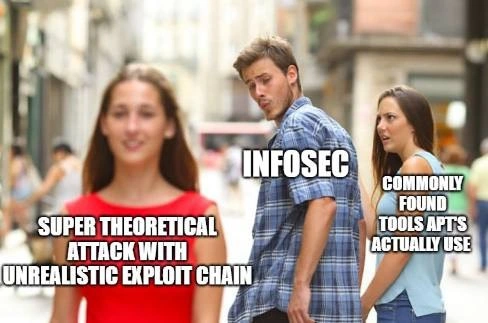
This meme uses the famous “distracted boyfriend” format to make a point about security. In the picture, a man labeled “INFOSEC” (short for Information Security, meaning security professionals) is walking with his girlfriend, who is labeled “COMMONLY FOUND TOOLS APTs ACTUALLY USE.” But he’s turning around to stare at another woman passing by, labeled “SUPER THEORETICAL ATTACK WITH UNREALISTIC EXPLOIT CHAIN.” The girlfriend looks understandably annoyed. This setup is a visual joke: the security person should be paying attention to the girlfriend (the common tools and attacks happening regularly) but is distracted by the flashy stranger (a very unlikely, fancy attack).

Let’s break down the labels. APT stands for Advanced Persistent Threat. That’s a term for well-resourced hacker groups – often government-sponsored teams or organized cyber-criminals. Advanced might sound like they use super high-tech magic hacks, but in reality, APTs frequently rely on pretty ordinary hacking tools and techniques. The girlfriend labeled “commonly found tools APTs actually use” represents those everyday attack methods that these hackers keep using successfully. Think about things like: sending a phishing email to trick someone into giving away their password, using malware (malicious software) that's widely available, or running a simple PowerShell script on a victim’s computer to create a backdoor. These are not glamorous techniques – they’re basic, tried-and-true tactics that work alarmingly well if defenders aren’t careful. For example, an APT might use a known tool to dump passwords from memory (a technique attackers have used for years) or take advantage of a server that hasn’t been updated (so it still has a known security flaw). It’s not rocket science, and that’s the point: these mundane methods cause most of the security breaches we hear about.

Now, the passer-by woman labeled “super theoretical attack with unrealistic exploit chain” symbolizes the opposite: a very elaborate and unlikely hacking method. An exploit chain means a hacker strings together multiple exploits (software vulnerabilities or security weaknesses) one after another, like links in a chain, to achieve a break-in. For instance, imagine a hacker first finds a tiny bug in a website, uses it to slip into the server, then finds another bug to become an admin on that server, then uses that position to jump into the company’s internal network, and so on – each step building on the previous one. It’s like a domino effect of hacks. “Super theoretical” and “unrealistic” imply that this chain of exploits is extremely complicated and not something you’d typically see outside of a controlled demo or a research paper. It might require very specific conditions or a perfect sequence of rare vulnerabilities all present at once. In short, it’s the kind of attack that sounds amazing in theory but almost never actually happens to the average company. It’s more likely to be found in an academic exercise or a hacking contest than in a real-life criminal attack.

The meme’s joke is highlighting a common issue in the security industry: sometimes security teams (InfoSec folks) get more excited about these flashy, hypothetical attacks than about the boring stuff that actually needs fixing. The “distracted” InfoSec guy represents a security professional focusing on the wrong thing. He’s ignoring his “girlfriend” – which in this context means ignoring the basic defenses and common threats that he should pay attention to (like those phishing emails, routine malware, or known hacking tools that APTs are actively using to break into systems every day). Instead, he’s fascinated by the “attractive” but impractical exploit chain – meaning he’s spending time worrying about or studying a very unlikely, complex hack scenario.

This resonates with a lot of developers and security professionals because it’s a clear real-world vs. theory problem. In reality, most companies get hacked due to simple issues: someone didn’t update a server with a critical security patch, an employee used a weak password, or they fell for a common scam email. These are the “common tools” the girlfriend label refers to – the unsexy, boring attacks that actually work. But those can be perceived as dull; there’s not much glory in diligently preventing a phishing email or enforcing multi-factor authentication, even though those steps seriously improve security. On the other hand, the “super theoretical exploit chain” is like the stuff of hacker movies – very complex, maybe involving new vulnerabilities nobody has seen before. It’s exciting to talk about and gives that thrill of high-tech intrigue.

The meme is poking fun at how InfoSec people can sometimes be like that boyfriend: they prioritize the wrong threat. It’s pointing out a kind of hype-driven misfocus (we sometimes call it “security theater” when efforts are more for show than effect). Essentially, a team might spend weeks obsessing over a hypothetical attack that requires, say, five different vulnerabilities all chained perfectly, while ignoring that their database still has the default password “password123”. Those of us who have been around in IT chuckle because we know that focusing on basic security hygiene – things like patching software, training people not to click suspicious links, using strong unique passwords, and monitoring for known attack patterns – will stop the vast majority of real attacks. But the temptation to chase the latest dramatic hack story is real. That’s why this meme is funny and rings true: it exaggerates that temptation by showing the security guy literally turning away from his actual job (protecting against common threats) to gape at a cool-sounding but unlikely danger. Everyone can see it’s a mistake, which is exactly the joke.

Level 3: Shiny Exploit Syndrome

In the world of CyberSecurity, there's a recurring pattern of chasing flashy theoretical threats at the expense of addressing everyday dangers. This meme nails it: InfoSec (information security professionals) are portrayed as the distracted boyfriend, drooling over a “super theoretical attack with unrealistic exploit chain” while ignoring the “commonly found tools APTs actually use.” It's a sarcastic take on a risk prioritization fail in security teams. Experienced engineers recognize this scenario immediately – it's far too common in our industry.

APT (Advanced Persistent Threat) groups are supposed to be the elite hackers, often state-sponsored actors. Ironically, these "advanced" adversaries frequently rely on common, well-known tools and scripts to breach targets. They often reuse off-the-shelf malware, known exploits, or simple tactics like spear phishing, because why burn a new 0-day if an old trick still works? For example, rather than deploying a sci-fi multi-stage kernel exploit, an APT might just use a one-liner PowerShell script or a commodity tool like a Cobalt Strike beacon – easy, reliable, and gets the job done. Seasoned security folks have seen it: major breaches that started with a phish or an unpatched 2-year-old vulnerability, not some galaxy-brain exploit chain.

Meanwhile, the “super theoretical exploit chain” in the meme represents those intricate, almost-impossible attack scenarios that infosec conferences and hype-driven media love to spotlight. Picture an exploit chain so elaborate it’s like a digital Rube Goldberg machine: maybe an attacker chaining a speculative CPU side-channel (think Spectre/Meltdown) → plus a memory corruption in the hypervisor → plus a race condition in the OS → all to achieve what a stolen admin password could do in 5 minutes. It’s not that these research proof-of-concept (PoC) attacks aren’t real or clever – they often are. But they’re edge cases. In real environments, attackers don’t usually need such acrobatics when simpler paths are wide open.

The humor (with a dark twist) comes from how accurate this meme’s satire is. Security teams can get infatuated with ExploitDevelopment challenges or “what-if” nightmare scenarios (the kind that make headlines or academic papers) – this is the shiny exploit syndrome. It's almost a form of SecurityTheater: focusing on dramatic, James Bond-style hacks to impress stakeholders, while neglecting everyday defenses. People nod knowingly because they’ve sat through meetings about hypothetical nation-state super-exploits, even as actual RealWorldVsTheory incidents (like ransomware via a known phishing kit) go unaddressed. It’s easier to geek out over an exotic exploit than to slog through patching old servers and auditing logs, even though the latter prevents 99% of attacks.

To highlight the absurd contrast:

InfoSec’s Latest Obsession (passer-by hottie) Actual APT Tactics (ignored girlfriend)
Hyper-complex 0-day exploit chain requiring multiple unknown vulnerabilities in perfect sequence A boring phishing email trick that steals an employee’s password
Featured in a research paper or demoed at Black Hat with a spectacular breach on stage Documented in real incident reports: e.g. reused credentials or an unpatched server being exploited
Improbable but exciting – “technically could happen if the stars align Happens weekly – yet totally mundane (attackers leveraging Mimikatz or a default admin password)
Gets InfoSec teams’ adrenaline and budget (“Did you see that demo?! We need to worry about this!”) Gets the attacker the keys to your network while the team is distracted by shiny threats

As the table shows, it’s a classic real-world vs. theory scenario. The meme humorously criticizes how InfoSec culture sometimes glorifies the flashy super theoretical exploit (left side) while underrating the threats that actually cause damage (right side). The boyfriend labeled “INFOSEC” literally turns away from the common APT tools that demand attention. That captured moment is funny to us because it rings true: despite all the training about threat modeling and risk management, even experts can be like that boyfriend – dazzled by hype and forgetting the basics.

Long-time security practitioners (the battle-scarred crowd who have responded to real 3 AM incidents) chuckle at this because they've lived it. They’ve spent nights cleaning up after simple PowerShell malware and commodity phishing scams, all while someone in the meeting room was fretting about a theoretical exploit chain that never came. The collective facepalm is real. This meme drives home that ironic truth – a comedic reminder that focusing on fundamentals beats chasing unicorn exploits any day.

Description

The meme uses the classic “distracted boyfriend” stock photo: a man (face blurred) walks with his girlfriend (right side, face blurred) but turns his head to admire another woman passing by (left, face blurred). Overlays read: the boyfriend is labeled “INFOSEC”; the neglected girlfriend is labeled “COMMONLY FOUND TOOLS APTs ACTUALLY USE”; the attractive passer-by is labeled “SUPER THEORETICAL ATTACK WITH UNREALISTIC EXPLOIT CHAIN.” Visually, it’s a busy pedestrian street with soft-focus buildings in the background, and all text is in bold white caps with black outline. Technically, the joke skewers security teams who obsess over exotic, academic proof-of-concept attack graphs while ignoring the mundane PowerShell scripts and cobalt-strike beacons real adversaries deploy daily. Seasoned engineers will recognize the commentary on risk prioritization, threat modeling, and the perennial allure of hype over operational reality
Comments

7
Anonymous ★ Top Pick Sure, the SOC just blocked another seven-step Rowhammer-over-IPv6 demo, but the production box is still RDP-ing with ‘password123’ - priorities, right?
  1. Anonymous ★ Top Pick

    Sure, the SOC just blocked another seven-step Rowhammer-over-IPv6 demo, but the production box is still RDP-ing with ‘password123’ - priorities, right?

  2. Anonymous

    After spending three weeks building a proof-of-concept for a 12-step exploit chain requiring kernel access and a solar eclipse, the red team discovers the APT just used PowerShell and valid credentials they bought for $50 on a forum

  3. Anonymous

    We funded a year of research into a 7-stage speculative-execution chain; the breach came through a phished password that was also the company name plus '2024'

  4. Anonymous

    InfoSec researchers will spend six months reverse-engineering a theoretical supply chain attack requiring physical access to a Faraday-caged data center while APTs are still getting in through 'admin/admin' on internet-facing Jenkins instances. We're out here publishing papers on speculative execution side-channels when the real threat actor just phished Karen in accounting with a fake DocuSign email - again

  5. Anonymous

    We keep threat‑modeling zero‑click chains, but every 3am page is still default creds → RDP → Cobalt Strike - write the Sigma for PsExec, not the screenplay for Blackhat

  6. Anonymous

    Every quarterly security review: 20 minutes debating an ROP chain from a conference talk, 2 minutes noting prod still allows PowerShell Remoting with domain-admin creds - guess which one gets a slide

  7. Anonymous

    InfoSec preaches ballistic chains of zero-days; APTs just LOLbin their way to domain admin with certutil - stealthier, no supply chain drama

Use J and K for navigation