Skip to content
DevMeme
945 of 7435
Password Hygiene Gets Too Literal
Security Post #1068, on Feb 28, 2020 in TG

Password Hygiene Gets Too Literal

Why is this Security meme funny?

Level 1: Private Things Stay Private

This is like saying your secret code should be treated like something very private: do not give it away, do not leave it lying around, and replace it when there is a good reason. The funny part is that the poster chooses a comparison that is memorable because it is so uncomfortable.

Level 2: Secrets And Sticky Notes

Authentication is how a system checks that you are allowed to access an account. A password is one kind of secret used for authentication. If someone else learns it, they may be able to pretend to be you.

The poster's first rule, Never share them with anyone, means each person should have their own password. The second, Change them regularly, refers to password rotation, where users are required to make a new password after some time. The third, Keep them off your desk, warns against writing passwords on paper where coworkers, visitors, or cameras might see them.

The meme is funny because the underwear comparison is intentionally awkward, but it makes the security lesson easy to remember. It also exposes how strange password rules can feel. The caption's imaginary errors, like "Your new underwear cannot be your old underwear," sound ridiculous because they translate normal password forms into the poster's metaphor.

Level 3: Compliance Laundry Day

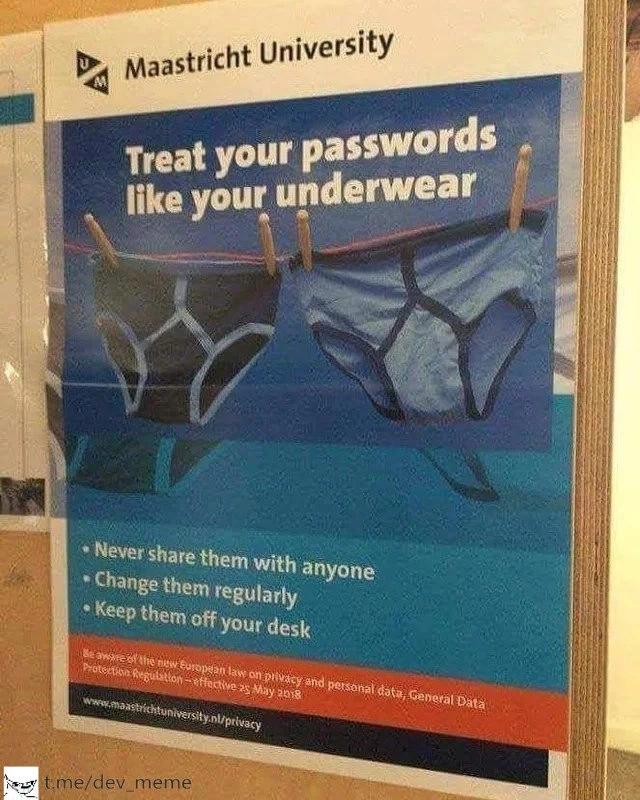
The poster is from Maastricht University and says, Treat your passwords like your underwear, then lists three rules: Never share them with anyone, Change them regularly, and Keep them off your desk. The visual doubles down by showing underwear on a clothesline, then anchors the message in privacy compliance with a GDPR footer. It is a security-awareness poster trying to be memorable, and it succeeds mostly because everyone now has to imagine credential hygiene as laundry policy.

The senior security joke is that the metaphor is both useful and dangerously overextended. Never share them with anyone maps cleanly to CredentialManagement: shared passwords destroy accountability, make revocation messy, and turn one leaked secret into a group incident. Keep them off your desk maps to the classic sticky-note failure mode, where a technically strong password becomes weak because it is physically visible. Those are solid awareness points.

Change them regularly is where the old enterprise smell enters the room. Mandatory password rotation used to be treated as common-sense SecurityBestPractices, especially in compliance-heavy environments. In practice, forced rotation often leads people toward predictable sequences like Winter2026!, Spring2026!, and the proud architectural successor, Summer2026!. If there is no evidence of compromise, rotating a strong unique password can create more usability pain than security value. The meme's technical edge is that the poster makes password policy sound simple, while real authentication policy is a compromise between risk, human memory, helpdesk load, password managers, multifactor authentication, and audit requirements.

The post message pushes the metaphor into full password-reset absurdity: "Your underwear is incorrect," recovery instructions by email, size rules, hints, and reuse prevention. That is funny because password systems often speak with robotic certainty about deeply human failure. A user forgets a secret, the system demands a new one, rejects the old one, rejects the weak one, rejects the similar one, and then asks for a hint that must somehow be helpful without being revealing. Somewhere, a compliance checklist is satisfied while the user invents another suffix.

The GDPR footer matters because it gives the poster institutional seriousness. DataPrivacy law raises the stakes around personal data, so universities and companies produce awareness campaigns to reduce avoidable breaches. The image is not wrong to connect passwords with privacy. It is just very funny that the path from European data protection to credential security runs through a public underwear analogy in a hallway.

Description

The image shows a Maastricht University security-awareness poster with underwear hanging on a clothesline against a blue background. The main text says "Treat your passwords like your underwear" followed by bullet points: "Never share them with anyone", "Change them regularly", and "Keep them off your desk". A red footer says "Be aware of the new European law on privacy and personal data, General Data Protection Regulation - effective 25 May 2018", and the bottom includes "www.maastrichtuniversity.nl/privacy" plus a small "t.me/dev_meme" watermark. The technical humor is the painfully literal password metaphor: memorable enough for awareness training, but also a reminder that periodic password rotation can become compliance theater if it just produces predictable suffixes.
Comments

1
Anonymous ★ Top Pick Forced password rotation is how `Winter2026!` becomes an enterprise identity strategy with a GDPR footer.
  1. Anonymous ★ Top Pick

    Forced password rotation is how `Winter2026!` becomes an enterprise identity strategy with a GDPR footer.

Use J and K for navigation