Skip to content
DevMeme
946 of 7435
The Fallacy of 'Premature Optimization'
CodeQuality Post #1070, on Feb 28, 2020 in TG

The Fallacy of 'Premature Optimization'

Why is this CodeQuality meme funny?

Level 1: Cake Before Frosting

Imagine you’re baking a cake and you get so excited that you start putting on the frosting and sprinkles before the cake is fully baked. What do you think would happen? You’d end up with a gooey mess, because the cake isn’t ready for decoration and you might even ruin it. It’s clear that you should bake the cake completely first, then add the frosting and sprinkles to make it fancy. This meme is making the same point with a big yelling crow: in programming, you should finish building the basic thing correctly before you try to make it super fancy or super fast. In other words, get the main part done right, and worry about the extra improvements later. It’s a funny way to say “don’t try to decorate the cake before it’s baked!”

Level 2: Write First, Optimize Later

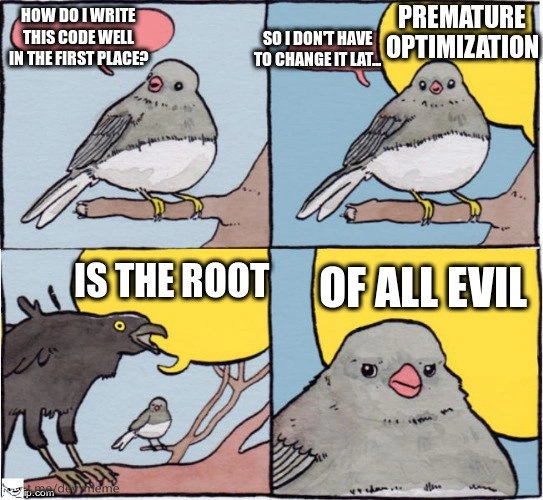
Let’s break down the meme in simpler terms. In the first panels, a small gray bird (think of a junior developer) asks, “How do I write this code well in the first place so I don’t have to change it later?” He wants to do a good job from the start. But before the little bird can finish, a big black crow (imagine a loud senior dev or mentor) interrupts, squawking “PREMATURE OPTIMIZATION… IS THE ROOT OF ALL EVIL!” in huge letters. The crow is basically yelling a famous programming advice.

Premature optimization means trying to make your code super fast or super efficient too early, even before you know if you need to. It’s like fixing a problem that isn’t there yet. In coding, this often leads to doing extra work or adding complex parts to the code that might not even be necessary. Sure, everyone wants their program to run quickly, but if you focus on that from the very beginning, you might lose sight of what’s more important at first: getting the code correct and easy to understand. The saying “Premature optimization is the root of all evil” is an extreme way of warning developers: “Don’t jump into making your code faster until you’re sure you need to – it can cause big problems!” It’s a bit of DeveloperHumor that also holds truth. Almost every programmer hears this line at some point when they start worrying about speed or memory too soon.

Now, what was the little bird actually asking? Essentially, “How can I write clean, good code from the start so I won’t have to redo it later?” That’s about code quality and good design. Writing code “well” means writing it in a simple, clear, and maintainable way. Maintainable code is easy to change or fix later because it’s organized and readable. When he says “so I don’t have to change it later,” he’s hoping to get the design right initially. It’s a great goal to have — nobody likes messy code that constantly needs rewriting.

But here’s the catch: requirements and ideas often change as a project goes on. No matter how well you write it now, there’s always a chance you’ll need to modify the code later (maybe to add new features or fix unforeseen issues). The crow’s point is that you shouldn’t try to over-engineer things in an attempt to avoid any future changes. Overengineering means adding more complexity, features, or optimizations to your code than necessary “just in case” they’re needed. It’s like building a huge, complicated machine for a simple task. The crow is basically yelling, “Don’t do that! Don’t over-complicate this from the start!”

Performance (how fast or efficiently the code runs) is one aspect of code quality, but it’s not the only one, especially not at the beginning. The crow’s phrase focuses on performance-related changes done too early – that’s what we call premature optimization. Early-career developers sometimes worry a lot about doing everything in the most efficient way right away. For instance, a beginner might think they should use a super clever algorithm or low-level trick everywhere to make the program run faster. However, if those parts of the code weren’t actually slow to begin with, all that “clever” stuff just makes the code harder to understand, without any real benefit. There’s usually a trade-off: you trade clarity and simplicity for speed or efficiency. A trade-off means you give up one good thing to get another. In performance tuning, the trade-off often is readability (or flexibility) versus speed. The saying warns that making that trade-off too early – sacrificing clarity for minor speed gains – is a bad idea. You could end up with confusing code that’s only maybe a tiny bit faster.

It helps to remember that you can always optimize (improve the performance of) the code later, but if the code is written clearly to start with, it will be much easier to change or tune when the time comes. There’s a common piece of advice: “Make it work, then make it fast.” This captures the same idea as the crow’s shout, but in a calmer way. First, get your program to work correctly and in a clean manner. Only after you verify it works and see where the slow parts really are, then you can go back and make those parts faster. Developers often use tools called profilers to find out which part of a program is actually slow. That way, they don’t guess – they know exactly what to optimize.

What about the phrase “root of all evil”? Of course, that’s an exaggeration – making a program a little too fast too early isn’t truly evil! 😄 It’s just colorful language to get the point across strongly. It became a bit of an inside joke in programming, because it’s such a bold statement. When the crow in the meme yells this, it’s both funny and recognizable to developers. It’s funny because of the exaggerated delivery, but it’s recognizable because it’s a super common lesson: Don’t try to make your code perfect and super optimized from the start, especially not at the cost of sanity and cleanliness.

To put it simply, the small bird is asking about quality and planning ahead, and the big bird responds with a famous one-liner that basically means “Focus on writing it clearly now, don’t overthink performance yet.” The meme format (polite small bird vs. loud interrupting crow) is used to show how one idea (clean code practices) gets interrupted by a strongly felt programming principle. It’s an example of coding humor where one character passionately delivers a lesson many of us have heard before. And the takeaway of that lesson is: write straightforward code first; you can always change or optimize it when you truly need to. If you try to do everything perfectly and fast from the get-go, you might just make life harder for yourself. In real life, too, you probably will end up changing the code later no matter what, and that’s okay! Good code is code that can be changed later without a big hassle. So the crow is essentially advising the little bird (loudly): “Don’t stress too much now about making it super efficient. Get it working cleanly, and improve it later if needed.”

Level 3: The Root of All Evil

In this four-panel comic, a tiny bird’s attempt to ask about writing code well is literally overshadowed by a giant crow shrieking the mantra, “PREMATURE OPTIMIZATION IS THE ROOT OF ALL EVIL.” This isn’t just random yelling – it’s a famous admonition from legendary computer scientist Donald Knuth. Over the decades it has become almost scripture in developer culture. The humor comes from how drastically the conversation gets hijacked. The little bird (a well-meaning dev) is cut off mid-sentence by the big crow’s overzealous warning. It’s an exaggeration of real programmer interactions: mention any plan to tweak or perfect code early, and someone will inevitably blurt out “Premature optimization!” like a reflex. It’s practically a rite of passage for new coders to get this phrase thrown at them in code reviews or design discussions.

Why are experienced devs so fervent (like this crow) about premature optimization? Because they’ve seen how focusing on speed or micro-efficiencies too soon can backfire. Knuth’s full advice was that PerformanceOptimization done at the wrong time often sabotages CodeQuality and maintainability. If you twist and contort your code to save a few milliseconds or bytes early on, you might make it harder to read, debug, and extend. In other words, you introduce complexity and create future headaches – the kind of thing that leads to dreaded TechnicalDebt. The crow’s dramatic line “is the root of all evil” is hyperbole (Knuth used strong words to make a point), but it captures a real trade-off: making code clever and super-efficient upfront often makes it evil to work with later. It’s a warning that resonates with anyone who has inherited a mess of OverEngineering done in the name of premature speed-ups.

For example, consider a simple task like summing up the numbers in a list. A straightforward implementation is very clean:

// Simple, clear method to sum an array:
int total = 0;
for (int i = 0; i < data.length; i++) {
    total += data[i];
}

Now imagine a developer trying to be “smart” and optimize this loop before knowing if it’s even a bottleneck:

// Prematurely "optimized" version (loop unrolling):
int total = 0;
int i = 0;
int n = data.length;
// Process 4 elements at a time for supposed speed gain
for (; i <= n - 4; i += 4) {
    total += data[i] + data[i+1] + data[i+2] + data[i+3];
}
// Handle any leftover elements
for (; i < n; i++) {
    total += data[i];
}

In theory, that second snippet might run a bit faster by reducing loop overhead. But look how much more complex it is! We have two loops, tricky indexing, and it’s harder to read (it’s doing four additions per iteration). If data isn’t extremely large or performance-critical, this micro-optimization gains almost nothing tangible and makes the code harder to understand. All that extra complexity was added just in case – and every future maintainer now has to untangle it. This is exactly what premature optimization refers to: investing effort in fancy speed-ups too early, before we know where the real performance problems are (or if they exist at all). The result is often code that’s less clear and more bug-prone, without meaningful benefit. It’s the kind of PerformanceTradeoffs seasoned developers warn against.

Experienced engineers prefer to write the simple version first, ensure it’s correct and clean, then measure performance with tools (profilers) to see if it’s actually slow. If and only if a real bottleneck is found, then they optimize that critical part. As Knuth famously suggested, 97% of the time, you shouldn’t worry about tiny efficiencies. Save your energy for the important 3% – the parts of the code that profiling shows are truly slow. There’s a popular development motto capturing this approach: “Make it work, make it right, then make it fast.” In other words, get the code working correctly (and in a readable way), then if you discover it’s too slow, improve the performance of the slow spots. The crow in the meme is basically screaming this wisdom at the little bird in one loud catchphrase. It’s funny (and relatable) because many of us have had a senior team member abruptly stop a design debate by declaring “premature optimization!” as a reality check. It’s a mix of genuine advice and comedic timing.

Notice the little bird’s original question: “How do I write this code well in the first place, so I don’t have to change it later?” That’s a fair question about doing things right from the start. But the hard truth (which the crow is hinting at, albeit bluntly) is that code will almost always change later. Requirements evolve, new features come along, or you learn better ways as you go. Trying to future-proof everything or make it ultra-optimized now — effectively coding as if you’ll never need to modify it — usually just makes the code rigid and over-complicated. Ironically, the best way to avoid painful rewrites later is to write code that’s easy to change later, not code that tries to anticipate every future need. That means favoring simplicity and clarity over premature complexity. The crow’s mantra is a loud reminder: don’t sacrifice clean design for speculative gains. We’ll deal with speed and special-cases when we actually need to.

So from a senior perspective, this meme nails a core piece of developer wisdom through dark humor. The big crow represents that battle-worn lead engineer in every team who has seen premature optimization cause real problems. The small bird is any junior dev who innocently asks “But can’t we just make it perfect now?”. The crow’s response – “Premature optimization is the root of all evil!” – is over-the-top, but it’s rooted in decades of shared experience in software development. We laugh at the scene, but we also nod knowingly. After all, most of us can recall a time we had to untangle someone’s overly optimized code (muttering this quote under our breath), or when we ourselves had to be reminded not to get ahead of ourselves. This comic brilliantly contrasts the earnest desire to do things right now with the seasoned knowledge that doing too much too soon is a recipe for trouble. It’s an inside joke among programmers, and the punchline is that booming crow literally cawing Knuth’s famous words – a warning so ingrained that it’s practically instinct. In short, the meme humorously delivers a serious message: write it clean first, optimize later.

Description

A four-panel comic meme format featuring a small bird and a large crow. In the first panel, a small, innocent-looking bird perched on a branch asks, 'HOW DO I WRITE THIS CODE WELL IN THE FIRST PLACE?'. In the second panel, it continues its thought, 'SO I DON'T HAVE TO CHANGE IT LAT...' (later). In the third panel, a large, aggressive black crow appears, shouting down at the small bird with the text 'PREMATURE OPTIMIZATION IS THE ROOT OF ALL EVIL'. The final panel is a close-up of the small bird's face, now looking annoyed and unimpressed. The meme humorously critiques the dogmatic and often misapplied use of Donald Knuth's famous quote. The junior bird is asking a valid question about code quality and good design, but the senior crow shuts down the conversation by mislabeling this desire for clean, maintainable code as 'premature optimization,' a common thought-terminating cliché in developer circles that ignores the nuance of the original advice
Comments

7
Anonymous ★ Top Pick There's a fine line between 'premature optimization' and 'not writing a steaming pile of tech debt.' The crow has clearly never had to maintain its own code
  1. Anonymous ★ Top Pick

    There's a fine line between 'premature optimization' and 'not writing a steaming pile of tech debt.' The crow has clearly never had to maintain its own code

  2. Anonymous

    “Premature optimization is the root of all evil,” says the crow who’ll ping you in six months asking why the unoptimized ETL now needs a Kubernetes cluster that costs more than the data it’s moving

  3. Anonymous

    The same developers who quote Knuth on premature optimization will spend three sprints building a "future-proof" abstraction layer for a feature that gets deprecated six months later

  4. Anonymous

    Every senior engineer has lived this exact moment: staring at a greenfield function, wondering whether to use a hash map or a sorted array, only to realize they're optimizing for 10 users when the real bottleneck will be that third-party API that times out randomly. Knuth's ghost appears like that crow every time we spend 3 hours micro-optimizing a loop that runs twice a day, while the O(n²) algorithm in the hot path quietly murders our database. The real evil isn't the premature optimization itself - it's the 47 lines of 'clever' bit-shifting code you wrote at 2 AM that nobody, including future-you, can maintain

  5. Anonymous

    Everyone loves quoting “premature optimization is the root of all evil” - until that clean O(n^2) path hits prod and your pager, profiler, and AWS bill unanimously disagree

  6. Anonymous

    Nothing derails a maintainability discussion faster than the engineer who thinks “premature optimization” means “measure never” - right up until the hot path turns the pager into a metronome

  7. Anonymous

    Knuth's ghost whispers: 'Profile or perish' - yet every dev dreams of that mythical 'just right' first draft

Use J and K for navigation