Skip to content
DevMeme
472 of 7435
A Bug's First Birthday: A Passive-Aggressive Customer Story
Bugs Post #542, on Aug 9, 2019 in TG

A Bug's First Birthday: A Passive-Aggressive Customer Story

Why is this Bugs meme funny?

Level 1: Bug's First Birthday

Imagine you told someone about a problem and an entire year went by with nothing done. Say you lent your friend a favorite toy, and after one whole year they still haven’t returned it. Instead of just asking for it back again, you decide to have a little fun: you send your friend a “Happy Birthday” card for that long-lost toy, celebrating its one-year anniversary at your friend’s house. It’s a silly, playful way to remind them, “Hey, it’s been a YEAR, and I still don’t have my toy back!” In this story, the “toy” is actually a software bug that wasn’t fixed. The customer waited a year and then jokingly treated the bug like it was having its first birthday. It’s funny because normally we celebrate birthdays for people or pets – not for problems. By throwing a pretend birthday party for the bug, the customer found a creative way to say “This issue has been around way too long!” Everyone can laugh at the idea of a bug getting a birthday card and cake, even though behind the joke the customer really does want it fixed.

Level 2: Spacebar Not Working

Now let's break down the situation in simpler terms. This post is about a software bug in a device, and a very creative customer response to that bug:

  • RS-232: This is an old-fashioned serial communication port – essentially a direct cable connection used for text-based communication with devices. If you've ever seen a computer with a 9-pin connector or heard of COM ports, that's RS-232. Back in the day, people used it to connect PCs to modems, or technicians used it to plug into network switches and industrial machines to configure them. It sends data one bit at a time over a wire at a set speed (the baud rate). In short, RS-232 is a simple, reliable way to send text commands to a device by wire, and it's been around forever (well, since the 20th century).

  • Telnet: Telnet is a text-based network protocol that lets you connect to a device over a network and enter commands remotely. Think of it like opening a terminal window to a machine that could be far away. You type, the letters go over the network, and you see the device’s reply on your screen. Telnet is very old and not secure (it doesn’t encrypt anything, unlike its modern cousin SSH). Despite that, a lot of older or simpler devices still offer Telnet because it's easy to set up. It’s like a phone call for computers where you literally send text back and forth.

  • Firmware updates: Firmware is the software that runs directly on a device’s hardware – kind of like the device’s built-in program. When a company issues a firmware update, they’re updating that built-in software to fix bugs or add features. So saying “one year of firmware updates” means the team shipped new software for the device over the course of a year. The key point here is that throughout all those updates, this particular bug stayed unfixed.

Now, what was the bug? The card’s message says: “spaces still don’t work on RS232 & telnet.” In plain language, whenever someone used the device via the serial port or a Telnet session, the space character (what you get when you hit the spacebar) didn’t work properly. That means if you tried to type a command that had a space in it, the device wouldn’t handle it. It’s like pressing the spacebar and nothing happens – the device just acts like you never pressed that key. So any command or text you send gets squashed together or cut off at the first space, which is obviously a big problem if you need to type anything more than one word.

For example, imagine the device expects commands with multiple words or arguments. If you tried to enter a two-word command like SET TIME 12:00, and the space isn’t recognized, the device might only see SET and ignore the rest. Here are a few illustrations of what that bug would look like in practice:

You try to type... Device actually processes... Outcome
SET TIME 12:00 SET Fails to set time (it got only "SET")
ping 192.168.0.1 ping Command is incomplete (no address)
Hello World HelloWorld (no space at all) Text comes out mashed together

In short, the device was acting as if the spacebar key was broken whenever you communicated with it through these interfaces. This is pretty frustrating! Spaces are one of the most common characters – we use them to separate words. A device that can’t handle spaces in commands or text is super inconvenient. (Imagine if your phone didn’t let you type spaces in a text message – youWouldHaveToWriteEverythingLikeThis.)

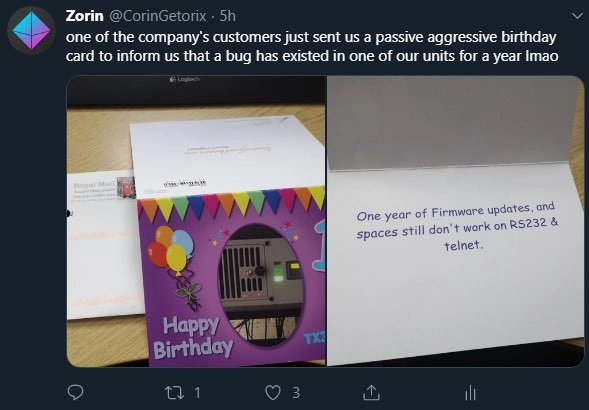
Now, onto the birthday card part. The customer who kept running into this space-character bug decided to report it in a really witty way. Instead of filing another support ticket or getting mad on the phone, they literally sent the company a birthday card. The front of the card looked like a regular colorful card with “Happy Birthday” on it. But inside, the printed message said something along the lines of “One year of updates, and this bug is still here.” In other words, happy first birthday to this unfixed bug!

This is a form of passive-aggressive humor. That means they didn’t directly say “I’m angry you haven’t fixed this,” but the message gets the point across in a sly, indirect manner. It’s like they were smiling while scolding the team. By calling it the bug’s “birthday,” the customer is joking that the bug has been alive for so long, it deserves a celebration (which is not a good thing in this context!).

Why is this funny to developers? Well, it’s a mix of embarrassment and camaraderie. On one hand, the engineers who see this have to admit it’s a clever burn – the customer found a humorous way to highlight something that’s wrong. On the other hand, every developer has experienced a bug that just wouldn’t die, or a small issue that kept getting pushed aside until it became a running joke. This story is basically one of those situations.

For someone new to software, the takeaway is: even little bugs can cause big headaches if left unfixed. Not being able to use the spacebar in a command line is a small glitch that creates a huge annoyance. The company probably wasn’t ignoring it out of spite; they might have thought it was low priority or hard to fix. But after a year, the customer was understandably irritated. Their choice to send a funny card instead of a regular complaint actually made a bigger splash – it got the developers’ attention (and even made them laugh, as we see from the “lmao” in the tweet).

In the end, the “birthday card bug report” is a humorous reminder that when software issues stick around too long, users notice – and they might get creative in reminding you. It’s a lighthearted nudge with a serious undercurrent: please fix this already! The whole thing turned into a joke that the tech community can chuckle at, and it probably embarrassed the team just enough to finally solve that spacebar problem in the next update.

Level 3: Baud Rate Blues

In the world of embedded systems, few things sting like a bug that lingers for a full year – especially one as absurdly fundamental as the space character not transmitting properly over a legacy interface. This meme highlights that exact scenario: after 12 months of firmware releases failing to squash a notorious input bug, a fed-up customer delivered their complaint with equal parts creativity and sarcasm. Instead of yet another email or support ticket, they mailed in a literal birthday card celebrating the bug’s first anniversary (practically toddler age in bug years). The front was all “Happy Birthday” with balloons and confetti, but inside, in crisp print, was the stinging message:

"One year of Firmware updates, and spaces still don't work on RS232 & telnet."
(Printed inside a cheerful birthday card from a very frustrated user.)

For a seasoned developer, this scene is both hilarious and painfully relatable. It's a passive-aggressive bug report delivered with a smile – a perfect example of a user saying “I shouldn’t have to remind you, but here we are.” The humor lands because we've all had that one bug that keeps surviving version after version, outliving our best intentions. A space character (ASCII code 0x20) is about as basic as it gets in text communication, so spaces "not working" on a serial/Telnet interface sounds almost unbelievable. And yet, those of us with battle scars know that tiny oversights can hide in plain sight for ages if they're in a corner of the system nobody wants to touch.

Why might a trivial-sounding bug persist through a year of updates? Easily: it’s probably buried in some old legacy code that everyone is afraid to modify. RS-232 serial handling might be decades-old C code written by an engineer who's long gone. Each firmware update likely focused on new features or urgent fixes, with every intention to fix the space issue next sprint, of course, but that "minor" bug kept getting deprioritized. Meanwhile, any user trying to type a multi-word command over the console was out of luck. Multi-word? Try no-word-after-the-first – the device essentially behaved as if the space bar didn't exist.

From a technical standpoint, the culprit is probably an input parsing flaw or a low-level data handling issue. Perhaps the firmware’s command interpreter uses a naive method that stops reading at whitespace, effectively truncating input at the first space. For example, imagine the device code doing something like:

char cmd[64];
scanf("%s", cmd);
// ^ This stops reading at the first whitespace.
// If a user types "OPEN DOOR", it captures "OPEN" and ignores "DOOR".

In such a case, any space character serves as a cut-off, and everything after it vanishes into the ether. Alternatively, there could be a configuration snafu at the serial protocol level – say a mismatch in baud rate or parity – but that would typically garble more than just spaces. The consistency of "spaces still don't work on RS232 & telnet" hints that the device’s common input logic (shared by both the physical serial port and the Telnet remote interface) has a bug where it refuses to handle the ' ' character. Essentially, the poor thing can't process a space in its input stream, turning commands like SET TIME 12:00 into just SET (and leaving the device very confused because it never sees the rest of the command).

It's the kind of oversight that good testing should catch – but perhaps the QA team only tried single-word inputs or never thought to include spaces in their cases. If nobody explicitly tests "can I send a command with a space?", a bug like this can slip through for far too long. Experienced engineers have seen similar issues: a missing newline here, an off-by-one array index there – suddenly basic functionality breaks in an embarrassing way. The difference here is the comedic flair in how it’s reported. The customer basically said, “Happy birthday to your bug – it’s old enough to have a party now!” and the development team had to collectively facepalm and chuckle at the same time.

For veterans, there’s a mix of admiration and dread here. On one hand, you can’t help but laugh at the sheer audacity and wit – it’s not every day you get a festive greeting card as a bug report. On the other hand, it’s a sharp reminder that technical debt and neglecting minor bugs can come back in the most public way. This particular bug is doubly ironic because RS-232 and Telnet are themselves vintage tech. (Telnet, for instance, hails from the late 1960s, and RS-232’s design comes from an era long before USB or Wi-Fi.) In many modern products, these interfaces exist mainly for backward compatibility or debugging. The fact that a 2019-era device still uses them is a clue: this is likely industrial or network equipment where if it ain’t broke… well, in this case it was broke, but nobody fixed it.

A veteran developer reading this can practically reconstruct the timeline. The bug was logged in the tracker ages ago, got passed over release after release, and wasn’t seen as “critical” enough to block shipments. Users in the field, however, stumbled over it every day – imagine not being able to put a space in a command, constantly working around that. Eventually one of those users said “Enough!” and found the most memorable way to make the point. And honestly, it worked. The dev team not only got the message, they even shared it with the world (hence this meme).

In summary, this meme is hilarious to experienced engineers because it combines a painfully familiar tech problem (a stubborn software bug) with an absurdly creative form of customer feedback. It’s a situation where you have to laugh to keep from crying: a year-old bug in an ancient interface, called out with cake and confetti. The developers basically got served a slice of humble pie on the bug’s birthday. I’d bet the next firmware patch notes finally included something like, “Fixed an issue where space characters were not recognized over RS-232 and Telnet” – a long-overdue present to the users, gift-wrapped in code.

Description

A screenshot of a tweet from user Zorin (@CorinGetorix) which reads, 'one of the company's customers just sent us a passive aggressive birthday card to inform us that a bug has existed in one of our units for a year lmao'. The tweet contains two photos. The first shows a colorful 'Happy Birthday' card with a picture of a piece of hardware on the front. The second photo shows the inside of the card with a handwritten message: 'One year of Firmware updates, and spaces still don't work on RS232 & telnet.' This meme illustrates an extreme case of customer frustration over a long-standing, unresolved bug. The customer has creatively and passive-aggressively marked the one-year anniversary of the bug by sending a birthday card. The specific mention of 'Firmware,' 'RS232,' and 'telnet' grounds the issue in the world of embedded systems and networking, making it highly relatable to engineers who deal with hardware-level issues and legacy protocols
Comments

7
Anonymous ★ Top Pick This bug has been in the backlog so long it's now considered a 'documented feature.' By its second birthday, we'll probably start selling enterprise support contracts for it
  1. Anonymous ★ Top Pick

    This bug has been in the backlog so long it's now considered a 'documented feature.' By its second birthday, we'll probably start selling enterprise support contracts for it

  2. Anonymous

    Celebrating a year of releases where ASCII 0x20 is still tagged ‘won’t fix’ - turns out our RS-232 firmware ships the most aggressive whitespace minifier in the industry

  3. Anonymous

    When your bug becomes old enough to walk, it's officially a feature. This one just learned to ignore spaces like a senior engineer ignores meeting invites

  4. Anonymous

    When your customer celebrates your bug's first birthday before you celebrate fixing it - that's when you know your backlog grooming sessions have become backlog hoarding sessions. At least they didn't send a cake; RS232 and telnet are already having enough trouble with special characters without adding frosting to the mix

  5. Anonymous

    Space is apparently an enterprise feature - our hand‑rolled argv parser treats the space character as a breaking change on RS232 and telnet

  6. Anonymous

    Firmware's first birthday: spaces still vanish on RS232 like a bad magic trick, unpatched and uncelebrated

  7. Anonymous

    Happy anniversary to the whitespace bug - twelve firmware releases later and the CLI still uses strtok(' '); shipping is continuous, parsing is not

Use J and K for navigation