Skip to content
DevMeme
473 of 7435
Deep Learning or Sparkling Logistic Regression?
AI ML Post #544, on Aug 10, 2019 in TG

Deep Learning or Sparkling Logistic Regression?

Why is this AI ML meme funny?

Level 1: Fancy Name, Same Thing

Imagine you have a regular cookie and someone says, “This is only a super cookie if it was baked in a magical bakery in France. If it’s baked anywhere else, well, it’s just a cookie with some sparkle.” 😋 Sounds silly, right? It’s basically the same cookie, but they’re acting like the location or name makes it completely different. This meme is doing the same kind of joking, but with computer models. It’s saying calling a computer technique “deep learning” is like giving it a fancy name (like calling a normal drink Champagne just because it’s from a special region). If it’s not truly from that special place (which is made-up here for fun), then the joke says it’s just “sparkling logistic regression” – which is a playful way to describe a plain old method with a fancier title. In simple terms, we’re laughing at how people sometimes take something normal and try to make it sound super special just by changing the name. The funny part is: the thing itself hasn’t really changed at all, only what we call it. So it makes us smile because we all know a sparkling cookie is still just a cookie! 🍪✨

Level 2: Deep vs Shallow Layers

Let’s break down the terms and the joke in a straightforward way. Deep learning is a type of machine learning where a model (usually a neural network) has multiple layers of units (often called neurons) between the input and output. Because it has many layers, we say it has depth. Each layer learns to recognize or compose more abstract features from the data – for example, in an image, one layer might detect edges, the next layer might combine edges into shapes, and a deeper layer might recognize objects composed of those shapes. Deep learning has become famous for its ability to handle complex tasks like image recognition, speech processing, and playing strategy games, often with superhuman performance, given enough data.

On the flip side, logistic regression is one of the classic, bread-and-butter algorithms in machine learning and statistics. Despite the name “regression,” it’s actually used for classification (like deciding if an email is spam or not, a tumor is malignant or benign, etc.). It’s a simple model with no hidden layers – essentially just an input layer feeding directly to an output. The model takes a bunch of input features (say, a person’s age, income, and credit score) and computes a weighted sum: score = w0 + w1*x1 + w2*x2 + ... + wn*xn. Then it passes that score through a special S-shaped function called the logistic function (or sigmoid), which squishes the score to be between 0 and 1. That number can be interpreted as a probability (e.g., probability of being spam). Finally, you classify by choosing 1 if the probability is above 0.5 (spam) or 0 if below (not spam), for instance. Logistic regression is considered a shallow model because there’s no stacking of layers – inputs go in, one calculation happens, and an output comes out. It can capture only relatively simple relationships (a linear separation boundary between classes, after that logistic squish). It’s popular because it’s easy to implement, fast to train, and the results are interpretable (each weight $w_i$ tells you how that feature influences the outcome, positively or negatively).

Now, what’s being joked about? The tweet plays on the idea that deep learning is sometimes treated as if it’s something almost mystical or fancy, when at heart, it’s built on simple concepts like logistic regression, just applied many times over. The line about the “Dieppe-Lerne region of France” is a spoof of a well-known rule in the world of drinks: legally, you’re supposed to call a sparkling white wine “Champagne” only if it comes from the Champagne region in France. If it comes from elsewhere, even if it’s made in the same way, it’s just called “sparkling wine” (or Crémant, Prosecco, Cava depending on the country, but generically sparkling wine). This is why you might hear wine enthusiasts or just people joking say, “Ah yes, Champagne – otherwise it’s just sparkling wine.”

In the tweet’s analogy, deep learning is likened to Champagne, and logistic regression is likened to sparkling wine. The made-up “Dieppe-Lerne” name is constructed to sound French (notice it sounds a bit like “deep learn” said with a French accent). The joke implies: if a machine learning model is truly from the fancy-sounding realm of Dieppe-Lerne (Deep Learning), then and only then can it be called “deep learning.” Otherwise, sorry, it’s not the real deal – it’s just “sparkling logistic regression.” In simpler terms, it’s saying: “We only call it deep learning if it’s the genuine fancy stuff; if it’s not, then it’s basically just logistic regression trying to seem fancy.”

Why logistic regression specifically? Because logistic regression can be seen as the most basic kind of neural network (one input layer directly connected to an output neuron with a logistic activation). If you take a deep neural network and strip away all the extra hidden layers, you essentially end up with logistic regression. Many neural networks use logistic-like functions (sigmoid) or similar ones (like ReLU, tanh) at each layer, so in a way a deep network is a bunch of logistic regressions stacked and connected. For example, consider these two code sketches:

# Pseudo-code for a simple logistic regression prediction:
score = w0 + w1*x1 + w2*x2    # linear combination of inputs
probability = sigmoid(score)  # apply logistic function
# Pseudo-code for a tiny neural network with one hidden layer:
hidden = relu(u0 + u1*x1 + u2*x2)      # hidden layer computes something from inputs
score  = v0 + v1*hidden                # output layer combines hidden layer output
probability = sigmoid(score)           # logistic function on output

In the first snippet, there are no hidden units – it’s one direct step, very much logistic regression. In the second, there’s one extra step (the hidden layer with weights u0, u1, u2 and a non-linear activation like relu), which means it’s no longer logistic regression but a simple neural network. Add many more hidden layers and non-linear activations, and you get a deep neural network. At each small step, though, you’re still doing a similar operation: multiply by weights, add bias, apply a non-linear function. So the core “DNA” of deep nets and logistic regression is shared. Deep learning just repeats that DNA in layers, making the model more complex and powerful.

Now, the humor is that in everyday conversation among tech folks, terms like "AI", "machine learning", and "deep learning" get thrown around a lot, sometimes incorrectly. A classic example: calling something AI can be as simple as using a rules engine or a regression, but it sounds cooler. Similarly, some might brand even a simple model as deep learning because that term currently has a lot of buzz. A junior developer or data science beginner might wonder, “Is deep learning fundamentally something different or magical?” This meme is a reminder that deep learning is just a specific approach within ML – it’s powerful, yes, but it’s not magic. It’s built on things like logistic regression, just scaled up.

The phrase “sparkling logistic regression” in the meme isn’t a real technical term; it’s a jokey phrase invented for this tweet. It’s deliberately fancy-sounding (sparkling!) paired with something as mundane as logistic regression to highlight the contrast. If someone didn’t get the reference, you could think of it this way: sparkling logistic regression = logistic regression that’s been given a flashy name to impress, akin to sparkling wine being a flashy name for wine with bubbles. The tweet writer, a statistician on Twitter, is having a bit of fun at the expense of deep learning hype, suggesting that if you strip away the hype, a lot of what’s going on is just well-known statistical modeling (with a twist of new tech). In fact, statisticians often point out that many AI techniques are basically statistics or linear algebra under the hood. You might even see jokes where they cross out “AI” and write “statistics” to make this point. Here, by bringing up logistic regression (a staple of stats) in the same breath as deep learning, the tweet is gently reminding everyone that the fancy Champagne of AI is made from the same grapes as traditional methods.

The title given, “Deep Learning Champagne vs Sparkling Logistic Regression: An AI Sommelier’s Dilemma,” paints a fun mental image. Imagine an AI sommelier – instead of sniffing and swishing wine, they examine algorithms. They hold up two glasses of “model output” and must discern: is this the prestigious Deep Learning Champagne, or an imposter sparkling regression masquerading as deep? The sommelier would check the body, the complexity, the aftertaste of the model’s predictions, much like a wine expert checks for bubbles, flavor notes, and finish. The dilemma is that, just like with sparkling wines, the difference might not be obvious at first sip if you’re not careful. Only an expert (or an insider joke) reveals that one is just a basic model with a fancy label.

So for someone newer to these concepts: deep learning = many-layered neural network (fancy, powerful, but essentially lots of simple steps chained), while logistic regression = one-layer model (simple, reliable, but not as hyped). The meme jokingly says you’re only allowed to call it deep learning if it’s legitimately from the sophisticated “deep” tradition (the pretend French region signifies that legitimacy). If it’s not, then we humorously downgrade it to “just logistic regression… with some fizz.” 😄 It’s a critique of how sometimes people in tech adorn something ordinary with special terminology to sell it as extraordinary. Anyone working in AI/ML or DataScience with a bit of perspective will recognize that feeling when someone takes a basic model and calls it an AI revolution – this tweet captures that feeling with a perfect champagne analogy.

Level 3: The Neural Hype Bubble

On an industry and cultural level, this meme is poking fun at the hype and branding in the field of AI/ML. It draws an analogy to the famous Champagne naming rule – only sparkling wine made in the Champagne region of France gets the prestigious name Champagne. Anything else, even if it’s essentially the same fizzy wine, must be called sparkling wine. In the tweet's words: “It’s only called deep learning if it comes from the Dieppe-Lerne region of France. Otherwise it’s just sparkling logistic regression.” Here, “deep learning” is humorously treated like the protected luxury label, and “sparkling logistic regression” is the generic equivalent for everything produced outside that exclusive domain. Of course, there is no Dieppe-Lerne region – it’s a pun that sounds vaguely French like “deep learn”. This tongue-in-cheek analogy makes seasoned ML engineers chuckle because it encapsulates how sometimes the only real difference between a trendy new AI technique and a classic algorithm is the marketing and mystique.

Deep learning has been the buzzword du jour (especially circa 2015-2019). It’s touted as the secret sauce behind self-driving cars, beating humans at Go, and making machines “think”. The term carries an aura of cutting-edge innovation. On the other hand, logistic regression is an old stalwart of statistics and data science – reliable, well-known, but about as glamorous as plain toast. Many of us have seen scenarios where a company or team builds a simple model (maybe even a logistic regression) to solve a problem, but for the press release or pitch deck, it gets branded as an “AI-powered deep learning system.” This tweet exaggerates that phenomenon to comic effect: if you’re not getting your neural network straight from the magical French vineyard of deep learning, then darling, you’re just drinking ordinary regression with bubbles. 🥂

The humor also comes from the pretense of exclusivity vs the reality of similarity. In wine terms, a California sparkling wine and a Champagne can taste nearly identical; the distinction is mostly nomenclature and origin, albeit with some snob appeal. Similarly, in machine learning, a sufficiently complex logistic regression (for instance, with polynomial features or one-vs-rest extensions) can sometimes perform comparably to a simple neural network on certain tasks. But slap the term “deep learning” on something and suddenly it sounds a lot more impressive. The meme satirizes this by implying an AI Sommelier is classifying methods by some fanciful provenance. If it isn’t from the hallowed halls of Dieppe-Lerne, it doesn’t deserve the name Deep Learning. It’s as if an expert is swirling a glass of algorithm, inhaling the bouquet of gradients, and proclaiming "Hmm, a delightful model... but not truly a deep learning from the Dieppe-Lerne terroir; this is a mere sparkling logistic regression."

For experienced data scientists, there’s an extra layer of wit in the details. Notice the Twitter display name: “Kareem 🔥 10x statistician 🔥 Carr.” This itself is a playful jab at tech culture. The “10x” moniker with fire emojis parodies the idea of the mythical “10x engineer”, a concept that went viral around the time (the notion that certain coders are ten times as productive as average). By calling himself a “10x statistician,” Kareem is cheekily blending boastfulness with self-aware irony. It sets the tone that this tweet isn’t to be taken too seriously – it’s tech humor from someone with a strong statistics background. Statisticians on Twitter often enjoy deflating overhyped concepts, reminding everyone that many shiny AI ideas are refinements of older statistical methods. Here, the author (a statistician) is essentially saying: “Deep down, a deep neural net is just a dressed-up logistic regression.”

The meme resonates because it captures a common situation in the AI/ML community: the tension between traditional, well-understood models and the newer, sexier approaches. Logistic regression is often taught in an intro machine learning or stats class as a fundamental tool – simple, interpretable, fast. Deep learning, in contrast, might be covered later as this powerful but complex technique requiring GPUs, big data, and lots of tinkering. In practice, if you can solve a problem with logistic regression, you probably should consider it – it’s easier to interpret and to deploy. However, saying “we just used logistic regression” isn’t nearly as likely to land you that research grant or VC funding as saying “we leverage a deep learning AI solution.” Incentives in industry and academia can unintentionally glorify complexity. Therefore, many senior engineers have witnessed cases where a deep learning model was used (or at least touted) where a simpler model might have done the job. This tweet is the wry, knowing laugh we share when we see overhype. It reminds us of those meetings where someone insists the project needs “AI” or “deep learning” for cachet, even if under the hood it’s a one-layer model.

From a systems perspective, the meme also hints at how terms evolve. What we call deep learning today largely grew out of research on neural networks from decades past. There’s a historical cycle: in the 1960s we had the perceptron (essentially a linear classifier like logistic regression without the fancy probability twist). In the 1980s-1990s, we got better training algorithms (backpropagation) and two- or three-layer neural networks became popular, but they weren’t yet called “deep” – just neural nets. Then in the 2000s and 2010s, with more layers (made feasible by more data and compute), the rebranding to “deep learning” occurred, and with it came a wave of hype and dramatic successes. To a cynic (or a statistician with a sense of humor), this progression can be seen as rebranding an old idea with new glitter when certain conditions (like big data) made it work better. It’s akin to how fashion revives old styles with a new name – the core is familiar, but the presentation is refreshed. So calling a plain logistic regression “sparkling” is a way to say: “Sure, you can add some pizzazz, but we know what that really is.” Even the word “sparkling” here is a double entendre: sparkling as in bubbly wine, but also hinting at something superficially shiny.

Another aspect experienced folks appreciate is how the joke underscores the importance of depth in “deep” learning. There’s an old quip in deep learning circles: a neural network with one hidden layer can approximate any function... but a neural network with zero hidden layers can only approximate logistic curves. In other words, if you remove all the hidden layers, you have a glorified logistic regression. Thus, not every machine learning model with weights and activations deserves the exalted title of Deep Learning. Some problems are solved with a single-layer model, and that’s okay – just don’t pretend it’s Champagne! Likewise, in data science, we sometimes meet people who are convinced their problem requires the most advanced AI, when a simpler approach would suffice. This meme is the collective smirk that says, “We see you calling that basic model ‘deep’. Sure it is... and my store-bought bubbly is Dom Pérignon.”

In essence, the meme humorously calls out the AI marketing bubble. It resonates with developers and data scientists who have watched the terms “AI” and “deep learning” get slapped onto every possible product and project (sometimes absurdly). By joking that only those models from the (made-up) Dieppe-Lerne region truly count, it satirizes the arbitrariness of these labels. It’s a reminder not to take the nomenclature too seriously. Just as wine aficionados roll their eyes at someone overly reverent about Champagne vs. Prosecco, experienced ML practitioners roll their eyes at inflated claims. The funniest part is the grain of truth: deep learning is essentially a bunch of logistic-like units under the hood. So why do we get so excited about it? The meme winks and nudges, suggesting that maybe we should keep our excitement in check – or at least acknowledge when the emperor (or model) is wearing the same clothes as before, just with a fancier name tag.

Level 4: The Shallow Limit

At a theoretical level, the meme highlights a fundamental concept in machine learning: the difference between shallow models and deep models in terms of representational power. Logistic regression is essentially a shallow model – in fact, it's a neural network with zero hidden layers. This means it makes predictions by applying a single, direct transformation (a weighted sum plus an activation function) from inputs to output. Mathematically, a logistic regression for binary classification computes something like:

$$ \hat{y} = \sigma(w_0 + w_1 x_1 + w_2 x_2 + \dots + w_n x_n) $$

where $\sigma$ is the logistic sigmoid function. There are no additional layers or intermediate neurons – just one layer of weights connecting the input features directly to the output prediction. This simplicity has a huge consequence: logistic regression can only carve out a linear decision boundary in the input space (after the sigmoid, it's effectively a linear separator between classes). If your data isn’t linearly separable (like the classic XOR problem), a single logistic unit can’t capture that complexity without some clever feature engineering.

By contrast, deep learning uses multiple layers of neurons (non-linear transformations stacked on each other), giving it the ability to model extremely non-linear functions. For example, a 2-layer neural network introduces an extra hidden layer:

$$ h_j = f\Big(\sum_i w^{(1)}_{ji} x_i + b^{(1)}j\Big), \quad \hat{y} = \sigma\Big(\sum_j w^{(2)}{j} h_j + b^{(2)}\Big) $$

Here $f(\cdot)$ could be a non-linear activation like ReLU or another sigmoid. This composition of functions $f(\sigma(W^{(1)}x))$ allows the model to bend and twist the decision boundary into complex shapes. Add even more hidden layers, and you have a deep neural network capable of hierarchical feature extraction – each layer learns increasingly abstract representations of the data. The Universal Approximation Theorem tells us that even a single hidden layer network (with enough neurons) can approximate any continuous function on compact domains. However, deeper networks can often achieve similar expressiveness with far fewer neurons by composing learned features across layers. In other words, depth can make learning more parameter-efficient and capture patterns in a layered way (like edges → shapes → objects in image recognition), which a one-layer model would struggle to do directly.

Another key difference is in the optimization landscape. Training logistic regression is a convex optimization problem – there’s a single global minimum for the loss function (e.g., using log-loss, it’s convex), so gradient descent will reliably find the best weights. In contrast, training a deep neural net is a non-convex optimization problem with a sprawling landscape of local minima and saddle points (due to all those extra weight layers). This is why training deep models is trickier – you need techniques like careful initialization, learning rate schedules, and maybe a bit of luck to navigate the loss surface. It’s as if shallow models offer a smooth, rolling hill to find the lowest point, whereas deep models present a mountain range with many valleys.

The meme’s joke about the fictitious “Dieppe-Lerne region of France” playfully implies there’s some exclusive origin or formulation required for a method to truly count as “deep learning.” In reality, there’s no geographical Appellation d'Origine Contrôlée for neural networks (imagine Terroir for algorithms!). Instead, the unofficial criterion is architectural: a neural network is typically called **“deep” once it has more than one hidden layer. If there are zero hidden layers, as in logistic regression, it’s not deep at all – just a single-layer model. With one hidden layer, some might call it a “neural network” (specifically a 2-layer network counting input->hidden->output), but the term “deep learning” usually implies several layers (dozens in modern practice, sometimes hundreds in cutting-edge research).

From a purist perspective, if you strip away the buzzwords, deep learning is really an extension of earlier neural network research, and a logistic regression is a basic building block of these networks. In fact, early neural network models often used the logistic sigmoid as the activation function for each neuron. So a multilayer perceptron with logistic activations is effectively many logistic regressions chained together (one per neuron per layer), with the outputs of one feeding as inputs to the next. The “sparkling logistic regression” quip wittily acknowledges this continuum: if you have just a dash of logistic function (one layer), you’re not enjoying the full-bodied Champagne of deep learning – you’ve got the cheaper bubbly. It’s a tongue-in-cheek way to say “most of the magic of deep nets comes from stacking a lot of simple units (like logistic regression units) together.” Without those extra layers, you might as well be drinking the plain stuff.

In summary, at the theoretical level, the meme cleverly nods to how adding depth increases a model’s capacity to capture complex patterns, much like layering flavors in a fine wine versus a single-note beverage. Logistic regression, with no hidden layers, hits a ceiling in complexity – that’s the shallow limit. To go beyond that (and earn the prestigious title of deep learning), you need more layers. The humor is that there’s nothing mystical about this; calling it sparkling logistic regression emphasizes that “deep learning” might be viewed as just a fancier label for a composition of many logistic-like units. It demystifies the hype by pointing out the lineage: deep models didn’t descend from the heavens of the Dieppe-Lerne region, they evolved from good old logistic regression (plus a lot more computing power and data).

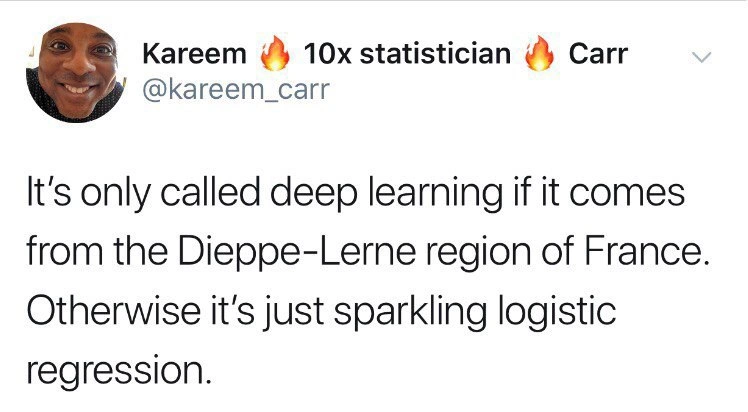
Description

A screenshot of a tweet from user Kareem Carr (@kareem_carr), who identifies as a '10x statistician'. The tweet text reads: 'It's only called deep learning if it comes from the Dieppe-Lerne region of France. Otherwise it's just sparkling logistic regression.' The humor is a clever analogy that mimics the 'terroir' concept for products like Champagne, which can only be called such if it originates from the Champagne region of France. The joke satirizes the hype and marketing in the AI/ML field, humorously suggesting that many complex-sounding 'deep learning' models are fundamentally just more basic statistical models, like logistic regression, given a more impressive-sounding name. This resonates deeply with experienced data scientists and engineers who are often skeptical of buzzwords and appreciate the humor in deflating industry hype


Comments

7
Anonymous ★ Top Pick We just rebranded our legacy ETL script. It's now a 'serverless, event-driven data actualization vortex.' It does the same thing, but now the business development team is very excited about it
  1. Anonymous ★ Top Pick

    We just rebranded our legacy ETL script. It's now a 'serverless, event-driven data actualization vortex.' It does the same thing, but now the business development team is very excited about it

  2. Anonymous

    Amazing how a zero-hidden-layer neural net becomes VC-ready once you carbonate the loss function

  3. Anonymous

    Just wait until the VCs find out their $50M Series B went into a gradient descent function with a marketing department attached

  4. Anonymous

    This perfectly captures the existential crisis every ML engineer faces when explaining to stakeholders that their 'revolutionary AI' is essentially a glorified weighted sum with a sigmoid function - but with a GPU budget that could fund a small country's infrastructure. The real deep learning was the logistic regressions we stacked along the way

  5. Anonymous

    Most enterprise ‘AI’ I audit is sparkling logistic regression - same sigmoid, fancier terroir, bigger GPU invoice

  6. Anonymous

    Like Champagne's AOC, deep learning demands Dieppe-Lerner provenance - else it's just logistic fizz masquerading as vintage depth

  7. Anonymous

    Rebrand logistic regression as a “neural network with zero hidden layers” and watch the AI budget triple

Use J and K for navigation