Skip to content
DevMeme
471 of 7435
A Desperate Warning From a Legacy Code Survivor
LegacySystems Post #541, on Aug 9, 2019 in TG

A Desperate Warning From a Legacy Code Survivor

Why is this LegacySystems meme funny?

Level 1: Just Throw It Away

Imagine you found an old, broken toy that someone left for you. Along with the toy, there’s a big note from the last kid who played with it. The note basically says: “This toy is a total disaster. I tried to fix it and play with it, but it only made me super upset. I even got sick because it was so bad. Please, don’t try to repair this toy – it’s not worth it. It’s put together in the worst way you can imagine. You’d be much happier throwing it in the trash and getting a new toy instead. Good luck, I mean it – you’ll need it if you ignore this warning. Farewell.

This is funny because usually you don’t see such dramatic warnings with toys (or with code!). The grown-up version here is a programmer leaving a note in a program saying the code is so terribly made that it made him feel awful, and he’s begging the next person to just start over fresh. It’s like someone saying a house is so haunted and badly built that you should just tear it down rather than try to live in it. The humor comes from how over-the-top the warning is – it’s extreme, but it shows just how frustrated and done the person was with this broken thing. In simple terms, the meme jokingly tells us: sometimes something is built so badly that the best fix is to throw it away and begin again, for the sake of everyone’s sanity.

Level 2: Spaghetti and XSLT Sauce

Let’s translate what’s going on here into simpler terms and explain the buzzwords. This meme is referencing a horribly written PHP project that one developer inherited from another. The current developer was so frustrated by the state of the code that they wrote a giant warning comment at the top of the file, basically telling anyone who works on it next: “This code is beyond redemption – do yourself a favor and throw it out and start over.”

Some key concepts and terms in this situation:

  • SpaghettiCode: This is a slang term for code that is extremely tangled and unstructured, much like a plate of spaghetti where all the noodles are jumbled together. In a well-organized program, you have clear layers or modules (for example, a database layer, a business logic layer, a presentation layer). In spaghetti code, everything is mixed together in one big mess. Here, the PHP script is described as “uncommented PHP spaghetti fit to feed an army”. That means the PHP code probably consists of one huge file or a few huge files with logic going all over the place, making it very hard to understand or maintain. There’s no clear structure or comments to guide you – you pull one strand (change one part) and the whole thing might unravel or break somewhere else.

  • LegacyCode / LegacySystems: Legacy code means old code that has been around for a while, often written by someone who’s no longer there, using outdated techniques or technology. Maintaining legacy systems is tough because you often weren’t around when they were built, and they might use approaches that are no longer common. In this meme, the developer inherited a legacy system from someone he jokingly calls a “monkey named Joel” – implying the previous coder was very unprofessional or clueless. The code uses older or niche technologies like XSLT and an XML database, which we’ll explain next. The overall CodeQuality of this legacy system is very poor, which is why it’s such a pain.

  • PHP (without a framework): PHP is a programming language mainly used for building websites. Modern PHP development often uses frameworks or Content Management Systems (CMS) like Laravel, Symfony, or WordPress which provide structure (for example, how to handle database, how to separate HTML from logic, etc.). But this project was “without any framework or CMS,” meaning the previous developer wrote raw PHP code from scratch. That’s not inherently evil, but it’s easy to do it poorly. Given it’s called “PHP spaghetti,” the code likely mixes HTML generation, database calls, and logic in one place, making it very hard to follow. The new developer had to dive into this bowl of spaghetti and probably got sauce all over them (figuratively speaking).

  • BaseX Integration: BaseX is a specific technology – it’s an open-source XML database and XQuery processing engine. Think of it as a specialized database for storing and querying XML data. XML is a data format that looks like HTML, often used to structure data. Using BaseX in a web app is uncommon unless you have a very XML-centric project (like storing documents or data in XML format). It’s not part of the typical web stack, especially not with PHP. So this project’s architecture is already peculiar: instead of using a normal relational database (like MySQL or PostgreSQL) or even a simpler solution, the previous dev chose BaseX. The comment says it’s “hardwired into an unfixably broken Manjaro VM,” implying the BaseX server or setup only runs on a particular virtual machine (more on that below) and is not easily reproducible. This is a big red flag for maintainability – if the database or its environment breaks, you can’t just reinstall it easily.

  • XSLT Stylesheet: XSLT stands for eXtensible Stylesheet Language Transformations. It’s a language used to transform XML documents into other formats (often HTML, text, or another XML). For example, if you have data in XML and you want to display it as a web page, you could write an XSLT file that specifies how to turn that XML into HTML. Back in the early 2000s, some systems used XML + XSLT for web content, but it’s fairly old-fashioned now. In this code, there is a “very long XSLT stylesheet” – likely used to format data from the BaseX (XML) into the HTML that gets sent to browsers. The developer mentions that the XSLT, PHP, and BaseX script all try to perform the same kind of document structuring. This suggests that the system was poorly designed – maybe some of the logic for organizing data is duplicated in these different places. For instance, perhaps the BaseX XQuery returns data in a certain structure, the PHP then manipulates it a bit (duplicating some logic), and the XSLT also applies rules to structure it for display. Keeping such logic in sync across three different languages (XQuery, PHP, XSLT) is a nightmare. If a change is needed, you might have to update code in three places consistently. That’s a recipe for errors. This is what the comment hints at: “I bet they have mismatches somewhere” – likely meaning the XSLT output and PHP output might not always agree due to these duplicated heuristics.

  • Manjaro VM Dependency: Manjaro is a user-friendly Linux distribution (based on Arch Linux). A VM (Virtual Machine) is an emulated computer system that runs inside another. So if the code runs in a “Manjaro VM,” that means they set up a virtual machine with Manjaro Linux to host the BaseX database or maybe the whole application. The phrase “unfixably broken Manjaro VM” indicates that this VM environment is messed up – maybe it’s configured in a weird way or has old versions of software that can’t be upgraded without everything failing. It might be one of those situations where “it only works on that one machine.” For a newcomer, that’s terrifying because if that VM ever goes down or if you have to move servers, good luck recreating all those conditions. Modern practice would be to use containers or at least have a clear setup script, but here it’s probably all manual and brittle. Essentially, the system is glued together inside this VM with no documentation on how to set it up again. That’s a huge part of the tech debt.

  • TechDebt (Technical Debt): This term refers to the idea that if you take shortcuts in code (quick fixes, poor design, no refactoring), you “borrow” time initially but you incur a “debt” which comes due later in the form of more complicated, painful maintenance. This project is loaded with technical debt – the original dev probably hacked it together quickly (or sloppily), not thinking about future maintainers. Now the poor maintainer is “paying the interest” on that debt with a lot of pain and suffering, having to tiptoe around fragile code. The rant comment is basically an admission that the debt is too high to ever pay off by incremental fixes – the only sane path is bankruptcy (i.e., throw the whole thing away and start fresh).

  • Developer Rant Comment: In well-kept code, comments are brief and explain tricky parts of the logic or important caveats. Seeing a giant rant like this is unusual and thus both shocking and comical. It’s like opening a textbook and finding a previous student has scribbled a whole page of “Don’t even try chapter 5, the professor is insane!” in the margin. The maintainer’s comment uses colorful, hyperbolic language: references to Mephistopheles (a demon from literature), a monkey with a typewriter (the infinite monkey theorem joke – except here the monkey’s output is diabolical code, not Shakespeare), and even says dealing with it gave him “CLINICAL DEPRESSION” and required therapy. That’s almost certainly an exaggeration for comedic effect (we hope!), but it conveys DeveloperFrustration at an extreme level. He’s basically venting his agony in writing, and also genuinely warning the next person not to follow in his footsteps.

  • "Nuke it and start over" Advice: The final piece of advice in the comment is to “nuke the app and recreate it in Django or whatever works for you.” “Nuke it” is slang for completely destroying something (like nuking from orbit – a dramatic way to say wipe it out entirely). The developer is telling any future maintainer that the codebase is beyond saving – it would be better to rebuild the whole application from scratch using a better toolset. Django is specifically named, which is a popular web framework for Python. Django is known for encouraging good structure (it’s an MVC framework – Model, View, Controller – which separates concerns). Suggesting Django implies that pretty much any modern structured approach would be an improvement over this PHP/BaseX/XSLT tangle. In essence, “or whatever works for you” means any proper framework or stack you prefer; just don’t continue with this madness. This rewrite advice is a bit tongue-in-cheek because, in the real world, rewriting a functioning system is usually risky and costly. But sometimes a system is so bad that a clean slate is actually less work long-term than trudging through mud. The fact that the maintainer explicitly says “I would do it myself, but I risked a relapse simply by opening this file again” is a final humorous exaggeration – like “I can’t touch this code without losing my sanity again.” They “wish you all the luck and strength in the world” – as if the next maintainer is embarking on a perilous quest and will need heroic levels of fortitude.

In summary, this meme highlights severe technical debt and poor code quality in a legacy project, through the voice of a developer who snapped and wrote an epic warning comment. It’s funny in a dark way because many of us in software have inherited projects that were total messes. We might not literally get depressed, but it certainly can be frustrating to the point of despair. The over-the-top language in the comment is what makes it meme-worthy – it’s a cathartic, dramatic expression of developer frustration. For a junior developer, it’s also a cautionary tale: this is what can happen if projects aren’t maintained properly or if you take too many shortcuts. You end up with a legacy codebase so bad that even adding “a few small enhancements” (as the professor requested in this story) becomes a traumatic experience. When you see the warning “DO NOT FOLLOW IN MY STEPS,” that’s a lesson to not continue kludging on a broken foundation. Instead, sometimes the right call is to step back and rebuild things the right way, if you have the opportunity. And if you ever find yourself writing a comment like this, well... you know something has gone terribly wrong in your project!

Level 3: Nuke from Orbit

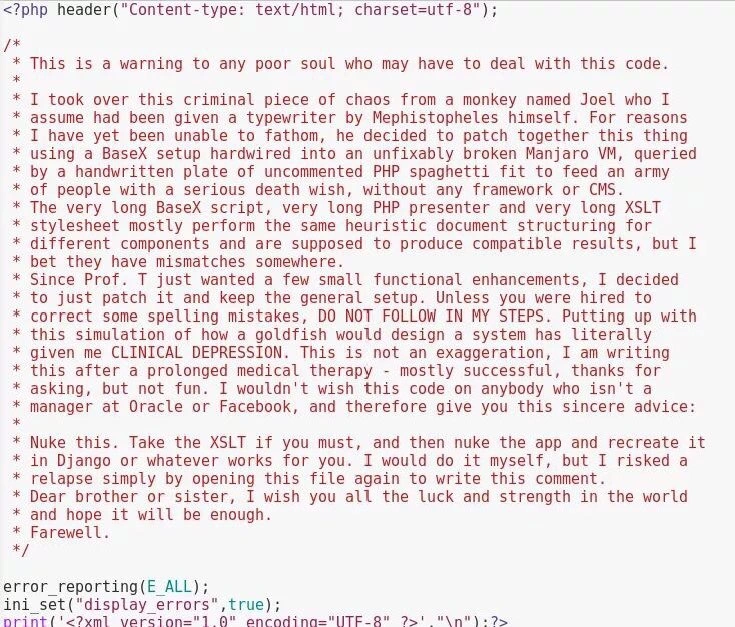
This codebase is the stuff of legend in the worst way – a Frankenstein of legacy systems and spaghetti code so tangled that the current maintainer basically left a suicide note in the comments. The screenshot shows a PHP file that opens with a massive rant comment spanning dozens of lines. It reads like a weary war veteran’s final letter, warning any future developer: “I took over this criminal piece of chaos from a monkey named Joel who I assume had been given a typewriter by Mephistopheles himself…” – and it only gets darker from there. The author claims maintaining this monstrosity gave him clinical depression, and half-jokingly says he wouldn’t wish such a cursed codebase on anyone short of “a manager at Oracle or Facebook.” In other words, this is a rallying cry from one burnt-out dev to all others: if you touch this, it will hurt.

From a senior developer’s perspective, the humor (and horror) comes from just how extreme this situation is. We’ve all seen bad legacy code, but this one checks every box of a nightmare project. It’s not just one issue – it’s all of them at once, turned up to 11. Let’s break down the hall of fame of CodeQuality sins on display here:

  • Unstructured PHP Spaghetti: Thousands of lines of raw PHP thrown together without any framework or CMS. This suggests the code has no clear architecture – it just flows and jumps around like a plate of spaghetti, impossible to untangle. Maintaining such code is a constant battle; you fix one thing and three other things break.
  • BaseX Integration: The app relies on an obscure BaseX XML database, hardwired into an “unfixably broken” Manjaro VM. BaseX is a niche XML data store and XQuery engine – powerful in the right context, but here it’s used in the most fragile way possible. The code likely issues queries to the BaseX engine for data, but because it’s “hardwired,” it may be using specific file paths or assumptions that only work on that one VM. If the VM’s state is messed up, the whole data layer collapses.
  • XSLT Hell: There’s also a long XSLT stylesheet in play, used to transform XML data into HTML. XSLT (Extensible Stylesheet Language for Transformations) is an old-school way to apply style/rules to XML. It’s powerful, but writing large XSLT by hand can be painful – it’s like writing programs in a templating language from the 90s. The kicker: the rant says “the very long BaseX script, very long PHP presenter, and very long XSLT mostly perform the same heuristic document structuring... supposed to produce compatible results, but I bet they have mismatches somewhere.” This implies duplicate business logic in three places (the database script, PHP code, and XSL transform). Maintaining one copy of complex logic is hard enough; imagine trying to keep three separate implementations in sync manually. It’s a breeding ground for subtle bugs and inconsistencies.
  • Manjaro VM Dependency: The whole thing runs on a specific Manjaro Linux virtual machine that’s “unfixably broken.” In senior-dev speak, this means the deployment environment is a ticking time bomb. Maybe library versions are locked or the system is so brittle that updating anything breaks everything. The next poor soul can’t just git clone the project and run it – they’d have to resurrect this exact VM (with all its quirks) to even see the app working. This is LegacySystems 101: when code becomes tied to a specific, ancient environment that nobody dared to change.
  • Zero Documentation (except the rant): There are no inline comments explaining the code – only this mega-rant at the top, which, while hilarious, doesn’t actually describe how the code works. It’s basically a big red “HERE BE DRAGONS” sign. That’s better than nothing (at least you know you’re in for pain), but it provides zero guidance on the code’s intent or structure. The new maintainer is flying blind, only with the knowledge that the last pilot crash-landed and cursed the plane on his way out.
  • Developer Frustration Personified: The commenter literally compares maintaining this system to torture. Lines like “simulation of how a goldfish would design a system” and “Putting up with this… has given me CLINICAL DEPRESSION” are hyperbolic dark humor, but they resonate with any dev who’s been stuck in a death-march maintenance project. It’s common in TechnicalDebt nightmares to feel helpless or crushed, and this dev vented all that pain into the code comment. Their mental health suffered ("prolonged medical therapy – mostly successful, thanks for asking"), and while that’s tongue-in-cheek, it underscores how toxic a bad codebase can become for the humans working on it. Burnout is real, and here it’s depicted in the most dramatic fashion.

In short, this codebase is a perfect storm of legacy horror: bizarre tech choices (PHP+BaseX+XSLT gumbo), no structure or support, environment lock-in, duplicated logic, and a maintainer at wits’ end. The humor lands because it’s an absurdly exaggerated version of something many developers have experienced: inheriting code that makes you want to pull your hair out. We usually keep our despair internal (or share war stories over a beer), but this hero put it all out there in a comment for posterity.

The punchline: after describing the madness, the commenter pleads with future maintainers to “Nuke this. Take the XSLT if you must, and then nuke the app and recreate it in Django or whatever works for you.” This is basically saying: “Burn it down and start over, trust me.” The fact they specifically suggest Django (a Python web framework known for cleanliness and strong architecture) is telling – it’s like saying, “Please, use anything sane instead of continuing with this pile of chaos.” Among experienced devs, a common dark joke for hopeless systems is “rewriting from scratch is the only option”. We all know the famous adage “rewrite is the single worst strategic mistake” (Joel Spolsky’s rule about never doing full rewrites)… but you also know a codebase is irredeemable when even a rewrite seems less painful. The humor here is that the situation is so dire, the usual best practices and caution about rewrites go out the window – just torch it and rebuild (or as sci-fi fans put it, "nuke it from orbit, it’s the only way to be sure"). The commenter essentially performed a last service: giving explicit permission to the next dev to ignore sunk costs and do the sane thing (start fresh), because continuing down this path broke them.

It’s rare to see such an honest, brutal commentary inside the code. Normally, comments are for clarifying code logic; here it’s a personal emotional log. That contrast is hilarious and tragic at once. It’s like finding a diary entry from the last survivor of a doomed expedition, warning you not to proceed. Seasoned devs laugh (and wince) at this because it captures, in ridiculously over-the-top fashion, the very real nightmare of inheriting a LegacyCodebase riddled with TechnicalDebt. The references to monkeys and demons, the dramatic curse-laden advice, the burnout confession – it’s cathartic humor. We’ve all wanted to write something like this at some point. Most of us refrain, but seeing someone actually do it – in bright red text in the source file – is both shocking and satisfying.

To put it another way, this meme is a code quality horror story distilled into one screenshot. It’s funny because it’s true (in spirit, if not literal fact) – bad code can feel like a curse. And here the poor maintainer isn’t just passing on the curse, he’s actively trying to break it by urging the next person to destroy the cursed object (the code) once and for all. In the realm of dev humor, this is as darkly comedic as it gets, and every senior engineer reading it is nodding along thinking, “Yup, been there – maybe not that bad, but close. I feel you, brother. Farewell indeed.”

Description

A screenshot of a lengthy, desperate, and humorous block comment within a PHP source code file. The comment is framed as 'a warning to any poor soul who may have to deal with this code.' The author details their harrowing experience taking over a 'criminal piece of chaos' from a previous developer, describing the system as 'uncommented PHP spaghetti' running on a 'hardwired... unfixably broken Manjaro VM' and using a bizarre combination of BaseX and XSLT. The developer claims the project is like 'a simulation of how a goldfish would design a system' and that it has given them 'CLINICAL DEPRESSION.' The comment culminates in sincere advice to the next developer: 'Nuke this... recreate it in Django or whatever works for you.' The author ends by saying they 'risked a relapse simply by opening this file again to write this comment,' and wishes the future maintainer luck. This captures the ultimate nightmare for senior engineers: inheriting a completely unmaintainable, illogical, and psychologically damaging legacy system
Comments

7
Anonymous ★ Top Pick That's not technical debt, it's a high-interest, subprime mortgage on a haunted house built over an ancient burial ground. The only sane refactoring strategy is arson
  1. Anonymous ★ Top Pick

    That's not technical debt, it's a high-interest, subprime mortgage on a haunted house built over an ancient burial ground. The only sane refactoring strategy is arson

  2. Anonymous

    Inherited a PHP script hot-glued to BaseX and XSLT on a forgotten Manjaro VM - updated the runbook to: 1) tar czf backup.tar.gz /dev/null, 2) git init a fresh Django repo

  3. Anonymous

    This comment achieves what most enterprise documentation fails to do: it tells you exactly why the system exists, why it shouldn't, and provides a clear roadmap for the future. Peak technical leadership is leaving breadcrumbs for the next poor soul who inherits your chaos

  4. Anonymous

    This comment is the software engineering equivalent of finding a note in a haunted house that says 'GET OUT.' The author didn't just leave breadcrumbs for the next developer - they left a full psychological evaluation, a warning label, and what appears to be a last will and testament. The suggestion to 'nuke it and recreate it in Django' is the technical equivalent of 'burn it down and salt the earth.' We've all inherited code that made us question our career choices, but this developer actually documented the five stages of grief in a single comment block. The real tragedy? Someone will still try to add a feature to this instead of following the advice, because 'it's just a small change.'

  5. Anonymous

    When your top-of-file comment reads like a blameless postmortem and PHP is printing XML for XSLT from BaseX on a haunted Manjaro VM, the pattern isn’t MVC - it’s RMR: rm -rf, migrate, rewrite

  6. Anonymous

    Patched the bleeds, but the diagnosis is terminal: 'rm -rf && django-admin startproject sanity' - tech debt's only cure when interest compounds faster than prod outages

  7. Anonymous

    When your stack is BaseX + handwritten PHP + XSLT on a broken Manjaro VM, the only accurate architecture decision record is “rm -rf” - finally, a comment that ships the correct design

Use J and K for navigation