The Perils of DIY Security: A Developer's Party Foul
Why is this Security meme funny?
Level 1: Cardboard Lock
Imagine a kid who doesn’t trust regular locks, so he makes his own lock for his treasure box using cardboard, tape, and glue. He’s at his birthday party, proudly thinking, “Haha, nobody knows I built this super-secret lock all by myself.” He believes he’s outsmarted everyone. But during the party, the worst (and funniest) thing happens: the box pops open and all his candy spills out on the floor! 🍬🚪 The homemade lock falls apart completely.
All the other kids see it happen. One friend shouts, “We all just saw your candy escape everywhere!” Another laughs and asks, “Is using tape and paper what we call a ‘real lock’ now?” The poor kid in the party hat turns red with embarrassment. He tried to be clever and do it his own way, but instead of keeping his candy safe, his fake lock failed and made a mess that everyone noticed.
This is exactly what’s going on in the developer meme, just in simpler terms. The developer’s “security from scratch” is like the kid’s cardboard lock. He was proud and thought no one would notice his special homemade solution, but it didn’t work at all. The “breach” was like the candy spilling out – all the secret stuff got out for everyone to see. And the other people at the party teasing him are like the developer’s friends or teammates saying, “Told ya so!”
It’s funny because the kid (and that developer) learned a very public lesson: some things, like locks (and computer security), are better left to the real experts or proper tools. Trying to do it with cheap craft materials (or sloppy code) might seem inventive, but it can backfire in an almost cartoonish way. Everyone ends up laughing, not because the candy or data spilling out is good, but because the overconfidence leading up to the fail is so relatable and silly. In the end, both the kid and the developer will probably do things differently next time – maybe use a real padlock, and in the developer’s case, use trusted security libraries – so their treasures stay safe and sound.
Level 2: Security 101 Fail
In plain terms, this meme is joking about a programmer who tried to create a whole security system by himself, and it backfired spectacularly. “Built my own security features from scratch” means he wrote his own code for things like user login, password handling, and data protection instead of using existing, proven solutions. That’s usually a bad idea, especially for a less experienced developer. Here’s why the situation in the meme is both funny and a bit painful:
- Security is tricky: Good security involves a lot of careful thinking and well-tested math. It’s easy to get wrong if you don’t have experience. Professionals usually rely on frameworks or libraries (pre-made code) that follow security best practices. Our guy ignored that and decided to do it all himself. That’s like saying, “I’ll build my own safe to store my valuables” when you’ve never built a safe before. Chances are, you’ll accidentally make a weak safe.
- The data leak: In the cartoon, everyone mentions a data leak. A data leak is when private information (like users’ passwords, emails, or personal data) gets out to people who shouldn’t have it. That might happen if a hacker breaks in or if the developer made a mistake so that the data became public. In this story, the “from scratch” security was so flawed that all the data spilled out — everyone at the “party” knows about it, meaning the breach was obvious. Think of a data leak like all your secret stuff suddenly being posted on a bulletin board for all to see. It’s a big oops.
- Emailing passwords (big no-no): One character asks, “Did anyone else just get their password emailed to them?” This is highlighting a terrible practice that the developer’s system did. Normally, websites and apps will never email you your actual password. If you forget your password, they send a reset link rather than the password itself. Why? Because they’re not supposed to know your password in plain text at all — it should be stored in a scrambled, secure form. If a system can email you your password, it means it was saving that password in an unsafe way (almost like keeping all the keys under the doormat). And emailing it is like sending a copy of your key through the mail where it could be intercepted. It’s one of those things that immediately tells you “this is insecure.” So, in the meme, someone noticing “hey, I got my password emailed” is basically them saying, “Wow, this system is doing something outrageously insecure.” Everyone recognizing that is part of the joke — it’s such a blatant mistake that even non-tech people know it’s bad.
To visualize the contrast, here’s a quick sketch of wrong vs right when handling passwords in code:
# ❌ Insecure approach (what our DIY dev might have done):
def register_user(username, password):
database.save(username, password) # store the actual password (unsafe!)
send_email(username, f"Your password is {password}") # email the user their password (very unsafe!)
# ✅ Secure approach (what should be done):
import hashlib
def register_user_proper(username, password):
password_hash = hashlib.sha256(password.encode()).hexdigest() # convert password to a hash
database.save(username, password_hash) # store only the hash, not the real password
# If the user forgets their password, we'd send a password reset link via email, not the password itself.
What’s happening: In the insecure approach, the password is stored in plain text (anyone who accesses the database can read it) and even emailed out (now it’s traveling across the internet, readable to anyone who grabs that email). In the secure approach, the password is turned into a hash (a one-way scrambled version). The database only stores that hash. Even if someone looks in the database, they can’t get the original password from it easily. And if the user forgets their password, the system will send a special link to reset it, instead of ever revealing the old password.
- Copy-pasting code (“from ScratchOverflow”): Another part of the meme jokes that our developer just copied code from Stack Overflow and called it “from scratch.” Stack Overflow is a website where programmers ask and answer coding questions, and often you’ll find code snippets as answers. Copying a snippet can be a quick way to solve a problem, but doing so without fully understanding it – especially for something like security – is dangerous. It’s like copying someone’s recipe but not reading the whole thing: you might mix in ingredients out of order or use the wrong temperature because you didn’t get the context. If the developer pieced together code from online answers, he might have introduced mistakes or gaps. Plus, saying you built something “from scratch” when half the code is copy-pasted is kinda dishonest (and people will definitely roll their eyes at that). This meme calls that out. In developer culture, there’s a tongue-in-cheek term, CopyPasteCoding, for when someone blindly uses others’ code. Seasoned team members usually catch it when a feature is oddly implemented or inconsistent. Here, the friend’s shirt text jokes that copying from Stack Overflow hardly counts as building it yourself, hinting the dev wasn’t as genius as he claims – and it probably contributed to the system being low-quality.
- “Do your own billing next” – sarcasm explained: The last joke suggests if the guy loves reinventing things so much, maybe he should build a billing (payment) system from the ground up too. This is said tongue-in-cheek, because doing your own billing software is another famously bad idea unless you’re a domain expert. Handling money (calculations, taxes, transaction security, compliance with banks) is complex and mistakes there can literally bankrupt a company or land you in legal trouble. By sarcastically proposing this, the friend is basically saying, “After the way you messed up our security, I dare you to also mess up something even more critical!” It’s teasing the developer’s overconfidence. In simpler terms, they’re joking “What’s next? Are you going to personally reinvent everything we rely on, and break that too?” It emphasizes how out-of-depth the dev was.
All together, the meme is a friendly warning disguised as a joke. The developer thought building his own security system would make him look smart and original, but it actually was a failure that everyone noticed. Now he’s the butt of the joke at the party. For a junior developer or anyone new: the lesson is not to underestimate tasks like security. Usually, it’s smarter to use well-known libraries or tools that experts have crafted and vetted. It’s not “cheating” or being lazy – it’s being responsible. In the end, everyone at the “party” would have been happier if this guy had just used a standard, safe solution instead of a clumsy homemade one. The humor works because it’s developer humor that rings true: we laugh, a bit nervously, because we know this could happen if we’re not careful. And let’s be honest, many of us have had a moment early on where we tried something wild on our own, only to have it blow up in our face. This meme just captures that feeling in one cringey, funny snapshot.
Level 3: Not Invented Here
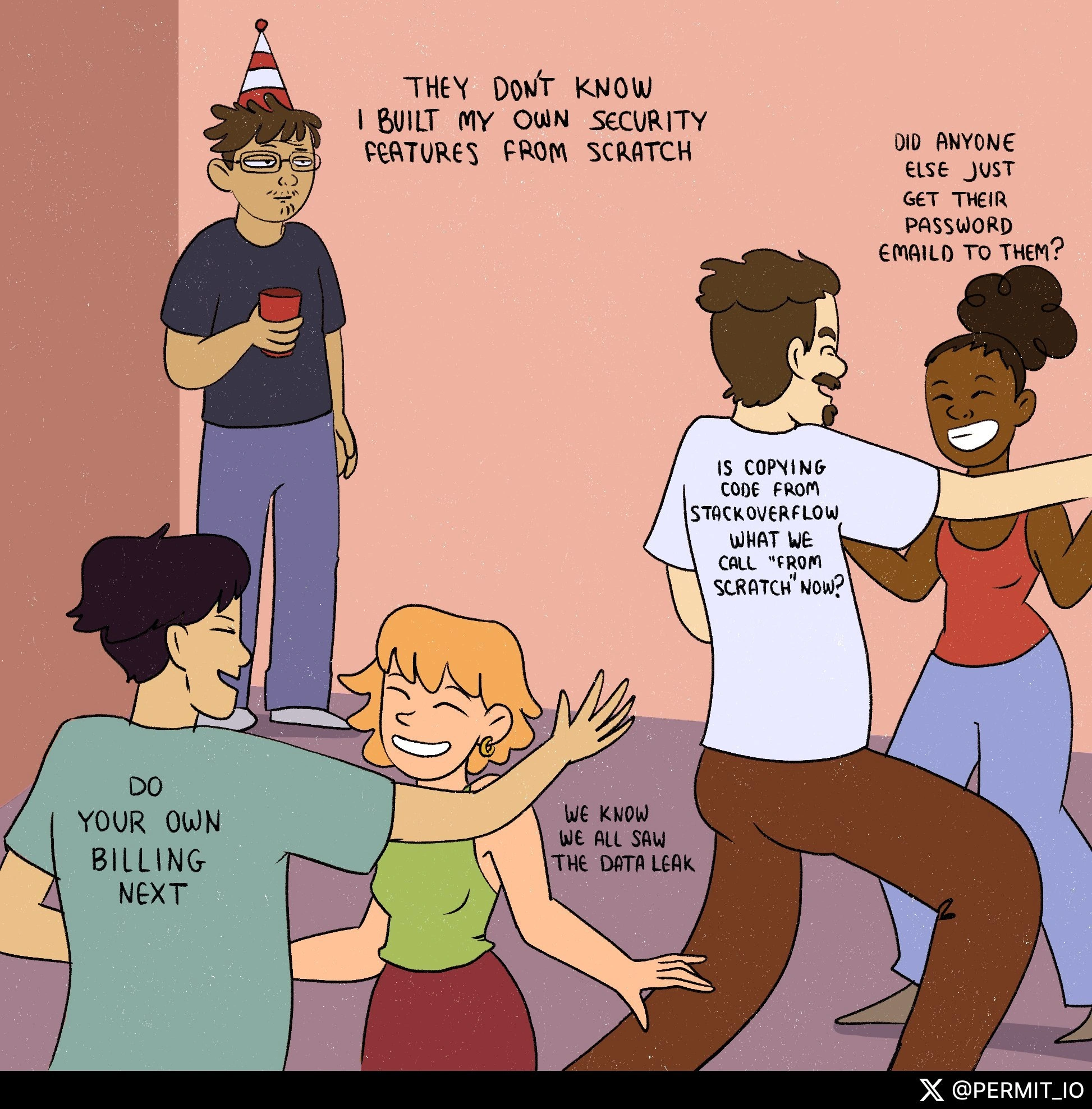
This meme highlights a scenario that makes every senior developer cringe: a proud programmer “rolling their own security” and learning the hard way why that’s a bad idea. It’s a mix of hilarity and horror, poking fun at NotInventedHereSyndrome in a security context. The image uses the classic party meme format (“They don’t know…”) to set up the punchline. Let’s break down each part of the joke:
- “They don’t know I built my own security features from scratch.” – This is the lone developer’s smug thought bubble. He’s at the party, wearing a silly birthday hat and holding a drink, assuming others are oblivious to his grand achievement of coding a security system by himself. In reality, any experienced dev hearing someone brag about a custom homebrew security solution immediately gets nervous. It’s usually a red flag. Why? Because building security from scratch often means ignoring battle-tested libraries and standards. The guy in the hat thinks he’s being clever and that everyone is impressed (or at least unaware of his daring feat). Little does he know, this is setting up for a punchline where his confidence will crumble.
- “We know, we all saw the data leak.” – Ouch. This blunt retort from another party-goer pops the bubble instantly. It translates to: “Yes, we do know what you did, and by the way, it ended in a disaster.” In other words, his custom security failed spectacularly, and everyone found out when a data leak happened. In real life, a data leak means sensitive user info (like passwords, personal data) got exposed publicly or stolen. So the whole “party” (think of it as his team or users) witnessed the breach. The humor here is dark and relatable – we’ve all seen projects where overconfidence led to an embarrassing failure. The fact that everyone remembers (“we all saw it”) adds to the humiliation: it wasn’t a quiet, sneaky bug; it was a big, flashing, siren-blaring incident.
- “Did anyone else just get their password emailed to them?” – Another attendee chimes in with this sarcastic question, highlighting a specific cringe-worthy detail of his implementation. Proper systems never email you your actual password. If you forget your password, they send you a reset link, not the password itself, because even the system shouldn’t know it in plain text. So if people got their passwords emailed, it means this dev’s system was storing passwords in plain, readable form (huge no-no) and then actually sending them over email (even bigger no-no). That’s like a bank sending you a letter saying, “Here’s a copy of your vault key in case you lost it” – ridiculously insecure. This line in the meme is both funny and horrifying to developers: it’s funny because it’s such an absurd rookie mistake, and horrifying because it implies a massive security flaw. It’s basically shouting, “Your system is so broken that it’s doing the one thing every security tutorial says not to do!”
- “Is copying code from StackOverflow what we call ‘from scratch’ now?” – The guy in the white shirt is dancing and roasting our DIY dev at the same time. Stack Overflow, of course, is the famous Q&A site where developers copy snippets of code to solve problems. There’s nothing wrong with learning from examples online – every developer does it – but there’s a big difference between using a snippet wisely and blindly copy-pasting critical code. This quip implies that our boastful dev didn’t truly write all his security code independently; he cobbled it together from random internet snippets. Calling that “from scratch” is pretty hypocritical. Plus, copying code without fully understanding it is a recipe for bugs and security vulnerabilities. Seasoned devs recognize this behavior: it’s how you get weird errors or holes in your system because you pasted something that wasn’t meant for your case. So this partygoer’s joke lands two punches: it undermines the “from scratch” brag and hints that the code quality of this custom security is probably terrible (since it was copy-pasted).
- “Do your own billing next.” – This final bit of snark comes from the friend in the teal shirt. If the developer enjoys reinventing wheels so much, why not try something even more notoriously complex and see how that goes? Billing systems (handling payments, invoices, credit cards) are infamously tricky and high-stakes. Telling him “do your own billing next” is basically saying, “Great job, you screwed up security, maybe you’ll be bold enough to screw up our payment system too!” It’s a form of tech sarcasm. In other words, the friend is joking that if this guy isn’t stopped, he’ll try to custom-build the next critical system (and likely create another mess). It highlights how absurd the situation is: nobody in their right mind writes a entire billing system from scratch without serious expertise, just like nobody should roll their own auth. This line underscores the overengineering folly at play. The developer focused on doing something himself that he really shouldn’t have, and now he’s being mockingly encouraged to make an even bigger mistake.
Stepping back, the whole party scene is a metaphor for the development team or community reacting to this fiasco. The lone developer thought he’d be the hero by not using standard solutions (perhaps out of pride or ignorance), but instead he created a huge problem — a breach everyone is now aware of. The meme is poking fun, but it’s also cautionary: security best practices exist for a reason. Ignoring them leads to technical debt (now someone has to fix his system, clean up the mess, and regain users’ trust) and often public embarrassment (like a breach that users notice, or colleagues making jokes at your expense). It’s funny to those of us in software because it’s a shared nightmare — we either have made similar mistakes in our early days or have seen a colleague do something like this. The “party” format exaggerates it, but the core is true: boastfully doing things your own way in a critical area like security usually ends with everyone whispering, “Remember that time you thought you were smarter than decades of security research… and weren’t?”
Level 4: Crypto Quicksand
In the realm of security, building critical features from scratch without deep expertise is like wandering into cryptographic quicksand. The mathematical foundations of encryption and authentication are unforgiving — a tiny mistake in an algorithm can introduce a glaring vulnerability. There’s a reason experts constantly warn “Don’t roll your own crypto.” Even professional cryptographers rely on widely studied algorithms and carefully vetted implementations.
Our party-hat developer presumably ignored these warnings. If he’s emailing passwords in plain text and calling it security, he likely skipped industry-standard hash functions (like bcrypt or Argon2) that safely store passwords. Instead, maybe he kept passwords in plaintext or “encrypted” them with a homemade scheme (the kind of naive cipher an attacker can break before the DJ finishes the next song). This betrays a violation of Kerckhoffs’ principle – the idea that a system should be secure even if everyone knows how it works (except the secret key). By relying on secret, untested code, he’s practicing security by obscurity. Seasoned engineers know that’s a false sense of safety: once someone peeks at or reverse-engineers his code (or intercepts those password emails), the house of cards collapses.
Historically, many DIY cryptosystems have crumbled quickly under scrutiny. Bruce Schneier famously said that anyone can create an algorithm that they themselves can’t break; the hard part is creating one that nobody else can break. Without rigorous peer review and cryptanalysis, a homegrown security feature is like a vault made of wet cardboard. It might look like a vault to its creator, but attackers will shred it in seconds. In our meme’s world, that “vault” broke so badly that all the party-goers are aware of the breach. It’s a textbook case of overconfidence backfiring: by neglecting proven cryptographic standards and best practices, the developer practically rolled out a red carpet for attackers. No formal verification, no comprehensive testing — basically no safety net. The result? A security implosion so obvious that even the casual onlookers at this cartoon party are in on the joke.
Description
This is a cartoon meme using the 'They Don't Know' party format. A smug-looking developer in a party hat stands alone in a corner, thinking, 'THEY DON'T KNOW I BUILT MY OWN SECURITY FEATURES FROM SCRATCH.' The rest of the party guests are dancing and talking, with speech and text on their shirts revealing the consequences of his work. One person's shirt reads, 'IS COPYING CODE FROM STACKOVERFLOW WHAT WE CALL \'FROM SCRATCH\' NOW?' while another guest asks, 'DID ANYONE ELSE JUST GET THEIR PASSWORD EMAILED TO THEM?'. Another shirt sarcastically suggests, 'DO YOUR OWN BILLING NEXT,' and a nearby comment adds, 'WE KNOW WE ALL SAW THE DATA LEAK.' The watermark '@PERMIT_IO' is visible at the bottom. The meme humorously critiques the Dunning-Kruger effect in software development, specifically the dangerous overconfidence of building critical systems like security from scratch. It highlights common anti-patterns like plaintext passwords and copying code without understanding, leading to a predictable data leak. The joke is deeply relatable to senior engineers who understand that using specialized, third-party services for complex domains like security (and billing) isn't a shortcut, but a mark of experience and wisdom

Comments
25Comment deleted
The quickest way to get promoted to 'customer' is to announce you've written your own authentication service. The second quickest is emailing everyone their password to prove it works
Rolling your own auth feels heroic right up until the SOC-2 auditor asks where you store the salt, and the only place you can point to is the password-reset email
The real security vulnerability here isn't the homebrew auth system - it's the developer's confidence surviving contact with production. Nothing says 'senior engineer' quite like watching your custom security solution become tomorrow's CVE while the PM asks why you didn't just use Auth0
Ah yes, the classic party where everyone's secretly aware that Bob rolled his own AES implementation using XOR and a random number generator seeded with `Date.now()`, but nobody wants to be the one to tell him that the 'security audit' he's so proud of was just ESLint complaining about unused variables. Meanwhile, the real elephant in the room is that their OAuth tokens are being stored in localStorage and the session cookies have `secure: false` because 'it was easier to debug that way' six months ago
Roll-your-own auth: the fastest path from ADR to IR - ‘build vs buy’ becomes ‘breach vs buy’ once the passwords start arriving by email
If your app emails passwords, congratulations - you’ve built a zero-cost secrets distribution service and an unlimited incident‑response budget; OIDC would’ve been cheaper
Nothing says 'secure' like a Stack Overflow answer with 2 upvotes and a 'works on my machine' comment
reinventing a square wheel ♥💖💘💞💟💕 Comment deleted
I mean, it depends. I'm tired of this absolutism Comment deleted
Only people who understand why you shouldn't write your own crypto are allowed to write their own crypto Comment deleted
Ron Rivest's crypto algorithms are quite a proof to that. Comment deleted
Since when "security features" mean cryptographic primitives? Also most commonly used security models are outright bad and the general track record of the industry is so absurd it boggles my mind. Comment deleted
fr, hacking means hacking people, data can be secured easily, but ppl keep forgetting passwords and their social media footprint is a shitton of personal data Comment deleted
That assumes existing libraries a) exist for the target platform, b) work. My friend had to implement RSA manually because all/most existing libraries required allocations, and their environment didn't provide allocation facilities. I'm not saying I'm happy with their decision, but it's one of the many possible ugly solutions in absence of a clean one Comment deleted
can you tell me what arch/env that was and what IP address they use? Comment deleted
mhm, not sure. that code was required for some weird playstation hack Comment deleted
…I couldn't do anything with actual info anyway 😅 Comment deleted
I needed a fast parallel SIMD-based SHA-256 implementation once. Side-channel leaks weren't a problem in that context, and no existing solutions suited me, so I just implemented it myself. How was I supposed to sidestep that? Comment deleted
oh, something something telegram Comment deleted
Not quite, but I think they used a custom cipher mode Comment deleted
AES IGE used in MTProto is in OpenSSL. Comment deleted
Also I plan to start implementing macaroons library soon. With canonical s-expressions and tweetnacl most likely. I want to keep it minimal. Comment deleted
Also also, you absolutely should do that. And then have someone come over and show you all the ways it is broken. Otherwise you'll never learn. The amount of cargo-culted nonsense that passes as security nowadays is pretty high. If you don't have security-focused person in your circle, or even if you do, consider doing it as an exercise with a friend and then swap the projects and try to break each other's thing. Comment deleted
Fr tho some things are stupidly genius. Like you dont need a backup if you have a printer that prints all transactions. And no hacker can ruin those /s Comment deleted
They can still spam them to hell. That's extremely common technique to do after intrusion to deal with network logging & IDS/audit logs. Comment deleted