The AI Wearables Body Map
Why is this AI ML meme funny?
Level 1: Gadget Stickers Everywhere
This is like companies looking at a person and putting sticky notes on every body part that says, "We can sell a gadget here." The funny part is that instead of asking whether people need all these devices, the picture makes it look like everyone is racing to claim a spot before someone else does.
Level 2: Gadgets Want Context
Wearable technology means computers people wear, such as watches, earbuds, glasses, pins, or sensors. Ambient computing means technology that is always nearby and reacts to context without the user opening a normal app each time.
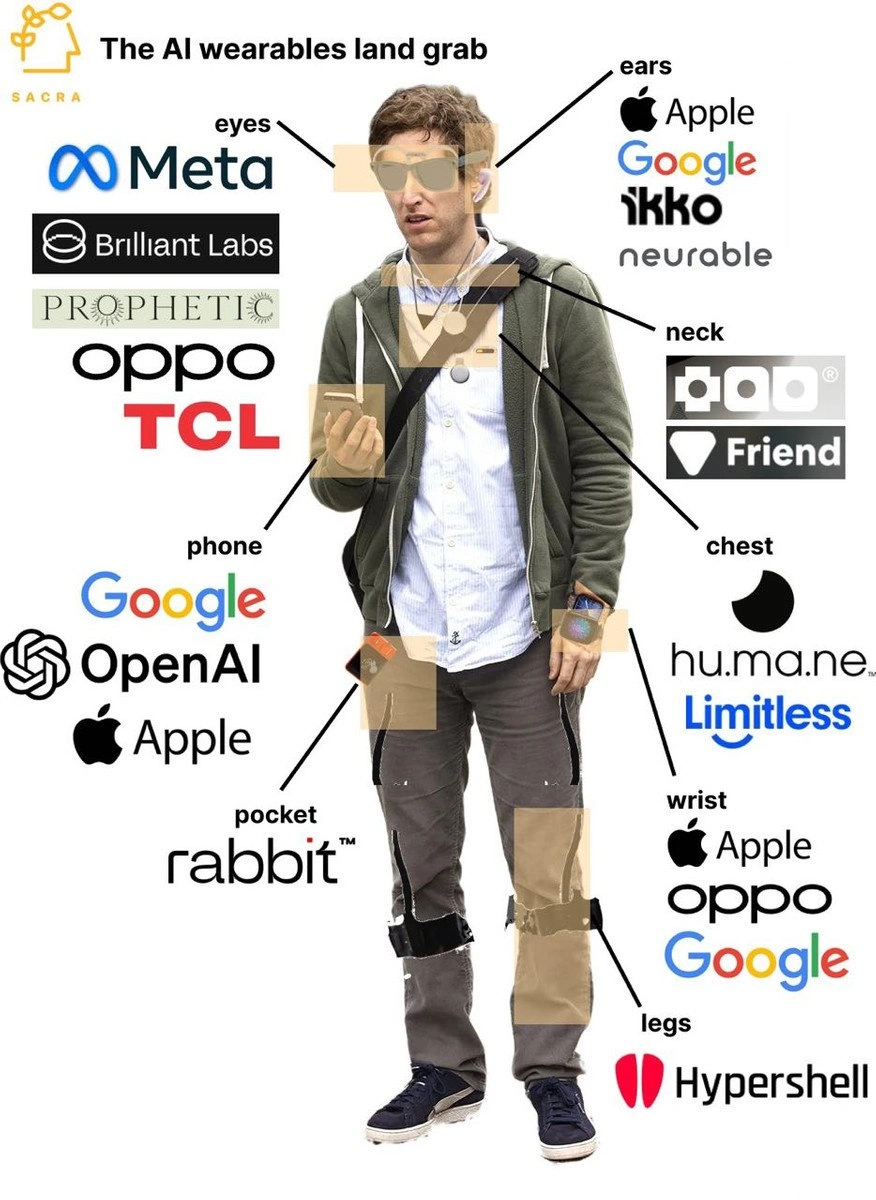
The image maps different companies to different body areas. "Eyes" points to glasses-style devices. "Ears" points to audio devices. "Chest," "neck," and "pocket" point to AI companion gadgets. "Wrist" points to watches, and "phone" points to the companies already fighting over mobile assistants.
For newer developers, the key idea is that AI products need inputs. A chatbot in a browser only knows what you type. A wearable can know more: what you hear, see, say, touch, or do. That extra context can make the product more helpful, but it also raises harder questions about permissions, privacy, latency, battery, and whether the user actually wants another device asking for a firmware update.
Level 3: Body As Platform
The image title says:
The AI wearables land grab
and the joke is that the human body has been turned into a market map. The central figure is covered with translucent rectangles, while arrows assign product categories to body parts: "eyes," "ears," "neck," "chest," "wrist," "phone," "pocket," and "legs." Around those labels are company names like Meta, Apple, Google, OpenAI, rabbit, humane, Limitless, and Hypershell.
The phrase land grab is doing serious work. In software, companies fight to own layers: the operating system, browser, app store, cloud, identity, payments, assistant, and developer ecosystem. This meme says the next platform layer is not a screen or server. It is your face, ears, chest, wrist, and pocket. Very normal industry behavior: when the phone platform gets crowded, begin partitioning the user.
For experienced developers, the humor is that AI wearables promise ambient computing but inherit every old platform problem. Who owns the microphone? Which assistant gets invoked first? Where does the data go? What is processed locally versus in the cloud? How does battery life survive always-on sensing? What happens when three devices all think they are the context layer? The diagram looks like a product roadmap, but it also looks like a distributed systems diagram where every node is strapped to someone's body.
The visible categories also reveal the interface-design bet. Eyes suggest AR glasses and visual overlays. Ears suggest voice assistants and audio capture. Neck and chest devices suggest always-available companions or memory aids. Wrist implies watches and health sensors. Phone and pocket imply the familiar mobile hub plus new AI gadgets trying to escape it. Legs are the most absurd and therefore maybe the most honest: if there is a body part left, someone can pitch a device for it.
The satire is not that all wearables are pointless. Watches, earbuds, glasses, assistive devices, and fitness hardware can be genuinely useful. The joke is the startup-market reflex to turn every physical surface into a wedge for ambient AI. The user becomes the cloud region. The body becomes the app store. The privacy policy becomes cardio.
Description
An infographic titled "The AI wearables land grab" shows a full-body photo of a man overlaid with translucent rectangles where different wearable devices might attach. The left side maps "eyes" to Meta, Brilliant Labs, Prophetic, Oppo, and TCL; "phone" to Google, OpenAI, and Apple; and "pocket" to rabbit. The right side maps "ears" to Apple, Google, ikko, and neurable; "neck" to Bee and Friend; "chest" to humane and Limitless; "wrist" to Apple, Oppo, and Google; and "legs" to Hypershell, with a small SACRA logo in the upper left. The humor is that AI hardware companies appear to be claiming human body real estate the way cloud vendors claim service categories, turning the user into a walking platform surface.
Comments
6Comment deleted
The platform strategy is simple: if the OS cannot own the user, ship enough peripherals to cover the user.
The dude doesn't have a smart ring, clearly missing out Comment deleted
He also doesn't have a smart brain. Comment deleted
What about shoes :D? Comment deleted
And a neuralink in the head Comment deleted
Oppo 🤮 Comment deleted