Boydefendr: The Dystopian Security Alert for Unwanted Gazes
Why is this Security meme funny?
Level 1: Tattletale Tech
Imagine you’re at school and you have a very overprotective friend or sibling. Let’s say every time anyone even glances at you, that friend runs to the teacher and yells, “Teacher, teacher! Someone is looking at them!” Even if it’s just a kid from another class who looked your way for a few seconds, your friend makes a huge deal out of it, like it’s a big security issue. Sounds pretty silly, right? That’s basically what this meme is joking about, but with your phone acting like that tattletale friend.
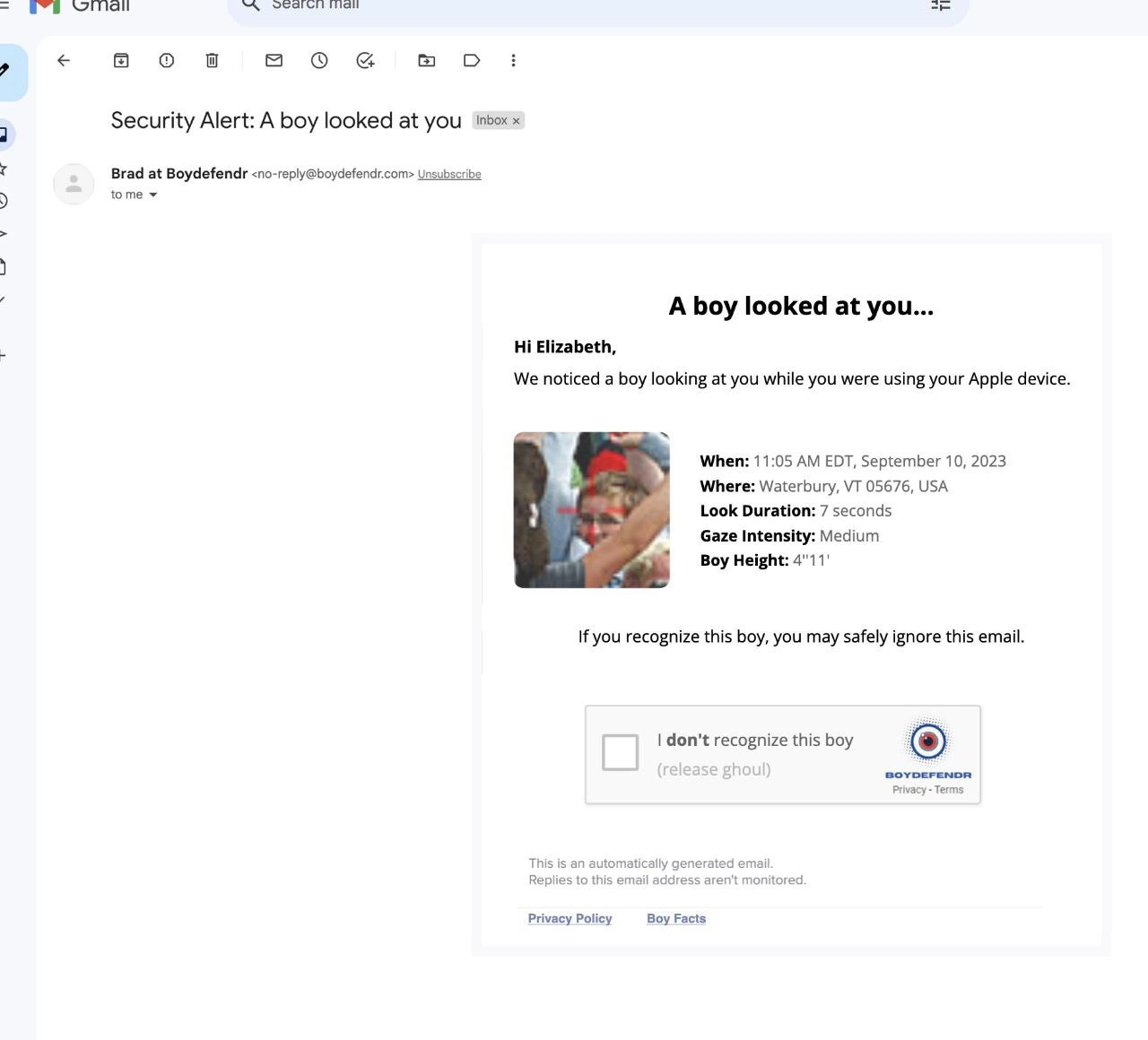
In the picture, the phone sends an email saying, “Security Alert: A boy looked at you.” That’s as if your phone is shouting “Stranger Danger!” just because a random kid saw you using it. It’s an extreme overreaction. Normally, we wouldn’t consider someone simply looking at us or our screen as a serious problem – people look around all the time. But this pretend phone feature treats it like something that needs an official warning. It even gives details like the time it happened, where it happened, how long the boy looked, and even how tall the boy is! It’s like your phone is keeping a detective’s notebook on innocent things.
There’s also a part that says you can check “I don’t recognize this boy” and then in parentheses “(release ghoul)”. Now, releasing a ghoul means letting loose a ghost or monster. Of course, no real phone is going to send a ghost after someone! This is pure make-believe for comedy. It’s like if your friend asked, “Should I send a spooky ghost to scare that kid away since you don’t know him?” That’s crazy, and that’s why it’s funny. It’s taking the idea of being safe to such a ridiculous level that it becomes a joke.
Think of it this way: You know how a smoke alarm beeps super loud if it senses smoke? Those are good for real danger like fire. But imagine a smoke alarm that went off just because you lit a birthday candle – every single time. That would be overkill and pretty annoying, right? You’d have a room full of loud alarms for something that isn’t actually dangerous. Similarly, this meme is showing a “security alarm” for something that isn’t dangerous at all (a kid looking at you). It’s an overprotective device scenario.
Another simple analogy: it’s like having a dog that barks not only at strangers coming to your door, but barks every time a person walks by on the street or even looks at your house. After a while, you’d be like, “Okay, we get it, calm down!” In the meme, the phone is that barking dog, but instead of barking, it’s sending formal emails, which is even more over-the-top.
The emotional core of the joke is about feeling overly watched. We all value a bit of privacy and normalcy. If your phone did this, you’d feel like it’s watching everything and freaking out for no reason. That’s both humorous and a bit uncomfortable to imagine. It’s funny because it’s so absurd: our phones are supposed to be smart, but this would be a “smart” feature that’s actually pretty dumb in terms of usefulness.
So, in the simplest terms: The meme is laughing at the idea of a phone that’s way too eager to keep you “safe.” It’s as if the phone is shouting, “Hey, I saw that kid look at you! Want me to do something?!” — which is a goofy thing for a phone to do. It makes us chuckle because it’s a cartoonish exaggeration. We trust our devices with a lot, and the joke here is what if that trust went wild and the device started handling things in the silliest, most paranoid way.
No need to worry, though – this isn’t real. It’s just tech folks having a laugh. The meme uses this crazy scenario to poke fun at how high-tech things could go wrong if taken to extremes. Even someone not tech-savvy can get the humor: it’s basically your gadget playing an overly dramatic bodyguard for you. And just like an overzealous friend who tattles too much, this imaginary feature would be more annoying than helpful – that’s why it’s amusing. It’s a reminder that while we want our devices to help protect us, nobody wants them to become an intrusive, paranoid nanny. So we can all giggle at how ludicrous this idea is and be glad our real phones don’t actually do this!
Level 2: Shoulder Surfing Alarm
Let’s break down what’s happening in this meme in simpler terms. The image is made to look like an email in someone’s inbox. The email’s subject is “Apple device security alert: A boy looked at you.” That alone sounds weird, right? Usually, a security alert from a device or service might say something like “New sign-in from a new device” or “Warning: Malware detected.” But here it’s literally telling the user that someone’s kid gazed at them. It’s immediately clear this is a joke – it’s poking fun at how far privacy and security tech could go.
The body of the email continues in a very official tone: “Hi Elizabeth, We noticed a boy looking at you while you were using your Apple device.” It even includes a small photo (blurred out) of presumably that boy, and a data section with details:
- When: 11:05 AM EDT, September 10, 2023 – a timestamp of when the “look” happened.
- Where: Waterbury, VT 05676, USA – so it logged the location to a very specific point (Waterbury, Vermont, with zip code).
- Look Duration: 7 seconds – meaning the system timed how long the boy was looking.
- Gaze Intensity: Medium – some made-up measure of how strongly he was staring (like moderate staring, not just a glance, but also not a full-on glare).
- Boy Height: 4'11" – it even estimated how tall this kid is!
Now, no real security system gives you details like “gaze intensity” or somebody’s height. That’s part of the humor. It reads like a ridiculously thorough report, as if an AI is treating a casual glance like a security breach. To someone new to tech, think of it this way: the meme is imagining that your device can detect any person around you who looks at your screen. The moment it notices, it snaps a pic, notes the time and place, judges how long and hard they looked, even guesses personal info (like height or age), and then fires off an email alert to you. That’s overkill and quite unrealistic – which is exactly why it’s funny. It’s a satire of privacy concerns and AI surveillance. It’s basically saying, “What if our gadgets became so privacy-conscious that they ended up being super intrusive?”
Some important terms and context here:
- Shoulder Surfing: This is a real term in security. It refers to someone looking over your shoulder (literally) to see confidential info on your screen or to watch you typing passwords/PINs. It’s a low-tech form of spying. For example, someone on a train glancing at you entering your phone password, or a nosy coworker watching you write an email. It’s generally considered a security risk in public places. Companies have thought of tech to mitigate that (like privacy screen filters, or as mentioned, experimental camera features to catch it). This meme uses the idea of shoulder surfing to extreme: treating a kid’s curious look as a serious incident.
- Face Recognition / Detection: Modern phones, especially Apple devices, use facial recognition for features like unlocking the phone (Face ID). They have pretty advanced cameras and sensors (like the TrueDepth camera system) to scan a face. The meme is riffing on that by saying the device not only recognizes you but also detects strangers’ faces around you. Real Apple devices don’t do that (they specifically avoid constantly scanning the environment to respect privacy). But here, the joke is it does exactly that without restraint. The AI in this scenario can categorize the face (knows it’s a “boy” presumably by youthfulness or maybe your contacts list didn’t have him). It’s basically an imaginary use of AI/ML wherein the device is hyper-aware of your surroundings.
- Data Privacy: Normally, Apple and other companies have policies to protect your data and not spy on you. Apple touts itself as very pro-privacy (e.g., they say they don’t collect Face ID images, it’s all on device). What’s funny is that if an Apple device did this, it would be breaking those ideals – it’s taking a picture of some random person (who didn’t consent) and emailing it. That’s a big privacy no-no in real life. The meme highlights this irony: a “privacy feature” that invades privacy. The mention of Privacy Policy at the bottom and all the formal language is mimicking how companies try to reassure users even while doing something potentially creepy.
- Security: The scenario is framed as a security alert. Typically, you’d get a security alert email for things like: “Your account was accessed from an unknown location,” or “We detected a virus,” etc. It’s something important to your security. Here, labeling a kid’s glance as a Security Alert is a tongue-in-cheek way to say this system is overly paranoid. It treats a glance like an intrusion. It’s as if the phone thinks the kid might steal secrets by looking, which is comedic exaggeration. For developers, it’s reminiscent of overly sensitive security systems that treat benign actions as threats. For a layperson, it’s just plain silly – who would consider a random kid looking in your direction a security issue?
- AI Humor: There’s a lot of AI involved in what’s described (face detection, possibly recognizing if it’s a known person or not, eye contact detection, even height measurement which could involve some AI or sensor processing). The humor here plays on the current hype of putting AI into everything. It’s joking, “what if Apple used all its fancy AI for something utterly trivial and invasive?” AI can do amazing things, but not everything it can do is useful or wise to do. So this is a lighthearted poke at that trend.
The email continues after the data block with: “If you recognize this boy, you may safely ignore this email.” This line is pure satire of typical security alerts (“If this was you, you can ignore this message.”). It implies that the system thinks maybe the user knows the kid (like a little brother, cousin, or friend’s child) and if so, it’s not a threat – which is absurd criteria, but follows the logic of login alerts (if it was actually you logging in, ignore; if not, it’s suspicious). Then it offers the alternative: the checkbox that says “I don’t recognize this boy (release ghoul).”
Let’s unpack “release ghoul”:
- Obviously, no real system has a button like that! This is the meme’s comedic climax. It suggests that if you indicate “I don’t know this person,” the system’s response is to release a ghoul – basically unleash some kind of ghost/monster on the poor kid who looked at you. It’s a ridiculous fictional action, making fun of how security systems respond to intrusions. In real alerts, clicking “I don’t recognize this login” might prompt the system to lock your account or alert admins. Here, by saying you don’t know the boy, it presumably would trigger…something crazy (a ghoul, which is like a creepy ghost). It’s blending a Halloween-style joke with tech. The humor is in the extravagance: instead of just blocking the “intruder,” the system resorts to a supernatural punishment!
- The checkbox style is also a parody of user interfaces. Many forms say things like “I don’t recognize this activity” or give you a checkbox to confirm an action. Putting “(release ghoul)” in parentheses is so outlandish that it underscores the email is not serious. It’s playing on the trope of overreacting security.
The email is signed from “Brad at Boydefendr” and says it’s automatically generated with no replies monitored. A few things here:
- Boydefendr is presumably the name of the fictitious service or software. The name itself is a joke: it sounds like a mashup of “boy” and “defender.” It evokes how a lot of security products have names ending in “-defender” or “-secure” etc. There’s even a real antivirus called Bitdefender. By calling this Boydefendr, it implies this system’s whole purpose is defending against… boys? Or more generally, defending you from people’s looks (the choice of “boy” just makes it funnier because it’s so specific and random).
- Having a person’s name (Brad) and a no-reply email is mimicking the style of some company emails where an employee or mascot name is used for friendliness, but you actually can’t respond. It adds to the corporate realism of the email.
- The unsubscribe link and Privacy/Terms links are the kind of boilerplate you see in marketing or alert emails. “Privacy Policy” is humorous here because the content of the email itself is a privacy issue! And “Boy Facts” – that one is purely comedic. Perhaps a spoof of something like “Kid tips” or just a non-sequitur (like maybe clicking it would show some statistics like “34% of glance alerts involve boys under 5ft” – who knows!). It’s just piling on absurdity.
For a junior developer or someone starting in tech, beyond the joke, there’s a little lesson about how modern devices and software work:
- Sensors & Data: See how the meme collected time, location, photo, etc.? Our devices can collect all that (with permission usually). Time and GPS location tagging are very common (think geotagged photos). Cameras and AI can gather visual data like faces. It’s technically feasible to do some of what’s described (like detect a face and estimate gaze direction). The meme is funny because it uses those capabilities in a silly way, but it’s a good reminder of what data your phone could capture. This is why people talk about PrivacyConcerns with smart devices – they have powerful sensors that, if misused, could invade privacy.
- On-device Machine Learning: Apple uses on-device ML for features (Siri suggestions, photo face grouping, Face ID unlocking, etc.), which means the phone’s chip can run AI tasks without needing a server. In theory, an app could use Apple’s ML libraries to detect faces through the camera in real time. There are even APIs to check if the user is paying attention to the screen (to, say, keep the screen lit when you’re reading). The meme just imagines taking that further to detecting other people watching.
- Security UX: Real security alerts aim to inform the user of something potentially bad in a clear, actionable way. This fake alert mimics the style but the content is nonsense, which highlights how important choosing the right security triggers is. It’s not a real feature, of course, but it humorously reminds us that alerting users isn’t benign – it can scare or annoy them if overdone.
- Satire as critique: The whole thing is a satire – that is, it uses humor and exaggeration to critique something. Here it might be critiquing tech companies for being too invasive under the guise of security, or the idea that not every new AI feature is a good idea. As a budding dev, it’s good to recognize these tongue-in-cheek warnings from the dev community. We often make memes to say “maybe let’s not build this, okay?”
In plain terms, the meme is joking that Apple (or any tech company) might go so far in protecting your privacy that it ironically violates privacy. By trying to defend you from even being looked at, the device becomes super creepy – emailing you pictures of whoever looks your way. It’s funny because it’s absurd, and it makes you think, “Yeah, that would be too much.” For anyone, techie or not, it’s a reminder that some ideas, especially around cameras and privacy, can cross the line from helpful into creepy. This meme finds humor in crossing that line deliberately to show how ridiculous it would be.
So, if you ever see your device or an app claiming to do something like this, you’d know it’s either a joke or a huge red flag. 😅 At the end of the day, the meme’s over-the-top scenario helps underscore why balance is needed between security features and respecting people’s boundaries. And it gives us a good laugh imagining a scenario that, thankfully, isn’t real (and hopefully never will be!).
Level 3: Release the Ghoul
From a senior developer or security engineer’s perspective, this meme is both hilarious and cringingly on-point. It reads like a security alert email gone mad. In our industry, we’re used to emails about password breaches, new device logins, or system warnings, all with that formal tone and detailed data. This meme takes that exact format and applies it to the most trivial “incident”: some random kid glanced in your direction. The humor comes from this mismatch in seriousness. It’s like using a fire alarm to announce someone lit a birthday candle.
One genius bit is the phrase: “I don’t recognize this boy (release ghoul).” It’s a perfect parody of those security steps that say, “If this wasn’t you, click here to secure your account.” Instead, we have a checkbox to unleash some ghastly countermeasure on an unsuspecting 4’11” pre-teen! 🧟♂️ This exaggeration tickles developers’ funny bones because it mocks the overzealous security mindset. We’ve all encountered enterprise security policies or features that felt over-the-top. (Think of those overly locked-down systems where even harmless actions trigger red flags, or the joke that “it’s not a bug, it’s a security feature.”) Here, the product has clearly gone off the deep end of paranoia.
Let’s compare a normal security email to this Boydefendr alert, to illustrate how spot-on the satire is:
| Real Security Email | Boydefendr Alert (Meme) |
|---|---|
| Subject: “Security Alert: New Login from Chrome” (Warns you of unrecognized access to your account.) |
Subject: “Security Alert: A boy looked at you” (Warns you of an unrecognized glance in your vicinity.) |
| Details: Occurred at 11:05 AM, IP address from Waterbury VT, using Chrome on MacOS. | Details: Occurred at 11:05 AM, Waterbury VT, look lasted 7 seconds, gaze intensity “Medium”, boy’s height 4’11”. |
| Action: “Secure Your Account” button (takes you to reset your password or verify login). | Action: “I don’t recognize this boy (release ghoul)” checkbox (prompts some bizarre countermeasure against the boy). |
| Footer: Automated email, do not reply. Links to Privacy Policy. | Footer: Automated email, do not reply. Links to Privacy Policy and an absurd “Boy Facts.” |
See how the meme mirrors every element? It’s a faithful parody. The sender being “Brad at Boydefendr” with a no-reply address lampoons those vendor emails we get from tech companies (often a marketing rep or support bot with a human name). It’s so realistic in format that at first glance you almost think “what new security product is this?” before reading the content. This level of detail is not lost on seasoned devs—we appreciate the craft.
Now, why is this so funny (and borderline uncomfortable) to us? Because it hits on several industry in-jokes and cautionary tales:
- Over-engineering & Feature Creep: We’ve all seen projects where someone says, “Hey, we have this cool new tech capability, let’s use it everywhere!” Even if the use case is flimsy. This is that scenario on steroids. An AI that emails you about gazes is a solution looking for a problem. It’s an overengineered privacy feature that nobody asked for. The meme is basically screaming, “Just because you can measure something doesn’t mean you should!” Experienced devs often have to push back on such wild ideas in meetings. You can almost hear the fictional pitch: Product Manager: “Our phone can detect faces… what if we warn users about ANYONE looking at them? That’s proactive security!” Engineers: “…uh, that could be a privacy nightmare…” – but in this meme’s world, the PM apparently won. This resonates with anyone who’s watched a simple project balloon into a ridiculous feature set.
- Security Theater: The term security theater refers to security measures that make a big show of protection but don’t actually provide proportional benefit. This “boy looked at you” alert is a prime example. It pretends something important is being safeguarded (“your device use is so secure that even onlookers are flagged!”) but in reality it’s useless and intrusive. Developers who’ve dealt with overly strict policies or checkbox-driven security compliance get the joke: a lot of it is theater. This meme just turns the theater into absurdist comedy.
- Alert Fatigue: In IT and DevOps, we worry about alert fatigue — too many alerts desensitize people. If you got an email every time any person glanced at you, you’d tune out or go insane. The experienced folks know that a good security system should only alert on truly suspicious events. The meme’s “crying wolf” over a 7-second look is poking fun at systems that trigger alerts too often. It’s like an intrusion detection system that flags normal behavior as threats, flooding your inbox. We find that funny because we’ve battled noisy monitoring systems and overly chatty spam from automated tools. (Some of us have inbox rules because we get so many code-scanning “alerts” that are mostly nonsense.) In short, an alert for something this minor is comic exaggeration of a real problem.
- Privacy Paradox: The senior perspective also catches the satire about privacy vs. security. Apple markets itself as very privacy-focused (“What happens on your iPhone stays on your iPhone”). Yet here we have a hypothetical Apple feature that violates privacy (taking and sharing a kid’s photo) in the name of security. It’s a dig at how tech companies can sometimes talk out of both sides of their mouth. It reminds us of real incidents: for example, Apple once proposed scanning users’ photos on-device for certain illegal content – meant to protect children, but many argued it was a slippery slope. This meme takes that slippery slope and turns it into a slide straight into absurdity. A seasoned dev or architect might chuckle and think, “Yeah, imagine the privacy team’s face if someone pitched this feature!” The company’s lawyers and privacy officers would likely faint on the spot.
- Surveillance Capitalism Satire: Those of us in tech are aware of how modern software often silently collects data on users (with or without clear consent) to improve products or target ads – a concept dubbed SurveillanceCapitalism. The meme satirizes this by showing a hypothetical product so overzealous that it surveils not just you but everyone around you. And it turns that into a product feature. It’s like a parody of a Silicon Valley pitch: “Our app uses advanced AI to monetize glances – know exactly who’s eyeballing your content!” It’s funny because it uncomfortably reflects the direction some tech is headed, just taken to a comedic extreme. We laugh, but also nervously think, “please, let’s never go this far.”
The inclusion of little details like the “Boy Facts” link and the “release ghoul” button also scratches a particular itch in developers’ humor. It mocks the tendency of products to include goofy marketing or extra info where it’s not needed. Boy Facts? – as if the company thinks, “Hey, while we’re emailing you about a boy, click here to learn fun trivia about boys!” It’s so nonsensical you can’t help but laugh. It highlights how sometimes product designs have these filler elements that feel out-of-place (though rarely this absurd). And “release ghoul” – that’s the cherry on top. It’s reminiscent of the meme “release the hounds” (from Mr. Burns in The Simpsons) but with a tech-horror twist. It implies an automated response that’s comically disproportionate (sic a ghoul on the poor kid!). In the real world, a security alert might offer to lock your account or alert authorities. Here it’s basically “wreak supernatural havoc.” It’s such a ridiculous escalation that a seasoned engineer finds it both dark and hilarious. We often joke on our teams about over-the-top solutions: “Oh, someone tailed our server logs? Let’s release the kraken!” This meme nails that vibe.
Also, think about the support or operations angle: if such a system existed, imagine being the dev on call for it. 😅 At 3 AM, you’d get paged because “the ghoul microservice threw a NullPointerException – ghost not released!” Now you’re in a Zoom war room, explaining to management why the phantom deployment failed to scare Timmy away from Daddy’s iPad. It’s a ridiculous mental image, but for those of us who have been on call for bizarre production issues, it’s a great joke. (We’ve seen error messages we never thought possible; a ghost failure wouldn’t even be the strangest!)
In summary, from a senior dev perspective, this meme is a sharp commentary wrapped in humor. It exaggerates real trends: increasing surveillance tech, corporate obsession with security features, and the sometimes absurd endpoints of combining the two. We laugh because it’s a bit of an “industry insider” joke – the kind of scenario you’d only dream up after living through many over-hyped tech solutions. It reminds us not to take every new AI feature too seriously and to always weigh the human factor. Plus, it’s a gentle poke at Apple and similar companies: “Sure, you care about privacy… until you decide to email me pictures of random kids for my ‘security’, right? Ha!” It’s the sort of joke you crack after a long meeting about “user safety initiatives,” to release the tension. And crucially, it’s a cautionary laugh: as developers, we’re implicitly reminded, don’t be this guy. Don’t build the “Boydefendr” – or you’ll become a meme for the rest of us!
(And if this ever does become a real feature, we’ll know tech has truly gone off the deep end…)
Level 4: Panopticon in Your Pocket
Modern smartphones have essentially become miniature surveillance systems, capable of real-time visual analysis thanks to advanced hardware and on-device AI/ML algorithms. This meme imagines an Apple device doing something extreme: continuously watching its user’s surroundings for any unfamiliar faces and triggering an alert for even a harmless glance. The term panopticon (a design where a single guard can observe everyone without them knowing) fits here – your phone is the guard tower, ever vigilant. Apple’s devices like iPhones come with a dedicated Neural Engine in their chip (e.g. the A-series chips) to accelerate machine learning tasks. Combined with multiple cameras (the front-facing TrueDepth camera system for Face ID, regular selfie camera, and possibly even a LiDAR scanner on high-end models), the hardware could theoretically detect and analyze faces in real time while you use the device. The meme takes that capability to comically absurd heights:
First, consider what it means to get an alert that “a boy looked at you while you were using your Apple device.” Under the hood, this implies a full computer-vision pipeline churning away. The device’s camera would need to capture the environment and run a face detection algorithm to find any human faces in the frame. Face detection itself is a complex task: older approaches like Viola-Jones Haar cascades scanned for facial patterns, whereas modern methods use deep learning (convolutional neural networks) to pinpoint faces quickly and robustly. Apple’s own Vision framework provides on-device detection of faces at high speeds. Now, your Apple device obviously knows your face (from Face ID enrollment). So it could filter that out and focus on other faces. Here it found one – identified as an unknown boy. That means the system isn’t just detecting a face; it’s also classifying attributes (estimating age or using a model that distinguishes children, maybe by face size or features). It might even be using face recognition in a different way: checking the face against your contacts or known photos. Since the email says “a boy” (a generic label, not a name), it implies the system didn’t recognize the face as someone you know, so it defaulted to describing it by category (possibly inferred gender and age as a young male). This is something AI can attempt: models can guess age-range and gender from facial features (not perfectly, but let’s say our hypothetical system does).
Next, the alert provides very granular metrics:
- When: 11:05 AM EDT, September 10, 2023. A precise timestamp – the device logged the exact moment of the “incident” just like a server log.
- Where: Waterbury, VT 05676, USA. So it grabbed your location via GPS or Wi-Fi geolocation to note where this occurred (down to a zip code!). This mirrors how security emails often include location of a login. It’s humorously over-detailed in this context (imagine your phone essentially saying “someone glanced at you in aisle 3 of the supermarket”).
- Look Duration: 7 seconds; Gaze Intensity: Medium. These are perhaps the most over-the-top stats. The device actually tracked the other person’s face over time – for a full 7 seconds – measuring how long they kept looking. Gaze detection is an advanced trick: the system would analyze the orientation of the boy’s face and eyes relative to the camera (which is basically your perspective). If his eyes were directed towards you/your screen, it counts as “looking at you.” Measuring intensity could involve how directly the gaze was focused (head-on stare vs. slight sideways glance), or maybe the system interprets facial features (like widened eyes) as “high intensity.” In reality, gaze estimation algorithms use facial landmarks (like the position of pupils, eye corners, head tilt) to compute a direction of gaze. “Medium” intensity is a made-up metric for comedic effect – it makes it sound scientific, as if the AI has a gauge of how strongly someone is eyeballing you. It’s akin to a surveillance system not just saying “motion detected,” but “motion intensity: moderate” – unnecessarily granular.
- Boy Height: 4'11". Perhaps the wildest detail: the device somehow measured the kid’s height. How on earth? This could be done if the device engaged its AR (Augmented Reality) capabilities. Apple’s ARKit framework, especially with a LiDAR sensor (found on iPad Pros and newer iPhones), can measure distances and even a person’s height (Apple’s Measure app will tell you someone’s height by detecting the floor and the top of their head in the scene). So in our parody scenario, the phone likely scanned the environment when it detected the boy, identified his full body, and used depth sensing or size estimation to get 4 feet 11 inches. It’s an absurd level of detail to include in a security alert, which is why it’s funny – imagine an email about a glance that reads like a police report: “suspect is approximately 4’11” tall.” This is cutting-edge tech (LiDAR and AR) being used for something trivial and invasive.
Now, to actually trigger an email alert, the device has to decide this event is noteworthy. A real device might simply show a notification (“someone is looking at your screen!”) if it had such a feature. But emailing implies it’s treating it like a significant security event stored in a server/system. Perhaps a cloud service (the fictitious Boydefendr) is involved. The phone might send the data to a server which then emails the user. The presence of “Brad at Boydefendr [email protected]” as the sender suggests a service infrastructure behind this, not just local phone action. It’s modeled after those automated emails from companies (no-reply address, unsubscribe link). So technically, your phone’s app would upload the snapshot and metrics to Boydefendr’s cloud. This itself raises serious DataPrivacy flags: an image of a minor and all this personal data being transmitted – exactly the kind of thing Apple encrypts and avoids in real life. The meme deliberately pushes Apple’s on-device privacy ethos to a contradiction: here data absolutely left the device (it’s in your Gmail inbox now!).
To appreciate the complexity, consider a miniature algorithm of how such a system operates:
# Pseudo-code for overzealous on-device gaze detection
faces = camera.detect_faces() # find any faces in the camera view
for face in faces:
if not face.is_owner(): # if face doesn't match phone owner's Face ID
if face.is_looking_at_user(): # check if the face's gaze is toward the user/camera
duration = track_duration(face) # how long has this face been looking
intensity = assess_gaze_intensity(face) # e.g., direct stare vs. brief glance
height = estimate_height(face) # use AR to gauge height
snapshot = camera.take_photo(face) # capture an image of the face
send_email_alert(snapshot, duration, intensity, height) # because a 7-second stare warrants a full report
This pseudo-code shows the chain: detect unknown face → confirm they’re looking at you → log how long and how hard → measure extra details → fire off that email. Underneath each of those steps, there’s serious tech:
- face.is_owner() suggests the system can recognize the owner’s face (that’s basically Face ID). By inversion, it recognizes who is not the owner.
- face.is_looking_at_user() is the gaze detection, likely using head pose estimation (maybe via the angles of the face relative to the camera) and eye direction. There’s research where a neural network, given an image of eyes, can estimate where they’re looking. Combine that with knowing the camera’s position, and you infer if they’re looking roughly at the user/phone. Apple’s TrueDepth camera even detects attention (eyes on screen) for Face ID to unlock only when you’re looking — here it’s applying similar logic to an outsider’s eyes.
- track_duration(face) implies the system continuously tracks that face across frames (e.g., using a unique face ID or just continuous detection). It might start a timer once a gaze is detected and stop when the gaze breaks, yielding “7 seconds.”
- assess_gaze_intensity(face) would be an extra flourish – maybe it looks at how focused the eyes are (if the person’s face is directly facing the camera vs. just peripheral). Medium could mean the kid was nearby and sort of looking, not full-on staring (perhaps “High” would be someone inches behind your shoulder, and “Low” a passing glance from afar). This isn’t a standard metric in real security – it’s comedic embellishment sounding techy.
- estimate_height(face) might use multiple frames to see the whole body or leverage the camera’s tilt and known geometry. If the phone is roughly at your face level, a second face lower in frame might indicate a shorter person; with a calibrated AR environment (like detecting the floor plane and the person’s head), ARKit can indeed spit out height. This is advanced – essentially using the phone as a 3D scanner.
- send_email_alert(...) ties it all together by packaging the evidence (maybe the photo and data) and sending it off via an email API.
All of this happening autonomously is technically feasible with today’s on-device tech, which is what gives the meme a grain of plausibility amid the absurdity. We have phones doing face recognition (unlocking for the right face), we have them aware of attention (not ringing loudly if you’re looking, etc.), and we have powerful chips that could run these tasks continuously in the background. In fact, some Android phones (Google Pixel series) have used their front camera and AI models for features like “attention awareness” and even an experimental shoulder-surfing detector (Pixel AI researchers demonstrated a feature that popped up a warning if an extra face was peeking at your screen over your shoulder). That was a real demo circa 2017, using a neural network on the Pixel’s front cam to catch eavesdroppers. It never became a consumer feature (likely due to privacy and battery concerns), but it shows the idea isn’t purely sci-fi.
However, turning that into an email to the user with a photo of the bystander is sci-fi in the worst way (or perhaps a Black Mirror episode pitch). For one, Apple is extremely careful about privacy: Face ID data never leaves your device, and cameras aren’t used to spy on your environment for unknown faces in any shipping feature. If they ever did implement a shoulder-snoop alert, they’d probably handle it on-device with just a brief notification – no images sent to the cloud. The meme deliberately violates this to make a point about privacy overreach. By emailing a picture of a random kid (a minor, no less), the system depicted would be violating not just Apple’s typical privacy policy but likely privacy laws (GDPR would have a field day with this in Europe!). Essentially, to “protect” the user, the system becomes a little spy, snapping and sharing data about everyone around. It’s the privacy paradox: increasing surveillance to supposedly increase security.
On the academic side, this touches on the concept of bystander privacy – the idea that people who happen to be near someone’s smart device deserve privacy even if they aren’t the primary user. Tech like Google Glass faced backlash for this reason (wearers could record anyone without them knowing). An iPhone that’s quietly monitoring for strangers’ faces shares a similar creepy vibe. The meme exaggerates it for humor, but it’s grounded in the very real capabilities (and concerns) of modern AI. We’re basically looking at a pocket-sized AI agent that says “No unauthorized eyeballs shall pass!” – a comically extreme extension of device security. It’s as if your phone became a paranoid bodyguard, using cutting-edge vision to overreact to innocent events. That overreaction is what makes it funny: it’s a high-tech overengineering of a problem that barely exists (a 7-second glance). In essence, the meme demonstrates a smartphone turned into a mini panopticon, an all-seeing eye watching not just you but everyone around you. It’s both impressive and absurd – impressive that our devices could theoretically do all this, and absurd that anyone would want them to. In tech we often say “just because we can do something doesn’t mean we should” – this meme is the poster child of that maxim, turned into a joke.
Description
A screenshot of an email in a Gmail-like interface. The email is a satirical security alert from a service called 'Boydefendr'. The subject line reads, 'Security Alert: A boy looked at you'. The email, addressed to 'Elizabeth', informs her that the service 'noticed a boy looking at you while you were using your Apple device.' It provides a comically detailed report with a blurry photo of the alleged boy, including the time, location (Waterbury, VT), look duration (7 seconds), gaze intensity (Medium), and the boy's height (4'11''). The most absurd part is the call to action: a checkbox next to the text 'I don't recognize this boy (release ghoul)'. The meme is a sharp satire on surveillance capitalism, over-engineered security solutions, and modern data privacy concerns, exaggerating them to a ridiculous and humorous conclusion
Comments
15Comment deleted
Finally, a service that solves the real issues. Forget DDoS protection, I need a globally distributed system that deploys a ghoul via webhook when an unrecognized entity exceeds the gaze-duration SLO
PM: “Just ship an MVP that emails users whenever someone looks at their screen.” Six sprints later we’ve got a Kafka topic named boy_look_events, a gaze-intensity threshold tuned by Legal, and a kubernetes job called release-ghoul that’s failing because boy_height is NULL
Finally, a security alert that's more honest than 'We take your privacy seriously' - at least Boydefendr admits they're watching you and gives you the nuclear option of releasing a ghoul on unrecognized minors
This is what happens when your product manager takes 'user engagement metrics' too literally and your security team implements 'zero trust' by trusting absolutely no one - not even 4'11" boys with medium gaze intensity. The real vulnerability here isn't the boy; it's the engineering team that built a system tracking 7-second look durations with geolocation precision while offering a 'release ghoul' escalation path. At least they followed best practices: no-reply email address, GDPR-compliant privacy policy link, and comprehensive incident logging. The CAP theorem clearly states you can have Consistency, Availability, or Partition tolerance - but apparently Boydefendr chose Creepiness, Absurdity, and Paranoia instead
Shipping an email that infers 'gaze intensity: medium' for 7 seconds is peak AI-Sec: PM calls it safety, Legal calls it Exhibit A, and SRE calls it alert spam
Peak misaligned OKR: the CV demo shipped as BoyDefendr, now we page on gaze_intensity=medium and look_duration=7s - runbook final step: release_ghoul()
Apple's biometrics: gaze intensity medium? Denied - clearly not senior enough for screen access
Real af Comment deleted
What the actual Fog? Comment deleted
An Apple device monitored you... Hi boy, We noticed an Apple device looking at you... Comment deleted
Release ghoul Comment deleted
wtf Comment deleted
Leave my boy alone Comment deleted
Is this for real? O_o Comment deleted
yes, especially 'release ghoul' option Comment deleted