MongoDB's Unrelenting Marketing Campaign
Why is this Databases meme funny?
Level 1: Coke vs Pepsi Moment
Imagine you go to a store and loudly ask for a Coke, and suddenly a salesperson pops up saying, “Hi! How about trying Pepsi instead? It’s the drink for the cool kids nowadays!” You’d probably laugh or feel a bit annoyed, thinking, “But I specifically wanted Coke…”
That’s basically what’s happening in this meme, but with computer stuff. The person was looking for information on PostgreSQL (which is like one brand of soda, but in databases), and out of nowhere an advertisement for MongoDB (a competing brand of database) jumped in front of them.
It’s funny in a simple way: someone asked for one thing and got an ad for something else, almost like a rival sneaking in to say “Hey, pick me instead!” It’s the kind of silliness you recognize from everyday life – like asking for your favorite chocolate and the shopkeeper smiling, “Sure, but have you tried this new candy bar?”
So the humor comes from that unexpected interruption. Even though the person just wanted a straightforward answer about Postgres, they got a marketing pitch for MongoDB. It’s a little like a friendly tug-of-war for your attention. Just as two cartoon ice cream vendors might playfully try to win over the same customer, here two databases are playfully tussling in a Google search. We find it amusing because it’s a harmless reminder that even in the tech world, competitors are always eager to grab your interest – sometimes at the funniest moments.
Level 2: Why Am I Seeing This Ad?
If you’re a newer developer or just getting into databases, this meme might raise a simple question: “I searched for Postgres, so why is an ad for MongoDB showing up?” Don’t worry – there’s a logical (and humorous) explanation.
What is PostgreSQL? PostgreSQL (a.k.a. “Postgres”) is a popular open-source relational database. Relational databases use tables (think rows and columns, like spreadsheets) and the SQL language (Structured Query Language) to store and query structured data. Postgres is known for being rock-solid and following the ACID principles (ensuring reliable transactions). When someone searches “postgresql version,” they might be looking for documentation about different versions of Postgres, or maybe a way to find the version number of their database (for example, by running the SQL command SELECT version(); or checking psql --version in a terminal). In other words, the person is specifically interested in PostgreSQL info at that moment.
What is MongoDB? Now enter MongoDB – a popular NoSQL database. “NoSQL” basically means “Not Only SQL” – it refers to databases that don’t use the traditional table-and-SQL model. MongoDB is a document-oriented database, which means instead of tables, it stores data as JSON-like documents. This can be super handy for certain situations: you don’t have to define a strict schema upfront, and you can nest data in a more free-form way (imagine storing an entire Pokémon’s data – name, type, stats, evolutions, etc. – as one big JSON document, rather than splitting it into multiple related tables). MongoDB became famous as part of the “modern” tech stack for web apps, especially when dealing with lots of unstructured or semi-structured data. It trades off some of the strict consistency of PostgreSQL for flexibility and easy horizontal scaling.
SQL vs NoSQL rivalry: Over the years, there’s been a bit of a friendly rivalry (sometimes not-so-friendly!) between fans of relational databases (like Postgres, MySQL, Oracle) and fans of NoSQL databases (like MongoDB, Cassandra, CouchDB). Early-career devs often encounter this when choosing tech for a project: Do we go with the tried-and-true SQL database, or a newer NoSQL approach? It’s an ongoing debate because each has its pros and cons. SQL databases are great for complex queries, relationships, and absolute data integrity. NoSQL databases can be easier to scale out across many servers and handle flexible or huge volumes of data without needing to carefully design tables first. There isn’t a one-size-fits-all answer; it depends on the application’s needs. But because they sometimes compete for the same role (“primary database for our app”), there’s a bit of a Coke-vs-Pepsi vibe. Developer humor often pokes fun at this – you’ll see jokes like “NoSQL is like going schema-less – great power, great responsibility” or memes about “I used MongoDB, and I missed having JOINs and transactions”.
Sponsored search results: Now, onto the Google search part. When you search something on Google, you don’t just get organic results (the ones determined by Google’s search algorithms). You often also see sponsored results or ads at the top. These are marked with a little label (in the image, it says “Sponsored” right above the MongoDB link). Companies pay Google to have their page show up when people search certain keywords. It’s part of Google’s advertising system (often called Google Ads or AdWords). So, in our case, the query was “postgresql version”. Apparently, MongoDB’s marketing team decided that if anyone is searching for “PostgreSQL”, that’s a potential user they’d love to reach. They paid for an ad so that their link appears first, before the actual search results, whenever someone looks up Postgres topics.
Think of it this way: Google sees the word “PostgreSQL” in your search, and behind the scenes it goes:
if (search_query.contains("PostgreSQL")) {
// MongoDB bid on this keyword, so show their ad
displayAd("MongoDB Atlas - The Database For Modern Apps");
}
(Not actual Google code, but conceptually that’s what’s happening!)
So, “Why am I seeing this ad?” Because Google is effectively saying: “Someone paid to get your attention right now.” It’s like you went to a bookstore and asked the clerk for a PostgreSQL manual, and suddenly another salesperson pops up saying, “Hey, if you’re interested in databases, have you considered this MongoDB book instead? It’s new and popular!” Google allowed that salesperson (MongoDB) to stand by the door because they paid for the spot.
Marketingtech meets Developertech: This meme falls into both Databases and Marketing. It’s showing a slice of how tech companies do marketing. SEO (Search Engine Optimization) usually means trying to get your website to rank high in the organic (unpaid) search results by being relevant. But what MongoDB is doing here is more direct: paying for an advertisement placement on a competitor’s keyword. Sometimes folks call it “SEO bidding” or just search ads strategy. A cheeky term could be “SEO bid sniping” – like sniping your competitor’s traffic. Big companies do this a lot. For example, Microsoft might buy ads on searches for “Slack chat app” to promote Microsoft Teams, or an automaker might buy ads on a rival car model’s name. In tech, database vendors, cloud services, even programming course sellers do it. If you search “Python tutorials”, you might see a sponsored link for a coding bootcamp at the top.
For a new developer, this might be eye-opening because we usually think technical choices are made by reading docs, articles, or community feedback – not by ads. And indeed, most developers don’t choose a database just because they saw an ad. But companies advertise anyway because visibility matters. Maybe a CTO or a startup founder searches Postgres and thinks, “Hm, MongoDB Atlas… what’s that? Maybe I should consider it.” It’s all about planting the seed of consideration.
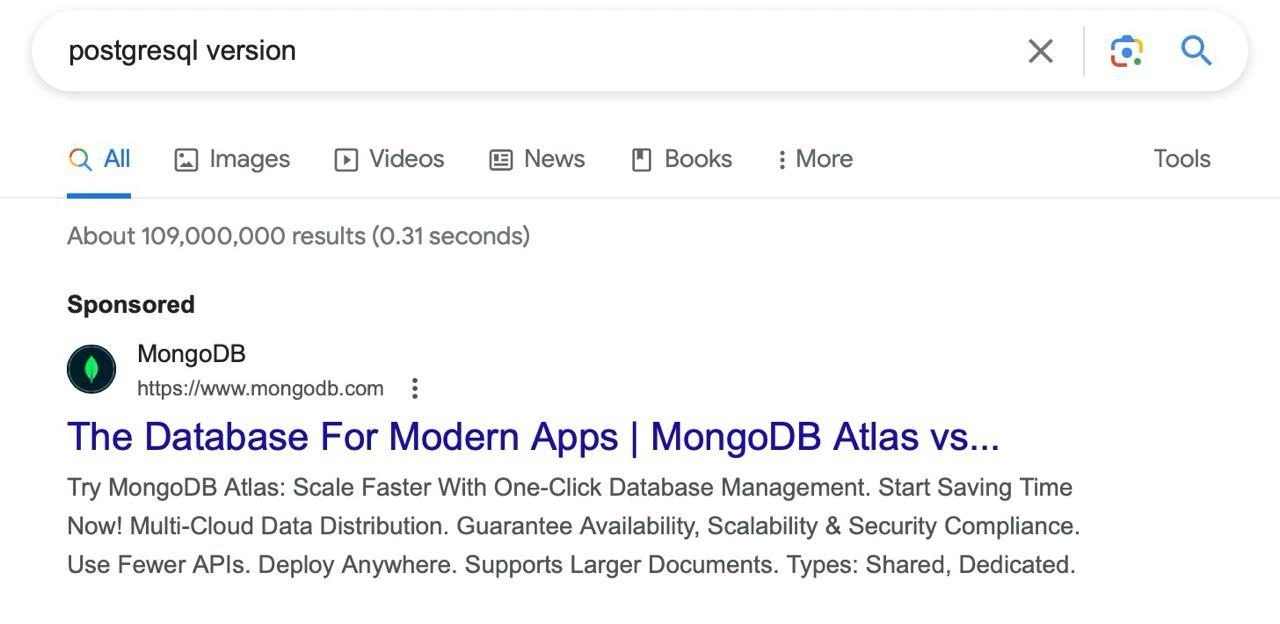
Context of the meme image: The screenshot in the meme shows Google’s interface: at the top it says About 109,000,000 results (0.31 seconds) – meaning there are a ton of results about Postgres version. But the first item on the list has that small label “Sponsored” and is clearly an ad for MongoDB Atlas (MongoDB’s cloud database service). It even has the little green leaf MongoDB logo. The title of the ad is “The Database For Modern Apps | MongoDB Atlas vs…”, implying maybe the full title was something like “MongoDB Atlas vs PostgreSQL” (the end got cut off, but that’s a common ad tactic: directly mention the thing you searched for vs their product). The text of the ad is typical marketing speak: “Scale Faster With One-Click Database Management. Start Saving Time Now! Multi-Cloud Data Distribution. Guarantee Availability, Scalability & Security Compliance. Use Fewer APIs. Deploy Anywhere. Supports Larger Documents.” That’s a mouthful of features and promises!
Let’s break a few of those down in plainer terms, since as a junior dev you might wonder what they mean:
- One-Click Database Management: MongoDB Atlas is a managed service. Instead of you installing MongoDB on your computer or a server, they host it for you. “One-click” means through their website you can spin up a database easily (no manual setup). It’s appealing if you want convenience. (With Postgres, you can also get managed services on cloud or use Docker to simplify, but the ad won’t mention that!)
- Multi-Cloud Data Distribution: This means you can have your MongoDB database spread across multiple cloud providers or regions. For example, a replica in AWS, another in Google Cloud, etc., simultaneously. It’s about flexibility and redundancy – if one cloud has an outage, your data’s still available elsewhere. It’s a feature for high reliability and global apps. It’s a bit advanced; most beginner projects won’t need multi-cloud deployments, but big enterprises might.
- Guarantee Availability, Scalability & Security Compliance: These are just strong assurances – basically saying “our service will stay up, handle lots of users, and meets security standards (like encryption, etc.).” In truth, guarantee is marketing language (there’s always fine print), but the idea is MongoDB Atlas is built to be robust and scalable so you don’t worry about those aspects.
- Use Fewer APIs: This one’s a bit hazy. Possibly the ad suggests that MongoDB’s features can eliminate the need for additional services or complex integrations (for example, maybe you don’t need a separate analytics database or search engine, because MongoDB might handle light analytics and text search). It’s saying Mongo can simplify your stack. “Fewer APIs” meaning fewer external systems to call since one DB does more.
- Supports Larger Documents: MongoDB stores data as documents (basically big JSON objects). They likely are hinting that they allow bigger document sizes or more data in one record than some other databases do. (PostgreSQL, for instance, has limits on row size, and some older systems or other NoSQL might cap document size; Mongo’s current limit is quite large at 16MB per document, which is usually plenty). This is a very niche point to advertise, but they’re basically flexing “you can store really big pieces of data in one go with us.”
Now, imagine you’re relatively new and you just wanted to know how to get the version of Postgres running on your server. Seeing an ad full of fancy terms can be confusing or humorous: “I just asked for one thing, why am I being told about an entire cloud platform?” Developers find it funny because it’s such a marketing vs reality mismatch. It highlights how tech advertising sometimes tries to insert itself at every opportunity, even when it’s not directly relevant to the question at hand.
Early-career experience: This is also a little nudge for newcomers to be aware: not every top result on Google is an answer to your question. Those “Sponsored” links are advertisements. It might even be a competitor or something tangentially related to what you need. As you gain experience, you’ll learn to spot and either use them wisely or ignore them. In our case, an experienced dev looking up a Postgres detail would likely scroll past the MongoDB ad and click the first real (organic) result, maybe from the official PostgreSQL docs or Stack Overflow. But a newbie might click the ad out of curiosity – and hey, sometimes you learn something new from it (“Oh, MongoDB Atlas is a thing”). Just know that its primary goal is to promote a product, not necessarily to directly answer your question.
In summary, this meme’s scene is a mash-up of tech and marketing. You have two database technologies (Postgres and MongoDB) being pitted against each other, not in a benchmark or a technical comparison, but on a Google search results page via ad money. It’s a lighthearted jab at how even geeky matters like database versions can trigger marketing antics. If you can appreciate that dynamic – the serious developer researching Postgres and the friendly-but-uninvited MongoDB ad trying to get attention – you get why it’s humorous. Welcome to developer humor in the age of sponsored content!
Level 3: Database Turf Wars
The meme highlights a SQL vs NoSQL rivalry playing out through modern marketing tactics. A developer searches for “postgresql version,” presumably looking for Postgres documentation or a command to check the DB version, but the very first thing Google shows is a Sponsored link from MongoDB Atlas. This is no accident – it’s a classic case of keyword ambush. MongoDB’s marketing team has bid on “PostgreSQL” search terms, effectively hijacking the query to advertise their own database service. It’s a cheeky move in the ongoing database turf war, akin to Coca-Cola buying a billboard right outside a Pepsi factory. For seasoned developers, this is both amusing and eye-roll inducing: we’re witnessing a MarketingTech and AdTech gambit intrude on a purely technical question.
From a senior developer’s perspective, several layers of humor and industry insight are at play:
The Perpetual SQL-vs-NoSQL Debate: This Google ad is a symptom of the long-running feud between relational databases (like PostgreSQL) and document stores (like MongoDB). For over a decade, tech forums and conferences have seen heated discussions on when to use each. MongoDB’s tagline in the ad, “The Database For Modern Apps,” implicitly suggests that relational SQL databases might be outdated for new applications. It’s a sly dig — one that many experienced devs smirk at because we’ve heard it all before. The reality? Both databases have evolved and even borrowed features from each other (Postgres now stores JSON, MongoDB added transactions), so calling one “modern” versus the other is oversimplified marketing bravado. The meme’s comedy comes from this feud being dragged into our search results, like two rival coworkers arguing in your office doorway when you just wanted a simple answer.
SEO Bid Sniping & Ad Bidding Wars: What we see is seo_bid_sniping in action. Companies often pay to display ads on queries for a competitor’s product — it’s an AdWords arms race for developer mindshare. Here, MongoDB is effectively saying: “Oh, you’re researching Postgres? Why not consider our solution instead!” The humor lies in the blatant audacity. It’s as if a MongoDB salesperson crashed a PostgreSQL meetup, handing out Atlas brochures to folks wearing elephant logos (the Postgres mascot). Industry veterans have grown used to these tactics; whether it’s cloud providers bidding on each other’s names or database vendors doing comparisons, everyone is trying to influence your stack decisions with glossy ads. We chuckle because it’s a high-tech twist on old-fashioned rivalry — imagine if every time you googled Honda Civic, you got a big banner saying “Test Drive a Tesla Instead!” Developers get the joke: even our database humor and choices aren’t safe from marketing interventions.
The Disconnect Between Query Intent and Ad Content: The developer’s intent here is likely something simple and specific (maybe they forgot the
SELECT version();command or want to see which Postgres version is latest). The MongoDB ad, meanwhile, is pitching a whole different product. This dissonance is funny because it’s so out of context. It’s as if you asked “How do I tune my PostgreSQL config?” and someone popped up, shouting “Forget tuning – try our hosted NoSQL, it scales with one click!” 🙃 The ad copy boasts: “Scale Faster… One-Click Database Management… Multi-Cloud Data Distribution… Guarantee Availability, Scalability & Security…” These buzzwords make experienced devs both laugh and sigh. It reads like every database vendor checklist crammed into one: multi-cloud (replicate your data across AWS/Azure/GCP), availability & scalability guarantees (bold claims that make an architect mutter about CAP theorem trade-offs), and security compliance (of course, because who doesn’t promise that?). The comedic element is that a person searching for a Postgres version might not even be remotely thinking about choosing a different database, let alone evaluating cloud distribution strategies. The ad is a hammer trying to hit a screw – the right tool but at the wrong time.Industry Patterns and Shared Experiences: Many of us have real-world stories where hype and marketing influenced technical choices. Perhaps a non-engineer manager saw ads or articles about “MongoDB powering modern apps” and pushed the team to use it, even if a relational database was a better fit. Or maybe during a project kickoff, someone brings up “Should we consider a NoSQL like Mongo? I keep hearing it’s web-scale.” Seasoned devs have learned that technology choice should be driven by requirements, not buzz. So when we see an ad that tries to sway someone mid-question, it’s practically a parody of those situations. The meme tickles developers because it validates a common experience: the feeling of being pitched or sold to when you least expect it. We’ve all had that one meeting where a stakeholder says, “I read in a magazine that MongoDB is the future, why aren’t we using it?” – and you have to patiently explain trade-offs. This Google ad is that scenario distilled: Marketing jumping in front of an engineer’s Google search with, “Wait! Try this shiny thing!”
Technical Realities vs Marketing Claims: The ad copy provides a buffet of selling points, and an experienced engineer can’t help but mentally translate them:
- “One-Click Database Management” – i.e., a fully managed service where you click a button and a cluster is set up. Sure, that’s convenient (no manual installation, no config files), but it’s primarily appealing if the person is shopping for a service. Someone simply checking a Postgres version probably just set up Postgres already! The humor is in the mismatch: it’s like advertising automatic transmission to someone asking how to check their car’s oil level.
- “Multi-Cloud Data Distribution” – a fancy way to say MongoDB Atlas can replicate data across multiple cloud providers or regions. It’s a legit feature for high availability and geo-distribution. However, a PostgreSQL guru knows you can achieve distributed setups with Postgres too (through replication, or newer scaling solutions) – it’s just not wrapped in such a snazzy one-click slogan. The ad tries to position Mongo as the only easy path to distributed data, which is an exaggeration. The senior dev chuckles, knowing that multi-cloud sounds cool until you’re the one troubleshooting the network latency and consistency issues it introduces. (In distributed systems, nothing is as trivial as marketing makes it sound – “guaranteed availability,” meet Murphy’s Law!)
- “Guarantee Availability, Scalability & Security Compliance” – these words are catnip for CTOs, but an ops engineer or DBA reads them with skepticism. Guarantee? Seasoned folks know that in distributed databases, guarantees come with footnotes (SLA uptime percentages, maintenance windows, eventual consistency caveats). It’s the classic marketing vs reality gap. We find it funny because we imagine the fine print: “guarantee (as long as you configure three replicas across distinct zones and don’t exceed X throughput… etc.).” It’s reminiscent of the joke, “NoSQL? No, SQL!” – at the end of the day, both systems can fail and both need care; no magic here.
- “Use Fewer APIs” – this line is a bit puzzling even to experienced devs. It suggests that MongoDB’s ecosystem can replace multiple layers (maybe they imply you won’t need separate search engines, caching layers, or ORMs because Mongo can cover some of that?). It’s a subtle jab: perhaps implying that with a flexible document model and their atlas tools, you won’t need as many external integrations or microservices. An architect might raise an eyebrow because reducing APIs isn’t usually the primary factor in choosing a database. It sounds nice, but it’s certainly not what someone querying “PostgreSQL version” was worrying about at 3 PM on a workday. This adds to the absurdity – the ad addresses pain points the searcher never expressed.
- “Supports Larger Documents” – likely a boast that MongoDB can handle very large JSON documents (object sizes) compared to some limits or performance drops in other databases. A Postgres pro might chuckle because Postgres can handle large data too (it can store large JSON in a column, use TOAST to compress big values, etc.). Each DB has limits, but marketing loves to cherry-pick. The humor here is the mental image of a MongoDB marketer thinking, “That’ll show those Postgres folks – we’ll tout big document support,” while the Postgres dev isn’t even thinking about that edge case while googling their version command. It’s like two ships passing in the night: the ad copy is solving problems the user never asked about at that moment.
Finally, beyond the technicalities, there’s a shared knowing grin about organizational dynamics. This meme implicitly pokes at how big tech companies fight for mindshare. Why do smart teams keep revisiting the SQL vs NoSQL debate? Because every few years, new tools and lots of marketing revive it! It’s a cycle: a new tech promises to solve all the old pain points (“Say goodbye to rigid schemas and complex JOINs!”), early adopters jump on it, then discover new trade-offs and gotchas, and eventually the hype cools and a balanced view emerges – until the next startup or ad campaign stirs the pot again. In this case, MongoDB (which itself was the upstart in the late 2000s) continues to push the narrative that it’s the go-to for “modern” apps. Meanwhile, PostgreSQL – a venerable open-source project – doesn’t have a single company funding Super Bowl ads or Google keywords on that scale (there’s no “PostgreSQL Inc.” pouring millions into marketing). Instead, Postgres grows by community adoption and word-of-mouth. So when devs see a Sponsored MongoDB link trying to poach Postgres-curious users, it’s a bit like watching a flashy new competitor try to dunk on the old champion via billboard, rather than pure technical merit. It’s funny and a tad brash.
In summary, the meme resonates on multiple levels with experienced developers. It captures the absurdity of ad-driven decision influence in tech – a reminder that even our Google searches about version numbers aren’t safe from the ever-present marketing machine. It’s a “too real” moment where technical life (checking DB version) collides with corporate strategy (convert that Postgres user!). And as any battle-scarred engineer would tell you with a smirk, sometimes the loudest tool isn’t the best one – it’s just the one with the biggest ad budget. This meme gave us a chance to laugh at that reality.
Description
A screenshot of a Google search results page. The user has typed 'postgresql version' into the search bar. Directly below the search bar, the first result displayed is a prominent sponsored ad for MongoDB, with the title 'The Database For Modern Apps | MongoDB Atlas vs...'. The ad features the MongoDB logo and a link to their website. The humor lies in the aggressive and sometimes misplaced marketing tactics of tech companies, where MongoDB is paying to advertise on keywords for its direct competitor, PostgreSQL. This is a universally relatable experience for developers who are often bombarded with ads for competing products even when searching for specific technical documentation or information
Comments
29Comment deleted
You search for a specific version of a reliable, battle-tested relational database, and Google's first suggestion is a document store that's 'web scale'. It's the digital equivalent of asking a librarian for a book on naval history and being handed a pamphlet for a cruise ship
Searched for the latest Postgres release and Google served a MongoDB ad - proof that in ad-tech, eventual consistency will happily pay CPC to shove ACID off the first page
MongoDB spending marketing budget to intercept PostgreSQL searches is like trying to solve a JOIN problem by throwing documents at it - technically possible, but everyone knows what you're really after is that sweet ACID compliance
When you search for 'postgresql version' and MongoDB shows up first with a sponsored ad - it's like asking for a screwdriver and getting a pitch for a power drill. Sure, they both work with fasteners, but one requires you to rethink your entire data model, rewrite your queries in a JSON-flavored DSL, and explain to your DBA why ACID guarantees are 'so 2010.' Meanwhile, you just wanted to know if you're running 14.2 or 15.1
Querying Postgres version for ACID reliability? Google serves MongoDB Atlas - because schema flexibility fixes everything except your eventual consistency nightmares
Googled “postgresql version” and the top result was a MongoDB ad - turns out the internet’s cost-based query planner prioritizes conversions over ACID
I searched for SELECT version(); Google served “MongoDB Atlas vs…” - AdTech’s CAP theorem: clicks, conversions, or credibility - pick two
That's on you for not using an adblocker in these trying times Comment deleted
*using google search engine Comment deleted
pablo? Comment deleted
Musician Escobar's axiom - if both things are shit, none should be chosen Comment deleted
say that to the radio button you have to choose otherwise you can't submit the form Comment deleted
I choose to go to an alternative site, unless it's a .gov with a shit UI Comment deleted
by original quote you have to do something to the author of the form Comment deleted
the teacher who arranged this online exam....😂💀 Comment deleted
Yeah, you got the idea 😈 Comment deleted
This is fucking hilarious Comment deleted
I don't want even try to translate using extraoblivious vernacular because that would be a race condition for mods to get the banhammer out Comment deleted
it's a classic webdev meme from 2010, I'm just old Comment deleted
the vid used to have a website under something like mongodb-is-webscale.com with the full transcript Comment deleted
http://web.archive.org/web/20120214035218/http://www.mongodb-is-web-scale.com/ Comment deleted
I told everybody I was able to. Ads are malicious 😂💀 Comment deleted
searx is dead and unmaintained Comment deleted
2 things 1 cry about it 2 thats google Comment deleted
Nobody cares about vodka and balalaika lol. Go home Ivan, we don’t have vodka here. Comment deleted
cope Comment deleted
No hate, just don’t want someone stole something here. Comment deleted
Use spoiler and tag for #nsfw don’t want to have it in public Comment deleted
so are the ones from google nowadays Comment deleted