Skip to content
DevMeme
1809 of 7435
The Two Eternal Moods of Programming
Bugs Post #2016, on Sep 6, 2020 in TG

The Two Eternal Moods of Programming

Why is this Bugs meme funny?

Level 1: Emotional Rollercoaster

Learning to code is a lot like riding a rollercoaster of feelings. Imagine playing a hard level in your favorite video game. Finally, after trying and trying, you beat the level – you’re jumping up and down, super happy that you did it. 🎉 But then the very next level starts, and suddenly things go wrong. You keep losing and it feels unfair — you might even shout, “This doesn’t make sense! I just won a minute ago!” That mix of emotions – the big high of winning and the low of being stuck again – is exactly what coding feels like. One minute you’re cheering because your program worked, the next minute you’re groaning because it broke. But just like with the game, you don’t quit. The fun of that win is so great that you keep playing, even if sometimes you feel frustrated. Coding is the same way: the happy moments make you want to continue, and the tricky parts just mean you’re getting ready for the next victory.

Level 2: The Learning Curve

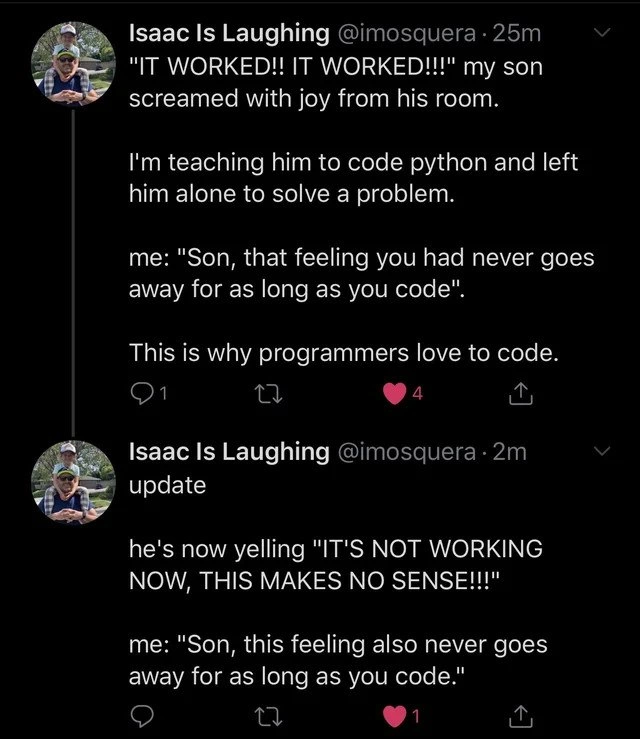
This meme shows a very real part of learning to code. In the screenshot, a dad is teaching his son how to program in Python. Python is a programming language often recommended for beginners because its syntax (the way the code is written) is clean and easy to read. When the son shouts “IT WORKED!!”, it means his Python code ran successfully and did what he expected. Imagine he was trying to solve a small problem or make the computer print something specific – hearing it actually give the right answer is a huge victory. That excitement is genuine: writing code can feel like solving a puzzle or performing a magic trick, so when you finally get it right, you’re overjoyed. This first tweet ending with “This is why programmers love to code.” underscores that triumphant feeling. Programmers often love the job because creating something that works (especially after struggling with it) is incredibly rewarding.

But then comes the second tweet: an update from the dad. Now the son is yelling, “IT’S NOT WORKING NOW, THIS MAKES NO SENSE!!!” What happened? Most likely, the child encountered a bug. A bug is what we call any mistake or problem in a program that causes it to behave unexpectedly or incorrectly. Maybe the son changed one tiny thing in his code or tried a new input value, and suddenly the program broke or gave a weird result. This is super common in coding. One moment you think you’ve got it all figured out, and the next moment you see an error message or wrong output that you don’t understand. He’s saying “This makes no sense!!!” because as a new coder he hasn’t learned yet why the error is happening – it feels illogical or unfair. Every programmer, even experienced ones, sometimes feels completely confused by a problem.

The father’s response, “Son, this feeling also never goes away for as long as you code,” is both funny and informative. He’s basically telling his son: “Welcome to programming, you will always have ups and downs.” The first feeling (the joy when things work) never goes away – even senior developers get excited when they finally fix a tough bug or get a feature working. The second feeling (the frustration when things break for no clear reason) also never goes away – because no matter how much you learn, you will still encounter new bugs and challenges that confuse you. This is often referred to as the learning curve in coding, or sometimes the emotional rollercoaster of development. As you continue to program, you constantly learn new things, but you’ll face new puzzles too. Debugging, which means finding and fixing bugs, becomes a regular part of the job. In fact, an old joke is that programming is 10% writing code and 90% debugging code! The meme is very relatable for developers because it shows that from the very start of your coding journey, you experience both the thrill of success and the frustration of failure. And guess what – that mix of feelings is normal. The meme reassures newcomers that it’s okay (even expected) to feel confused and ecstatic often in the same day. This dramatic swing in emotions is part of the developer experience (DX): you learn to enjoy the highs and not get discouraged by the lows, because every error is just another problem to solve. The dad is using humor to teach an important lesson: if you felt great when your code worked and upset when it didn’t, congratulations, you’re now a real programmer!

To put it simply, programming gives you very quick feedback. You write some code, and right away you can run it to see what happens. This immediate response is great for learning – you don’t have to wait long to know if you did it right or wrong. The son in the meme got immediate positive feedback (it ran correctly) and was super happy. Then he got immediate negative feedback (an error or broken result) and got upset. This quick back-and-forth is how we all learn to code: try something, see it succeed or fail, and adjust. It’s normal to feel a bit like a yo-yo in the beginning. Over time, you get more used to it. You realize that when something “makes no sense,” it’s just a puzzle you haven’t solved yet. And solving it is going to feel as good as the first time it worked. That’s why his dad says programmers love to code — we kind of get addicted to that cycle of challenge and triumph. The meme perfectly captures this learning to code journey in two tweets, and it’s comforting to anyone starting out that even a kid and his mentor are going through the same swings of emotion.

Level 3: Infinite Loop of Emotions

In this tweet-thread meme, a father teaching his son Python captures the entire developer experience in under 30 minutes. First, pure euphoria: the child runs his code and gleefully shouts “IT WORKED!! IT WORKED!!!” Moments later, utter despair: “IT’S NOT WORKING NOW, THIS MAKES NO SENSE!!!” Anyone who’s spent time coding recognizes this whiplash. It’s an instant feedback loop that defines programming — the code either does exactly what you intended (thrilling triumph) or it stubbornly misbehaves (head-scratching frustration). The humor here comes from how relatable this cycle is. The dad’s tongue-in-cheek wisdom, “that feeling never goes away for as long as you code,” is funny because it’s so true: whether you’re a beginner writing a ten-line script or a senior engineer debugging a complex system, those emotional highs and lows remain constant.

From a seasoned developer’s perspective, this scene is a rite of passage. The son’s joy at seeing his program run correctly for the first time is a rush every coder remembers – a hit of dopamine that programmers love to code for. Maybe the boy just solved a small problem (like getting a loop or a function to work), and that first success feels like magic. This is why many of us got hooked on coding: that addictive “Yes! I solved it!” moment. But programming has a cruel sense of humor: it only takes one small change or a new test case to flip success into failure. Perhaps the child’s code worked for one scenario, but as soon as he tried a slightly different input or tweaked something, it broke unexpectedly. Suddenly he’s encountering a bug – a flaw in the code – and yelling “This makes no sense!!!” in bewilderment. Every developer has been there, often multiple times a day. In fact, a running joke among engineers is that our job alternates between feeling like genius problem-solvers and feeling completely bamboozled by something that should work but doesn’t.

The father’s update (“Son, this feeling also never goes away…”) nails another truth: the debugging frustration never fully disappears either. No matter how experienced you get, there will always be moments when your code, which you were so sure was correct, inexplicably fails. You might spend hours troubleshooting some error only to discover a missing comma or an off-by-one mistake. It’s practically a law of coding that right after a victory lap, you’ll hit a wall that makes you question reality (or at least your sanity). Senior developers just learn to expect this. We’ve all had that “what the heck, it was just working!” meltdown – be it a misconfigured environment, a hidden state that changed, or the classic “works on my machine” scenario where code passes all tests locally and then tanks in production. The tweet thread is hilarious because the dad is playfully introducing his son to this eternal cycle on day one. It’s like he’s saying: “Welcome to the club. Coding humor is often about laughing so we don’t cry.” The rapid swing from triumph to defeat is exaggerated here for comedic effect, but it’s a spot-on satire of real life in software development. In a single snapshot, it references the perpetual learning curve and the constant back-and-forth between debugging and “Eureka!” moments that define a programmer’s journey.

On a technical note, using Python as the learning language adds a layer of authenticity. Python is beginner-friendly, giving new coders quick results – which means instant highs when things work. But Python’s simplicity doesn’t spare anyone from bugs. A newbie can just as easily run into a SyntaxError by forgetting a colon or get baffled when print(2 + "3") raises a TypeError. The child in the meme likely experienced something similar: perhaps he wrote a small script that printed correct output once, then modified a line or tried a new input and got a cryptic error or wrong result. The “makes no sense” feeling often comes when the code’s behavior defies our current understanding. This is a hallmark of the learning process in coding – every programmer builds a mental model of how the code should work, and debugging is the painful but important process of refining that model when reality doesn’t match. The father’s advice highlights a kind of twisted comfort: both the soaring success and the baffling failure are here to stay, but that’s also what makes coding endlessly engaging. In essence, the meme humorously distills the learning-to-code journey: an emotional rollercoaster powered by an instant feedback loop — one minute you’re on top of the world, the next you’re tearing your hair out, and strangely, we developers wouldn’t have it any other way.

Description

A screenshot of a two-part Twitter thread from the user Isaac Is Laughing (@imosquera). In the first tweet, the user shares a heartwarming story about teaching his son to code in Python. The son yells 'IT WORKED!! IT WORKED!!!' with joy after solving a problem. The father wisely tells him, 'Son, that feeling you had never goes away for as long as you code. This is why programmers love to code.' A few minutes later, an 'update' tweet follows. The son is now yelling, 'IT'S NOT WORKING NOW, THIS MAKES NO SENSE!!!' The father's response is a perfect parallel: 'me: "Son, this feeling also never goes away for as long as you code."' This meme captures the fundamental emotional rollercoaster of software development: the intense euphoria of solving a problem, immediately followed by the soul-crushing despair of an inexplicable new bug. It's a universally relatable narrative that resonates deeply with developers of all experience levels, highlighting the constant cycle of triumph and frustration that defines the profession
Comments

7
Anonymous ★ Top Pick The two states of a developer: 1. 'I am a genius, and my creation is flawless.' 2. 'Okay, who broke my flawless creation?' The time between these states is approximately one run
  1. Anonymous ★ Top Pick

    The two states of a developer: 1. 'I am a genius, and my creation is flawless.' 2. 'Okay, who broke my flawless creation?' The time between these states is approximately one run

  2. Anonymous

    If it works once and then implodes, congratulations kid - you've spotted your first Heisenbug; welcome to the career where your real job is brokering peace between the GIL, the import cache, and yesterday’s “temporary” global state

  3. Anonymous

    After 20 years in the industry, the only difference between junior and senior developers is that seniors have learned to mute themselves on Zoom before screaming at their code

  4. Anonymous

    This perfectly encapsulates the fundamental theorem of software engineering: code exists in a quantum superposition of 'working' and 'broken' until observed by a different developer, at which point it collapses into whichever state causes maximum confusion. The kid's learning the most important lesson early - that 'it worked on my machine' is both the beginning and end of every debugging session, and the emotional amplitude between those two states remains constant regardless of your years of experience or architectural sophistication

  5. Anonymous

    Coding's observer effect: Celebrate 'it works,' and the Heisenbug collapses your wavefunction straight to 'WTF.'

  6. Anonymous

    Teaching my kid Python: welcome to eventual consistency - dopamine is at-least-once delivery, sanity is best-effort, and the order of “it worked” vs “this makes no sense” has no SLA

  7. Anonymous

    The arc from 'IT WORKED' to 'THIS MAKES NO SENSE' is the core curriculum: state, nondeterminism, and why 'works on my machine' isn’t a test

Use J and K for navigation