A Literal Interpretation of Network Packet Loss
Why is this Networking meme funny?
Level 1: Lost Letters in the Mail
Imagine you’re sending out a bunch of letters or birthday invitations to your friends. You put six of them in the mail. A few days later, only five friends call to say “thank you for the invite.” The sixth friend never got theirs because that letter got lost in the mail. Maybe it fell out of the mailman’s bag or got stuck under a car seat — who knows, it just never arrived. In computer terms, each of those letters is like a little bundle of information (we call it a packet) traveling across the internet. And when one doesn’t show up on the other end, that’s what we call packet loss – some of the information got lost along the way.
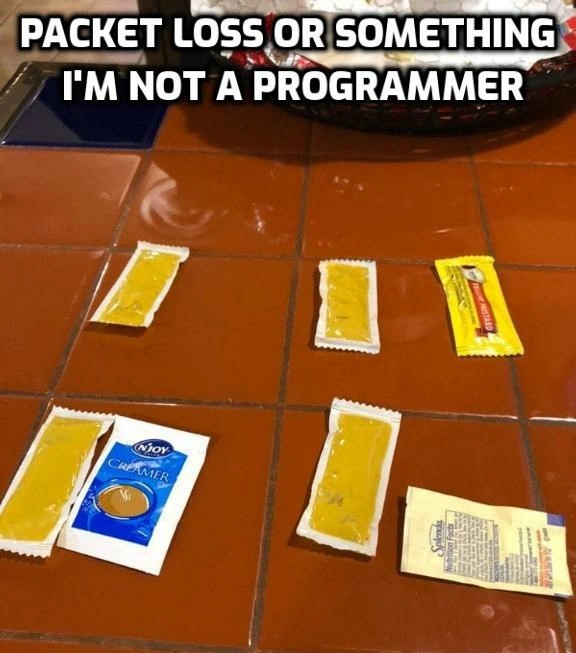
Now picture walking into your kitchen and seeing a messy floor: sauce packets (like those little mustard or ketchup packets) are lying around, torn open, with sauce spilled everywhere. If someone jokes and says, “Oops, looks like packet loss!”, they’re comparing those sauce packets to the internet packets that got lost. The sauce that should’ve been inside (to go on your food) is gone, just like the data in a lost internet packet doesn’t make it to its destination. It’s a silly play on words because “packet” can mean the tech thing (data packet) and also a packet of ketchup. So spilled sauce packets are being compared to lost data packets.
When the person in the picture says, “or something I’m not a programmer,” it’s like they’re admitting, “I just used a tech word, but I actually don’t know much about tech!” That’s part of the joke. It’s funny because they’re using a big computer term to explain a simple everyday oopsie. It’s as if you spilled your drink and then shrugged, “Gravity malfunction or something, I’m not a scientist.” Most people wouldn’t describe a spill that way, right? So it sounds goofy.
The heart of the humor here is mixing up a normal life moment (making a mess with snacks) with computer talk. Anyone can understand that some of the sauce didn’t end up where it was supposed to — just like mail that doesn’t arrive, or a message that never got delivered. The meme makes us laugh because it takes that very relatable situation (a spill) and frames it in an over-the-top technical way. You don’t need to be a programmer to get the basic joke: something was supposed to go from point A to point B (mustard from the packet to the sandwich, or data from one computer to another) and it didn’t make it. The result? A mess on the floor or a missing piece of information, and a funny excuse to lighten the mood.
Level 2: Dropped Packets IRL
Let’s break down the joke in simpler terms. In computer networking, a packet is just a small bundle of data — imagine a digital envelope that carries a piece of a message. When you load a website or send a message, your data is actually chopped into many packets that zip through the network to the other side. Now, packet loss is when some of those packets never make it to their destination. It’s as if you mailed 6 birthday cards and 1 got lost in the mail – the recipient got 5 cards and one empty envelope or nothing at all from that missing one. Packet loss can happen for all sorts of reasons: maybe the network is too busy (congestion), maybe there’s interference (like static on a phone line), or maybe a device in the path is misbehaving. In reliable networks and protocols, losing packets is a problem because it means part of your data didn’t arrive.
Now, there are two common ways to send packets: UDP and TCP. These are like two different mailing services:
- UDP (User Datagram Protocol) is the quick-and-simple service. It just sends out packets and doesn’t require a signature on delivery. There’s no tracking, no confirmation. This is great for things that need speed and can tolerate some loss (for example, live video or voice calls). If a few packets in a video call get lost, the call doesn’t stop – you might just see a tiny glitch or hear a slight dropout. UDP is essentially fire and forget. But if something goes wrong, there’s no automatic fix. It’s like throwing six paper planes with messages across a room: if one gets caught by the wind and never lands in your friend’s lap, you’re probably not even going to realize it missing in the moment.
- TCP (Transmission Control Protocol) is the reliable but slower service. It acts more like certified mail or a courier that requires a sign-off. When you send data with TCP, every packet that arrives is acknowledged by the receiver. If the sender doesn’t get an acknowledgment in time, it will resend the packet. TCP also puts packets back in order if they arrive out of order, and it checks for errors. So TCP is what we use for things that absolutely must arrive intact, like loading a web page, sending an email, or downloading a file. If one packet gets lost, TCP will notice (“hmm, I never got an ACK for packet #42”) and resend it – kind of like noticing one page of a letter is missing and asking for a replacement.
The meme’s title says “UDP-style packet loss on the office snack network.” That’s a playful way to say: look, these condiment packets on the office counter are acting like data packets on a network using UDP – some of them got dropped (spilled) and nobody retried sending them. The condiment_packets (mustard, sugar, creamer) scattered on the brown tiles are standing in for data packets traveling across a network. The mustard that oozed out of those packets and is now missing is like data that didn’t reach the receiver. No one came to replace those mustards (no TCP-like retransmission), so the “network” in our kitchen is unreliable. It delivered maybe some of the packets (perhaps a couple of them are intact?), but several packets just ended up empty. This is exactly what happens with packet loss: part of the information is gone. If this were an actual computer network scenario, those empty packets would mean, say, parts of a file or parts of a video stream never arrived, possibly causing visible glitches or errors. In the kitchen, it means someone’s sandwich isn’t getting its mustard because those packets didn’t survive the trip from the condiment basket.
Now, the big caption on the image reads: “PACKET LOSS OR SOMETHING I’M NOT A PROGRAMMER.” This is where the humor really kicks in as a sysadmin_joke. The person saying this is basically shrugging and using a tech term (“packet loss”) to explain a non-tech situation (a bunch of sauce packets spilled). They even admit “I’m not a programmer”, meaning they know they might be using the term wrong. This is funny to IT folks because it’s a reversal of what we often see: usually, it’s the techies using complicated jargon that non-tech people don’t get. Here, a non-tech person is throwing out jargon in a goofy, half-incorrect way. It’s similar to if someone saw a broken coffee mug on the floor and said, “uh, memory leak or something, I’m not an IT guy.” It just comically misses the mark. But at the same time, it kind of makes sense if you stretch your imagination — spilled condiment packets do look like “lost packets” scattered outside the normal flow. It’s a great example of visual_wordplay: using the two meanings of “packet” (data packet vs. sauce packet) to make a pun. Even the phrase “office snack network” in the title is a playful way to tie it together; obviously, a snack network isn’t a real network, but we’re pretending the path from the snack basket to your plate is like network traffic.
For someone newer to tech or just starting out (maybe a junior dev or a student), there are a few key takeaways hidden in the joke:
- Packet loss is real: It’s something you’ll encounter when dealing with networks. It can cause problems like lag, errors, or incomplete data transfer. This meme just demonstrates it in a funny, physical way.
- UDP vs TCP differences: The joke specifically says “UDP-style” because UDP won’t correct packet loss. If this were “TCP-style,” those spilled packets would have triggered some response (someone realizing “hey, we’re missing some mustard” and fetching new ones). But UDP-style means if it’s gone, it’s gone — exactly what we see on the floor.
- Not everyone speaks tech fluently: The caption reminds us that tech language sounds foreign to outsiders. If you’ve ever tried explaining a bug to a non-technical friend and watched their eyes glaze over, you know the feeling. Here, the outsider is humorously using tech talk without full understanding, which shows how jarring (and amusing) that mix-up can be.
- Production incidents can be anything: Today it’s a laughing matter with condiments, but in a real ProductionIncidents scenario, “packet loss” can be a critical issue that teams scramble to fix. The meme puts a light spin on it, but it’s referencing those serious moments where something as small as a few lost packets can wreak havoc on a system (like causing a video call to drop or a webpage to time out).
Lastly, the presence of different packets (mustard, sugar, creamer) is a cute detail. It’s like our “network” is carrying different types of data. Maybe the mustard was the important data (since its loss is highlighted by the bright yellow splatter), and the sugar packet might be like a control message or a less important data packet that coincidentally also ended up in the mess. In real networks, we often send many kinds of packets over the same lines, and it can get messy figuratively. Here it got messy literally!
All in all, this meme uses a simple scene from office life — a spill in the break room — to explain a tech concept and make us laugh. By equating mustard packets to network packets, it creates an immediate mental link that’s both educational (if you think it through) and humorous. And if you’re a junior dev who has ever been confused by a senior talking about “dropped packets” or “UDP traffic,” well, now you have a memorable image to associate with it: just think of mustard splattered on the floor and you won’t forget what packet loss means.
Level 3: It's Always the Network
To a seasoned engineer, this image triggers an immediate “aha, I’ve been there” chuckle. We’re looking at a messy countertop with empty mustard packets, and our brain can’t help but map it to a network outage post-mortem. NetworkEngineering veterans have sat through countless ProductionIncidents where some critical data “didn’t make it” to its destination. Seeing actual condiment packets spilled and emptied feels like a perfect physical parody of those incidents. It’s the kind of NetworkHumor that makes you smirk because it mixes the banal with the technical. The bold caption spells out the joke: “PACKET LOSS OR SOMETHING I’M NOT A PROGRAMMER.” Someone who clearly isn’t a network guru is using war-room lingo to describe a break-room mess. And ironically, they’re kind of right — it is a packet loss scenario, just involving mustard packets on a tile “network.” This meme is basically a sysadmin_joke come to life: take a frustrating technical problem (packets dropping in the network) and illustrate it with an everyday annoyance (spilled condiments), then add a dash of “clueless bystander” for comedic spice.
For those of us who have been on OncallLife duty, the scene might dredge up absurd memories. Picture a 3 A.M. outage call: you hunched over a laptop, VPNed into some data center, trying to figure out why service responses are timing out. The metrics show intermittent packet_loss. Everyone’s frantically throwing out theories — maybe it’s a bad fiber link? Could be a flapping switch port? QoS misrouting? In the meme, though, that high-stakes scenario is playfully transposed to the office kitchen. The “network” here is the counter, and instead of data packets being dropped between servers, we have mustard packets dropped between the coffee maker and the napkin dispenser. A senior engineer will enjoy how the visual_wordplay turns a break_room_incident (somebody making a mess with lunch supplies) into a stand-in for a network incident. It’s a reminder of those tense outage investigations, but it’s okay to laugh when the stakes are just a stained counter rather than a downed website. The phrase “It’s always the network” echoes in our minds — that cynical rule of thumb that whenever something goes wrong and we don’t immediately know why, someone in the room mutters about the network. Here, the poor mustard packets become the scapegoat for whatever went awry.
The caption also nails another layer of humor: “I’m not a programmer.” How many times have experienced devs heard this line? People outside of tech often blur the lines between roles — to many, anyone who works with computers might be a “programmer.” In reality, network engineers, system administrators, SREs, and developers all have different specialties. The meme riffs on that confusion. A non-tech office worker sees a mess on the counter and, having overheard the tech folks complaining about “packet loss” during a Zoom outage last week, jokingly parrots the term. They half-jokingly diagnose the spill as a network issue, then immediately disown any expertise with “or something, I’m not a programmer.” It’s funny because it’s an innocent misapplication of jargon. As senior engineers, we’ve encountered folks who do this in real situations: maybe an executive who read an article on dropped_packets and starts asking if our database lag could be “packet loss or whatever?” You can almost hear the facepalm. Yet, we find it endearing here because the person in the meme ostensibly got it hilariously wrong and right at the same time. After all, those are literally packets that were lost!
This image also slyly pokes at the absurdity we deal with. Think about it: in a serious incident, we talk about lost packets in abstract terms—little binary payloads zipping through wires, disappearing into the ether. There’s usually no visual corollary, just graphs with red lines or log files with error counts. But here we have a crime scene: yellow mustard splattered, empty packets as evidence. It’s like an SRE’s hallucination after too many hours debugging a flaky network connection. We joke that we wish diagnosing real network issues was as straightforward as “Oh look, three mustard packets fell behind the counter at 10:32 AM — must have been when those video frames dropped.” A veteran knows in reality it’s never that obvious; instead, you’re combing through router logs or trying to reproduce the issue with ping and traceroute. The meme takes that invisible headache and makes it tangible (and sticky).
There’s also a wink here at QoS reliability and general network chaos. The inclusion of a random coffee creamer and sugar packet among the mustards feels like the late-night incident where unrelated things get pulled into the mix. (“Why is the DNS server acting up at the same time we have packet loss? Is it related, or just another random thing on the floor?”) It’s a subtle nod to how in complex systems, multiple failures or oddities can collide. A senior engineer has seen incidents where one misconfiguration (say a QoS rule treating important traffic as low priority) cascades into a big mess. In our condiment analogy, maybe someone literally dropped the basket of mixed packets — the network equivalent of a fat-fingered router update — and now we’ve got mustard (critical data) and sugar (maybe less critical data) all over. Cleaning up involves sorting out which packets were lost and which survived, just like in a real incident we separate primary issues from side effects.
Ultimately, the humor here comes from relatability and relief. We’ve all stressed about elusive network problems that ProductionIncidents hinge on. Seeing it play out with mustard packets in a low-stakes environment is cathartic. It says: hey, packet loss happens, things spill, and sometimes all you can do is laugh and grab a mop. And trust a grizzled IT veteran to appreciate that sentiment — after all, if we didn’t laugh about these things, we might just cry into our coffee (hopefully without spilling it on the network gear…).
Level 4: Best-Effort Mustard Delivery
On the deepest technical level, this meme is a metaphor for how UDP (User Datagram Protocol) handles data. In Networking, UDP provides best-effort delivery with no guarantees — it just fires off packets and doesn’t wait around to see if they arrive. In the image, each mustard packet represents a network packet filled with data (the mustard). When you send data via UDP, there's no ACK (acknowledgment) coming back to confirm receipt and no automatic resend if something goes wrong. Likewise, these condiment packets have been “sent” across the office snack network (our playful term for the break-room counter), and some didn't survive the journey intact. The torn-open, empty mustard packets on the tile floor are a visual analogy for packet_loss: the payload (mustard) got spilled midway, and all that arrived was an empty wrapper (a packet with no useful data). In networking terms, the data was dropped, and UDP isn't going to retry — the mustard’s on the floor and it’s game over for that packet.
From a protocol perspective, this is highlighting the classic udp_vs_tcp trade-off. TCP, in contrast to UDP, would never let your precious “mustard data” just splatter and vanish without notice. TCP is like a careful courier: it keeps track of every packet (using sequence numbers), expects a confirmation (ACK) from the receiver, and if an ACK doesn’t come, it will retransmit the packet. In our condiment analogy, a TCP approach would mean if a mustard packet burst, someone would realize it (no ACK received), go back to the kitchen, and send a new mustard packet to make sure the sandwich still gets mustard. UDP, being the fast but unreliable courier, doesn’t do any of that – it’s fire-and-forget. That’s why UDP is sometimes jokingly called Unreliable Datagram Protocol. It’s great for things that can tolerate a little loss (like live video or voice chat where a dropped frame or syllable is no big deal), but you better not use it for delivering critical data unless you build your own recovery system on top. The meme exaggerates this by showing dropped_packets as literal dropped condiment packs: once they hit the floor, UDP’s attitude is basically “meh, keep going.”
Why do packets get lost at all? In real networks, packet loss can happen due to congestion (routers and switches may toss excess packets when their queues are full), signal noise or interference (especially over Wi-Fi or long distances, analogous to someone bumping your elbow so you drop a packet), or errors that fail integrity checks (TCP has checksums, as do lower layers – a bad checksum means the packet is treated like it never existed). In the condiment_packets scene, imagine the floor is a busy network route. Too many packets (condiments) going through at once can cause collisions or drops – some packets get knocked out of the path and torn open. This is where Quality of Service (QoS) comes in: QoS protocols let network engineers prioritize certain traffic. Think of QoS as deciding which condiment packets get gentle handling and which can be sacrificed if the hallway gets crowded. A misconfigured qos_reliability setting might treat mustard as low priority, so those get carelessly handled and end up dropped, while the sugar packet (maybe considered higher priority for someone’s coffee) makes it through unscathed. The meme hints at this with the mix of mustard, creamer, and sugar packets – in a real network, different packet types (voice, video, background data) might be juggled with QoS rules, and a mistake can result in important data splattered all over, metaphorically speaking.
It’s also worth noting the reference to “lost data frames” in the description: in networking jargon, a frame is a packet at the Data Link layer (Ethernet frame, for example). The image shows empty frames (the physical packets) with nothing in them – as if the data got stripped out and dropped. It humorously visualizes a concept we normally only see in graphs and logs: you might check a router and see 6 packets dropped, but here you can see six sad empty mustard sleeves as evidence. If only debugging real network issues left such obvious clues (a trail of mustard to follow…), our on-call nights would be a lot easier! Instead, network engineers often rely on traceroutes, ping tests, and metrics to infer where the "spill" happened. This meme gives us a tangible “packet loss report” in mustard-yellow, no fancy tools required.
Finally, consider the broader system aspect: networks are built on layers (remember the OSI model with its layers 1 through 7?). UDP operates at Layer 4 (Transport), sitting on top of IP (Layer 3). The design of the Internet deliberately leaves certain tasks like reliability to higher layers if needed – this is known as the end-to-end principle. UDP embodies that principle by keeping the network simple and pushing complexity (like error handling) to the edges. Seeing those condiment packets on the floor evokes the reality of that design: the network core (the floor, the transport process) didn’t attempt recovery. If reliability is crucial, it has to be handled by the application or another layer (e.g., a person noticing the spill and fetching new mustard). In summary, the visual_wordplay here brilliantly captures a core technical truth: a Transport Layer using UDP will deliver data fast but not always fully intact. And if something goes “splat” en route, well… you just have to live with some dry sandwiches (or build a better system to get your mustard where it needs to go).
Description
A photograph displays several condiment packets - mustard, creamer, and Splenda - scattered randomly across a brown tiled surface, likely a restaurant table or counter. A prominent white banner with bold black text at the top of the image reads, 'PACKET LOSS OR SOMETHING I'M NOT A PROGRAMMER'. This meme employs the popular '...or something, I'm not a...' snowclone format to create a visual pun. The humor stems from the literal misinterpretation of a technical term. In computer networking, 'packet loss' is a critical issue where data packets traveling across a network fail to reach their destination. The image humorously reimagines this concept as the physical loss or misplacement of condiment 'packets,' making a technical frustration tangible and relatable through simple wordplay

Comments
23Comment deleted
That's just UDP. No one guarantees the delivery of that Splenda packet, and there's definitely no retransmission request coming
Looks like these mustard packets were sent over UDP - zero retries, best-effort flavor delivery
This is exactly how the product manager explains network reliability issues to the board: "See, sometimes packets just... disappear" while the SRE team frantically checks if someone accidentally set the retry timeout to infinity again
They must be using UDP - nobody's going to acknowledge those packets or retransmit the creamer
When your network engineer tries to explain packet loss to management and they start checking the break room inventory. At least with UDP, you don't have to acknowledge the missing packets - unlike TCP, which would keep retransmitting until someone finds that mustard
Classic UDP: blast the packets kitchenward, then shrug as half the mustard ghosts you
0.5% loss turns p99 into a crime scene; clearly UDP - unreliable dinner packets
Packet loss is the only bug you can’t fix with a PR; tune the NIC, MTU, and QoS - or end up implementing TCP in user space and spilling mustard everywhere
Even not a programmer can understand packet loss. Comment deleted
Nah, its just a joke format, like "happy 9/11 or something idk I'm not american". Comment deleted
Happy platform 9 3/4 or something idk I'm not Englishman. Comment deleted
This one I don't understand... Explain? Joke about how English like fractions and non-metric system? Comment deleted
me neither lol Comment deleted
Joke about Harry Potter and teleportation from London to magic land. Comment deleted
ah, haven't read the books nor seen the films Comment deleted
not many messages down, and there is an explanation Comment deleted
Woops Comment deleted
Is it harry potter? Comment deleted
Ye :) Comment deleted
Maybe a network engineer Comment deleted
Yeah, it's definitely the programmers that don't understand networking at all. WDYM my HTTP requests can fail? Comment deleted
I think its more to networking, like using UDP Comment deleted
Admin saw my request for more of this type of memes? :D Love'em Comment deleted