Skip to content
DevMeme
3739 of 7435
The Developer's 'Yes': A Two-Part Answer
Bugs Post #4079, on Jan 5, 2022 in TG

The Developer's 'Yes': A Two-Part Answer

Why is this Bugs meme funny?

Level 1: Almost But Not Quite

Imagine you tell your parents you’ve cleaned your room. At first glance, everything looks neat so you say, “Yes, I’m done.” But then your mom looks under the bed and finds a big mess of toys and clothes you shoved under there. Oops! Suddenly, you realize you’re not completely done cleaning. Now you have to pull all that stuff out and put it away properly. It’s a bit funny and a bit frustrating – you thought the chore was finished, but there was a hidden problem you hadn’t dealt with. In the meme, the developer saying “Yes” is like you saying the room is clean. The new bug they found is like that jumble under the bed that still needs cleaning. So the joke is: sometimes we think we’ve finished a job, only to discover a surprise mess we need to fix. It’s poking fun at that “almost but not quite done” feeling we all recognize, whether it’s in coding or cleaning your room.

Level 2: Yes, But Actually No

This meme highlights a common misunderstanding in software development between a developer and a manager. The manager (the person in charge of tracking the project or your boss) asks, “Did you finish your task?” – basically, “Is the work done?” The developer initially says “Yes”, which is the short, simple answer managers love to hear. But then the developer immediately adds, “Yesterday found a new bug, fixing it.” In other words, “Yes, I finished the main task, BUT a new bug showed up and I’m taking care of it now.” Here a bug means a mistake or error in the code that causes the software to not work correctly. So even though the planned feature or task was completed, something isn’t working right, and the developer has to debug (find the problem) and fix it.

The humor comes from the contrast between the manager’s expectation and the developer’s reality. The manager expects a clear-cut “Yes, it’s done” or “No, not yet.” But the developer’s situation is not that black-and-white. They did finish writing the code for the task, but during testing (maybe the next day) they discovered a problem – the new bug. So the real status is, “I was done, except now I have an unexpected issue to resolve.” This is a very relatable humor moment for anyone who has written code. Often, you think you’ve completed something, and it works on your machine, but then you find an edge case (an unusual scenario) or run it on a different machine/environment and suddenly something breaks. Instant DebuggingAndTroubleshooting mode! It’s almost a running joke in development that saying “It’s done” is dangerous because it invites the universe (or Murphy’s Law) to prove you wrong with a new bug.

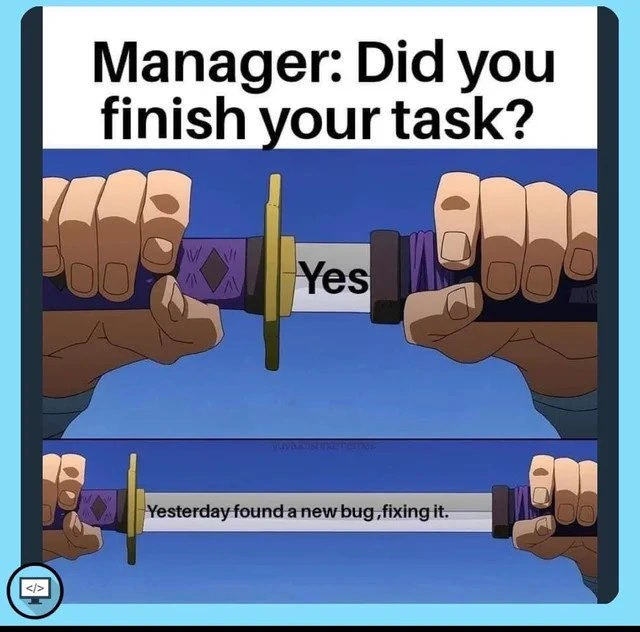
In the image itself, the meme uses an anime sword meme format to get the point across. Visually, there’s a scene of hands pulling a katana (a Japanese samurai sword) out of its sheath. When the sword is only a little bit unsheathed in the first panel, you can see the word “Yes” written on the metal of the blade. This represents the short answer the developer gives initially. In the second panel, the sword is pulled out completely, and you can read the full sentence engraved on it: “Yesterday found a new bug, fixing it.” This full sentence was hidden at first, just like the full truth of the situation was hidden behind the simple “Yes.” It’s a clever way to show hidden details being revealed. The first slice of the blade (with "Yes") is what the manager hears at first. The fully revealed blade is the developer’s full explanation that suddenly appears. The dramatic unsheathing is a playful exaggeration of how a simple status update can turn into a longer discussion about a problem.

For a newcomer to programming, this situation is very common (and now you know it’s not just you!). You might be working on a coding assignment or a feature and tell your team or teacher, “I’m finished.” Then when you run more tests or someone else tries it out, an unexpected error pops up. Now you have to go back and troubleshoot that bug. It feels a bit embarrassing or frustrating – you thought you were done, but there’s more work. This meme labels that feeling in a funny way. The SharedPain tag fits because developers have all been there: you feel the mix of frustration and resignation upon finding a last-minute bug. The Miscommunication part is also real: the poor manager hears “Yes” and thinks they can close the task, but actually the task is still ongoing due to the bug. In Agile teams, people even talk about the “definition of done” – meaning all criteria are met and there are no known bugs. By that strict definition, the task here isn’t really done until the new bug is fixed. But in everyday conversation, the developer still said “Yes” initially, because they did finish the main coding part. They quickly clarified the situation though, because leaving the manager with a false sense of completion could cause bigger misunderstandings (like scheduling a release when there’s still a fix in progress!).

So essentially, this meme is a light-hearted way to show the gap between expectations and reality in software projects. The manager’s simple question got a not-so-simple answer. The phrase “Yes, but actually no” sums it up: yes, the feature was done, but no, we’re not truly done because there’s a bug. It’s funny to developers because it happens all the time – it’s a little slice of everyday developer life turned into a visual joke. And if you look at that katana image and imagine the dramatic “shiiing” sound of a sword being drawn, it perfectly matches the dramatic reveal of that pesky bug at the last moment!

Level 3: Unsheathing the Bug Blade

At a senior engineer’s eye level, this meme reveals the hidden scope lurking behind a seemingly simple status update. The manager’s question “Did you finish your task?” expects a clean one-word answer. And sure enough, the developer initially responds with a quick “Yes” – that’s the few centimeters of sword blade peeking out. But as the katana is fully drawn in the second panel, the real status is engraved along its length: “Yesterday found a new bug, fixing it.” This dramatic unsheathing is a perfect visual metaphor for those nasty surprise bugs that emerge just when you thought you were done. It’s relatable developer humor precisely because any experienced dev has felt that sinking feeling: task complete, except… not really. The meme format (anime sword reveal) amplifies the humor by treating a routine debugging update with over-the-top dramatic flair – very on brand for how even a “small bug” can feel like a boss battle at the end of a quest.

Seasoned developers recognize this scenario as the classic “Definition of Done” dilemma. In theory, a task is done when it meets all acceptance criteria and has no known issues. In practice, done often isn’t done – it’s “done-done” only after those last-minute bugs are fixed too. Here the dev did complete the feature, but yesterday a subtle bug was discovered during testing or integration, pulling them back into debugging & troubleshooting mode. This is shared pain across software teams; it highlights the perpetual tug-of-war between ManagerExpectations (fixed scope, fixed timeline) and the messy reality of code. A project manager or PM hears “Yes” and thinks the task is closed, while the developer’s full answer amounts to “Yes – well, almost, just fighting one more bug.” The humor comes from that miscommunication: the manager gets a reassuring answer on the surface, but the developer immediately unsheathes the gritty truth that more work popped up. If you’ve ever been in a standup meeting where someone says “It’s done, but...”, you know exactly why this is funny in that it-hurts-because-it’s-true way.

Why does this happen so often? Veteran engineers might call it Murphy’s Law of Software: Anything that can go wrong will go wrong (right after you say it’s done). The moment you declare victory, some gremlin in the codebase says “Not so fast!” In fact, there’s a well-worn joke called the ninety-ninety rule: “The first 90% of the code accounts for 90% of the development time... the last 10% of the code accounts for the other 90%.” 😅 That extra 10% is often chasing down edge-case bugs and polishing off rough corners. A bug found at the last minute is practically a rite of passage in software development. Maybe the code worked on your machine but failed in staging, or a last-second refactor introduced a sneaky bug. Here are common culprits that senior devs will nod at:

  • Integration surprises: The feature is complete in isolation, but when merged into the full system, something breaks (a service call fails, a null pointer appears, etc.).
  • Edge case oversight: An unusual scenario or input wasn’t covered by initial tests. Of course, that’s exactly what happened in production or when QA tried it.
  • Regression or side-effect: Fixing or changing one thing accidentally broke something else. You closed one ticket only to immediately open a new bug ticket.

Sound familiar? It’s practically a task_completion_paradox: finishing the task unveils new subtasks. The meme nails this paradox with the anime_sword_meme_format – the blade’s short “Yes” is what management wants to hear, while the fully drawn sword exposes the hidden scope reveal: there’s more work due to a bug. The developer’s reply is essentially a polite way of saying, “I thought it was done until a SubtleBug bit me. Now I’m on an unplanned bug-fixing side quest.” A battle-hardened dev might even chuckle darkly at this, having learned that saying “It’s done” out loud is the fastest way to jinx it. Yes, the DebuggingFrustration is real, but so is the camaraderie – we’ve all been in this fight. In true cynical veteran fashion, many of us have a rule: never trust a “Yes, it’s done” until that code has survived at least a day in production without paging you at 3 AM.

# Developer's status update logic (simplified, with hidden bug detail)
task_done = True
bug_found_yesterday = True

status_update = "Yes"  # the short answer unsheathed to manager
if bug_found_yesterday:
    status_update += ", I found a new bug and I'm fixing it now."  # the full blade reveal

print(status_update)  
# Output: "Yes, I found a new bug and I'm fixing it now."

In the code above, the status_update starts as the manager-friendly "Yes", but then our little boolean bug_found_yesterday flips the script, appending the inconvenient truth. It’s a tongue-in-cheek way to illustrate that binary done/not-done status doesn’t capture the whole story when subtle bugs strike. The developer in the meme basically did this string concatenation in real life: they gave the manager a one-word answer, but couldn’t help appending the bug saga immediately after. The result? A comedic manager_vs_developer_dialogue moment. The manager likely hears “Yes” and then blinks as the dev continues with a long explanation. It’s funny because it’s a scenario that managers and devs both know too well, highlighting the eternal gap between “Task complete 🤝 Wait, one more bug”. In summary, the meme brilliantly captures that facepalm moment when “done” isn’t done, using an epic anime sword reveal to turn a routine status update into a mini-drama every developer recognizes.

Description

A two-panel meme, often called the 'Truthful Sword' or 'Unsheathing the Sword' format, which uses a scene from an anime. The meme is set against a blue background and has a title at the top: 'Manager: Did you finish your task?'. In the first panel, a samurai sword is partially unsheathed, revealing only the word 'Yes' on the blade. In the second panel, the sword is fully drawn, and the full text on the blade is visible: 'Yesterday found a new bug, fixing it.' The meme humorously illustrates a common communication challenge in software development. A developer might say a task is 'done,' but this simple answer often conceals a more complex reality. The initial task is complete, but in the process, a new, unforeseen issue (a bug) has emerged, which now requires attention. For senior developers, this is a universal experience of how 'finished' is rarely a final state in a complex system
Comments

20
Anonymous ★ Top Pick My status updates are like API responses. You get a '200 OK', but you have to check the payload to see the five new exceptions it threw
  1. Anonymous ★ Top Pick

    My status updates are like API responses. You get a '200 OK', but you have to check the payload to see the five new exceptions it threw

  2. Anonymous

    The sprint board says 'Done,' but like a quantum katana, every time the PM observes it we collapse the state vector into one more P1 defect

  3. Anonymous

    The task is technically complete in the same way Schrödinger's cat is technically alive - it exists in a quantum superposition of 'done' and 'spawning regression tickets' until someone actually deploys it to production

  4. Anonymous

    Status reports are like swords: the truth is only visible once fully unsheathed, and by then someone's already getting hurt

  5. Anonymous

    The classic 'task is done' Schrödinger's cat scenario: simultaneously complete and incomplete until the manager asks for details. Every senior engineer knows that 'finished' just means you've graduated from planned work to unplanned work - yesterday's bug fix is today's archaeological dig through a codebase where the original author left no forwarding address and the tests were 'TODO: write tests.'

  6. Anonymous

    The observer effect in action: manager asks 'done?', spawning a fresh regression like quantum debugging

  7. Anonymous

    Senior translation of “Yes”: it compiles locally; after you draw the rest of the katana, Jira reopens the ticket, the definition of done gains three clauses, and the burndown achieves eventual consistency

  8. Anonymous

    Management asks for a boolean; engineering runs an eventually consistent status stream with late-arriving bug fixes

  9. @jerinisready 4y

    Repeating

  10. @saidov 4y

    Still waiting for reactions

    1. Deleted Account 4y

      same

    2. @tymchasovinegarazdy 4y

      same

    3. @SamsonovAnton 4y

      There is no specific reaction provisioned for a repeating post. 🔄 🪗 🔁

  11. @mpolovnev 4y

    +1 for reactions!

    1. dev_meme 4y

      thank god im not seeing them because of outdated fork

      1. @freeapp2014 4y

        whats wrong

        1. dev_meme 4y

          hujak-hujak-to_production feature tdesktop's design for reactions is not the best

  12. @mpolovnev 4y

    ontopic: guys, youre totally right: It's repeating. This thing keeps on repeating in my team 😄

    1. dev_meme 4y

      https://t.me/devs_chat/17347

      1. dev_meme 4y

        best repeating meme

Use J and K for navigation