The Tragic Lifecycle of a 'Planned Feature'
Why is this ProjectManagement meme funny?
Level 1: Broken Promises
Imagine your teacher promised the class a big pizza party on Friday. Everyone was excited all week. On Friday, you even see the teacher start setting out paper plates and napkins – it really looks like the pizza is coming, right? But then time passes… and no pizza arrives. Finally, the teacher says, “Actually, we’re not having a pizza party after all.” How would you feel? Pretty disappointed and confused, probably. You were told something fun was going to happen, you even saw a little bit of preparation (plates and napkins), but in the end it just didn’t happen.
This meme is showing basically that situation, but in a software context. The “planned feature” was like the promised pizza party – users were told to expect a new feature in a program. Some preparation for it was even done in the code (like those plates on the table). But then, later on, the update says it’s “no longer planned” – meaning the feature was canceled, just like canceling the pizza party. The feeling it gives is the same: a promise was made and everyone got their hopes up, and then the promise was broken quietly. That mix of hope and let-down is what makes it funny in a kind of “oh, I’ve been there” way. Even if you’re not a programmer, you know the feeling when someone says they’ll do something for you, you see hints of it happening, and then… they don’t do it. It’s a little frustrating, a little ironic, and in hindsight you might even chuckle at how plans can change so fast. In simple terms, the meme is joking about how a software feature went from “Coming soon!” to “Nope, never mind,” just like a much-anticipated pizza party that got called off.
Level 2: Backlog Graveyard
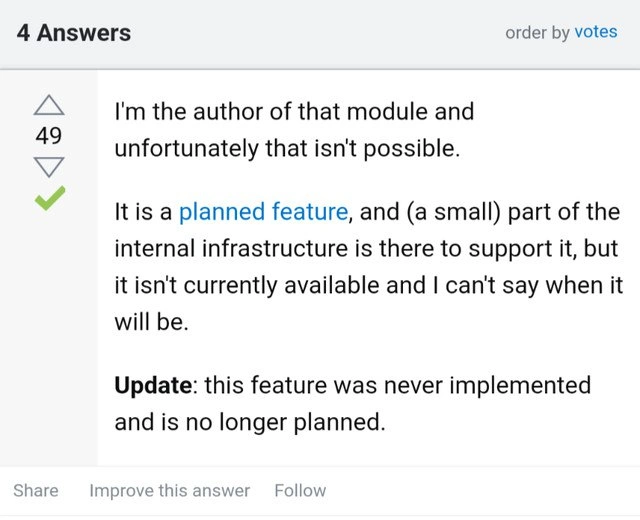
Let’s step back and explain what’s going on here in simpler terms. The image is a screenshot from Stack Overflow, a popular Q&A site where programmers ask and answer questions. In this screenshot, a user likely asked how to use or enable a certain capability in a software module. The person who answered is actually the author of that module – basically the developer who built that part of the software. That’s like getting an answer straight from the horse’s mouth. He starts by saying, “Unfortunately that isn’t possible.” In other words, “sorry, the software can’t do that.” Why not? Because the feature the user wants doesn’t exist yet. The author then explains it was planned as a new feature. In project terms, a planned feature means it was on the roadmap – a list of things the team intended to build in the future. They even set up a bit of groundwork in the code (he mentions a small part of the internal infrastructure is in place to support it). That means the developers wrote some internal code preparing for this new feature, kind of like laying a foundation for a house they intended to build. However, he makes it clear it’s not currently available to use. The feature is basically hidden or inactive in the software because it’s incomplete. He also says “I can’t say when it will be [available].” That’s a careful way of phrasing it – essentially, “we have no idea when we’ll actually finish this, so don’t hold your breath.” This is a common situation with software features that are promised but not yet delivered: developers don’t want to commit to a date because so many things can change (ProjectDeadlines slip, other tasks take priority, etc.).
Now, the kicker is the Update in bold. Sometime after that initial answer, the author came back and edited the post to add: “Update: this feature was never implemented and is no longer planned.” This is the sad (but unsurprising) conclusion: the team never actually built the feature in the end, and they officially decided to drop it from the plans entirely. In plainer terms, “we hoped to make this happen, but it didn’t work out, so now we’re not going to do it at all.” The reason this resonates with a lot of developers is because it’s a pretty familiar story in software development. Features can be promised and documented as “coming soon,” but sometimes they just don’t make it.
There are a few key concepts and terms here to unpack for a junior developer:
Roadmap / Planned Feature: Think of a roadmap as a high-level to-do list for a product. It outlines features and improvements the team intends to work on in the future. When something is a planned feature, it means the team has agreed it would be nice to have and at least penciled it into their schedule or backlog. It’s not done yet – it’s basically a promise or intention. In our scenario, the feature was on the roadmap (hence “planned”), which is why the author mentions it in his original answer to give hope to the user asking.
Internal Infrastructure is there: This means the developers started building the underlying support for the feature. For example, they might have written some internal classes, database changes, or configuration flags that would make adding the feature easier when they got around to it. It’s as if you were planning to install a new appliance in your house, so you went ahead and ran some wiring for it beforehand. In code, sometimes you’ll even find bits like:
// Partial support for Feature X if (isFeatureXEnabled) { enableNewBehaviour(); // This function might exist, but perhaps it's empty or not fully wired up. }Here the variable
isFeatureXEnabledmight always be false or hidden, meaning the new behavior never actually turns on for users. The skeleton of the feature is present, but the flesh is missing. This leftover code is a small example of Technical Debt – extra stuff in the code that isn’t delivering value now, and might need to be cleaned up later. It’s not necessarily harming anything immediately, but it’s essentially unfinished work chilling in the codebase.Not currently available: This is straightforward – it means end users like us can’t use the feature yet. Even if some code exists behind the scenes, there’s no way to access it or it’s incomplete, so from a user’s perspective the feature might as well not exist.
No ETA / Can’t say when it will be: ETA stands for Estimated Time of Arrival. When a dev says they can’t give an ETA, it usually implies uncertainty. Maybe the feature turned out to be harder than expected, or it’s waiting for some decision. Importantly, it indicates the team doesn’t want to make a promise they might break. This often happens when Stakeholders (like managers or clients) are told a feature is in the works, but the devs aren’t confident about timing. It’s a way to avoid directly saying “this is delayed indefinitely,” but it’s a hint that it’s not coming anytime soon.
Feature was never implemented: This is the final outcome – the team ended up not writing the code to deliver this feature at all. Plans don’t always become reality in software. Sometimes initial research or changing priorities lead a team to conclude “actually, we’re not going to do this.” It can happen for many reasons: maybe the feature wasn’t as useful as initially thought, maybe there were technical hurdles, or maybe resources/time were reallocated to other projects. It’s like a promise being taken back, which can be frustrating for users who were waiting for it.
No longer planned: This phrase means the feature was removed from the roadmap entirely. It’s not just “not done yet” – it’s off the table. The team isn’t even claiming they’ll do it later. This is basically a cancellation. In project management terms, the item is closed as “Won’t Fix” or “Won’t Implement.” It’s the end of the line for that idea, at least for the foreseeable future.
For a junior developer, it might be surprising that a feature can go from “we’re working on it” to “we gave up.” But in real development teams, this happens more often than you’d think. Priorities change fast. For example, say you planned to add Feature A to your app because a couple of customers asked for it. You even wrote some basic code in preparation. But then a bigger opportunity or problem comes along – maybe Feature B is suddenly more urgent or a bug fix takes all your time. Feature A keeps getting pushed back. After a while, you realize those customers either found a workaround or don’t need A as much anymore, or maybe the idea no longer fits the product strategy. Eventually, the team decides to abandon the roadmap item. They might not make a big announcement about it; it just quietly disappears from the next version’s goals. If an outside developer (or a user) comes asking later (like on Stack Overflow), the answer will be “sorry, we decided not to pursue that.” It’s a bit of a development reality check – plans are always subject to change.
This meme is a lighthearted look at that scenario. It’s tagged as ProjectManagementHumor for good reason. The humor comes with a wink: every developer who’s been involved in planning and releasing software can relate to the situation. There’s even an unofficial term for features that are promised but never delivered: vaporware – like vapor (steam), it evaporates before you can touch it. While “vaporware” usually refers to entire products that never materialize, the concept is similar for individual features. You could say this planned module feature turned into vaporware.
Another angle here is stakeholder expectations and the ensuing whiplash. Stakeholders could be anyone with a vested interest: maybe the person who requested the feature, or a project manager who promised it to clients. Early on, those stakeholders are told “Yes, we plan to have that.” Naturally, they get excited or they make plans assuming it’ll happen. When it doesn’t, there’s disappointment (and sometimes a bit of finger-pointing). It’s called stakeholder whiplash because the change in direction (from expecting a feature to finding out it’s cancelled) is sudden and jarring, much like the snapping motion of whiplash. A junior dev might not deal with the stakeholders directly, but they might still feel the pressure: one day your boss is saying “Feature X is top priority,” the next month you hear “Actually, drop Feature X, we’re not doing it anymore.” It can be perplexing and frustrating, but it’s common in the software industry.
Finally, let’s talk backlogs and the term I cheekily called the “Backlog Graveyard.” A backlog is essentially the master list of all tasks, features, and bugs that a team has logged. Think of it as the team’s giant to-do list, often managed in tools like JIRA or Trello. As you might guess, not everything on that list gets done. Some items keep getting pushed to the bottom, postponed over and over. If an item stays in the backlog forever without progress, it’s effectively in limbo – that’s what I mean by Backlog Graveyard. It’s where tasks go to die (even if no one announces their death). In our case, this feature lived in the backlog for a long time – it had some initial life (some code written), but then it languished and eventually was scrapped. The Stack Overflow answer update is basically the team admitting “Yep, that one is buried in the backlog graveyard. RIP.”
In summary, this meme’s screenshot is funny to developers because it condenses a whole messy project management story into a few lines of text that we instantly recognize. It’s the story of a promised feature that never made it – something we’ve all seen. The lesson for a newer dev is: don’t be surprised if a “planned feature” doesn’t appear when expected (or ever). It’s not fully real until it’s released. Plans can change, and in software, they often do. And if you ever stumble on a line in documentation or Q&A saying “Update: not happening,” now you know the kind of tale that likely came before that conclusion. It’s a bit of a sarcastic lesson, but an important one in managing expectations in the tech world.
Level 3: Roadmap vs Reality
In this Stack Overflow Q&A snippet, we witness a textbook case of roadmap drift captured in real time. A module’s author responds to a user’s question by essentially performing a feature’s last rites: first acknowledging it was a “planned feature”, and later editing the post to admit it was never implemented and is no longer planned. For seasoned developers, this answer is a darkly comic monument to how Stakeholder Expectations and reality often diverge. It’s the kind of post that triggers war-weary chuckles in senior engineers who’ve survived one too many “planned” features quietly put out to pasture. The combination of the hopeful initial promise and the blunt Update is hilariously relatable. It perfectly encapsulates that familiar cycle of announce, half-build, delay, then abandon. It’s a development reality check that satirizes corporate dysfunction and creeping Technical Debt all in one go.
Why is this so funny (or rather, painfully funny) to us in the industry? Because we’ve all been there: the Feature Request that everyone cheered as “coming soon” ends up slipping into limbo. The stakeholder hype turns into whiplash when months later the feature dies quietly in the backlog with barely an obituary. That bolded “Update” line reads like a tombstone inscription for the feature, and those 49 upvotes on the answer are basically the community offering their condolences (with a knowing smirk). It’s ProjectManagementHumor born from shared trauma — the humor of recognizing our own failed roadmaps and broken promises in a public forum’s cold, hard text. The author even mentions “(a small) part of the internal infrastructure is there to support it,” which is programmer-speak for “we started laying the groundwork, but never got to flip the switch on”. To an experienced dev, that phrase screams Tech Debt: some half-implemented support code now haunting the codebase, serving no purpose except to remind everyone of the feature that never was. It’s a little shard of ghost code that future maintainers might stumble over, triggering déjà vu and a “why is this here?” moment. In other words, the feature didn’t ship, but its internal infrastructure remains as a lingering specter — a gentle development_reality_check that plans changed.
This meme nails the stakeholder whiplash effect. Initially, likely after user requests or internal pressure, the team put Feature X on the roadmap. The module_author_response on the thread basically tells the story of that feature’s arc: from confident planning to indefinite postponement, and finally to outright cancellation. Any senior architect can relate to that dance: trying to keep Stakeholders/Clients happy by promising “it’s in the pipeline”, then coping with the fallout when priorities shift and you have to backpedal. The humor comes from how succinctly the Stack Overflow answer lays out this fiasco. With one edit, years of project management déjà vu are condensed into two brutally honest sentences. It’s both a roadmap_rift chronicle and a cautionary tale about Feature Creep (because often it’s the ever-growing list of “more important” new features that push the originally planned one off the cliff). We can practically read between the lines: New deadline came up, team got re-org’d, Feature X kept slipping until someone finally said “let’s quietly drop it.” Been there, done that, got the t-shirt (and the pile of JIRA tickets marked “Won’t Fix”).
Let’s break down the typical life cycle of these “planned-but-not-planned” features — a saga every senior dev recognizes:
- Initial Hype – A new capability is requested and gets put on the roadmap. Maybe a big client or many users asked for it (
FeatureRequests). Management gives the go-ahead, and everyone sets their StakeholderExpectations that it’s coming. - Half Implementation – The team builds a bit of groundwork: perhaps a hidden flag, some skeletal classes, an API stub. This creates a teaser in the code (the “(small) part of the internal infrastructure”). Technically, the foundation is laid – but the house isn’t built. This is where TechnicalDebt starts brewing if things stall.
- Priority Shift – Other tasks barge in. Maybe a critical bug, a new urgent feature, or FeatureCreep from scope expansion diverts attention. The planned feature gets sidelined. In meetings, it slips from “next release” to “we’ll get to it eventually.”
- The Long Silence – Time passes. The feature lingers in the backlog, gathering digital dust (
abandoned_roadmap). Users occasionally ask “hey, any update on X?” on forums or threads like this Stack Overflow one. The answer remains “not yet, still planned… no ETA.” Everyone involved gets a sense of deja vu – we’ve seen features linger like this before. - Quiet Cancellation – Eventually, reality wins. Perhaps a product manager decides it’s not worth it, or the original requester moves on. The team officially pulls the plug internally. Publicly, this might be reflected in a one-liner update in documentation or, in this case, an edited Stack Overflow answer: “this feature was never implemented and is no longer planned.” Ouch. It’s the polite way of saying “sorry folks, show’s over.”
- Aftermath – What about that partial code in the codebase? Often it just sits there, a vestigial organ in the software. Future developers might stumble on it and scratch their heads. “PlannedFeatureEnabled = false; // TODO enable someday” becomes an everlasting joke. This leftover is pure TechDebt: at best harmless clutter, at worst something that might complicate future changes. And the stakeholders? They’ve moved on (probably to ask about the next new feature), but with a little more skepticism next time.
Each of these steps is dripping with Project Management irony, and the meme’s answer condenses multiple stages into a single Q&A post. It’s funny because it’s true: nothing is more real in software development than plans changing. The top answer’s green checkmark (accepted answer) almost feels symbolic here — accepting that harsh reality. It’s as if the community collectively said, “Yep, this is the truth of it. Case closed.”
So, why do smart teams let this happen? Often it’s not incompetence, but shifting business winds. Maybe a competitor feature lost relevance, maybe the team realized the Requirements Ambiguity made it impractical, or maybe someone up the chain yelled ProjectDeadlines! and anything not already done got axed. What begins as a well-intentioned roadmap item can turn into vaporware if the stars don’t align. And developers, especially the battle-scarred ones, have learned to take any “planned feature” with a grain of salt the size of a rock. This Stack Overflow answer’s journey from optimism to abandonment is both a nerdy inside-joke and a rallying cry: Don’t believe it’s delivered until you see the commit in main and the release notes. Until then, as the meme slyly shows, today’s planned feature can easily become tomorrow’s no longer planned footnote. It’s a witty reminder that in the war between plans and reality, reality usually wins.
Description
This image is a screenshot of an answer from a Q&A website, resembling Stack Overflow, which has been upvoted 49 times and marked as the accepted solution with a green checkmark. The answer, from the author of a software module, addresses a feature request. Initially, the author states, 'I'm the author of that module and unfortunately that isn't possible. It is a planned feature, and (a small) part of the internal infrastructure is there to support it, but it isn't currently available and I can't say when it will be.' This is followed by a stark, bolded update: 'Update: this feature was never implemented and is no longer planned.' The humor captures the harsh reality of software development, where well-intentioned plans and roadmaps often collide with practical constraints like time, budget, or shifting priorities. For experienced developers, this is a painfully familiar scenario, representing the graveyard of features that were once promised but ultimately abandoned, leaving behind vestigial code and unfulfilled user expectations
Comments
16Comment deleted
Every codebase has a ghost haunting it - the partially implemented infrastructure for a 'planned feature' that's now just technical debt
A “planned feature” is just Schrödinger’s backlog item - simultaneously shipping and cancelled until you open JIRA
The rare Stack Overflow answer where the author shows up to personally deliver the bad news, like a doctor explaining why your architecture has six months to live
The full lifecycle of a feature request, immortalized: 'planned' → 'infrastructure partially exists' → 'never implemented and no longer planned'. The only roadmap with 100% honest status reporting
Ah yes, the classic 'planned feature' - the software equivalent of 'we should grab coffee sometime.' It's got 49 upvotes, infrastructure partially built, and a roadmap entry that aged like milk. The author's update is the technical debt equivalent of finding your ex's wedding announcement: 'this feature was never implemented and is no longer planned.' At least they had the decency to come back and update it, which puts them ahead of 90% of abandoned GitHub issues. This is why senior engineers read 'planned feature' as 'maybe in 2-3 years if we don't pivot, get acquired, or decide to rewrite everything in Rust first.'
OSS roadmaps: 'Planned with infra' today, 'RIP ticket' tomorrow - faster iteration than any CI pipeline
When the accepted answer is basically your Jira workflow - Proposed → stubbed infra → indefinite ETA → Won’t Fix - you’ve reached peak roadmap realism
Schrödinger’s roadmap: we stubbed the interfaces, scheduled “later,” and after a reorg it collapsed into WONTFIX
What was the question? Comment deleted
https://stackoverflow.com/questions/22352907/apply-format-to-a-cell-after-being-written-in-xlsxwriter Comment deleted
He should mention pull request is welcome Comment deleted
*isn’t Comment deleted
Um….why not just turn off pull request then? Comment deleted
to humiliate those who will try, of course Comment deleted
what a fucking joke Comment deleted
Unity Engine moment Comment deleted