Journalist Discovers the 'AI' of 1980s Pac-Man
Why is this AI ML meme funny?
Level 1: Silly Ghost Stories
Imagine you have a little toy that can move on its own in a simple way – like a toy ghost that always turns left when it hits a wall. Now suppose someone points at that toy and excitedly says, “This is proof that ghosts are going to become geniuses and take over all the games soon!” You’d probably giggle, right? Because you know the toy is just following a tiny trick its maker gave it, not actually thinking for itself. That’s what’s happening here: people are treating the Pac-Man game’s cute chasing ghosts (which only do what they were programmed to do) as if they’re super-smart robots about to conquer the video game world. It’s a funny mix-up – like confusing a simple magic trick for real magic – and that’s why it makes us laugh.
Level 2: When AI = If/Else
At this level, let’s break down what’s actually happening in the meme and the technical terms involved. The meme references Pac-Man, a famous arcade game from 1980, in the context of modern AI hype. In Pac-Man, you control a little yellow character who eats dots in a maze while being chased by four ghosts. Each ghost behaves a bit differently, and back in the day this was referred to as the game’s “A.I.” or enemy intelligence. Now, it’s important to clarify what that means: in the context of GameDev, especially in the 80s, game AI usually meant any code that made the enemies or NPCs (non-player characters) act in a way that challenged the player. It did not mean the ghosts were thinking for themselves or learning new tricks; it meant the developers programmed each ghost with a specific behavior pattern.
The article snippet in the meme is treating these ghosts as an early example of deploying AI in gaming. Technically, yes, the ghosts have unique behaviors written by programmers. For example: one ghost (Blinky) always tries to move towards Pac-Man’s current position – effectively chasing the player’s avatar directly. Another ghost (Pinky) tries to anticipate Pac-Man’s moves by going to the spot Pac-Man is about to go (if Pac-Man is heading right, Pinky aims a few tiles ahead to the right). A third ghost (Inky) uses a combination of Pac-Man’s position and another ghost’s position to decide its approach, resulting in some quirky unpredictable movement. The fourth ghost (Clyde) sometimes chases Pac-Man but if he gets too close, Clyde gets shy and wanders off to a corner. These predefined behaviors made it feel like each ghost had a different “personality” – one aggressive, one tricky, one shy, etc.
How were these behaviors implemented? Finte state machine is one common technique. A finite-state machine is basically an organized way of handling different modes or states an AI can be in. In Pac-Man’s case, ghosts actually have modes: a normal chase mode, a scatter mode (where they temporarily wander to corners away from Pac-Man at set intervals), and a frightened mode (when Pac-Man eats a power pellet, the ghosts turn blue and run away). Each ghost switches states based on timers or events. For instance, they might chase for 20 seconds, then “scatter” for 7 seconds (running a fixed routine that doesn’t involve chasing Pac-Man), then return to chase mode, etc. When frightened, their logic changes entirely: instead of targeting Pac-Man, they run away or move randomly. This finite_state_machine_reference just means the ghost’s code checks what state it’s in (Chase/Scatter/Frightened) and what kind of ghost it is, then decides the movement accordingly.
To put it in concrete programming terms, you could imagine some pseudo-code for the ghost AI like this:
for ghost in ghosts:
if ghost.state == "FRIGHTENED":
ghost.run_away_from(pacman.position) # Blue ghost mode: flee Pac-Man
elif ghost.name == "Blinky":
ghost.target = pacman.position # Blinky: head directly toward Pac-Man
elif ghost.name == "Pinky":
ghost.target = pacman.position + pacman.direction*4 # Pinky: aim 4 tiles ahead of Pac-Man
elif ghost.name == "Inky":
# Inky: target a point based on Pac-Man and Blinky's relative positions (complex calculation)
ghost.target = mirror_point(pacman.position, blinky.position)
elif ghost.name == "Clyde":
# Clyde: if he’s far from Pac-Man, chase; if he gets too close (<8 tiles), retreat to his corner
if ghost.distance_to(pacman.position) < 8:
ghost.target = ghost.corner_location # go scatter in his home corner
else:
ghost.target = pacman.position # chase Pac-Man normally
ghost.move_one_step_towards(ghost.target)
// The above pseudo-code shows simplified logic for each ghost’s behavior. Each ghost either chases Pac-Man in its own style or runs away if frightened. None of this involves the ghost “learning” – it’s all predetermined rules.
As you can see, this looks like a bunch of if/elif conditions controlling what the ghost does. That’s essentially what the article calls “A.I. programming” – and in the 1980s_game_ai context, it was indeed considered state-of-the-art for games. These ghosts gave an illusion of intelligence; players noticed that each ghost acted differently and had to adjust their strategy, which made the game fun and challenging. In reality, under the hood it was straightforward logic crafted by the game developers. This approach is sometimes jokingly referred to as “If/Else Intelligence” – because it’s literally a series of if-else statements driving the behavior, not some self-thinking Skynet.
Now, let’s talk about the AI hype angle. The meme text suggests that “most experts” think AI will take over the video game industry in the next five years, and executives are restructuring their companies accordingly. That’s a bold claim and sounds like something you’d read in a trend-chasing news article. IndustryTrends_Hype often involves such sweeping statements (e.g. “AI is going to revolutionize everything!”). In reality, what they might be talking about is things like using modern machine learning in game development – perhaps letting AI generate game levels, create NPC dialogue, balance game difficulty dynamically, or even assist in designing games. There’s genuine movement in those areas (for example, some games use AI to test levels, and companies are exploring AI-generated art or voice acting). However, saying an “AI takeover” is coming suggests a massive change, like AI replacing large parts of the development team or being the central pillar of all game logic, which is more science fiction than fact at the moment.
The funny part is the justification they give: pointing to Pac-Man’s ghosts from 40+ years ago as evidence that gaming has been an AI pioneer. Pac-Man_ghost_ai is indeed a piece of gaming history, but comparing it to today’s AI is like comparing a paper airplane to a space rocket. Yes, both fly, but one is a child’s toy and the other is a technological marvel. The article’s logic is a bit flawed: just because game developers have long used some form of AI techniques (even simple ones like in Pac-Man), doesn’t automatically mean we’re on the brink of sentient video game characters or that the business side of gaming should brace for an AI earthquake.
For a junior developer or someone new to these terms:
- Artificial Intelligence (AI) in general means making computers perform tasks that normally require human intelligence (like learning, problem-solving, pattern recognition). In games, AI usually means the code that controls enemies or allies, making them act in challenging or lifelike ways. There’s a spectrum here: from very simple rule-based AI (like Pac-Man ghosts) to more complex AI (like bots in a modern strategy game that can adapt to your tactics).
- Machine Learning (ML) is a subset of AI where instead of coding the rules by hand, you let the computer learn the rules from data. This is what’s driving a lot of recent AI hype – things like neural networks that can learn to play games by themselves (for example, Google’s DeepMind taught an AI to play old Atari games better than humans by letting it experiment thousands of times).
- Finite-State Machine (FSM) is a design pattern often used in game AI. It’s a way to organize behavior into states and transitions. For instance, a guard in a stealth game might have states like “Patrolling,” “Alerted,” “Chasing,” “Searching,” and “Returning to Patrol.” The guard switches between these states based on what’s happening (saw the player, lost sight of player, etc.). Each state has its own set of actions. This makes the AI’s behavior structured and easier to manage. Pac-Man’s ghosts effectively had an FSM controlling them, even if they didn’t call it that explicitly back then.
- Executives restructuring companies for AI: This refers to high-level managers or CEOs reorganizing teams, budgets, or company priorities to focus on AI-related projects. In practical terms, a game studio might, for example, start an “AI division” or shift more developers into roles working with machine learning, or invest in new AI tools. It can sometimes also mean layoffs of roles deemed “irrelevant” while hiring more AI specialists. The meme hints that some execs might be doing this just because they’re riding the hype wave, not necessarily because it fits a well-thought-out strategy.
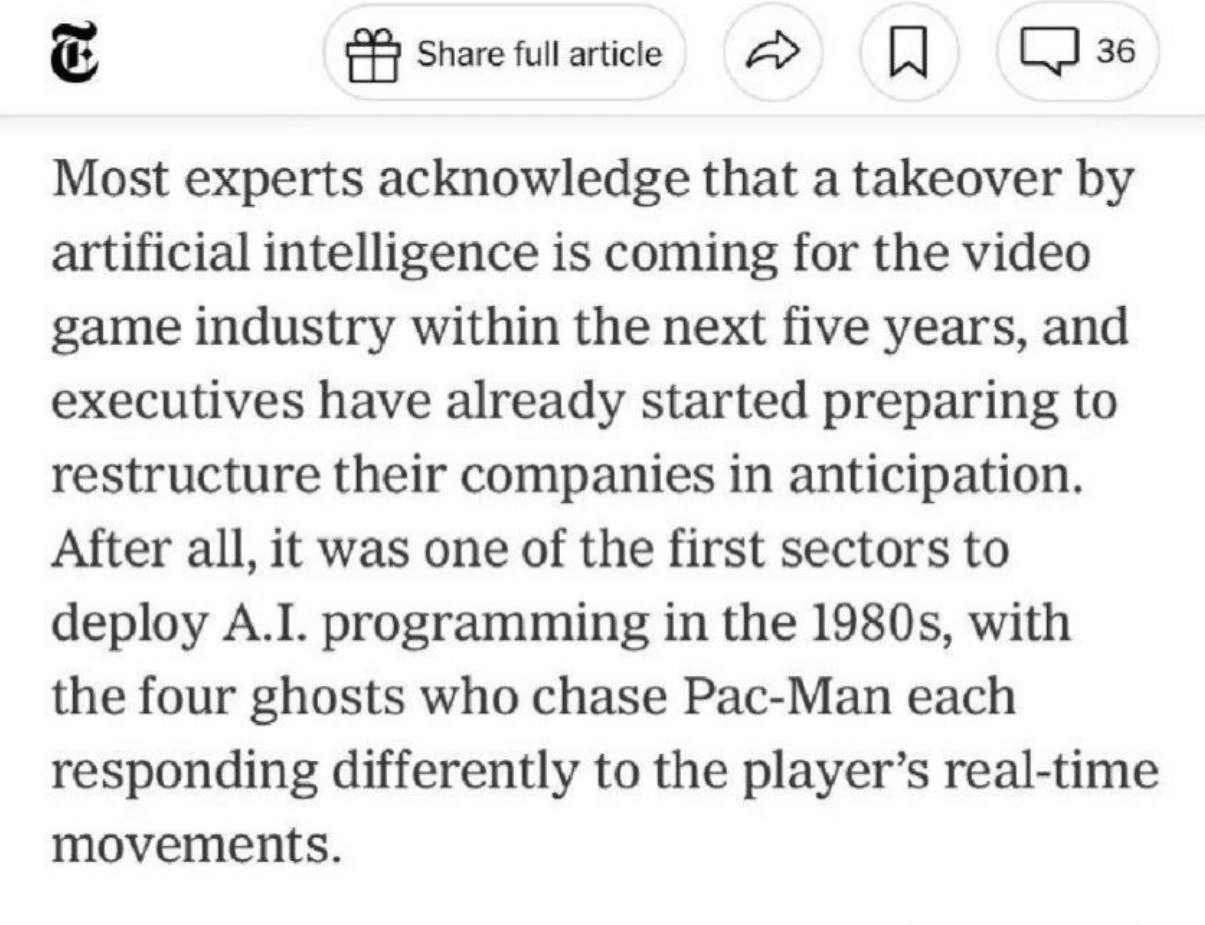
The image itself being a nytimes_screenshot style suggests it’s poking fun at how mainstream media sometimes presents these tech trend stories. The presence of icons like share buttons and a comment count (“36”) makes it look like a real mobile news article screenshot, which adds to the parody feel – it blurs the line between an actual news piece and a meme. If you were a newcomer reading that snippet without context, you might think “Wow, is the NYT really saying Pac-Man had AI and now games will be run by AI soon?” The tech-savvy readers instantly see the joke: it’s a satirical take on how some articles oversimplify history to make a sensational point.
In simpler terms: Pac-Man’s ghosts are to AI what a bicycle is to a Tesla autopilot. Both involve moving around obstacles, but one is a fixed mechanism (you pedal, it moves) and the other is a complex self-driving system. The meme’s author is basically saying, “Look, these journalists or so-called experts are citing something as trivial as Pac-Man ghosts as proof that AI is about to take over gaming – how ridiculous!” It’s a critique of AIHype. And indeed, the poster’s message (“you can hate on AI all you want, it will still outsmart most journalists”) suggests they think journalists are getting outsmarted by even basic AI concepts, or at least that journalists are not doing a great job conveying the reality.
For a junior dev or anyone early in their tech career, the takeaway humor is: be cautious of grandiose claims. The industry has a habit of repackaging old ideas with new buzzwords. Pac-Man’s ghosts were called AI, but they were basically clever programming. Today’s AI in games might use fancier techniques, but whenever someone says “revolution in five years!”, healthy skepticism is warranted. If you’ve seen a few hype cycles, you recognize the pattern – if not, this meme is a playful introduction to that dynamic in tech culture.
Level 3: Chasing Ghosts of AI
The meme shows what looks like a serious news article (complete with the New York Times-style T logo) proclaiming that “a takeover by artificial intelligence is coming for the video game industry within the next five years.” As evidence, it earnestly points out that gaming “was one of the first sectors to deploy A.I. programming in the 1980s, with the four ghosts who chase Pac-Man each responding differently to the player’s real-time movements.” For seasoned developers and game historians, this claim triggers instant eye-roll and laughter. Why? Because equating the Pac-Man ghosts to an impending AI revolution is a textbook case of AI hype vs. reality.
First, let’s unpack the humor in context. Pac-Man, a classic from 1980, is often beloved in GamingCulture for its simple yet effective enemy behaviors. The four ghosts – Blinky (red), Pinky (pink), Inky (blue), and Clyde (orange) – were each coded with slightly different personalities. Blinky directly chases Pac-Man aggressively, Pinky tries to ambush by predicting where Pac-Man is heading (aiming a few steps ahead), Inky’s behavior is a bit quirky, using a combination of Pac-Man’s and Blinky’s position to decide its target, and Clyde sometimes chases Pac-Man but retreats to a corner if he gets too close. These behaviors were clever design for their time, giving the illusion that each ghost had a distinct “strategy” or “personality.” In the 1980s, it was common to refer to such NPC (non-player character) coding tricks as “AI programming.” Game developers would proudly tout their enemy AI, which really meant a bunch of hard-coded rules and maybe some basic pathfinding. It was game development ingenuity working within technical limitations – not the kind of adaptive, general intelligence we dream about today.
Now fast-forward to the present hype cycle. The article implies that because games used “AI” decades ago in Pac-Man, the video game industry is primed for an AI takeover soon. This is where experienced devs detect the IndustryTrends_Hype and get a smirk. It’s as if a journalist or an “expert” executive remembered something vaguely about Pac-Man ghosts being called AI and decided it’s proof that the AI revolution in gaming has been brewing for 40 years and is now about to erupt. They’re chasing ghosts – both literally (the Pac-Man ghosts) and figuratively (the specter of hype). The phrase “chasing ghosts” also idiomatically means pursuing something insubstantial or not quite real, which makes it the perfect metaphor here. The article is chasing the ghost of AI hype, seeing significance in a decades-old trivial example.
For a senior engineer or game developer, the comedic absurdity lies in the disconnect between buzzwords and actual tech. We’ve all sat through meetings where a non-technical executive references a flashy headline or a half-understood concept and suddenly wants to pivot the whole product strategy. (The classic “We need blockchain/AI/VR because I saw it on the cover of a magazine” syndrome.) In this case, the execs are said to be “restructuring their companies in anticipation” of an AI takeover. Seasoned folks know this pattern too well: management preemptively reorganizing teams, chasing an IndustryTrend because some consultants or experts waved around big predictions. It’s reminiscent of other hype-driven gold rushes – remember when every game studio tried to bolt on a “battle royale” mode after PUBG’s success, or when every company suddenly needed a “Big Data” department? Here we have AI as the new shiny object, and leadership is gearing up as if Skynet’s about to become CEO.
The punchline, of course, is using Pac-Man’s ghosts as justification. That’s like an executive saying: “We’ve had AI since the days of 8-bit arcades, so clearly the next five years will bring an AI apocalypse in gaming!” It conflates AIHype with AIHumor. In truth, anyone in GameDevelopment knows that Pac-Man’s ghost AI is simplistic AI at best – it’s a brilliant hack of game design, but not at all comparable to modern machine learning or the kind of AI that could “take over” creative roles. The ghosts weren’t training on data or evolving new tactics on their own; they were doing exactly what their programmers told them to do, frame by frame. We often joke in dev circles that many so-called “A.I.” in games are just a bunch of if statements. Well, Pac-Man is literally that joke; its ghosts are governed by fixed logic and maybe a random number generator here or there.
To someone who’s been around tech news for a while, the line “within the next five years” is a red flag of overly optimistic forecasting. It’s eerily similar to countless past predictions: AI has been proclaimed as “five years away” from revolutionizing various industries for, ironically, many decades. In the 1980s, experts predicted fully intelligent machines in a couple of decades (cue the first AI winter when those promises fell flat). In the mid-2000s, we heard that by the 2010s, AI-driven NPCs would pass the Turing test and feel like playing against humans – yet most game AI still runs on scripted behavior patterns today. A seasoned dev might chuckle and think, “Five years, huh? We’ll see if in 2030 we aren’t reading the same headline with a new date.” The meme taps into that cynicism: the tech industry’s habit of perpetual hype with moving goalposts. AIIndustryTrends often oscillate between overhyping and underestimating what’s possible, and articles like this fuel the former.
Additionally, there’s a cultural nugget being poked at: mainstream media’s understanding of tech can be shallow or skewed. The New York Times style snippet, with its authoritative tone, asserts that “most experts acknowledge” this coming AI takeover – but then undermines its credibility by citing Pac-Man ghosts as an example. For developers, this feels like reading a science article that claims “most scientists agree the ocean is going to turn to cherry soda, and as proof, remember that one time it rained lemon-flavored water in a kids’ cartoon.” It’s TechHumor 101: highlighting how non-technical folks sometimes latch onto a buzzword and a historical anecdote without grasping the nuances. We laugh (perhaps a bit ruefully) because we’ve seen business decisions made on such flimsy understanding.
In reality, the video_game_industry_projections for AI are both exciting and uncertain. Yes, AI (in the modern sense) is increasingly used in games – from procedural content generation (think algorithmically generated levels in roguelikes) to adaptive difficulty, to even letting neural networks control NPC behavior in experimental projects. But even now, those systems require heavy lifting, careful design, and don’t automatically guarantee a “takeover.” The meme exposes how jargon can be misused: calling Pac-Man’s ghost logic “A.I. programming” is technically true in the historical context, but it’s a far cry from saying AI will replace game developers or dominate the industry in a half-decade. It’s a bit like claiming “We had self-driving technology in the 1890s because horses knew how to find their way home; therefore, Lyft drivers will be obsolete in five years.” That leap in logic is what makes us grin.
In sum, this meme resonates with experienced devs because it satirizes the AIHypeVsReality gap. It’s poking fun at executives and journalists who might not know a finite_state_machine_reference from a neural network, yet spew confident predictions. We recognize the mix of buzzword ignorance and historical name-dropping: Pac-Man’s ghosts were cool, but they’re not an argument for a coming AI singularity in gaming. The humor has a slightly bitter edge (especially noting the post caption: “AI will outsmart most journalists” – implying the journalists hype it without understanding it). It’s a comedic reminder to take sensational headlines with a grain of salt and to remember that just because something was labeled “AI” in the past doesn’t mean we were on the brink of the AI revolution all along. As cynical veterans might say with a smirk, “Sure, we’ve had AI in games since the 80s – and we’ve been 5 years away from the big AI takeover ever since!”
Level 4: Ghost in the Finite-State Machine
At the theoretical extreme, this meme highlights the contrast between hard-coded algorithms and genuine learning systems in AI/ML. The Pac-Man ghosts aren’t powered by magical intelligence – they run on a simple finite-state machine (FSM) and predefined rules. In automata theory, an FSM is a mathematical model of computation consisting of a limited number of states and transitions between those states based on inputs. In Pac-Man’s case (circa the 1980s), each ghost’s “brain” can be described as a small set of states (like Chase, Scatter, Frightened) with transitions triggered by game events (e.g. Pac-Man eating a power pellet triggers ghosts to enter the Frightened state). Formally, one could say each ghost implements a deterministic function f(game_state) -> next_action. This is classic game AI in the academic sense: an application of game theory and automata to create the illusion of intelligence under tight technical constraints.
From a computer science perspective, the ghosts’ behavior is algorithmic rather than heuristic or learning-based. Each ghost follows a specific algorithm that can be fully understood and even proven correct or exhaustively tested (a hallmark of finite-state systems). For example, the ghost Blinky continuously computes the shortest path toward Pac-Man’s current tile (essentially a pathfinding algorithm on the grid), whereas Pinky calculates a target tile a few steps ahead of Pac-Man’s direction. These rules are deterministic: given the same input (Pac-Man’s position and direction, ghost positions, etc.), the ghost will always respond in the exact same way – a hallmark of an FSM or a simple algorithm. There is no probability distribution or weight matrix being adjusted on the fly; it’s all if-this-then-that logic embedded in the game’s code. Mathematically, we can model it as a state transition table or flowchart rather than as any sort of self-optimizing system.
It’s enlightening to compare this with modern A.I. approaches: today’s hype around an “AI revolution” in gaming often refers to machine learning techniques such as deep reinforcement learning or procedural content generation. Those systems use models (like neural networks or advanced search algorithms) that learn from data or simulate many possible outcomes. For instance, a reinforcement learning agent playing Pac-Man could actually improve its strategy through trial and error – adjusting numerical weights to maximize a reward (score) over time. That’s fundamentally different from Pac-Man’s original ghosts, which have no capacity to learn or adapt beyond their coded instructions. In theoretical terms, Pac-Man’s ghost AI is a finite, closed system; modern AI aims to be open-ended and adaptive, sometimes employing infinite state spaces or continuous state variables, far beyond what an 80’s arcade machine could handle.
There’s an old tongue-in-cheek saying in computing: “If statements are the original artificial intelligence.” The meme dredges up that truth – in the arcade era, what game developers called AI was often just a handful of conditional branches governing behavior. We’re effectively witnessing a conflation of Good Old-Fashioned AI (GOFAI) – which relies on explicit rules and state-machines – with the current wave of statistical AI and deep learning. The humor is rooted in the theoretical mismatch: citing a finite-state, deterministic system as proof of an AI revolution driven by self-learning algorithms is like citing a pocket calculator to prove impending breakthroughs in quantum computing. Both involve “computation,” but on vastly different scales of complexity and principle. In short, the meme underscores how far removed the IndustryTrends_Hype can be from the actual academic and technical meaning of terms like A.I..
Description
A screenshot of a news article, likely from The New York Times judging by the distinctive 'T' logo in the top left. The text of the article makes a bold claim about the future of artificial intelligence in the video game industry. It reads: "Most experts acknowledge that a takeover by artificial intelligence is coming for the video game industry within the next five years... After all, it was one of the first sectors to deploy A.I. programming in the 1980s, with the four ghosts who chase Pac-Man each responding differently to the player's real-time movements." The humor, especially for a technical audience, stems from the absurdly outdated and simplistic example used to represent AI. The Pac-Man ghosts operate on simple, deterministic algorithms (e.g., Blinky follows, Pinky ambushes), which are more accurately described as finite state machines or basic pathfinding, not the complex, learning-based systems that constitute modern AI. The image is a satire of mainstream tech journalism's tendency to misunderstand and oversimplify complex technical concepts
Comments
24Comment deleted
If the Pac-Man ghosts' FSM logic is considered AI, then my weekend script that just deletes empty folders is basically Skynet
Nothing says ‘looming AI disruption’ like executives benchmarking their strategy against a 128-byte finite-state machine that still runs flawlessly on a 3 MHz Z80
Calling Pac-Man's ghosts 'AI' is like calling a switch statement 'machine learning' - next they'll tell us the Space Invaders were using neural networks to predict player movement patterns and Pong was an early implementation of reinforcement learning
Ah yes, the impending AI apocalypse - clearly foreshadowed by four ghosts running if-else statements in a maze. If Pac-Man's deterministic state machines from 1980 count as 'A.I. programming,' then every switch statement I've written makes me a machine learning pioneer. Next they'll tell us the gaming industry should brace for a quantum computing revolution because Tetris blocks exist in superposition until they hit the bottom
Calling Pac-Man's ghosts AI is like calling if-statements machine learning; if that's a takeover, my cron has been AGI since 2006
Pac-Man's ghosts nailed multi-agent coordination on 4KB RAM; modern game AI devs still can't avoid friendly fire without hallucinating the map
Pac‑Man’s “AI” is four deterministic FSMs with different target tiles; if that’s a takeover, my cronjobs are multi‑agent systems
i confirm Comment deleted
Another proof that looking at the world through the prism of memes is more meaningful than through the prism of the news articles Comment deleted
the 7th layer of irony protects us Comment deleted
I think AI needs to replace journalists first Comment deleted
there will be at least some kind intelligence Comment deleted
In the words of Michael Malice: "The corporate press is the enemy of the people" And the Auron MacIntyre's: "You don't hate journalists enough. You think you do but you don't" Comment deleted
Will AI replace AI programmers? 🤔 Comment deleted
pretty low effort meme where the last pic can literally be anything at all Comment deleted
Jarvis, make me a GTA 7 Comment deleted
That's a great idea! Comment deleted
I mean, isn't the article kinda right? AI may not be better at the job than humans, but it sure is better at giving CEOs those juicy green arrows going upwards. Firing thousands of employees and closing studios isn’t good for the industry either, yet Microsoft went for it anyway. Comment deleted
Nah, the absurdity is about/reason for meme is "After all, it was one of the first sectors to deploy A.I. programming in the 1980s, with the four ghosts who chase Pac-Man each responding differently to the player's real-time movements." Comment deleted
Did you mean written by the same AI? Ha-ha. Comment deleted
ain’t no way this is a real article, made by a real journalist Comment deleted
А если ИИ начнёт писать статьи, кто будет их проверять? 😅 Comment deleted
Artifical intelligence is a loose concept. The 4 ghosts of pacman can be AI, taken that they are an artificial algorithm that are designed to complete a specific task. Today AI refers more to neural networks and LLMs for the most part tho. Comment deleted
written by the very same AI Comment deleted