Skip to content
DevMeme
6361 of 7435
The Fourier Transform's Identity Crisis
Mathematics Post #6975, on Jul 29, 2025 in TG

The Fourier Transform's Identity Crisis

Why is this Mathematics meme funny?

Level 1: Name Mix-Up, Big Laughs

Imagine you have a really big important toy that can do something amazing, like a special machine that can break music into all its individual notes. It has a fancy name – let’s pretend it’s called “Fourier” (foor-yay) the Magic Music Breaker. Now, picture one excited kid who sees this machine and wants to tell everyone about it, but they accidentally call it “furry transfem” by mistake. That sounds nothing like the real name! It’s as if they called a lion a “giant kitty” or a dinosaur a “dancing sore.” Immediately, the big machine (imagine it with a cartoon face on its screen) turns around with a comically annoyed voice and says, “HEY! That’s NOT my name!” Everyone can’t help but giggle because the kid’s silly pronunciation made this super serious machine sound like a completely different, funny thing.

The core of the joke is a simple mix-up: a hard, weird-looking word got jumbled into funny-sounding words. It’s like when you try to say a tongue-twister or a new word and it comes out all wrong. The serious thing (the Fourier transform, which is just a fancy math tool) feels almost like a character that got called a goofy nickname – and it’s protesting! We find it funny because we know how it’s supposed to sound, and hearing it said so wrong is super silly. It’s the same kind of laugh you get when someone mishears song lyrics in a ridiculous way. In the end, the meme is just showing that even really smart science ideas can have a sense of humor when a word is mispronounced. It makes us smile and remember: everybody slips up with tricky words sometimes, and that’s ok – it can even be hilarious!

Level 2: Sine Waves & Slip-Ups

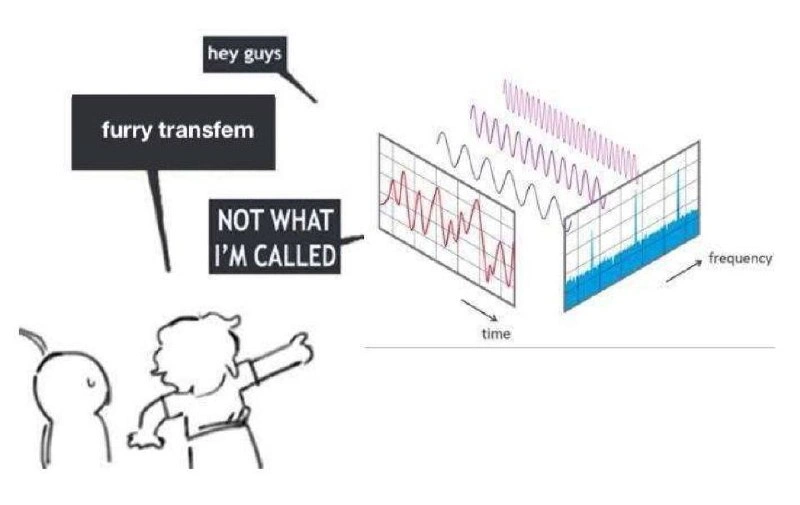
Let’s break down what’s happening here in simpler terms. The image on the right is illustrating a Fourier transform, which is a fundamental idea in math and engineering for understanding signals. A signal could be anything that varies over time – for example, a sound wave, a heartbeat ECG line, or even the daily temperature. We usually first look at it in the time domain, meaning we see how it changes over time (that’s the red jagged line labeled “time” in the meme). But there’s another way to look at that same data: the frequency domain, which tells us which frequencies make up that signal (that’s the set of blue bars in the meme, labeled “frequency”). Frequencies are like the ingredients of the signal: imagine a musical chord – instead of hearing it as one sound, you could identify the individual notes (frequencies) that make up that chord. The Fourier transform is basically the recipe that converts the time-based signal into those frequency ingredients. It’s as if you have a complicated sound and you ask, “which pure tones (sine waves) are in here, and how strong is each one?” The result of a Fourier transform is often visualized as a spectrum – bars or a curve showing the strength of each frequency component. In the meme’s diagram, the red waveform on the front grid might be something wiggling in time (say, an audio clip of you saying “hello”), and the blue bars on the side grid show the frequency makeup (maybe one bar corresponds to a 200 Hz tone, another to 400 Hz, etc., indicating what frequencies your “hello” contains). The curvy purple and gray waves drawn in between hint at how the original signal can be reconstructed by adding up those individual frequency waves. This concept is central in signal processing – it’s how your MP3 player knows what frequencies to boost for bass vs. treble, and how JPEG images break down an image into parts that can be compressed. In computing, when we actually calculate this transform, we typically use an algorithm called the Fast Fourier Transform (FFT for short) to do it quickly, because doing it by the basic definition would require a lot of math operations. You might have even seen code or libraries with fft in their name – for instance, in Python you can do:

import numpy as np
time_signal = np.array([0.0, 1.0, 0.5, -0.2, ...])   # a series of data points over time
frequency_spectrum = np.fft.fft(time_signal)         # compute the Fourier Transform (FFT)
print(frequency_spectrum)  # this will show complex numbers representing amplitudes of frequencies

Here, time_signal could be samples of a sound wave, and np.fft.fft will output an array of complex numbers. Those numbers encode the amplitudes (and phases) of various frequency components present in the original signal. Don’t worry if that sounds complicated – the key idea is that Fourier transform is a tool to go from the time-world to the frequency-world. It’s a bit like shining white light into a prism and getting a rainbow: the rainbow is the frequency-domain view of the light, showing the colors (frequencies) that were mixed together in the original white light. Pretty cool, right?

Now, the meme’s joke is purely about wordplay – it’s taking the term “Fourier transform” and mispronouncing it in a ridiculous way. Fourier is named after Joseph Fourier, so it’s not a word you’d know unless you’ve studied this stuff. It’s pronounced “FOR-yee-ay” (or often just “FOR-ee-er” in casual English). But if you only ever saw it written, you might try to pronounce it like it’s spelled and get something like “FOUR-ee-ur.” The person in the meme goes even more off-track and says “furry transfem.” This phrase doesn’t mean anything in tech; it’s just a phonetic mess-up. It sounds like it could be words – “furry” is an English word meaning covered in fur, and “transfem” on its own might hint at something (perhaps short for a transgender female in some contexts) – but together “furry transfem” is complete nonsense in the context of math. The humor here is that the excited stick figure misheard or bungled the big fancy term, and the Fourier transform (as a drawn entity) snaps back like, “Nope, that’s not my name!” It’s a playful way to poke fun at how easily technical jargon can be garbled. If you’ve ever been new to a topic and mispronounced terms like Linux (saying “Lie-nucks” instead of “Lin-ux”) or SQL (saying “S-Q-L” when others say “sequel”), you know that slight embarrassment – and later, the ability to laugh about it. This meme falls into that bucket of misheard math terms and tech puns. It’s taking a rather serious concept from Mathematics/CS Fundamentals and making it approachable through a silly mistake.

For clarity, let’s define a few key terms and why they matter here:

  • Fourier Transform: A mathematical operation that transforms a signal from time domain to frequency domain. In simpler words, it answers “what frequencies are present in this signal and how strong are they?” It’s fundamental in fields like audio processing, communications, and image analysis. If you see a graph of frequencies (like an equalizer display bouncing up and down to music), that’s the result of a Fourier transform.

  • Time Domain vs. Frequency Domain: Two ways to describe a signal. Time domain is like a timeline of the signal’s amplitude (e.g., how a sound wave oscillates over time). Frequency domain is like a breakdown of the signal into tones – it tells you “this signal is made of a 100 Hz tone, a 200 Hz tone, etc., with these magnitudes.” In the meme, time is on the front axis with the red waveform, and frequency is on the side axis with the blue bars. They’re two sides of the same coin, and the Fourier transform connects them.

  • Fast Fourier Transform (FFT): This is not depicted in the meme, but it’s worth mentioning because you’ll encounter it when working with code. The FFT is a highly optimized algorithm to compute the Fourier transform quickly (in $O(N \log N)$ time instead of $O(N^2)$ if you did it naively). So whenever you convert a digital signal to frequencies on a computer (like using numpy.fft or filtering audio in real-time), you’re likely using an FFT under the hood. Fun fact: without FFT algorithms, things like real-time audio equalizers or JPEG image compression would be much slower or practically impossible to do on devices. And to be clear, FFT has nothing to do with being fuzzy or furry – it stands for Fast Fourier Transform, not, say, Fuzzy Furry Thing! 😄

  • Mispronunciation and Tech Humor: The phrase “furry transfem” is just a goofy mispronunciation of “Fourier transform.” Tech folk love this kind of pun because it breaks the ice. It reminds us not to take all the complex terminology too seriously. Everyone makes mistakes with jargon, especially names that come from non-English origin (Fourier is French, after all). Memes like this circulate in developer and engineering communities to get a quick laugh and say, “hey, we’ve all been that person at least once.” It’s a form of inside joke because if you know the real term and how important it is, the mix-up becomes ten times funnier. If you didn’t know about Fourier transforms at all, the phrase might just sound bizarre and maybe slightly humorous on its own, but you wouldn’t get why it’s funny — the comedy lives in the gap between what was said and what was meant.

In summary, for a newer developer or student, this meme is showing: there’s a serious concept (Fourier transform, converting time to frequency) being pointed at by a cartoon figure who tries to say the term but completely botches it as “furry transfem.” The all-important diagram itself (the poor Fourier transform!) gets angry and replies, “NOT WHAT I’M CALLED,” which is exactly what your math teacher might say if you mispronounce it in class. It’s a lighthearted way to remember the proper name of something important — through a little laugh at an absurd mistake. And who knows, maybe after seeing this, you’ll never forget how to say Fourier transform correctly!

Level 3: Frequency Domain Facepalm

For the seasoned developer or engineer, this meme is a frequency-domain facepalm moment that’s all too relatable. It captures that split-second mix of horror and humor when someone mangles a term you’ve spent years working with. The elements in the image immediately register for an experienced eye: on the right, there’s a classic Fourier transform visualization – a red jagged waveform plotted over time, and a corresponding set of blue bars indicating amplitudes over frequency. This 3D-style diagram is basically Signal Processing 101 material. It screams “time-to-frequency domain conversion,” something any engineer who’s dealt with audio signals, RF communications, or even image compression has encountered. So when the stick figure on the left excitedly points at this diagram and says, “hey guys, furry transfem,” you can practically hear a roomful of senior engineers groaning and chuckling at once. It’s the kind of inside joke you only appreciate after you’ve wrestled with the concept in real life.

Why does this particular combination of words evoke such a strong reaction? Because Fourier Transform is not just random jargon – it’s a fundamental concept we hold near and dear in the toolkit of computation and analysis. Seasoned developers remember the first time they had to implement an FFT in code or troubleshoot why a filter wasn’t working, only to realize they misunderstood something about frequencies. The term carries weight: it’s the key to analyzing sound waves, debugging oscillations in a circuit, optimizing data compression algorithms, and so much more. So hearing it butchered as “furry transfem” is like nails on a chalkboard and a joke all in one. It’s as if someone walked into a serious meeting about signal_processing and dropped a goofy non sequitur. A senior engineer might rub their temples in a facepalm reflex (because yep, that’s not what it’s called), but at the same time, they’ll crack a grin because it’s unmistakably TechHumor of the nerdy variety. We’ve all been that person or met that person: the junior developer who has read all about a concept in textbooks or documentation but has never said it out loud. They proudly blurt out “Fury-er Transform” or something equally off-mark in a presentation. Cue the chuckles and gentle corrections from the vets in the room. The humor isn’t mean-spirited — it’s a shared camaraderie over how bizarre and unintuitive these fancy terms can be to pronounce. In fact, many of us only learned how to say “Fourier” correctly after an embarrassing moment or a kind mentor’s intervention. (Remember the classic InsideJokes about mispronouncing SQL as “squirrel” or cache as “cash-ay”? This meme rides that same wavelength of geeky laughter.)

There’s also a layer of tribal knowledge here. Pronouncing things correctly is a subtle gatekeeper in tech communities. The first time you hear a colleague casually mention “the fast Fourier transform” (pronouncing it “FOR-ee-yeah”), you might do a double-take if you’ve been secretly saying “FOUR-ee-ur” in your head for years. Mispronunciations can be endearing evidence that someone is self-taught or has mostly read rather than heard a term. In a senior-heavy environment, hearing “furry transfem” is an instant giveaway that the speaker either has an epic case of nerves or has never actually discussed the concept outside of text. The collective reaction (after the initial huh?! moment) is usually a mix of empathetic laughter and maybe someone quipping “I think you mean Fourier Transform.” The meme plays on that scenario by having the diagram itself do the correcting, shouting “NOT WHAT I’M CALLED,” as if the concept is so fundamental that it has its own ego. This anthropomorphic touch resonates with veteran developers, because honestly, haven’t we all assigned a sort of personality to our favorite tools and algorithms? (Who hasn’t cursed at a segfaulting program as if it could hear you, or felt a sorting algorithm was “angry” at your dataset?) Here the Fourier transform is depicted as that long-suffering expert in the room that’s tired of newbie misnomers.

Importantly, this meme is a nod to the shared foundation many of us have. Fourier transforms are taught in college math and CS fundamentals, so virtually every senior developer from fields like graphics, audio, data science, or embedded systems has that common experience. Tossing a Fourier joke out is a quick way to bond with colleagues over “that time we all nearly failed the signals exam” or “the countless hours spent debugging an FFT off-by-one frequency bin error.” It’s DeveloperHumor with a dash of nostalgia for the grind. The caption “NOT WHAT I’M CALLED” might even trigger memories of stern corrections by a professor or a meticulous tech lead: “It’s pronounced for-yee-ay, not furry, by the way.” The senior perspective appreciates how the meme wraps a lesson (get your terminology right, kids!) inside a joke. It’s practically a dad joke for engineers — a pun so bad it’s good. And speaking of puns, this one sits right at the intersection of Wordplay and technical reference. It’s not every day you see gendered language (“transfem”) and fuzzy creatures (“furry”) pop up in a serious engineering context, which only heightens the absurdity. A veteran dev might jokingly respond, “I’ve heard of Fast Fourier Transforms, but what the heck is a Furry Transfem? Is that like FFT’s cousin who goes to comic-con?” — poking fun at how wildly off-base the phrase is, yet acknowledging how it phonetically almost fits.

In essence, the senior crowd is laughing both at the joke and at themselves. We’re laughing because we’ve seen this exact mix-up happen in real life (maybe not “furry transfem” specifically, but plenty of “Fourier” mispronunciations). We’re also laughing because it’s a reminder not to take ourselves and our jargon too seriously. Even a high-and-mighty concept like the Fourier transform can become the butt of a silly joke. And if you’ve spent late nights wrestling with Fourier analysis code (perhaps muttering “why is this FFT not working?!” under your breath), it’s oddly cathartic to see the concept portrayed in a cartoon, yelling in frustration for once! This meme encapsulates that feeling of shared relief and humor: yes, this stuff is hard and esoteric, but we can still have a laugh about it. It’s a quick dopamine hit of TechPun recognition in the middle of a workday – a little reminder that even in the serious world of math and code, there’s room for playfulness.

Level 4: Phasors, Phonemes & Fourier's Fury

At the most theoretical level, the Fourier Transform is an elegant cornerstone of applied mathematics and engineering. It converts a signal from the time domain to the frequency domain by expressing that signal as a combination of sinusoidal basis functions. In plain terms, any complicated waveform can be decomposed into a sum (or integral) of pure sine and cosine waves. This concept was pioneered by Jean-Baptiste Joseph Fourier in the early 19th century while studying heat equations, and it has since underpinned vast areas of signal processing, telecommunications, and even quantum physics. Formally, the (continuous) Fourier transform of a function $f(t)$ is defined by an integral that looks like pure sorcery to the uninitiated:

F(\omega) = \int_{-\infty}^{\infty} f(t)\, e^{-\,i\,\omega\,t}\, dt 

Here $e^{-i \omega t}$ (a complex exponential) is essentially a rotating phasor, representing a sinusoidal wave of frequency $\omega$. This formula says: “mix $f(t)$ with a bunch of complex oscillations $e^{-i\omega t}$ and sum it up over all time” – the result $F(\omega)$ tells you how much of frequency $\omega$ was present in the original signal. Each frequency component neatly falls out as an orthogonal coefficient in the frequency domain. The mathematics is deep: these complex exponentials form an orthonormal basis for square-integrable functions (the fancy way to say any reasonable signal can be represented by them). Engineers and mathematicians revere this transform for its power to turn calculus problems into algebraic ones (differential equations become polynomials in the frequency domain), and for beautiful properties like the convolution theorem (convolution in time becomes simple multiplication in frequency). In many ways, the Fourier transform is a bit of magic that makes the impossible (or at least the ugly) possible in analysis.

Given this almost sacred status, mispronouncing Fourier Transform as “furry transfem” is both wildly absurd and geekily hilarious. It’s the kind of high-brow tech humor that arises from an unexpected collision of formal jargon with silly phonetics. The term Fourier is pronounced roughly “for-yee-ay” (with a French flair), but someone mixing up phonemes could arrive at “furry”, a real English word that conjures images of something fuzzy and animal-like. And “transform” turning into “transfem” is an even stranger twist – likely a slurred attempt at the second big word, ending up with a term that hints at gender (fem) but decoupled from context. From a phonetic perspective, the phrase “Fourier transform” contains a lot of sounds that can tongue-tie a person (FOO-ree-AY TRANS-form), and a slight slip or mis-hearing can yield a comedic misheard math term. In linguistics this is akin to a mondegreen, where a word or phrase is misinterpreted due to similar sounds. Here, the phasors (those complex exponentials) have met their match in phonemes (distinct units of sound): an innocent phonetic hiccup generates a phrase that means nothing in our domain but sounds amusingly plausible as English words.

Why is this so funny to the initiated? Because calling the venerable Fourier Transform a “furry transfem” is like calling Euler’s identity (the famous $e^{i\pi}+1=0$) something like “oiler’s idiot-sea” – it’s nonsensical, a bit sacrilegious, yet oddly endearing in its ignorance. It’s the ultimate incongruity: a high-level concept from Mathematics and CS_Fundamentals being referenced with a phrase that sounds like it came from a completely different conversation (perhaps discussing a costume party or a social identity, not an integral transform!). That stark contrast tickles the brain. The meme even personifies the Fourier transform plot itself: the 3-D diagram (with its red time-domain waveform and blue frequency bars) is given a speech bubble to retort “NOT WHAT I’M CALLED.” This adds a layer of anthropomorphic humor. From an advanced perspective, it’s as if the very algorithm (or mathematical entity) is rebelling against the indignity of being mislabeled. Every seasoned professor or senior engineer who’s heard their students butcher the pronunciation can relate – it’s Fourier’s fury embodied in a graph scolding the speaker. The wordplay here is a classic example of insider academic humor: you have to know who Fourier was and what the transform does to get why calling it “furry transfem” is a facepalm-worthy moment. Yet, that inside knowledge makes the pun TechPuns gold. It simultaneously celebrates the importance of the Fourier transform (by assuming the audience knows it) and pokes fun at how arcane and non-intuitive these terms can sound to the uninitiated. In essence, this meme delivers a multidimensional joke – one axis is the signal processing brilliance of Fourier’s idea (time vs frequency), and the other axis is pure phonetic slapstick. Even at this theoretical altitude, we can’t help but chuckle at the dissonance: a lofty concept dragged into the mud of a spoken goof-up, prompting the thought, “Did they just say what?!”. It’s a delightful reminder that even our most powerful technical tools have human-friendly (and sometimes human-fumbling) names.

Description

A two-part meme contrasting a humorous cartoon with a scientific diagram. On the left, a simple black-and-white cartoon character points at an off-screen entity, with speech bubbles conveying a conversation. One bubble says "hey guys," another, larger one mislabels the entity as "furry transfem." A third bubble, originating from the mislabeled entity, protests, "NOT WHAT I'M CALLED." On the right is the entity in question: a standard diagram of the Fourier Transform. It visually depicts a complex signal waveform in the time domain (red line) being decomposed into its constituent sine waves (purple lines), which are then represented as a bar chart of amplitudes in the frequency domain (blue bars). The joke is a deliberate and absurd pun, replacing the mathematical term 'Fourier Transform' with the phonetically similar but contextually nonsensical phrase 'furry transfem.' It's a high-context joke for a technical audience who would recognize the diagram and understand the wordplay, highlighting the esoteric nature of engineering and scientific humor
Comments

7
Anonymous ★ Top Pick A signal's identity is already composed of complex numbers; it doesn't need an identity crisis on top of that
  1. Anonymous ★ Top Pick

    A signal's identity is already composed of complex numbers; it doesn't need an identity crisis on top of that

  2. Anonymous

    When your coworker says the spectrum looks "furry," just remind them the only thing transitioning is the signal from time to frequency

  3. Anonymous

    The real transform here is watching junior devs discover that FFT optimization can turn their O(n²) convolution into O(n log n), only to spend three weeks debugging off-by-one errors in their butterfly operations because they thought they could implement Cooley-Tukey from memory

  4. Anonymous

    When your autocorrect has clearly never taken a signals and systems course - though to be fair, both Fourier transforms and furry transfems involve complex decomposition into orthogonal bases, just in very different contexts. One converts time-domain signals into frequency components; the other is just trying to exist without being confused with a mathematical operation that's been fundamental to DSP since 1822

  5. Anonymous

    When Zoom’s auto-transcript turns “Fourier transform” into “furry transfem,” you quietly ship the FFT behind a spectral_analysis flag and let product think you reduced noise by diversity

  6. Anonymous

    'Furry transmem'? That's aliasing in the pronunciation domain - Nyquist would've undersampled that hard

  7. Anonymous

    STT heard 'furry transfem'; seniors hear the real incident: another off-by-2π fight over FFT normalization and windowing

Use J and K for navigation