Literal 'Watercooling' for a High-Performance Smartphone
Why is this Hardware meme funny?
Level 1: Phone Takes a Bath
Imagine your phone is like a little engine that got too hot from working really hard. What would you do if something gets too hot? Maybe you’d cool it down with water. Well, that’s exactly what happened here, and it looks super silly! The person was playing a big adventure game (with dragons and all) on their phone, and the phone started to feel like a hot potato. Instead of turning the game off, they put the phone in a glass of cool water to chill it out, kind of like giving the phone a quick bath to relax.
This is funny because we all know water and electronics usually don’t mix – it’s like seeing someone put a toaster in a pool (not a great idea!). But some new phones are built to survive a dunk, so this phone didn’t die; it just sat in its little water cup and kept working. The cool water sucked away the heat, so the phone could keep playing the game without overheating. It’s an extreme way to fix the problem, sort of like if you had a toy that was overheating and you dunked it in water so you could keep playing with it immediately. You wouldn’t normally do that, right? That surprise of seeing a phone literally underwater while gaming is what makes everyone laugh. It’s a crazy cartoon-like solution: the phone was too hot, so we threw it in water and now it’s happy and cool. In the end, the phone got to play in the water and the person got to continue their game – a win-win, apart from maybe having to dry off their phone afterwards!
Level 2: High Temp? Just Add Water
Let’s break down what’s happening here in simpler terms. We have a smartphone (the S25+, presumably a fancy new phone model) being used to play Skyrim, which is a big, graphically rich video game. Normally, you’d play Skyrim on a PC or a gaming console, not a phone, because it’s a lot of work for a small device. The phone here is showing the game on a large monitor, and there’s a game controller and keyboard in front. How is the phone doing this? Most likely through game streaming. That means the heavy-duty work of running the game might be happening elsewhere (like on a powerful computer or a cloud server), and the phone is just streaming the video and sending your button presses back – kind of like watching a movie and controlling the characters in it. Alternatively, the phone could be running some special version of the game itself, but either way, the phone’s processor is working really hard to display the game on that big screen.
When phones work hard, they get hot. You might have noticed your own phone warming up when you play games, record video for a long time, or even during a video call. Electronics produce heat, and cramped little phones have a tough time cooling down. If a phone gets too hot, it will perform something called thermal throttling – basically slowing itself down to cool off. It’s like the phone saying, “I need to take a breather!” This protects the phone’s components (and your hands) from getting too hot, but it also means your game or app might start to lag or run slower, which isn’t fun when you’re in the middle of an epic dragon battle in Skyrim.
So, to keep the phone from overheating and throttling, this person did something wild: they put the phone in a glass of water to cool it down. Yes, the phone is literally standing in a glass filled with water, while it’s on and playing the game! It sounds crazy because we’re always told that water and electronics don’t mix. Normally, dropping your phone in water is a recipe for disaster (ever hear the advice to put a wet phone in rice to dry it out?). However, modern high-end phones are often water-resistant to some degree – they can handle splashes or brief dunks. The S25+ is likely rated something like IP68, which means it can be submerged in water up to a certain depth for a certain time without immediately breaking. That’s how this person gets away with this stunt: the phone’s build is tough enough to survive underwater, at least for a little while. They were confident (or crazy) enough to dunk it to keep it cool.
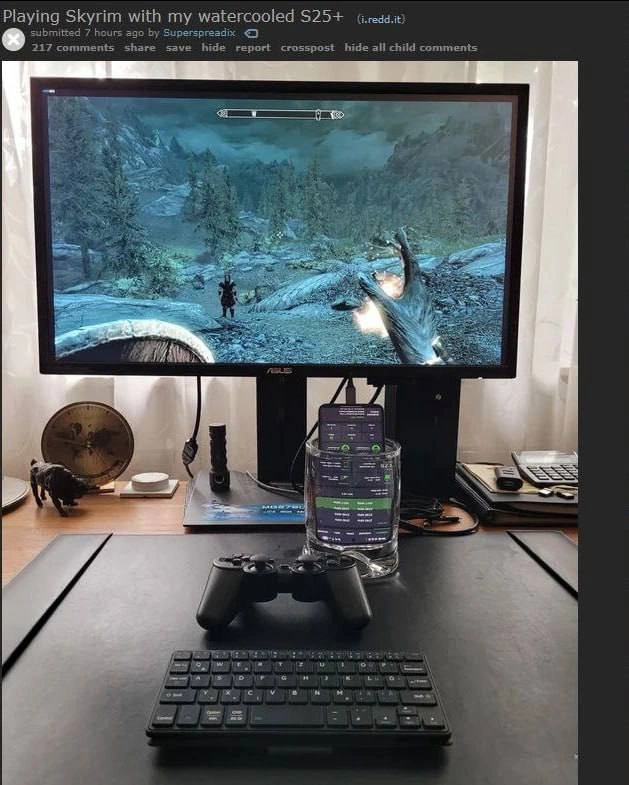
Water cooling is actually a concept borrowed from big computers. In powerful gaming PCs, people use water (or special liquids) in tubes to carry heat away from hot parts like the CPU and GPU. It’s like how a car uses coolant to keep its engine from overheating. Water can absorb heat much faster than air can. So by putting the phone in water, they gave it a super efficient cooling bath. The heat from the phone’s processor spreads into the water, keeping the phone itself cooler. In the photo, the phone’s screen is displaying some temperature and performance numbers in green; that’s a monitoring app showing that the CPU/GPU temperatures are staying in a safe range, likely thanks to the impromptu water cooling.
This DIY solution is both clever and comical. It’s clever because, in theory, it really does prevent the phone from overheating. The water in the glass will heat up slowly while drawing heat away from the phone, kind of like a heat sponge. That means the phone might run the game longer or smoother without needing to slow down. But it’s comical because it’s overkill – most people would never think to drop a $1000+ device into a glass of water just to keep gaming! It’s a huge risk (if water leaks into the wrong spot, the phone could short out and die instantly). It also looks ridiculous, which is a big part of why the image is meme-worthy. On the desk you see a serious gaming setup – nice monitor, proper controller – and then this phone chilling in a glass like it’s at the spa. It’s a tech joke come to life.
In summary, the phone was getting too hot trying to handle a big video game, so the owner literally cooled it down by submerging it in water. This kept the phone from slowing down, allowing them to continue playing Skyrim on the big screen via the phone. It’s like using a firehose to put out a candle – an extreme solution for a small device overheating. People find it funny and impressive at the same time: funny because who would dunk their phone in water, and impressive because it actually worked (at least long enough to snap a photo and enjoy the game). This kind of over-engineering isn’t meant to be a regular fix, but as a one-time gag or experiment, it definitely makes a splash!
Level 3: Overclockers Gone Overboard
In the pantheon of HardwareHumor, this one's an instant classic. Imagine a proud gamer posting on Reddit with the title, “Playing Skyrim with my watercooled S25+”. You click it expecting a custom PC with tubes, pumps, and neon coolant... but instead see a smartphone submerged upright in a drinking glass full of water, cables sprouting out, connected to a full-sized ASUS monitor. In front of the monitor sits a game controller and a mini keyboard on a neat desk mat. The whole setup looks like a serious gaming battlestation – except the "PC tower" is literally a phone taking a bath. It’s the perfect send-up of enthusiast excess: a parody of high-end liquid cooling culture where someone took OverEngineering to a delightfully literal extreme.
Experienced developers and hardware tinkerers can’t help but chuckle at the audacity. We’ve all heard of liquid-cooled gaming PCs – those rigs where people spend days routing coolant tubes through their case to chill an overclocked CPU. But dunking a phone like an Oreo in milk? That’s next-level improvised cooling. 😄 It’s absurd, yet oddly relatable. Anyone who’s pushed their phone to its limits (say, playing a graphically intense game or running AR apps on a hot day) has felt it get toasty and seen it start to lag. We know the pain of thermal throttling kicking in right when the boss fight starts lagging. Instead of the usual advice — “turn down the settings,” “take a break,” or “maybe buy a clip-on phone cooling fan” — this clever soul basically said, “Eh, I’ll just water-cool it, problem solved.” It’s a tongue-in-cheek thermal_throttle_workaround that actually leverages the same principle as expensive PC cooling, achieved with a $0 glass of tap water. Talk about EngineeringAbsurdity!
There’s a bit of real-life precedent to this craziness, which makes it even funnier. Seasoned overclockers have tried wild cooling techniques for decades. People have mounted car radiators to their PCs, chilled systems with Peltier coolers (those ice-cold chips), and even dunked entire motherboards in aquarium tanks filled with mineral oil for kicks. There’s an old running joke: “If it runs too hot, just toss it in a lake!” — usually not meant to be taken literally, but here we are. This Reddit post takes that over-the-top tinkerer spirit and applies it to a modern smartphone, a device we usually treat with kid gloves around liquids. It’s the PerformanceOptimization arms race taken to a comical height: extra frame rates at any cost, even if it means turning your phone into a mini submarine.
The choice of Skyrim is the cherry on top. That game is famous for being ported to everything (there’s a meme about running Skyrim on a smart fridge). Seeing it on a phone is impressive, but seeing that phone in a glass is a brilliant wink at the game's ubiquity. It’s like the person said, “I’m not only running Skyrim on my phone, I’ve even got water cooling for it!” – as if a phone were a tricked-out gaming PC. The humor also lies in the visual contrast: the very serious look of the setup (big monitor, proper controller, stats on the phone’s screen) versus the utterly not-serious cooling method. It’s a classic “look Ma, I improvised!” moment. And technically, it probably worked: the phone likely stayed cooler and maintained solid performance, letting the player roam Skyrim’s mountains without the device puffing out hot air or throttling down.
For the veterans, there’s a mix of admiration and cringe. Admiration because, hey, it’s a brave and creative solution – the kind of hacker mentality we respect in the lab (or the garage). Cringe because every instinct screams “electronics in water – NO!” We normally go to great lengths to hide our gadgets from water (waterproof cases, rice bag rescues for drops in the toilet). Here someone did it on purpose! But as the saying goes, “If it’s stupid and it works, it ain’t stupid.” In this case, it’s stupid-funny, but indeed, the phone survived and the game ran smoothly, so can we really argue? It’s the ultimate nerd flex, achieved with everyday items. Somewhere, a cautious hardware engineer might be facepalming, while a gamer raises a glass (literally) to toast this crazy solution. In the end, this meme perfectly captures the spirit of GamingCulture fused with mad-scientist Hardware experimentation: it’s bold, it’s geeky, it’s borderline crazy — and we love it because it worked (at least long enough to snap a photo and get the internet laughing).
Level 4: Specific Heat Shenanigans
Water to the rescue? It sounds like a paradox, but immersing electronics in liquid is an actual cooling technique in cutting-edge scenarios. Here’s the science: water has a very high specific heat capacity (meaning it can absorb a lot of heat energy with only a small rise in temperature) and excellent thermal conductivity. Compare that to air: water can carry away heat about 25 times more efficiently. In other words, dunking a working smartphone in water turns that entire glass into a big, lazy radiator. The phone’s internal heat, generated by the CPU/GPU crunching through Skyrim’s world, transfers rapidly into the surrounding H₂O via conduction and convection.
Now, in legitimate immersion cooling setups (like experimental server tanks or extreme PC overclocking feats), engineers use special non-conductive liquids or oils. Regular water would normally trigger a short-circuit fiasco because impure water conducts electricity. That’s why this meme is equal parts insane and ingenious: it leverages water’s superb cooling properties while hoping the phone’s waterproofing holds up. A flagship phone like the S25+ likely has an IP68 waterproof rating, meaning it can survive being submerged (usually up to 1-2 meters for 30 minutes in lab tests). But those tests don’t involve running the processor at max load while cabled to a monitor! In this scenario, the user is banking on the phone’s sealed design to prevent a catastrophic short while it’s bathed in liquid.
From a thermodynamics perspective, the phone’s tiny chassis is normally a thermal bottleneck. A high-end smartphone SoC (System-on-Chip) might pump out ~5–10 watts of heat under heavy gaming. Enclosed in a slim case with no active fan, heat builds up fast and has nowhere to go. The device’s thermal sensors might hit, say, 80°C on the chipset (or around 45–50°C battery temperature) and trigger thermal throttling algorithms. Throttling will dial down CPU/GPU frequencies to avoid a silicon meltdown (and to protect the lithium battery – which really dislikes going much above 50°C). But dunk the device in water, and suddenly there’s a huge external heat sink around it. Using the heat equation $Q = m \cdot c \cdot \Delta T$, a 250 ml glass of water can absorb about 1050 J of energy for just a 1°C rise (since water’s $c ≈ 4.2 \text{J/(g·K)}$). If the phone outputs ~8 J of heat per second (8 W), that water warms only ~0.008°C per second – meaning it could take over 2 minutes to raise the water by just 1°C. This dramatically slows down the temperature climb inside the phone. Newton’s Law of Cooling tells us the greater the temp difference between the hot object (phone) and the cool environment (water), the faster the heat flows out. So initially, the phone dumps heat quickly into the cool water, staying below throttling thresholds far longer than it would in air. In essence, the user created a crude but effective liquid cooling loop: the phone’s heat dissipates into the water, which then dissipates into the room as the water gradually warms. No pump, no radiator, just plain old physics doing the work.
It’s worth noting that smartphones already use clever tiny cooling methods (like vapor chambers or heat pipes that shuttle heat internally). This meme simply externalized that idea in a drenchingly direct way. It’s ironically similar to advanced data-center cooling experiments – with one big exception: those use dielectric fluids (non-conductive coolants), whereas here we have plain water. As long as no water seeps onto an exposed circuit, the phone essentially behaves like it’s strapped to a chilly wet heatsink. Of course, one stray mineral or an unnoticed leak and our hero’s device could go from watercooled to a waterlogged brick. But for now, physics is on their side – the phone stays cool, and the absurd DIY experiment actually has solid science underneath the silliness.
Description
A photograph of a computer desk setup where the video game 'The Elder Scrolls V: Skyrim' is being played on a large monitor. In front of the monitor, a black game controller and a small black keyboard are on the desk. The central joke of the image is a smartphone, with its screen on, placed inside a drinking glass full of water. The Reddit post title visible at the top of the image reads, "Playing Skyrim with my watercooled S25+". The humor is derived from the literal and destructive interpretation of the term 'watercooled.' In high-performance computing, watercooling is a sophisticated method of heat dissipation using circulating liquid in a closed loop. The image humorously contrasts this with simply submerging a phone in water, which would destroy the device. It satirizes the lengths gamers and tech enthusiasts go to for optimal performance, presenting a low-tech, absurd 'solution' to a high-tech problem (phone overheating during intensive tasks like gaming)

Comments
16Comment deleted
Senior devs know this isn't just 'watercooling,' it's a primitive form of liquid immersion cooling. The only bug is the pending catastrophic hardware failure
Finally, a data-lake architecture with literal water: the handset only maintains 60 FPS if the coolant is served in a pint glass
Ah yes, the classic H2O cooling loop - single-threaded performance with zero pump noise. Next iteration: mineral oil immersion cooling by dropping the phone in a fish tank. At least it's more reliable than waiting for Samsung to fix their thermal throttling in the kernel governor
When your mobile device's thermal throttling solution has better specs than most data center cooling systems, but you're still getting 30 FPS because it's running on a mobile GPU. This is what happens when a hardware engineer reads 'mobile-first development' and decides the phone needs a custom loop with more radiator surface area than thermal output. Somewhere, a DevOps engineer is wondering if they can orchestrate this in Kubernetes
Watercooled rig for Skyrim: like refactoring a monolith into serverless - elegant overkill for physics that still yeet rocks into orbit
Finally shipped runtime hydration: when the edge node hits its thermal budget, enable liquid autoscaling by dunking the service in a glass
When the edge device starts thermal‑throttling, the incident response is apparently to add a water sidecar - proof that performance engineering eventually devolves from algorithms into HVAC
Gold Comment deleted
Amazing Comment deleted
This future is stupid but funny Comment deleted
What is the name of that keyboard ? Comment deleted
https://a.co/d/hzwnxmI apart from swapped z and y keys in the original pic, this looks like the keyboard Comment deleted
Thanks a lot Comment deleted
yup. I guess the picture has a (super cursed, might I add) german variant of that Comment deleted
In that case it's missing accented characters (such as ö and ü), is that why you call it super cursed ? Comment deleted
I think it has ö, but it's missing ä and ü, and a bunch of special characters on the right side (+*~#') Comment deleted