The Mathematical Rook Guarding the AI Pawn
Why is this AI ML meme funny?
Level 1: Running Before Walking
Imagine you want to do a really cool trick on your bike, but you never actually learned how to ride a bike properly. Sounds a bit silly, right? This meme is joking about the same kind of idea, but with learning. It’s saying: I’m trying to jump into learning fancy AI stuff, but oops, I’m not so good at basic math. It’s funny because it’s like trying to read a big book without learning the alphabet first.
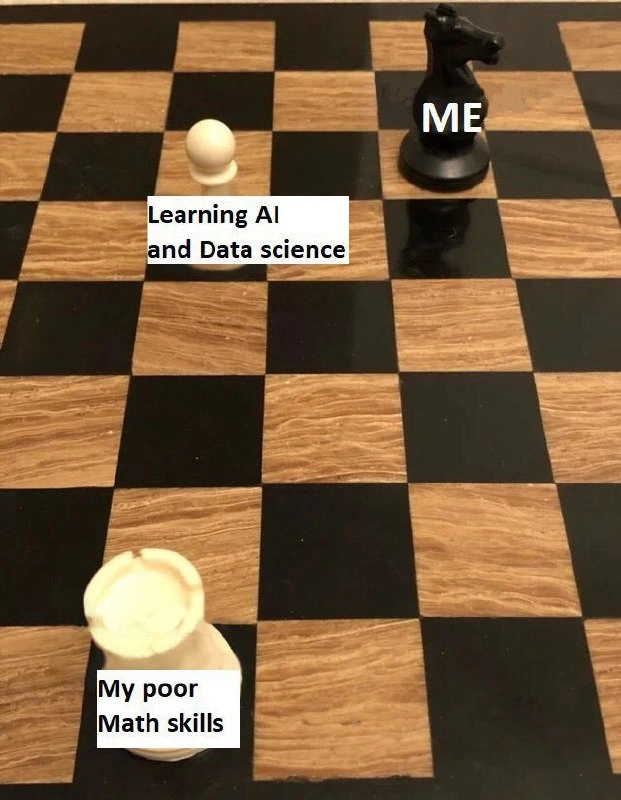
On the chessboard in the picture, the person (that’s "ME") is the knight – a piece that likes to jump ahead. They’re leaping towards "Learning AI and Data science" (that’s the exciting, advanced goal – like the bike trick). But far behind on the board is "My poor Math skills" – that’s the basic stuff they skipped, just sitting there. The picture makes it obvious that the person left something super important way back at the start.
In super simple terms: it’s like trying to build a tall tower with no foundation. At first you might stack a few blocks and it looks like a tower, yay! 🏗️ But as you go higher, it gets wobbly and falls over because the bottom wasn’t strong. The meme is a funny reminder that if we ignore the basics (math, in this case), our big plans (becoming an AI whiz) might come crashing down or get stuck. We laugh at it because many of us have felt excited and impatient and tried to skip right to the fun part, only to discover we have to go back and learn the “unfun” basics after all. It’s a friendly nod that says, “Yep, I tried to run before I could walk, and I tripped!”
Level 2: Mind the Math Gap
For those newer to the field, let’s clarify some terms and what this meme is literally showing:
Artificial Intelligence (AI) is a broad term for making computers perform tasks that normally require human intelligence. This includes things like understanding language, recognizing images, making decisions, etc. Data Science is a related field where you analyze and draw insights from data; often this involves using AI or machine learning techniques to find patterns or make predictions. Think of AI/ML as the tools and models, and Data Science as the application of those tools to answer questions or solve problems using data.
Now, both AI and Data Science sound super cool (and they are!), but they rest on some fundamental math skills:
- Linear Algebra: This is the math of vectors and matrices (grids of numbers). In practical terms, if you have a table of data, or an image made of pixels, or a set of preferences in a recommendation system – you use linear algebra to represent and manipulate that information. For example, a color image is essentially three matrices (for red, green, blue intensities). In machine learning, parameters of models are often organized in matrices. Linear algebra teaches how to do operations like rotations, transformations, or finding relationships in multi-dimensional space. It’s basically the language in which a lot of AI computations are written.
- Calculus: This is the math of change, dealing with derivatives and integrals. If you’ve heard of gradient descent (a common algorithm to train neural networks or other models), that’s an application of calculus. The model gradually improves by calculating the gradient (derivative) of a loss function to see which direction to adjust its internal parameters. In simpler terms, calculus helps the computer answer: "If I change this weight a little, does the error get bigger or smaller?" That’s how it learns. No calculus, no understanding of how learning algorithms make those tiny tweaks.
- Statistics & Probability: This area of math helps us make sense of data and randomness. Data Science often involves questions like "Is this result significant or could it be a fluke?" or "What’s the probability that this email is spam?" Statistics provides methods to answer these. Probability theory underlies many AI algorithms (like Bayesian networks or the probabilities output by a classifier). If you’ve ever heard terms like mean, median, variance, Gaussian (normal) distribution, correlation, p-value, etc. – that’s statistics. It’s crucial for evaluating models and making sure we’re not fooling ourselves with patterns that aren’t really there.
Now to the meme itself: it’s set on a chessboard. There are three pieces:
- A black Knight piece labeled "ME". In chess, the knight moves in an L-shape and crucially, it can jump over other pieces. So it’s often used metaphorically to represent an attempt to jump ahead or bypass something.
- A white Pawn labeled "Learning AI and Data science". Pawns are the most basic pieces, one step forward at a time. Here it likely represents the next step or goal the person (the knight) is chasing – learning AI/DS is right there in front of them, one move away.
- A white Rook labeled "My poor Math skills". The rook is way back, in the lower-left corner of the board (far from the knight). Rooks move in straight lines across the board, but this one hasn’t moved – symbolizing that the person’s math foundation is stuck at square one, and is poor/weak.
What’s happening is the person (the knight) is focusing on moving toward the pawn (AI and Data Science), while completely ignoring the rook (their neglected math skills). On an actual chessboard, if you only move your knight and ignore developing other pieces, you’ll quickly get into trouble. Likewise, in learning, if you run ahead to advanced topics and ignore the basics, you end up with a big gap in knowledge. The spatial gap in the meme – the knight and pawn up there, the math-rook far behind – visually jokes about how far apart the person’s ambition and their preparation are.
This is a common scenario in the learning journey of a developer or student:
- Enthusiasm to learn AI/ML: Perhaps you saw some cool demo of an AI (like how a neural network can generate art or beat humans at chess) and you think, I want to do that! You may jump into an online course or a project labeled "AI for beginners."
- Realization of math prerequisites: Very soon, you encounter terms like matrix multiplication, differential calculus, logistic function, standard deviation. If you’ve not brushed up on math, these terms feel like a foreign language. Many tutorials might gloss over them at first (“just use this library and don’t worry about the math”), which is how you manage to start without math – essentially how the knight leapt forward over the boring stuff.
- The inevitable confusion: As you go a bit deeper, maybe trying to tweak the algorithm or understand why it works, you hit a wall. The library documentation or research papers suddenly look intimidating, full of equations or advanced concepts. This is where you realize your "poor math skills" are a bottleneck. It’s like the rook piece sitting there, reminding you “hey, you left me behind, and now you need me.”
The meme is relatable and funny because it’s self-inflicted: the person is basically admitting, “Yeah, I tried to cheat the learning process.” It’s self-deprecating humor – making fun of one’s own shortfall (poor math) in a lighthearted way. Lots of people in AI/ML have a similar story, so it’s a shared joke. The learning curve for AI is known to be steep partly because of the math. Instead of a smooth ramp, it can feel like a wall. So the temptation is to find a ladder or trampoline (like high-level frameworks or just ignoring the math parts) to jump over that wall. This meme’s knight is exactly that trampolining attempt.
It’s worth noting: the meme doesn’t say “math isn’t important” – quite the opposite, it implies math is so important that neglecting it is ludicrous. The person’s “poor Math skills” being a rook is interesting: rooks are powerful in chess, so the image suggests that math could have been a powerful ally if it wasn’t left behind. The humor has an element of irony: the thing you treated as unimportant (basic math) is actually crucial and strong.
For a junior developer or student, the takeaway is: be aware of the math prerequisite. It doesn’t mean you can’t start playing with AI if your math is weak, but know that you’ll eventually need to loop back and fortify that knowledge. The meme resonates because it’s basically an inside joke among learners: “Haha, I tried to do an advanced trick without fundamentals and life gave me a reality check.” In more general learning terms, it’s like trying to read advanced literature without fully knowing the alphabet and grammar – sooner or later, you get stuck. And that’s exactly the scenario shown on this chessboard – stuck pieces and misaligned progress, presented in a humorous way. So, if you ever find yourself as the knight, excitedly coding an AI model while your algebra notes collect dust, remember this meme and perhaps consider moving that rook (cracking open that math textbook) a few squares forward!
Level 3: No Free Knight Moves
This meme strikes a chord with seasoned developers and data scientists because it captures an almost universal learning pitfall: diving head-first into the exciting world of AI/ML and Data Science while neglecting the boring foundational stuff (math). The humor here comes from the chessboard metaphor. The knight piece labeled "ME" is known for its ability to jump over other pieces – it’s the only chess piece that can do that. This is a perfect analogy for how many eager learners behave: the knight (the learner) is leaping ahead toward the pawn labeled "Learning AI and Data Science," skipping over intervening squares. Those skipped squares could very well be the prerequisite knowledge – and in the image, the rook piece labeled "My poor Math skills" sits far back on the board, practically left in the dust.
Why is this funny to developers? Because it’s painfully relatable. In the era of high-level libraries and one-click Jupyter notebooks, it’s entirely possible to get something working in AI by cobbling together example code. You can load up scikit-learn or TensorFlow, copy a tutorial, and presto – you’ve trained a model to recognize cats in photos or predict housing prices. You feel like a genius chessmaster making a clever knight move. MachineLearningHumor and DataScienceHumor communities are full of self-deprecating stories like this: “I just trained a random forest by blindly calling .fit(), but don’t ask me to explain the math behind Gini impurity or gradient boosting!” It’s funny because it’s true – many of us have been that person.
Let’s break down the chess analogy a bit more, as a senior dev would appreciate: in chess, a rook (the piece labeled "My poor Math skills") is actually a very powerful piece with long-range control – but only if you bring it into the game. If you leave your rook stuck in the corner (never moving it, like never improving your math), you’re handicapping yourself. Meanwhile, the knight (the excited you) can hop around quickly but has limited range and very specific move patterns. Similarly, a developer might hop into building a neural network with quick shortcuts, but without a strong math foundation, their progress will be limited and oddly constrained. Eventually, they face positions (problems) where the knight alone isn’t enough to win – e.g., troubleshooting why a model isn’t converging requires understanding what’s happening with the loss function’s gradient. That dormant rook – the math you sidelined – becomes the missing piece you desperately need.
In real-world AI/ML practice, the learning path often looks like this:
- Initial excitement: “Wow, I can use Python and scikit-learn to predict stock prices!” – You (the knight) jump ahead and get something working by following a blog or copying code.
- The first roadblock: “Why did my model become a potato when I added more features?” – Suddenly the documentation or error messages spew some math or terms like singular matrix, gradient exploded, or NaN loss. You realize you’re in unfamiliar territory.
- Reality check (the meme’s "reality check" moment): You recognize that "My poor Math skills" are holding you back. It dawns on you that concepts like linear algebra (e.g., matrix dimensions, eigenvalues) or statistics (e.g., distributions, significance tests) aren’t just academic hoop-jumping – they directly impact model performance and interpretation. This is the “chessboard reality check” as titled: the board doesn’t lie, and there’s a big gap you attempted to vault over.
- Either retreat or re-group: Some people get discouraged (thinking “I’m just bad at math, maybe AI isn’t for me”), while others humbly go back to basics and strengthen those fundamentals, effectively moving that rook piece out of the corner square at last.
From a senior engineer or data scientist perspective, the meme is a gentle nod and wink because it encapsulates the pattern they’ve seen in newcomers (or experienced it themselves). There’s a well-known saying in software engineering circles: "Math is to Machine Learning what grammar is to writing code." You can maybe get a simple script working with bad grammar (or none at all, by copying others), but to write complex, original code you must understand the syntax and structure. In AI terms, you can use a pre-built model without math, but creating or truly tuning a model requires mathematical intuition.
The tags like LearningCurve and SelfDeprecatingHumor highlight that this isn’t mean-spirited gatekeeping; it’s more about laughing at ourselves. The community finds it funny because we’ve all had that overconfidence followed by “uh-oh” moment. The gap between the hype of "Learning AI and Data Science" and the reality of "need to remember high school math" is exactly the kind of cognitive dissonance that produces a chuckle (and maybe a groan). It’s reminiscent of the trope "it’s always DNS" in DevOps humor – a simple underlying thing causes trouble after you chased complex solutions. Here the trope is "it’s always math": whenever your AI project faceplants, you’ll often find a math concept you overlooked at the root.
Historically, this divide has become more pronounced. A decade or two ago, anyone doing serious AI research had to get deep into the math because tools were not as abstracted. You’d derive equations on paper, implement algorithms from scratch in MATLAB or C++, and thoroughly understand them. Nowadays, with powerful libraries, one can treat AI a bit like using a microwave – push some buttons and out comes a result, no idea how the internals work. This democratization is great, but it sets up exactly the meme’s scenario. The AI_ML and DataScience fields have so much hype that learners are often rushing in. And let’s admit it, math can be intimidating; it’s tempting to avoid it. The meme resonates because it’s essentially saying: “I’m so eager to do cool AI stuff that I left my math behind… and I know that’s kind of ridiculous.” Everyone who’s struggled through a calculus MOOC after the fact, or cracked open a statistics textbook only after their model started spitting out nonsense, will smirk at this image.
In short, the senior-perspective punchline: You can’t truly cheat the learning process. Like a clever chess tactic that fails against a solid defense, trying to skip core math might get you a few moves into the game, but eventually the complexity of AI will call your bluff. The meme uses a simple visual joke to convey this serious-yet-funny reality: we’re all sometimes knights dreaming of glory, until the immovable object of mathematics reminds us we have to play by the rules. No free knight moves, indeed.
Level 4: The Linear Algebra Gambit
At the deepest level, this meme highlights a fundamental truth about AI: under all the flashy frameworks and high-level code, math is the backbone. In advanced machine learning, concepts from linear algebra, calculus, and statistics form the theoretical bedrock. Ignoring these is like ignoring the physics while trying to build a rocket. To appreciate why math is crucial, consider what learning algorithms are doing:
Linear Algebra: Virtually every AI model, from simple regression to deep neural networks, is built on vectors and matrices. A dataset can be seen as a matrix $X$, and model parameters as another matrix or vector $W$. Training often boils down to linear algebra operations. For example, solving a simple linear regression analytically involves the normal equation:
$$ W = (X^T X)^{-1} X^T y $$
This formula (full of matrices, transposes, and an inverse) finds the optimal weights $W$ given data $X$ and targets $y$. It’s pure linear algebra. If that looks intimidating, well, that’s the point! It’s what our friendly ML libraries are doing under the hood. Skipping linear algebra means treating such equations like magic. A knight might jump a few squares, but it can’t teleport across an entire vector space – similarly, you can’t grasp high-dimensional data transformations without the math.
Calculus: Modern AI, especially neural networks, relies on calculus for training via gradient descent. The model learns by gradually adjusting parameters to minimize an error function. Those adjustments require computing derivatives (slopes) to know which way to move in the search for a minimum. This is essentially the chain rule and partial derivatives at work. For a neural network, you end up with long chains of calculus: $$\frac{\partial L}{\partial w} = \frac{\partial L}{\partial z} \cdot \frac{\partial z}{\partial w}$$ (where $L$ is loss and $z$ some intermediate output). If phrases like partial derivative and chain rule make you sweat, that’s exactly what the meme is poking fun at. The knight (you) might try to leap ahead, but the rules of calculus still apply – you can’t capture the king (master AI) without playing by those rules.
Statistics & Probability: Much of Data Science is about drawing valid conclusions from data, which is fundamentally a statistical exercise. Probability theory underpins algorithms from Naive Bayes classifiers to A/B testing. Without statistical fundamentals, one might misinterpret results (e.g., thinking a model is great just because it memorized the training data – a classic overfitting scenario). Statistical literacy is like knowing how each chess piece moves: you need it to navigate the game of inference and avoid random blunders.
The meme’s chessboard distances hint at mathematical maturity. Each square between the knight and the distant rook could represent entire chapters of math knowledge: maybe matrix eigenvalues on one square, gradients on another, p-values on the next. Skipping over those squares isn’t possible in real life (outside of chess horsies). In fact, there’s a known concept in machine learning theory called the "No Free Lunch" theorem – it essentially says there’s no one-size-fits-all shortcut to solve every problem. In our context, it wryly translates to “no free leaps” in understanding: you can’t expect to generalize as an AI expert without putting in the work on fundamentals. So the knight’s bold jump might get you started with pre-built models, but eventually, the long-range power of the rook (solid math) is what secures the endgame. Ignore it, and you’ll face checkmate by complexity you can’t crack.
Description
A meme is depicted using a wooden chessboard as a visual metaphor. In the upper right, a black knight chess piece is labeled 'ME'. In the center-left, a white pawn is labeled 'Learning AI and Data science'. In the lower-left corner, a white rook is positioned, bearing the label 'My poor Math skills'. The arrangement humorously illustrates a common struggle for aspiring AI and data science professionals. The knight ('ME') appears to be aiming for the pawn ('Learning AI and Data science'), but the powerful rook ('My poor Math skills') stands as a formidable obstacle, effectively blocking any easy path. The joke lands with senior engineers who understand that advanced fields like AI and machine learning are built on a strong foundation of mathematics (linear algebra, calculus, statistics), and neglecting this foundation can completely stall one's career progression in these domains

Comments
7Comment deleted
You think you're making a brilliant knight move towards that AI job, but you've completely overlooked the fact that your math skills have you in checkmate from across the board
Shipping AI without revisiting linear algebra is like leapfrogging your knight past the pawn and rook - impressive right up until QA asks why the covariance matrix isn’t positive-semidefinite in production
After 20 years of convincing myself that "we'll never actually need calculus in production," I'm now explaining to my team why our neural network thinks every customer is going to churn on exactly day 42
Ah yes, the classic knight fork in career development: you're simultaneously attacking your AI ambitions and being checked by that linear algebra course you skipped in college. The real checkmate is realizing that 'pip install numpy' doesn't actually install mathematical intuition into your brain, and now you're stuck reading research papers where every other sentence is just Greek letters having a party. At least the knight moves in an L-shape - much like your learning path through gradient descent, backpropagation, and the realization that 'just use AutoML' isn't the answer your architect interviewer was looking for
Modern AI lets you knight-jump past linear algebra straight to a Hugging Face checkpoint - then production asks about calibration and drift, and the rook named “probability” slides in with check
AI/Data Science: Where your calc II from two decades ago backprops straight into imposter syndrome
Knight-jumping to ML works until the loss function backpropagates your math debt straight into production