Skip to content
DevMeme
284 of 7435
The Over-Engineering Regret Cycle
CodeQuality Post #341, on Apr 27, 2019 in TG

The Over-Engineering Regret Cycle

Why is this CodeQuality meme funny?

Level 1: Oops, That Was Easy

Imagine you spend all afternoon trying to reach a cookie jar on a high shelf by stacking chairs, books, and boxes into a huge wobbly tower. You climb and struggle for hours, almost falling down – it’s a lot of work. Then your friend walks in, looks at your teetering tower, and simply pulls out a step stool. They climb up and grab a cookie in a few seconds. You’d feel pretty silly, right? You’d probably smack your forehead and laugh because you made it so much harder than it needed to be. That’s the feeling this meme is joking about, but with coding. The developer (like SpongeBob in the picture) worked way harder on the problem than they needed to. When they finally see the easy solution, it’s a big “oops!” moment. It’s funny and a bit embarrassing. We laugh because everybody sometimes overcomplicates things and then learns the simple solution afterward. It just feels good (and kind of relieving) to recognize the mistake and say, “Well, that was dumb – next time I’ll keep it simple.”

Level 2: KISS vs Overkill

Overengineering means designing or coding something in a more complicated way than necessary. In this meme’s story, the programmer spent 3 hours building a very complex solution when an extremely simple method existed the whole time. That’s like writing 200 lines of code with fancy logic to do a job that maybe a single built-in function could handle. It feels crushing because you realize all that effort was wasted. Code complexity refers to how complicated and tangled the code is. More complexity usually makes a program harder to understand and fix. Good code maintainability means the code is easy to read, debug, or extend later on – something simple code is much better at than complex code. In fact, all that unnecessary complexity essentially becomes technical debt – extra problems and work the developer now has to deal with later because of the clumsy initial approach. When the developer finally discovers the simple solution, they’ll probably do a refactoring. Refactoring is when you clean up or rewrite your existing code without changing what it does, often to make it simpler or more efficient. It’s a key part of improving code quality after you realize you went down the wrong path.

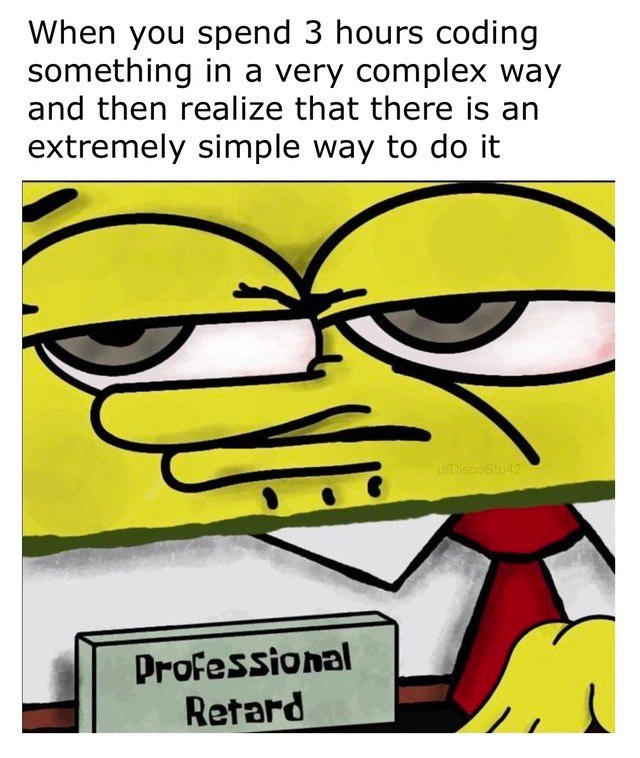
In the image, we see SpongeBob (from SpongeBob SquarePants) looking completely done and annoyed. SpongeBob is a popular cartoon character used in many SpongeBob memes because he has expressive faces for every emotion. Here he represents the tired, disappointed developer. On his desk, there’s a little sign that says "Professional Retard". That’s a very derogatory label – definitely not a nice word to use in real life – but in the context of this meme it’s an extreme form of developer self-deprecation. Self-deprecation means making fun of yourself. Developers often joke about their own mistakes by using harsh humor (even calling themselves dumb) to cope with embarrassment. The meme uses that shock value to highlight just how foolish the programmer feels after realizing their over-complicated solution was unnecessary. It’s a kind of developer humor that might seem mean, but among programmers it’s understood as “I messed up, and I’m owning it by joking about it.” The top caption text spells out the situation: “When you spend 3 hours coding something in a very complex way and then realize that there is an extremely simple way to do it.” Every programmer has experienced that punch-in-the-gut feeling when you discover a much easier solution after slogging through the hard way.

A big theme here is complexity vs simplicity. Simple code is usually better and less error-prone. A common newbie mistake is reinventing the wheel – coding something from scratch that already exists in the language’s libraries or could be done with a simpler approach. For example, imagine you need to find the largest number in a list. A beginner might not know about the easy way and write a clunky piece of code like this:

# Over-engineered way to find the largest number (effective, but overkill and slow)
max_val = float('-inf')     # start with the smallest possible value
for i in range(len(nums)):
    for j in range(len(nums)): 
        if nums[i] >= nums[j] and nums[i] > max_val:
            max_val = nums[i]

# Simple built-in way in Python:
max_val = max(nums)

In the first part, the poor programmer is using two loops to compare every pair of numbers – that's overkill! Not only is it more code, it’s also much less efficient (the double loop grows slow really fast as the list gets bigger). In the second part, we use Python’s built-in max(nums) function to get the largest number in one go. It’s straightforward and runs faster. This is the kind of “extremely simple way to do it” that our meme is talking about. When developers realize they've written a big complex block of code and there was a one-liner like max() available, it’s a huge facepalm moment. (“Facepalm” is that gesture of slapping your forehead when you suddenly understand you've been silly.) The meme perfectly captures that mix of embarrassment and laughter. The takeaway for any coder is: whenever you catch yourself going in circles with a complicated solution, take a step back and ask, “Is there a simpler way to achieve this?” Often, the answer is yes.

Level 3: Rube Goldberg Code

In the life of a seasoned developer, this scenario is as familiar as a production outage on a Friday night. The meme highlights a classic case of overengineering: investing hours into an elaborate solution when a simple one was right under your nose. It’s darkly funny because it’s true — every experienced dev has built a convoluted, Rube Goldberg-style system at least once, only to have an aha! moment (or a colleague in a code review) point out a one-liner that does the same thing. Picture a programmer who just spent 3 hours writing a custom algorithm or a maze of classes. They might have proudly employed six different design patterns and created an entire abstraction framework for what turned out to be a one-function problem. The code works, but it’s a beast: hard to read, hard to maintain. Then reality hits: there’s a far easier way. Perhaps a library function or a simpler logic was available all along. That crushing realization is both hilarious and painful. The humor comes from a kind of shared trauma among developers — we've all been that person who missed the forest for the trees.

The SpongeBob image perfectly captures that exhausted, exasperated face of a dev who knows they’ve just wasted a ton of effort. On the desk in the meme, there’s a nameplate labeled "Professional Retard". It’s an intentionally jarring, self-deprecating label, reflecting how brutally we might judge our own mistake (thinking I can’t believe I was such an idiot). In real life, you’d never use that slur — but in the dark humor of developer memes, it emphasizes the feeling of utter foolishness. Seasoned engineers chuckle at this not because the word is okay (it’s not), but because that extreme label mirrors the dramatic shame we heap on ourselves in private moments of failure. It’s an edgy way of saying “wow, that was a really dumb way to do it, and I was the professional who wrote it.”

Technically speaking, the meme hints at the importance of the KISS principleKeep It Simple, Stupid. Ironically, that acronym itself calls the developer “stupid” for not following it. When we ignore KISS, we often accumulate technical debt without realizing it. Overly complex code is like debt because the longer it stays, the more “interest” you pay in debugging and maintenance. A contrived solution might work today, but it’s a nightmare for code maintainability and future development. This comic scenario usually ends with the developer refactoring (rewriting) their monstrosity into something clean and obvious. But those hours are gone, and all you get is a lesson in humility.

From a senior perspective, there’s also an implicit commentary on dev culture and developer experience here. Why do smart people fall into this trap? Sometimes it’s pride or the urge to flex our coding muscles — turning a simple task into a personal engineering sandbox. Other times it’s lack of knowledge: maybe you didn’t know about the one-liner solution or the right library function (Stack Overflow could’ve saved you, if only you had asked!). Organizations can inadvertently encourage overengineering too: ever seen a team where every problem must be solved with the new microservice architecture du jour, even when a simple script would do? The result: we build a cathedral when a hut was enough. The meme's punchline is a blunt reminder that in software, simplicity is a virtue. The best code often looks obvious in retrospect. Experienced devs laugh (and cringe) at this meme because they’ve been there, swearing at themselves under their breath, thinking “How did I make this so complicated?”. It’s a comedic snapshot of the developer journey from naïve over-complication to wiser simplicity, one facepalm at a time.

Description

A meme depicting the frustration of needlessly complex coding. At the top, white text on a plain background reads, 'When you spend 3 hours coding something in a very complex way and then realize that there is an extremely simple way to do it'. Below the text is a close-up image of the cartoon character SpongeBob SquarePants, wearing a white shirt and red tie, with a deeply annoyed, tired, and contemptuous expression. On the desk in front of him is a nameplate that says 'Professional Retard'. The meme captures the universal developer experience of over-engineering a problem, only to discover a much simpler, more elegant solution later. This moment of realization often brings a feeling of intense self-criticism and regret for the wasted time and effort, perfectly encapsulated by SpongeBob's expression and the self-deprecating, albeit offensive, nameplate
Comments

8
Anonymous ★ Top Pick The face of a developer who just built a custom state management library before realizing the entire feature could have been a single CSS selector
  1. Anonymous ★ Top Pick

    The face of a developer who just built a custom state management library before realizing the entire feature could have been a single CSS selector

  2. Anonymous

    Spent the afternoon wiring a Kafka-backed, event-sourced Saga with exactly-once semantics - turns out a single SQL UPDATE would’ve sufficed; instant masterclass in YAGNI

  3. Anonymous

    The worst part isn't the wasted time - it's knowing you'll defend your complex solution in code review because admitting the junior's one-liner works better would destroy what's left of your imposter syndrome coping mechanisms

  4. Anonymous

    Three hours building a recursive visitor pattern with memoization, then you find the stdlib one-liner - the design doc now lives forever as a monument titled 'alternatives considered'

  5. Anonymous

    Every senior engineer has that moment when they finish implementing a custom distributed caching layer with Redis Sentinel, complex sharding logic, and custom serialization - only to realize the entire use case could've been solved with a simple in-memory Map and a TTL. The real professional move is recognizing this *before* the code review, not during the post-mortem when someone asks 'why didn't we just use...?'

  6. Anonymous

    Built a resilient, async DedupeService with retries and tracing; PR comment: “Could be SELECT DISTINCT.”

  7. Anonymous

    Three hours into a fault-tolerant, idempotent, event-driven pipeline, I realized the requirement was basically SELECT DISTINCT

  8. Anonymous

    Veteran ritual: Forge a 300-LOC state machine for a toggle, then nuke it with `if self.enabled` in prod - character built

Use J and K for navigation