Skip to content
DevMeme
283 of 7435
Thanos Learns About Database Backups the Hard Way
DevOps SRE Post #339, on Apr 26, 2019 in TG

Thanos Learns About Database Backups the Hard Way

Why is this DevOps SRE meme funny?

Level 1: Backups Save the Day

Imagine a naughty wizard who has a magic glove and with a snap of his fingers can make half of all the toys in a town disappear. He’s laughing because he thinks it’s a brilliant, sneaky trick – poof, randomly half the toys are gone! That sounds pretty bad, right? But luckily, the town’s folks were prepared. They had a backup stash of toys hidden safely away. So when the wizard is done causing trouble, the townspeople come in and say, “Nice try, did you forget we saved copies of all those toys?” It turns out they can bring all the missing toys back from the backup stash. Now the wizard feels silly and a bit scared, because he realizes he has to spend his whole afternoon putting all the toys back where they belong. And guess what? It’s Friday afternoon, just when the wizard wanted to relax and start his weekend. Instead, he’s sweating, working hard to fix the mess he made. Meanwhile, the other folks just thank him sarcastically and head off, saying “Good job, genius. This is your endgame!” as a way of joking that his game is over and now it’s cleanup time. In the end, the backup (the extra copy of the toys) saved the day. The bad guy didn’t win at all – he just gave himself a big chore. The lesson is: if you have a spare copy of important things, even a big magical disaster can be undone. And maybe, just maybe, don’t do crazy stuff right before the weekend, or you’ll be stuck working when everyone else is having fun!

Level 2: Backup to Reality

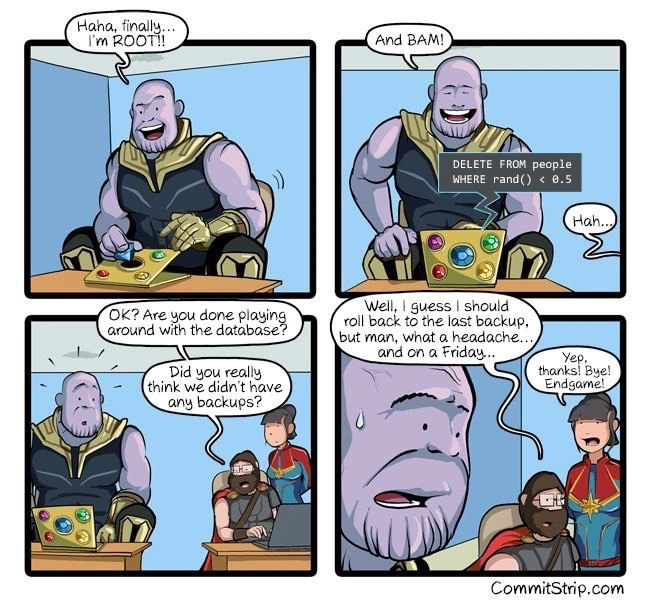
Let’s break down the scenario in simpler terms. We have a developer dressed up as Thanos, the comic book villain known for wiping out half of all life with a snap of his fingers. In the first panel, this developer is overjoyed, shouting “I’m ROOT!”. In computer systems, being "root" means you are the all-powerful administrator. For example, on Linux servers the root user can do anything, and in databases the admin account (often also called “root” in systems like MySQL) has full control. So this person suddenly has ultimate access to the company’s database and is feeling invincible – much like Thanos with all the Infinity Stones. The golden glove he’s wearing in the comic is the Infinity Gauntlet from Marvel lore, which in that story gives Thanos god-like powers. Here it’s a visual metaphor for root-level access: he literally has a gauntlet that can control reality, just as a root user can control the entire system.

Now, what does our Thanos-like dev decide to do with this god-mode access? He executes a destructive SQL query on a table named people. The query is:

DELETE FROM people WHERE rand() < 0.5;

This is an SQL command. In SQL (Structured Query Language), DELETE is used to remove records (rows) from a table. DELETE FROM people means “remove data from the table called people.” Normally, we add a WHERE clause to specify which rows to delete (otherwise, without a WHERE, it would delete all rows in the table, which is usually a terrible mistake!). Here, the condition is WHERE rand() < 0.5. The function rand() returns a random number between 0 and 1 each time it’s evaluated. So for each row in “people”, the database generates a random number; if that number is less than 0.5 (which has a 50% chance of being true), then that row qualifies to be deleted. In plain language, this command is attempting to delete about half of the entries in the people table, chosen at random. It’s as if he said, “Delete roughly half of everyone, at random.” This is directly mimicking Thanos’s infamous plan in the Avengers story, where Thanos randomly eliminates half of all people in the universe to achieve "balance". Here, the developer is doing the same to a database table. It’s a very unusual and dangerous operation – you would almost never want to delete data at random like this! It’s done purely as a mischievous act. The comic shows him saying “And BAM!” to indicate the query is executed instantly, and then he chuckles “Hah…” with satisfaction. He’s basically role-playing as the villain, enjoying the moment of seeing half the data disappear.

At this point, any junior developer can guess this is a big problem. Removing half the data in a production database is catastrophic. If this were a real system, many things would break: customers’ data would vanish, application logic might start throwing errors, and it would definitely trigger a major production incident alert. Usually, only a mistake or a bug would cause such mass data loss. Doing it intentionally is even worse! The key takeaway is: Don’t run random DELETE queries on production data! In fact, be extremely careful with any DELETE or UPDATE queries in production – always double-check the WHERE clause (there’s a common saying: “DELETE without a WHERE is like a grenade with the pin pulled.”). Here we do have a WHERE, but it’s intentionally random, which is just as bad.

Now, the good news in the comic is that the company was prepared for this kind of disaster. The coworkers come in and essentially say, “Alright, fun’s over. You didn’t think we had backups?” This implies that they back up their database regularly. A backup is simply a saved copy of data from an earlier time. Companies usually perform backups daily or even more frequently, storing copies of the database either as special backup files or snapshots. For example, a database backup might be a dump file containing all the tables and rows as of midnight last night. Backups are crucial because they let you restore your data if something goes wrong – whether it’s hardware failure, a software bug, or human error (like someone accidentally deleting data). In this case it’s human mischief, but either way, the backup is there to save the day. The bearded developer’s question “Did you really think we didn’t have any backups?” highlights that any responsible team always keeps backups of important data. It’s almost teasing Thanos: no matter how powerful you felt as root, there’s a safety net you didn’t consider. You can’t permanently destroy the data because we have a copy of it stored safely elsewhere. In a way, it's like saying, "We anticipated that something could go wrong (even a silly stunt like yours), so we made sure we could undo it."

For a junior developer, it’s worth noting just how standard backups are in production. There are many strategies: full backups, incremental backups, real-time replication to a standby server, etc., but the simplest concept is having a recent copy of the database that you can load back if needed. Smart teams also test their backup restoration process regularly (because a backup is only as good as your ability to restore it!). Here, the coworkers seem confident that their backup exists and works, which is why they’re not panicking. Instead, they’re kind of amused, treating the rogue query as a childish prank that they can reverse.

Now, reversing it isn’t instantaneous. When Thanos realizes the jig is up, he says, “I guess I should roll back to the last backup… what a headache… and on a Friday…” Let’s unpack that: “roll back to the last backup” means he is going to revert the database to its state at the time of the most recent backup. If their last backup was taken, say, early that morning or the night before, he will restore that. Doing a rollback via backup usually involves stopping the database (or isolating it), loading the backup copy (which could be importing a large dump of data), and then bringing the system online again. This can indeed be a major “headache” because it’s a laborious process and often there’s pressure to do it quickly to minimize downtime. Also, any new data or changes since the time of that backup will be lost (unless they have some way to merge them back, which is complex). So Thanos has created a big mess that he must now clean up.

The kicker is “...and on a Friday...”. In developer culture, Fridays have a special caution around them. FridayDeployments (pushing code or making big changes on a Friday) are frowned upon because if something breaks, it ruins your Friday night and maybe your whole weekend. It’s an unwritten rule in many teams: do not deploy late on Friday unless absolutely necessary. Here, it’s presumably Friday, and instead of relaxing or going home on time, Thanos has to do an emergency restoration. This is very relatable in the tech world – many of us have had plans spoiled by a last-minute production issue cropping up at week’s end. People even joke, “The database only crashes at 5 PM on Friday.” So in the comic, having this dramatic incident happen on a Friday amplifies the pain (and the humor, for us observers). Thanos thought he was having some fun, and now he’s stuck in the office performing a delicate recovery operation while his coworkers head out for the weekend. The coworker in the cape saying “Yep, thanks! Bye! Endgame!” as they leave is basically them quipping, “Thanks for fixing what you broke. We’re done here – game over for you, buddy, and enjoy your ‘endgame’ (implying this is the end of the fun, now comes the hard work).” The word Endgame is used cheekily – it’s the title of the Avengers movie where the heroes finally undo Thanos’s snap for good. In the movie, “Endgame” meant the final, decisive part of the conflict. In this office, “Endgame” means the final state: everything will go back to normal thanks to backups, and Thanos’s little game is ended. It’s also a way of saying “we’re finished here.” The coworkers basically drop a one-liner and take off, leaving Thanos to clean up. This reflects a bit of real team behavior: if one person causes a non-critical but messy issue (and it’s solvable), often they will be the one responsible for fixing it while everyone else goes home. It’s a sort of natural consequence and learning moment for the person who messed up.

A couple of important technical terms and concepts from this scenario for a junior to know:

  • Root Access: Full administrative rights on a system or database. Root users can read, modify, or delete any data. It’s like being the system “superuser.” Because of how powerful it is, usually only very trusted individuals or automated processes have root access in production, and even they use it very carefully.
  • SQL DELETE: A command to remove data from a database table. It’s permanent – once you commit a DELETE, those rows are gone (unless you have backups or you were in a transaction that you can roll back). Always be extra cautious with DELETE queries; use a WHERE clause to target specific records and double-check it’s correct. Many developers test their delete conditions with a SELECT first (e.g., SELECT * FROM people WHERE condition;) to see which rows would be affected, before running the DELETE.
  • RAND() function: In many programming languages and databases, there’s a function to get a random number. MySQL’s RAND() returns a random floating-point number between 0 and 1. Using RAND() < 0.5 as a condition effectively selects ~50% of the items randomly. This is not a common practice in production code since it’s unpredictable. Here it serves a joke: equating randomness with Thanos’s indiscriminate snap.
  • Backup: A backup is a saved copy of data. In databases, this could be a SQL dump file, a point-in-time snapshot, or a continuous archive of changes. Backups are usually stored on separate storage. For example, with MySQL you might use mysqldump to produce a .sql file containing all CREATE TABLE statements and INSERTs for the data, or with PostgreSQL you might use pg_dump. There are also more advanced backup techniques like binary logs for point-in-time recovery or replication to standby servers. But at heart, a backup’s purpose is to let you restore the data if the original is lost or corrupted.
  • Restore / Rollback: Restoring from backup means taking that saved copy and loading it back into the database. People sometimes casually say “roll back” to a backup, meaning revert the system to how it was at the backup time. Note that in database terms, “rollback” often refers to undoing a transaction that hasn’t been finalized/committed yet. But here, since the destructive action is already done and committed, the only way to “undo” is to do a full restore from a backup (you can’t just run an UNDO command for a delete that has been committed long ago unless you have some special point-in-time recovery tool). So effectively, he’s rolling the state of the database back in time by reloading the old data.
  • Production vs. Non-production: Production (prod) is the live environment serving real users. A change in prod affects actual customers or data of record. Non-production environments include dev, test, or staging environments meant for trying things out safely. You never want to run a wild command like DELETE ... WHERE RAND() < 0.5 in production. If you were experimenting, you’d do it in a local or test database where it doesn’t matter. Part of the joke is that he’s doing this in the real database where it definitely does matter.
  • Friday Deploy / Friday Rollback: A cultural caution in IT. Because weekends are personal time and many offices have fewer staff around, a problem introduced late on a Friday can be extra painful to deal with. Thus, teams often avoid non-essential changes on Fridays. Here we see why: performing a backup restore is going to take away Thanos’s Friday evening (at least).

Finally, it’s worth noting this comic strip is by CommitStrip, known for capturing developer life with humor and often referencing current events or nerd culture. The date of the comic (April 26, 2019) was the release date of Avengers: Endgame, so the creators timed it to spoof that. The characters in the strip include a bearded developer (possibly representing an experienced colleague) and a caped female coworker (a tongue-in-cheek nod to one of the Avengers superheroes). The line “Endgame!” serves as both a farewell and a direct reference to the movie title. It’s a fun crossover of the Marvel universe with the everyday world of software engineering. The bottom line for a junior dev reading this: Even if you somehow get god-like powers on a system, don’t do silly destructive things – your team’s safeguards (like backups) will kick in, and you’ll just create a lot of work for yourself (and spend your Friday night fixing the mess!). Always respect the data and think before you hit that Enter key, especially in production.

Level 3: Half Data, Double Trouble

In this comic, Thanos (the infamous purple villain from Marvel's Avengers) is portrayed as a rogue developer gleefully wielding root access to a production database – essentially the Infinity Gauntlet of system privileges. When he exclaims “I’m ROOT!!”, he’s bragging about having the highest level of access on the system (like a Unix root user or a DBA with all permissions). This means he can run any command, no matter how destructive, on the company's data. With great power comes great opportunity for catastrophic mistakes: in one snap of his fingers (or rather, one press of Enter on his keyboard), he executes a reckless SQL command to delete half the records in a table.

The SQL shown, DELETE FROM people WHERE rand() < 0.5, is a horrifyingly dramatic example of a random_delete_query. Let’s break down what it does:

DELETE FROM people 
WHERE RAND() < 0.5;
  • DELETE FROM people – Remove rows from the people table (perhaps a table of user accounts or citizens).
  • WHERE RAND() < 0.5 – For each row, generate a random number between 0 and 1 using the database’s RAND() function. If that random number is less than 0.5 (a roughly 50% chance), then delete that row.

In effect, this query gives every row a coin-flip chance of being purged. About half the data (on average) will be gone when it finishes. Thanos is mirroring his infamous “snap” from Avengers: Infinity War – randomly wiping out half of all entries in true DataLoss genocide style. This is DatabaseHumor blending with pop culture: using an SQL query to imitate the supervillain’s act of eliminating half the people in the universe. It’s a prime example of reckless_sql; no sane DBA or developer would ever run something like this on a real production database (except by awful mistake or for dark humor).

From an experienced dev’s perspective, the humor (and horror) comes from how absurdly irresponsible this scenario is. This is an OnCall_ProductionIssues nightmare. An engineer with unfettered root_access in production deciding to run a random mass DELETE is basically every senior developer’s fever dream (or nightmare parody). Usually, production databases are treated with extreme care: changes are tested, backups are taken, SQLQueries are double-checked – especially if they involve deletion. There’s even the classic safeguard of adding AND 1=0 to a DELETE query during testing to avoid accidental execution. The meme exaggerates a worst-case bug or operator error for comedic effect. It’s like the ultimate bug: not a subtle code bug, but a developer manually doing something shockingly destructive for laughs. Thanos’s smug “And BAM!” after executing the query captures that overconfident attitude: he’s proud of his quick hack to achieve a diabolical goal (half the data gone), akin to a developer deploying untested changes on a Friday just because they can.

Why is this funny to industry folks? Because we’ve all heard disaster stories or lived through them. Perhaps someone ran DELETE * FROM table without a proper WHERE clause, or dropped the production database table by accident. Those incidents teach hard lessons. Here it’s deliberate – which makes it darkly comic. It’s an exaggerated nod to the idea that with root access, a person can do literally anything, including really stupid things. The inclusion of the rand() function adds a twist: it’s not just deleting the wrong table or all rows outright; it’s randomly deleting half the rows. That’s an unusual choice – in real life, very few legitimate tasks require randomly removing ~50% of data. It’s clearly a reference to Thanos’s philosophy of “perfectly balanced” destruction. For a seasoned developer, the mere sight of WHERE RAND() < 0.5 might induce panic or laughter (or both) – it’s the kind of fringe misuse of a function you might joke about but never expect to see in an actual codebase. This juxtaposition of Marvel supervillainy with SQL mischief is classic DatabaseHumor.

Now enter the superhero_coworkers in panel 3. They’re drawn as Avengers-like colleagues (one even in a cape resembling Captain Marvel or another hero), and they confront our wannabe Thanos with a dose of reality. “OK? Are you done playing around with the database?” they ask, unimpressed. This line brings us back to professional reality: in a real team, someone would definitely step in if a dev was “playing around” in prod. The bearded dev then delivers the zinger: “Did you really think we didn’t have any backups?” Ah, the big reveal – our villain’s triumph is short-lived because of good DevOps practices! This punchline nails a key best practice in the Databases world: DatabaseBackup is standard procedure. Of course they have backups of the data. Any production environment with competent engineers will have regular backups (daily, hourly, or even continuous backups) precisely to prevent irreversible DataLoss from incidents like this. The bearded coworker’s question is half scolding and half amused: it implies that only an ignorant newbie or an overly prideful villain would assume a company has no backups at all. It’s a bit like saying, “Did you seriously think you could snap your fingers and we’d just permanently lose half our data? Please – we have fail-safes.”

This is where the meme also pokes fun at Thanos’s hubris. In the Avengers storyline, the heroes didn’t initially have a quick backup or easy undo for the Snap – it took them an entire Endgame (time travel, Infinity Gauntlet re-snapping, etc.) to restore everyone. In contrast, in IT, we do have something akin to time-travel for data: backups and backup_restore procedures. Restoring from a backup is basically rewinding the state of the database to a point before the bad query ran, just like undoing an evil finger snap. It’s our real-world endgame_quote moment where we say “Ha, we can bring them all back!” So from a veteran developer’s view, this panel is satisfying: the villainous act can be nullified thanks to solid preparation. It’s emphasizing how crucial backups are – they’re the unsung heroes (the true Avengers!) of ProductionIncidents. Many of us have experienced that enormous relief when a backup saves the day after an accidental deletion or corruption. It’s also a reminder (with a wink) that no matter how powerful your destructive query is, a well-timed restore can defeat it. The thanos_meme here flips the script: in the movies Thanos smugly asks “You should have aimed for the head” because the heroes didn’t stop him in time; in the comic the devs effectively say “You should have checked for backups” – the villain didn’t realize the heroes had an ace up their sleeve all along.

However, having backups doesn’t mean you get off easy. Panel 4 drives that home. The camera zooms in on Thanos’s face – he’s sweating and regretful, sighing, “Well, I guess I should roll back to the last backup, but man, what a headache… and on a Friday…”. This line is loaded with real-world developer pathos. First, “roll back to the last backup” means he now has to restore the database from whatever the most recent backup is. In practice, this might involve taking the production database offline or into maintenance mode, loading the backup dump file or snapshot, and possibly replaying any transactions that occurred after the backup (if point-in-time recovery logs are available). It’s a slow, careful process – definitely a headache. During this time, the application might be down or in read-only mode, so it’s a high-pressure situation to get things back up quickly. The phrase “the last backup” also implies there’s potentially some data loss of recent changes (all changes after that backup was taken will be lost). This is the price of undoing his chaos – whatever happened between the backup and the moment of the DELETE is probably gone for good, or must be recovered from other sources. Thanos the developer is now coming to terms with the real consequences: rolling back isn't as simple as waving a magic wand; it’s a tedious recovery operation.

And then there’s the kicker: “...and on a Friday...” – this elicits a knowing groan from anyone in tech. Deploying or messing with production late on a Friday is widely regarded as tempting fate. There’s a running joke (with a lot of truth) in engineering circles captured by tags like FridayDeployments: never push major changes on a Friday unless you’re absolutely ready to spend your Friday night (and maybe the weekend) fixing things. Here our Thanos-dev did the ultimate forbidden Friday action – a mass deletion. So now, instead of kicking back for the weekend, he’s stuck performing emergency database resurrection. The comic pokes fun at this universal truth of IT: incidents love to happen late on Fridays. Murphy’s Law for DevOps says if something can go wrong at the worst time, it will – and 5 PM on a Friday is basically prime time for disaster. So his face-palming regret is highly relatable: he brought this upon himself right before the weekend. Cue the collective sigh of all on-call engineers who’ve been there.

Meanwhile, the superhero-like coworker cheerfully calls out “Yep, thanks! Bye! Endgame!” as they walk away, leaving Thanos to his fate. This part is rich with meta-reference and office dynamics. The coworkers have effectively said, “Thanks for undoing your mess, we’re off now. Game over.” The use of “Endgame” is a playful endgame_quote from the Avengers finale (which was released around the time of this comic in April 2019, hence the timely reference). In Avengers: Endgame, Captain Marvel actually says something like “You took everything from me” and Tony Stark says “And I am Iron Man” to finish Thanos – but a key line is Doctor Strange indicating “We’re in the endgame now” when the final plan is in motion. The coworker saying “Endgame!” is thematically telling Thanos “This is the end for your stunt,” and also quite literally they’re ending the comic strip with a titular pun. It’s the coworkers’ mic-drop moment, as if they’re Avengers walking away after vanquishing a villain. However, amusingly, they didn’t have to fight him with superpowers – the backup was the real hero, and now the villain has to clean up the aftermath himself. There’s a bit of office humor here: when someone breaks production, often the team’s attitude is “you fix what you broke.” The others might supervise or assist if needed, but they’ll definitely rib the perpetrator and then head out if the situation is under control. In this strip, the coworkers clearly trust that the backup restore will handle it, so they sarcastically thank Thanos for giving them an “Endgame” to watch and then peace out for the weekend, leaving him sweating over the restore progress bar.

From a seasoned perspective, there are even deeper technical wrinkles subtly alluded to by this scenario. Consider database replication and consistency: if this production database had replicas/mirrors (for load balancing or high availability), executing a non-deterministic query like WHERE RAND() < 0.5 could lead to chaos across the cluster. In some SQL databases, RAND() (or any random function) might produce different results on a primary vs secondary database if the query is replicated via statement-based replication. That means each replica might delete a different random 50% of the rows – leaving every node with half its data missing, but not the same half! 😱 This is a distributed systems nightmare: the databases would diverge, violating consistency. The only way to recover from that would be even more painful – likely resynchronizing replicas from scratch using backups. It’s a scenario so bad it’s almost comical (fitting the meme): one snap and you’ve created multiple parallel universes of data, none of which agree on what’s left. Modern setups often use row-based replication or WAL shipping to avoid such problems, but the mere thought of random deletes in production raises all these hairy issues. It’s the kind of deep Bugs we try to prevent with code reviews and restricted prod access. Thankfully, in this comic’s simpler universe, we focus just on one DB and its backup, but industry veterans can’t help but shudder at the thought of how much worse it could be.

In summary, this meme hits on multiple relatable points for developers: the intoxicating power of being “root” and the foolish decisions that might enable; the sheer horror (and dark comedy) of using a random function to delete data (evoking Thanos’s cosmic balance obsession via an SQL query); the relief that robust backup_restore practices provide when someone inevitably does something disastrous; and the timeless IT folklore that if something’s going to blow up, it’ll probably be at 4:59 PM on a Friday. It’s a tongue-in-cheek reminder that no matter how powerful or clever you think you are (even if you’re a Mad Titan or a cocky engineer), preparation and safeguards trump bravado. The backups win in the end, turning Thanos’s would-be database apocalypse into nothing more than a tedious Friday evening rollback. As the coworker said: “Endgame!” indeed. The villain’s fun is over, and the day (and data) will be saved – but poor Thanos-dev is going to have a long night ahead reconstructing what he so whimsically destroyed.

Description

A four-panel comic strip from 'CommitStrip' that parodies the 'Avengers: Endgame' plot in a software development context. In the first panel, the Marvel villain Thanos sits at a desk, gleefully exclaiming, 'Haha, finally... I'm ROOT!!' as he holds a controller resembling the Infinity Gauntlet. In the second panel, he 'snaps' by executing a destructive SQL command: 'DELETE FROM people WHERE rand() < 0.5', wiping out half the user data. In the third panel, his triumph is cut short by two developers, dressed as Thor and Captain Marvel, who ask condescendingly, 'OK? Are you done playing around with the database? Did you really think we didn't have any backups?'. The final panel shows a defeated and stressed Thanos realizing his epic act of destruction is merely a mundane inconvenience. He laments having to 'roll back to the last backup... on a Friday,' while the senior developers mockingly say, 'Yep, thanks! Bye! Endgame!'. The comic humorously contrasts a junior developer's fantasy of causing chaos with the reality of robust operational procedures, illustrating that for a prepared team, a catastrophic event is just another routine incident requiring a restore
Comments

8
Anonymous ★ Top Pick Thanos learned the hard way that the most powerful force in the universe isn't the Infinity Gauntlet, but a senior SRE's restore script that finishes five minutes before their on-call shift ends on a Friday
  1. Anonymous ★ Top Pick

    Thanos learned the hard way that the most powerful force in the universe isn't the Infinity Gauntlet, but a senior SRE's restore script that finishes five minutes before their on-call shift ends on a Friday

  2. Anonymous

    Letting the guy with the Infinity Gauntlet get root was funny right up until his random DELETE proved our RPO was “whatever the gauntlet spares” and our RTO became “cancel your weekend.”

  3. Anonymous

    The scariest part isn't the DELETE with rand() < 0.5, it's that he got root access on a Friday and nobody noticed until after he'd already executed it in production

  4. Anonymous

    Thanos called it perfectly balanced, but rand() < 0.5 without a transaction is just an unaudited DELETE - the real infinity stone was a tested restore procedure all along

  5. Anonymous

    Ah yes, the classic 'Thanos approach' to database optimization - when your DELETE statement has a WHERE clause that's basically a coin flip. At least he's consistent with his 50% philosophy, though I suspect the post-incident review will note that 'perfectly balanced, as all things should be' isn't an acceptable data retention policy. The real tragedy? He did this on a Friday. Even with backups, someone's weekend just got snapped out of existence, and unlike the movies, there's no time heist to undo merge conflicts in the restore logs

  6. Anonymous

    Thanos' prod query: DELETE FROM universe WHERE rand() < 0.85; backups? For mortals who fear imbalance

  7. Anonymous

    Thanos got root and ran DELETE FROM people WHERE rand() < 0.5 - omnipotence still loses to a DBA with point‑in‑time recovery. Enjoy your Friday rollback

  8. Anonymous

    Omnipotence is great until the DBA sets RPO=5m and PITR on row-based replication - then even a 'DELETE WHERE RAND()<0.5' gets dusted

Use J and K for navigation