Skip to content
DevMeme
6376 of 7435
The Slow, Incremental Crawl of AI in Software Engineering
AI ML Post #6990, on Aug 5, 2025 in TG

The Slow, Incremental Crawl of AI in Software Engineering

Why is this AI ML meme funny?

Level 1: Little Wins Feel Big

Imagine two students taking a really hard test. One student got 72 out of 100 questions right, and another student got 74 out of 100 right. That’s only a tiny bit better – just two more questions correct – but the second student is super excited because it means they did better than before. In fact, they beat the first student’s score, even if just by a nose. This meme is like that, but for a clever computer program that fixes mistakes in code. The “old” version of the program was like the older kid who did well (72.5%). The “new” version is like the younger kid who studied a bit more and did slightly better (74.5%). Everyone is happy and proud of the new version, just like a kid would be proud for scoring higher on a tough test. The picture with the two bars (one taller than the other by a small amount) is a fun way to show that little improvement. The joke is that even a small win like this feels like a big victory in the tech world – kind of how getting just a couple more points on a hard quiz can make your day. It’s celebrating the idea that every bit of progress counts, no matter how small, and that can put a big smile on a programmer’s face.

Level 2: Benchmark Boost Basics

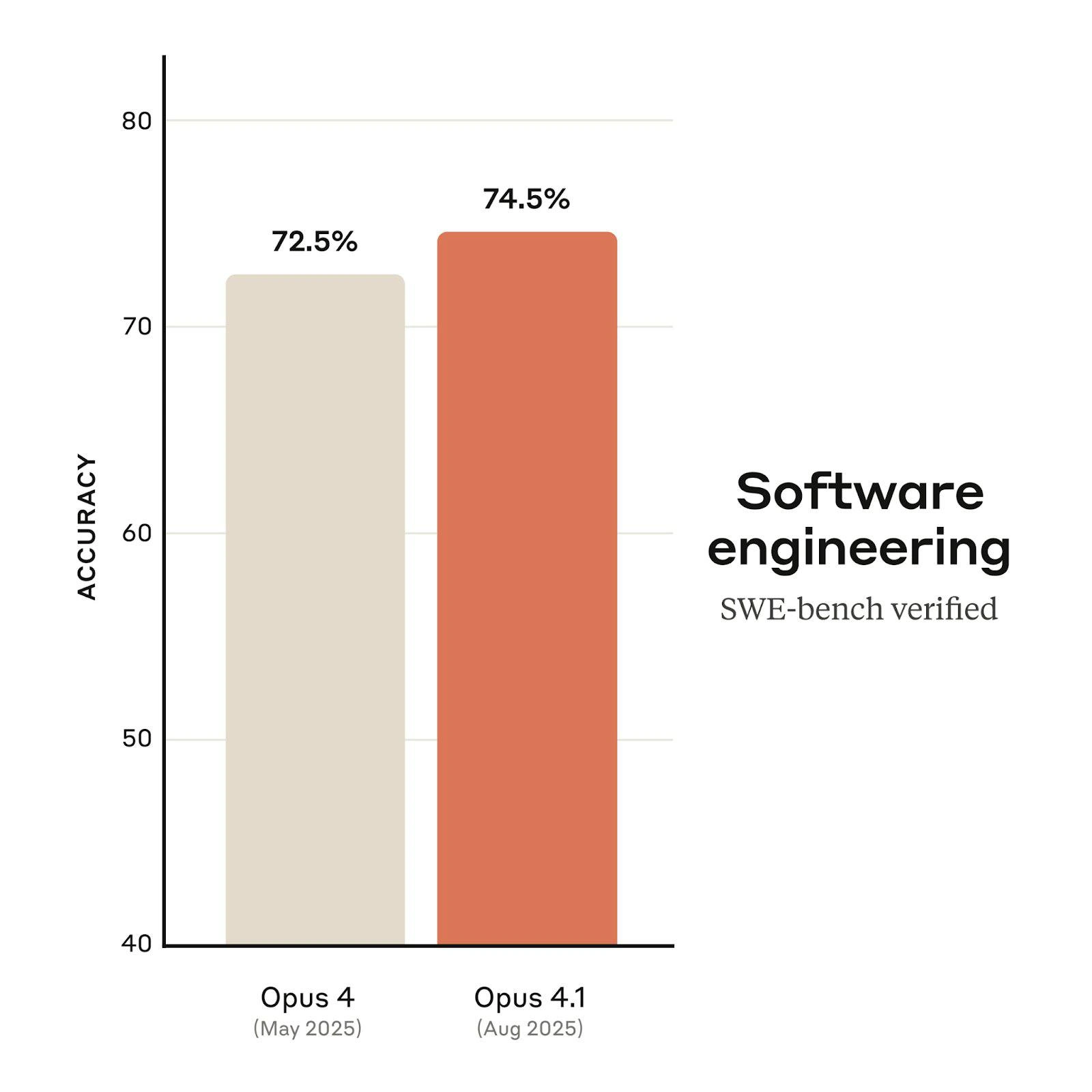
So what’s going on in this meme? It’s comparing two versions of an AI model on a specific test, and the newer version does a little better. The left bar labeled Opus 4 (May 2025) represents an earlier version of an AI model (we can call it “Opus 4”). It was likely a main release, possibly even an LTS (Long Term Support) version – that means it was a stable release meant to be reliable over time. The right bar Opus 4.1 (Aug 2025) is a patch release, basically a small update or minor version that came after Opus 4. In software, a patch release (like going from version 4.0 to 4.1) usually includes minor improvements or bug fixes rather than huge changes. Here, that patch seems to have made the model a bit more accurate on a certain benchmark test.

The y-axis is labeled “ACCURACY”, and these bars show the accuracy percentages: Opus 4 scored 72.5%, and Opus 4.1 scored 74.5%. That’s a difference of 2 percentage points. In simpler terms, if there were 100 test questions (or tasks), Opus 4 got about 72 of them right and Opus 4.1 got about 74 right. The specific test mentioned is SWE-bench, which stands for “Software Engineering Benchmark.” This is a special evaluation that checks how well AI models can handle software engineering tasks – in this case, automatically fixing bugs in code. The subtitle “SWE-bench verified” means those accuracy numbers were confirmed by this official benchmark, so it’s not just a random guess; it’s been measured and vetted. Think of SWE-bench as an exam for AI models where the questions are real-world coding issues from GitHub, and the model has to come up with correct fixes. Getting ~74% accuracy on such an exam is actually pretty impressive, since these aren’t easy textbook problems – they’re real bugs that developers encountered.

For a junior developer or someone new to AI, the key points are: machine learning models often have version upgrades, just like apps do. An LTS version (like Opus 4) is kind of like the stable, trusted edition of the model that users rely on. A patch release (like Opus 4.1) is a smaller update – maybe the team found ways to improve the model a bit, or fix some issues in how it was trained. It’s humorous to see the patch outperform the LTS, because “patch” sounds minor, but here it actually made the model better at the task. In AI development, it’s common to evaluate progress using benchmarks (standard tests). Benchmarking tools give us a consistent way to measure improvement. A 2% boost might not sound huge, but it’s considered an incremental improvement – and if the benchmark is well-known or tough, even a small jump is noteworthy. In fields like AI research, beating the previous best score by any margin is a cause for excitement.

The context here is specifically about AI that deals with software bugs. “Software engineering – SWE-bench” implies this model is tested on tasks like reading bug reports and code, understanding the problem (that’s the triage part), and then suggesting a code change to fix it (that’s the patch). It’s a bit like a very advanced auto-complete that doesn’t just write code, but tries to fix broken code. The categories include AI_ML and Bugs, because it’s the intersection of machine learning and debugging code. The tags like auto_code_fixing and ai_code_quality indicate the theme: using AI to improve code quality by automatically fixing issues. So Opus 4.1 presumably had some enhancements (maybe it was trained on more examples of code fixes, or the developers tweaked its algorithm) that let it catch and fix a few more bugs correctly than Opus 4 did. Two percent more might mean, for example, that if there were 200 bug-fixing challenges in SWE-bench, Opus 4.1 solved 149 of them while Opus 4 solved 145 – so Opus 4.1 fixed four more bugs than its predecessor in that test suite. Not bad for a “minor” update!

For a junior engineer, the humorous angle is also a gentle jab at how we celebrate these improvements. It’s like saying: “Our new model isn’t a complete overhaul, but hey, it’s a bit better and we’re proud of it.” The bar_chart_visualization with the tiny difference makes it visually obvious: see that little extra height on the red bar? That’s our achievement. In developer terms, it’s relatable because we often push out patch releases hoping to see any improvement – a slightly faster build, a slightly higher test coverage, or in this case, a slightly smarter AI. And when the metrics confirm a positive change (even +2%), we’ll happily announce it. The post’s tone (“When your model patch release outscores the LTS by 2%”) is both factual and a bit tongue-in-cheek: it sets up the scenario as a moment of triumph, however small. It implies that those working on the model are probably giving each other high-fives for eking out that gain. If you’ve ever fixed a tough bug or optimized something to run 2% faster, you know the quiet satisfaction that brings. In machine learning, especially, improving accuracy from an already high 72.5% to 74.5% can be pretty hard – it might require a clever idea or a lot of tweaking. So the meme is celebratory in a nerdy way. It tells new devs: even minor version bumps can hide major effort and be a big deal in the right context. And it tells us all: progress in AI is often step-by-step, not giant leaps, so we learn to enjoy the small wins.

Level 3: Minor Bump, Major Hype

To seasoned developers and ML engineers, this meme hits on the incremental improvement culture of model development. The bar chart shows Opus 4 (the established model, likely an LTS-style stable release from May 2025) being edged out by its younger sibling Opus 4.1 (a minor patch release in Aug 2025) by a mere 2 percentage points in accuracy. On paper it’s just 72.5% vs 74.5% on SWE-bench, but in the world of AI benchmarks, that’s newsworthy. It’s the classic scenario where a tiny version bump – essentially a .1 patch – manages to dethrone the long-term support champion on a key metric. The humor comes from how proud and validated we feel by such a modest gain. Every AI researcher knows the trope: “Our new model outscores the previous state-of-the-art by X%,” and here X is just 2.0. To outsiders, that might sound trivial, but to those in the trenches it’s a major victory that can involve weeks of tuning or an inspired new idea. It’s a wink at the AIHumor inside joke that we’ll throw a mini-party for a couple points improvement on a tough benchmark – especially one marked “Software engineering – SWE-bench verified.”

Why is that funny? Because we’ve all seen (or been) the colleague who, after a long training run or a careful patch, excitedly emails the team: “New model version beats old one by +2% on the leaderboard, yay!” 🎉. It resonates with the shared experience of chasing SOTA (state-of-the-art) results, where even a 1-2% bump can be the difference between a paper accepted at NeurIPS or a product that actually starts handling edge cases. The meme’s scenario specifically targets a model that auto-fixes software bugs – a notoriously hard problem. So an accuracy rise from ~72 to ~74% on that benchmarking tool is a genuine achievement. Seasoned devs also catch the meta-joke: this patch release (4.1) likely fixed some issues in the model itself or added a new trick, thereby enabling it to better fix external software bugs. The patch got better at patching! There’s a recursive comedy in that.

In real-world terms, SWE-bench is described as a dataset where large language models try to automatically triage and patch real GitHub issues. Picture feeding the model a bug report and the relevant code, and it outputs a code change to fix the bug. Getting ~74.5% accuracy likely means it produces a correct fix about 3 out of 4 times across a battery of real issues – frankly impressive, but still leaves plenty of “bugs” it fails to squash. The LTS version (Opus 4) was at 72.5%, so maybe it stumbled on a few more edge cases. The patch release presumably introduced some improvement: maybe it was fine-tuned on a larger corpus of bug-fix commits or the team tweaked the model’s architecture to better understand code context. MachineLearning progress is often like this: once you hit a strong baseline, each extra percent requires clever ideas or lots more data/compute. We joke, in a half-exasperated way, because we know how much work can go into squeezing out that extra bit of performance. The meme’s teracotta-red bar looms just a smidge higher than the beige bar, and that tiny visual gap represents countless GPU-hours and possibly a few stressed engineers double-checking if the gain was real or just noise.

From a software engineering perspective, the LTS vs patch dynamic is also amusing. Normally, an LTS (Long Term Support) version is the trusted old guard – stable, well-tested, but maybe not incorporating the absolute latest enhancements. A patch release is usually for minor fixes, not dramatic improvements. Yet here the patch isn’t just fixing a small bug; it’s actually outperforming its predecessor on a key capability. It’s as if a minor update to an app suddenly made it smarter than the big official release. Senior engineers have seen analogous situations: maybe a tiny config change or a one-line fix that unexpectedly boosts performance. In an ML context, it could have been something as simple as enabling an extra training data source or turning on a new optimization. We can almost imagine the Git diff:

- // Opus 4: did not fine-tune on real bug fixes to remain general
- useRealBugFixData = false;
+ // Opus 4.1: fine-tuned on thousands of real GitHub bug fixes for better accuracy
+ useRealBugFixData = true;

It’s a tongue-in-cheek way of saying the patch might have toggled “on” some experimental training regimen or fixed an oversight that the LTS had. And voilà – a tangible jump in model_accuracy on the benchmark. The auto_code_fixing model literally got better at coding by eating more code.

There’s also a subtle commentary on benchmarking tools and leaderboards: everyone chases the top score, even if it’s by a nose. We know internally that a 2% jump might not transform the user experience from night to day – if you were using Opus 4, you’d still see it fail on roughly 1 out of 4 bugs, and Opus 4.1 might fail 1 out of 4 and a bit. But for the engineers and researchers, that higher bar feels like winning Olympic gold. It’s AI humor because we laugh at how we obsess over these numbers. The poster’s caption “Nice 🌚” with the moon emoji drips with a playful, slightly deadpan pride – like they’re trying to play it cool, but you can sense the satisfaction. In the developer community, especially those dealing with AI_ML and hairy BugsInSoftware, this scenario is so relatable: you grind on a tough problem, you finally beat the benchmark by a sliver, and you share a minimalistic chart flexing that achievement. It’s both a brag and a self-aware chuckle at our own enthusiasm for tiny improvements. After all, we’ve learned to savor any win we get, even if it’s just a 2% edge – because we know the blood, sweat, and compute that went into it. And hey, it’s SWE-bench verified, so you can’t argue with the numbers, right? Minor version bump, major bragging rights – this is how engineering progress often feels at the frontier.

Level 4: Heuristics vs Halting

At the bleeding edge of AI research, automatically fixing code bugs is like solving a mini halting problem for every issue. The task behind SWE-bench – having an LLM triage a bug report and synthesize a code patch – sits in a realm of computational complexity. In theory, determining the perfect fix for an arbitrary program bug can be as hard as proving a theorem: there are infinitely many code variations to consider, and knowing if one truly resolves all cases is undecidable in the general case (thanks, Church-Turing). So how do we get a 2% accuracy bump at all? Heuristics. The Opus 4.1 model patch likely incorporates smarter heuristics or broader knowledge, nudging it to find correct fixes more often without brute-forcing the impossible. It’s leveraging patterns learned from countless bug-fix examples (essentially compressing human expertise into model weights) to navigate that astronomically large search space of code changes.

This small version change hints at some non-trivial innovation under the hood. Perhaps the model architecture was refined to better preserve code semantics during generation, or the training data was augmented with trickier real-world bugs to improve generalization. In machine learning theory, pushing accuracy from ~72% to ~74% on a mature benchmark is significant – it suggests the model uncovered new “terrain” in the solution space that the LTS version hadn’t mapped. We might even suspect an emergent capability: maybe Opus 4.1 learned to reason about code context a bit more deeply, inching closer to understanding program flow or common bug patterns (think off-by-one errors, null-pointer checks, race conditions) in a way Opus 4 didn’t. It’s an incremental step toward what formal methods aim for (proving code correctness), achieved not by strict logical proof but by a statistical giant brain honing in on likely fixes. Essentially, Opus 4.1 is playing the odds with more finesse – and those odds just improved by a hard-won 2%. In academic terms, that’s a huge win on the high end of an asymptotic curve: as models approach the theoretical limits of a complex task, each additional percent is exponentially more difficult to get. This little patch beat the LTS not by brute force exhaustive search (which is intractable for code), but by a clever tweak that gave it a slight edge in solving what amounts to a combinatorially explosive puzzle.

From a systems perspective, this highlights the interplay between machine learning and classical CS theory. The LLM’s improvement hints that it’s capturing a bit more of the underlying semantics of software: maybe better internal representations of code (an improved embedding of abstract syntax trees or execution behavior), or more refined chain-of-thought prompting to reason through a bug fix. It’s fascinating because it’s a pragmatic sidestep around theoretical barriers: we can’t systematically derive a fix for any arbitrary bug (that would require solving halting or having a formal spec for everything), but we can train a model on thousands of previous bug-fixes and let it probabilistically generalize. Opus 4.1’s creators likely exploited this, perhaps by fine-tuning on fresh GitHub issues or introducing a new feedback loop (like running the candidate patch through test cases during training, akin to an automated unit test Oracle guiding learning). That 2% gain isn’t just a random fluctuation – it’s evidence that the patch release sliced through a bit more of the combinatorial fog surrounding automated bug fixing. In a domain where full certainty is unattainable, an improvement verified by a benchmark means the model’s heuristics got tangibly better at darting toward correct solutions. It’s a sliver of progress in taming an AI-hard problem: real-world code repair. And for those of us nerding out on ML theory and software correctness, it’s both exciting and darkly humorous – we celebrate that tiny uptick, all while acknowledging the Sisyphean enormity of what the model is attempting under the hood. After all, when you can’t have a halting-problem-solving oracle, a well-trained stochastic parrot that’s 2% more accurate will have to do!

Description

A minimalist bar chart on a white background illustrates the performance of an AI model on a software engineering task. The y-axis is labeled 'ACCURACY'. Two vertical bars are shown. The first, a light beige bar, represents 'Opus 4 (May 2025)' and reaches an accuracy of 72.5%. The second, a slightly taller terracotta-colored bar, represents 'Opus 4.1 (Aug 2025)' and shows an accuracy of 74.5%. To the right of the chart, the text reads 'Software engineering' and 'SWE-bench verified'. The image visualizes a small, incremental improvement of 2 percentage points over three months. This chart provides a dose of realism for the senior developer audience. While the hype around AI suggests revolutionary leaps, this data from a respected benchmark like SWE-bench (which tests AI on real GitHub issues) shows the hard-won, gradual nature of progress in automating complex software engineering tasks. It's a subtle nod to the immense complexity of the domain, where even minor gains are significant achievements


Comments

17
Anonymous ★ Top Pick A 2% accuracy boost on SWE-bench in three months. Great, at this rate the AI will be qualified to confidently close a 'won't fix' ticket by 2028
  1. Anonymous ★ Top Pick

    A 2% accuracy boost on SWE-bench in three months. Great, at this rate the AI will be qualified to confidently close a 'won't fix' ticket by 2028

  2. Anonymous

    Sure, it’s only a 2 % lift - but it’s still the most productive junior dev I’ve onboarded this decade

  3. Anonymous

    After three months of training and probably millions in compute costs, Opus 4.1 proudly announces it can now solve 2% more LeetCode problems - still leaving a solid 25.5% chance it'll suggest using a bubble sort in production

  4. Anonymous

    When your Q3 OKR was 'ship Opus 4.1 with breakthrough performance' and you deliver a 2% bump that took three months, $10M in compute, and 47 ablation studies - but hey, at least the bar chart makes it look like we're crushing it on the logarithmic scale of executive expectations

  5. Anonymous

    Nice, +2% on SWE-bench; wake me when it can bisect a flaky test in a 500k-line monorepo, dodge CI secrets, and still pass after cache invalidation

  6. Anonymous

    A patch release that literally patches ~2% more SWE-bench bugs - ping me when that delta survives the confidence interval and a Friday deploy

  7. Anonymous

    2% gain in three months: enterprise velocity at its finest - even AIs can't escape quarterly planning

  8. @paranoidPhantom 11mo

    A leap

  9. @dwtexe 11mo

    Damn

  10. bur del lago 11mo

    make the graph start from 70% and you’ll see the shareholder magic

    1. @theodolu 11mo

      Make it start from 72

  11. @theodolu 11mo

    But in any case 8% improvement is pretty good for 3 months

    1. dev_meme 11mo

      For top model But idk how to trust all those charts Tho Antropic is only one who’s left in the field to whom you can trust that they actually have progress So idc about charts They pushed new version, I gonna simp it

  12. @mihanizzm 11mo

    What does these percentage mean btw? What is 100%?

    1. @NickNirus 11mo

      graph says accuracy, so I assume it's a percentage of tasks solved correctly

      1. @mihanizzm 11mo

        Interesting... Actually, they can get any tasks (very easy for example) and say that the new model has 100% accuracy🤔

        1. @SamsonovAnton 11mo

          Isn't it what AI should be best used for — to solve routine, primitive tasks that nobody wants to spend their time on?

Use J and K for navigation