SEC Provides Regulatory Clarity on Crypto Liquid Staking
Why is this Blockchain meme funny?
Level 1: Teacher Says It’s OK
Imagine you and your friends came up with a cool new game to play during recess. At first, you’re a bit scared – what if the teacher thinks it’s against the rules? You’ve been playing it quietly, hoping no one gets in trouble. Then one day, the principal makes an announcement: “We checked out the game you all invented, and it doesn’t break any school rules. It’s allowed!” You’d feel super happy and relieved, right? That’s basically what happened here. The grown-ups in charge (a big group called the SEC, kind of like the principal for finance stuff) told the crypto folks, “Your new idea is not against the rules.” Everyone who was worried can smile now, because the big boss gave a thumbs-up. It’s funny because normally those announcements are boring and complicated, but to the people making crypto projects, this one felt as good as getting an A+ or a big “Approved!” stamp on their work. It’s like a huge permission slip that means they can keep doing their thing without fear of getting in trouble. The meme makes us picture that serious approval in a fun way – as if the strict rule-keepers just high-fived the inventors and said “Good job, carry on!”
Level 2: Code Reviews & Compliance
Let’s break this down in plainer terms. In software development, a pull request (PR) is when you ask to merge your new code into the main codebase. It’s like saying, “Hey team, I’ve added a feature – can someone check and approve it?” The code must pass automated tests in a CI/CD pipeline (Continuous Integration/Continuous Deployment pipeline). If all tests pass, you get a green build indicator, meaning everything is good to go. A senior developer or maintainer will then approve the PR, and your code goes live. Developers love seeing that green checkmark and an “approved” message – it means their work made it through all the hurdles.
Now, in the world of Blockchain and Cryptocurrency, developers face a different kind of reviewer besides their teammates: the SEC, which is the U.S. government agency that regulates stocks, investments, and financial products. When crypto engineers create something like a new token or a new way for users to earn yield (profit) on their crypto, they have to worry, “Will the SEC consider this a security (like a stock)?” If something is a security, the company might need to register it, follow strict laws, and it might even be forbidden for regular folks to use without lots of paperwork. It’s a big deal – getting it wrong can mean huge fines or shutting down the project. This makes compliance (following laws and rules) a huge part of FinTech projects. Teams will often run everything by lawyers (the “legal pipeline”) just like running code through tests, to ensure they won’t get in trouble.
Liquid staking is a concept in newer crypto networks (especially ones using Proof-of-Stake like modern Ethereum). Normally, staking means locking up your coins in the network to help secure it – you get rewarded, but your coins are stuck (illiquid) for a while. Liquid staking lets you stake your coins and get a tradable token in return. For example, you deposit 10 ETH to a staking protocol, and you receive 10 “staked ETH tokens” (often called staking receipt tokens). Those receipt tokens are like a coat-check ticket for your crypto: they prove you have 10 ETH staked, and later you can redeem them to get your original ETH (plus any rewards). The cool part is you can also trade or use those receipt tokens in the meantime. It’s as if you left your coat with a valet and got a claim ticket, and you could even give that ticket to a friend or sell it – whoever holds the ticket can claim the coat later. This makes staked assets liquid, meaning you’re not locked out of using that value.
The worry was that these receipt tokens or the act of liquid staking might be seen by the SEC as a kind of investment product (like stocks or funds), which could be labeled an “investment contract” (legal term from the famous Howey Test that defines securities). If that were the case, all the companies offering liquid staking would possibly have to register with the SEC or shut out U.S. users – a nightmare for those projects and their dev teams. It’s like coding an app and fearing that as soon as you launch, the app store will ban it for breaking some rule you aren’t even sure about. Compliance humor like this meme comes from that stressful backdrop.
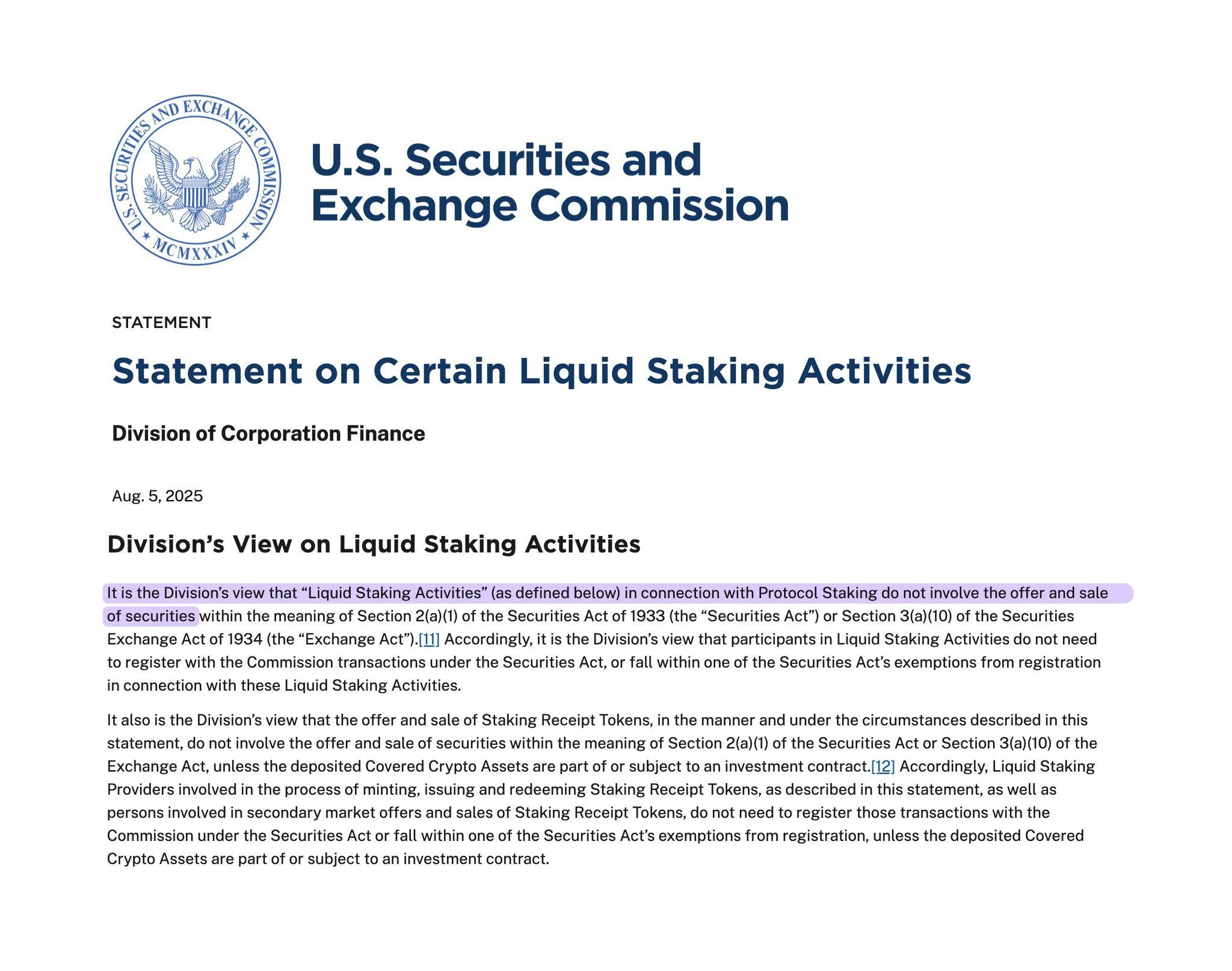
So what happened on Aug 5, 2025 (according to the meme)? The SEC’s Division of Corporation Finance issued a statement basically saying: “In our view, liquid staking isn’t the kind of activity that counts as offering securities to people.” The snippet in the image literally says participants in liquid staking “do not need to register with the Commission” and that the special tokens people get (staking receipt tokens) aren’t considered securities by themselves (unless they’re packaged into something that clearly is a security). In simpler terms, the SEC is telling crypto developers and companies, “This particular thing you’re doing is not against the securities rules.” That’s a huge crypto policy shift! It’s like a teacher publicly announcing that a new game the kids have been playing is officially allowed – no one’s getting detention for it. In the community, this news is hype because it removes a big source of uncertainty. It’s much easier to plan your tokenomics (the economics/design of your token and rewards) and build DeFi features when you’re not constantly afraid of a regulator popping up and yelling “Stop! That’s illegal.”
Now the analogy: calling the SEC’s statement the “ultimate pull-request approval” is a tongue-in-cheek way to map the situation to developer life. Think of the SEC as a senior engineer or tech lead in charge of the entire project (except here the “project” is the whole U.S. financial market!). Crypto teams have essentially been submitting their “feature” (the liquid staking concept) for review, anxiously waiting. This statement is the lead maintainer saying “Approved – looks good to deploy.” The CI/CD for DeFi backends mentioned is comparing the process of deploying financial features to deploying code. DeFi (Decentralized Finance) backends are basically smart contracts and blockchain code running financial services without traditional banks. They often had to include extra steps – like a legal review stage – in their development pipeline. Those were the lawyer-driven gates: checkpoints where the legal team had to say “okay” before moving on, just like automated tests or QA checks. With the SEC giving a thumbs-up here, a major gate is cleared. Developers feel validated, similar to how a junior dev feels when their code change gets approved by a rock-star senior dev or architect. It’s a mix of relief (“We’re not inadvertently breaking the law, yay!”) and excitement (“We can ship this feature to users now.”).
In short, for someone newer to the field: this meme is celebrating a moment where complex blockchain/FinTech engineering intersected with high-level compliance confirmation. The big regulator essentially said “this tech feature is fine by us,” and the meme cleverly expresses that in the language of developers – like getting a legendary code merge approved. It underlines how even in cutting-edge tech industries, an old-school PDF from a government agency can feel as gratifying as seeing “All checks passed” on your GitHub PR. For newcomers, it’s also a peek into how much legal and tech are intertwined in crypto: success isn’t just about writing solid smart contracts, but also about navigating laws. And when the law side finally says “all good”, the dev side can move forward with one less worry.
Level 3: From Red Tape to Green Build
At the highest level, this meme mashes up blockchain compliance with developer culture. Imagine the normally stodgy U.S. Securities and Exchange Commission (SEC) dropping a statement that reads like a successful CI/CD run. The meme shows what looks like an official SEC PDF titled “Statement on Certain Liquid Staking Activities” dated Aug 5, 2025. The kicker? The highlighted paragraph basically says “Liquid staking activities... do not involve the offer and sale of securities”, meaning the SEC isn’t treating them as regulated investments. For crypto engineers who’ve been living in fear of regulatory red tape, this is like a long-awaited all-tests-passed green build. It humorously frames the SEC’s statement as the ultimate pull-request approval in the DeFi repo – the big boss code review we’ve all been waiting for.
Why is this funny to experienced devs? Because it captures a real industry saga: building a FinTech or DeFi product often feels like coding with a lawyer peering over your shoulder. Every new feature (or token) is like a commit that might fail the compliance pipeline. Here the SEC – the enterprise-grade gatekeeper – essentially gave a giant “LGTM” (Looks Good To Me) on liquid staking. It’s a compliance humor crossover: the formal language of regulators gets translated into developer terms. Instead of a terse GitHub comment, we have a verbose SEC document, but the effect is the same – approved! Seasoned blockchain devs chuckle because they’ve seen the opposite plenty of times: surprise “bugs” in the form of enforcement actions or ambiguous laws forcing hotfixes at 3 AM. This time, though, it’s no bug, just feature – a crypto policy shift that removes a blocker.
There’s a shared relief underlying the humor. Many crypto projects have tiptoed around the SEC, uncertain if features like staking rewards or token distributions would be labeled as dangerous securities. A single dreaded word from the SEC can sink a protocol or require a total refactor of the business logic (and tokenomics). The meme winks at this tension: an SEC regulation update that doesn’t punish or constrain developers is as miraculous as a legacy monolith app finally passing all integration tests. Liquid staking protocols (think projects like Lido or Rocket Pool) have been in a gray zone – offering users a way to stake crypto (like ETH) and get a tradeable token back. Up until now, teams treated every staking receipt token release like a risky deploy on a Friday, afraid it might break in production (i.e., draw a lawsuit). This statement is essentially the SEC merging that pull request into main. 🎉
By calling it “the ultimate PR approval,” the meme highlights how this formal Division of Corporation Finance statement is akin to getting sign-off from the highest authority. It’s IndustryTrends hype because such regulatory green lights are rare and game-changing. In dev terms, compliance went from being a relentless flurry of “failed checks” to a big friendly green checkmark. Every lawyer-driven gate in the CI/CD for a DeFi startup – those tedious approval steps before shipping a feature – just got a little faster and less nerve-wracking. The humor lands because it’s true: for once, an SEC PDF has crypto devs feeling the same giddy triumph as seeing a passing Jenkins build after a week of failing tests. The Division’s view basically says “carry on, you’re not breaking the rules,” which in code speak is like an all-clear from the ultimate QA tester. And trust me, for battle-scarred crypto veterans, seeing no-securities in writing is as surreal (and satisfying) as seeing an infamous flaky test finally go green.
Description
A screenshot of an official document from the U.S. Securities and Exchange Commission (SEC), identifiable by its seal and formal layout. The document is a statement from the Division of Corporation Finance, dated August 5, 2025, titled 'Statement on Certain Liquid Staking Activities.' A key sentence is highlighted in purple: 'It is the Division's view that “Liquid Staking Activities” ... do not involve the offer and sale of securities...'. The text provides a formal regulatory opinion. This image captures a pivotal moment for the cryptocurrency industry, specifically in the area of Decentralized Finance (DeFi). For years, the question of whether staking activities and their derivatives could be classified as securities has created significant regulatory uncertainty. This statement provides much-needed clarity, suggesting a more favorable regulatory stance. For senior developers in the FinTech and blockchain space, this isn't just text; it's a foundational piece of news that impacts system architecture, product viability, and risk assessment for any project involving staking
Comments
8Comment deleted
The SEC finally decided liquid staking isn't a security. Apparently, the real unregistered security was the friends we made arguing about it on Crypto Twitter all along
Looks like the SEC just merged a ‘NOT-A-SECURITY’ flag into main - time to delete that 10,000-line registration micro-service before it accrues any more technical (and literal) debt
After 15 years of arguing whether tokens are securities, the SEC finally discovered the blockchain equivalent of 'it depends' - just in time for quantum computing to make all our cryptography obsolete anyway
Finally, the SEC clarifies that liquid staking isn't a security - unless it is. After years of 'regulation by enforcement,' we now have official guidance that basically says 'staking tokens are fine, except when they're not.' At least now architects can design DeFi protocols with slightly less existential dread about whether their governance token will trigger a Wells Notice. Though knowing the SEC, they'll probably issue a contradictory statement next quarter and claim both were 'consistent guidance.'
Wild how one PDF flips howey_passed from unknown to false; Legal wants a feature flag, Finance wants a press release, and DevOps wants to know why this is now a Friday deploy
SEC just turned liquid staking into a feature flag: liquid_staking_enabled=true unless investment_contract; product wants ship, legal wants a decision log, SRE wants rollback - welcome to compliance‑driven development
SEC finally groks delegation: no custody in liquid staking pools means no 13(d)/16 filings. DeFi yields just got a regulatory pump
Breaking: thing that was impossible to regulate is now not regulated Comment deleted