Skip to content
DevMeme
6079 of 7435
The Simple Expectation vs. Chaotic Reality of AI Model Versioning
AI ML Post #6658, on Apr 18, 2025 in TG

The Simple Expectation vs. Chaotic Reality of AI Model Versioning

Why is this AI ML meme funny?

Level 1: Too Many Choices

Imagine you just finished reading the fourth book in a series and you’re excited for book number five. You go to the store expecting to buy “Book 5,” nice and simple. But instead, you find a whole shelf full of books with titles like “Book 4½ Mini Edition,” “Book 4.1 Turbo Story,” “Book 4 Special Pro Version,” and “Book 4 Deluxe Sequel.” There are so many versions that you can’t even tell which one to read next! You’d stand there confused, scratching your head, wondering, “Uh... which one of these is the real next book?” That’s exactly the feeling this meme is joking about. We thought we’d get one clear new AI model (GPT-5), but instead we got a bunch of weirdly named mini-models. It’s funny in the way that getting twenty slightly different options when you expected just one is funny – it’s a silly overload that leaves you both amused and a little perplexed.

Level 2: Version Overload

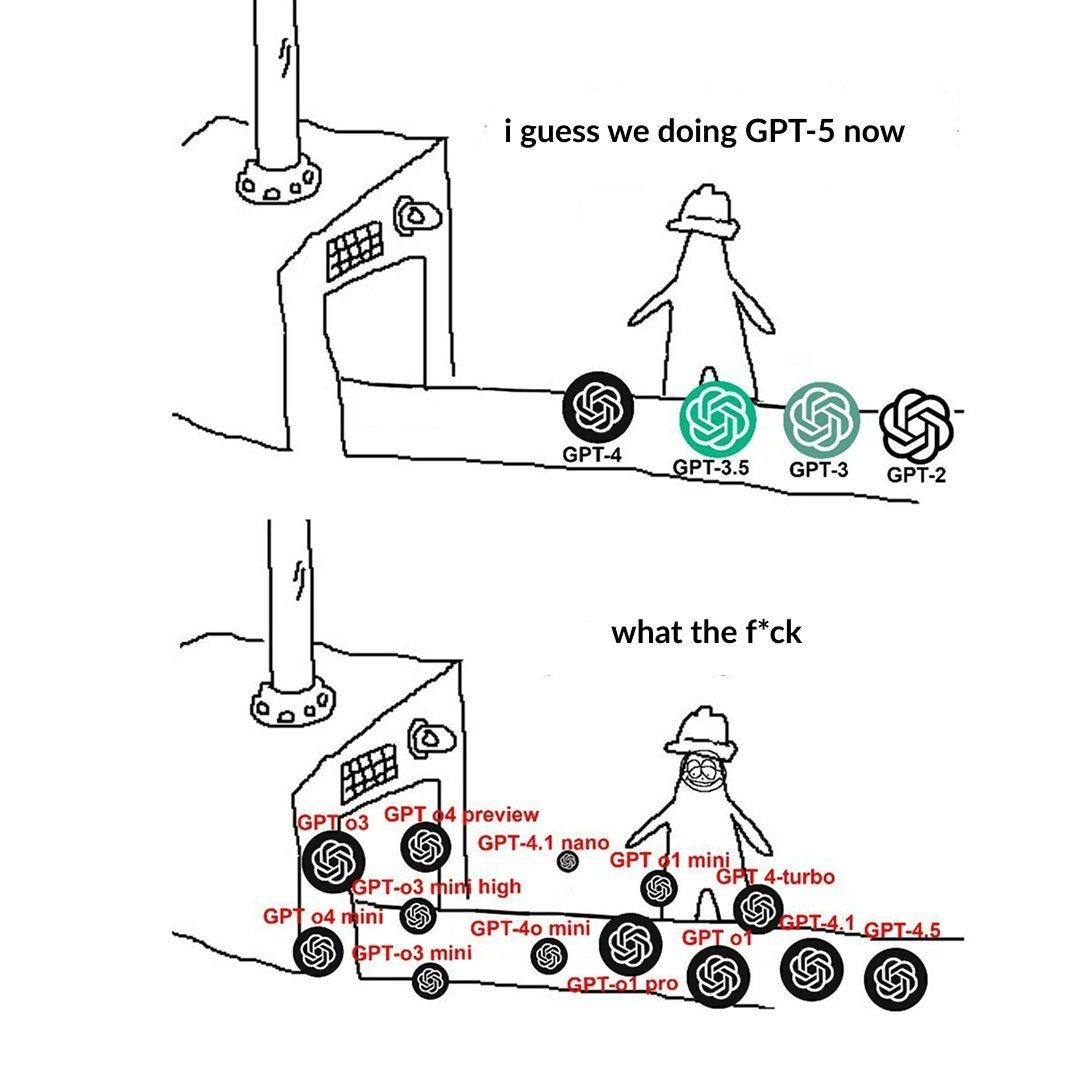
In this meme, we see a simple two-panel comic about AI model versions. In the top panel, an engineer stands by a conveyor belt that’s carrying out OpenAI’s past GPT models in order: GPT-2, GPT-3, GPT-3.5, GPT-4. The caption says, “I guess we doing GPT-5 now,” which shows the engineer expects the next model will be GPT-5 (following the nice, normal sequence of whole numbers). Everything seems orderly.

But in the bottom panel, things go crazy. The conveyor belt is now flooding with a bunch of OpenAI GPT logos, each labeled with confusing names like GPT 03, GPT 04 preview, GPT-4.1 nano, GPT d1 mini, GPT-4 turbo, GPT 04 mini, GPT-3 mini high, GPT-4o mini, GPT-01 pro, GPT-4.5, and so on. The engineer is staring at this chaos, and the caption “what the f*ck” (a shocked reaction) shows he’s completely bewildered. Essentially, instead of one clear GPT-5 model, he’s getting a dozen oddly named versions. It’s like expecting a single new phone model and seeing a whole shelf of nearly identical phones with different labels – pretty overwhelming!

Let’s break down what all this means. GPT stands for Generative Pre-trained Transformer, which is a type of large language model (LLM) made by OpenAI. They release these models in numbered versions. For example, GPT-2 came out around 2019 and was improved upon by GPT-3 around 2020. Later, they made an enhanced version of GPT-3 (kind of like GPT-3.5) which was used in early ChatGPT. Then in 2023, GPT-4 was released as a much more advanced model. So naturally, after GPT-4, people would expect the next big version to be called GPT-5, indicating the fifth generation with significant improvements.

Now, have you heard of how software versions usually work? Often we use a version numbering system: a major version number that goes up when there’s a big update, and maybe minor numbers or patch numbers for smaller updates. For instance, if we have version 3.0, a small update might be called 3.1, then 3.2, and a big overhaul would be 4.0. This is sometimes called semantic versioning when done strictly (meaning the numbers have meaning: major.minor.patch). In the context of GPT models, we’ve basically had major versions (2, 3, 4). They even used a “.5” for a halfway upgrade (GPT-3.5 was an intermediate step between 3 and 4).

What the meme jokes about is that instead of following that orderly approach (just going to GPT-5 or maybe doing a single 4.1 update), OpenAI’s model lineup has exploded into a confusing mess of names. Let’s look at some of those labels in the bottom panel:

  • GPT 04 preview – this sounds like a preview version of GPT-4 (perhaps an early beta release of an update).
  • GPT-4.1 nano – this might imply a version “4.1” of GPT-4 that is a tiny (nano) model (maybe a smaller, faster variant).
  • GPT-4 turbo – “turbo” suggests a tuned-up, faster version of GPT-4. Companies often use words like Turbo or Pro to indicate a performance boost.
  • GPT-3 mini high – this one is odd; maybe a smaller (mini) GPT-3 model that’s “high” (high capability or high efficiency?). The naming here is intentionally absurd.
  • GPT-01 pro – this is really strange, because GPT-1 (if we count from the very beginning) was the original model. Calling something “01 pro” looks like a marketing attempt to rebrand an old model as a “Pro” version. It doesn’t fit at all with the usual numbering.

You can see there’s no clear pattern – some names have hyphens, some don’t; some use a decimal point, others jam the numbers together. It’s total naming chaos. This kind of mess is what developers mean by a “versioning nightmare.” The meme exaggerates it to be funny, but it’s referencing a real frustration. Keeping track of many slightly different versions of a product can be hard, especially if the naming isn’t consistent.

Imagine you had to choose which AI model to use for your project. Earlier, it was simple: if you wanted the best, you’d pick GPT-4 over GPT-3. But now, if you were presented with GPT-4, GPT-4 turbo, GPT-4.1 nano, GPT-4.5, etc., which one is the best or newest? It’s not obvious at all. The entire point of version numbers is to make it clear what comes before what, but here it looks like someone just threw every naming idea into a bucket. It’s a bit like if your web browser had versions “Firefox 98”, “Firefox 99 Beta”, “Firefox 99 Ultra”, “Firefox 100 Mini” all at once – you’d be confused which one you’re supposed to use.

This ties into the idea of API versioning too. Many AI models like GPT are offered through an API (Application Programming Interface), where you have to specify which model you want. If there are a dozen model names, developers need to know which one to plug into their code. Too many options (especially with unclear names) means more chance to pick the wrong one or constantly switch as new ones come out. It’s much easier when there’s just a single clear “latest version” or a small, well-defined set of choices.

Another factor here is the AI hype and how tech companies handle releases. AI has been evolving quickly, and companies love to announce improvements frequently to stay in the news. If they don’t have a brand-new breakthrough ready (like a true GPT-5), they might still release something to show progress — maybe a slightly better version of GPT-4, or a specialized smaller model — and give it a fancy name. Over time, this can lead to a lot of model variants. Each variant might be useful in its own way (one might be cheaper to run, one might be more powerful but slower, etc.), but from the outside it starts to look like a jumble of names and numbers. The meme is poking fun at exactly that: the confusion that programmers feel when a simple progression becomes an overloaded product lineup.

In plain terms, this meme is funny because it takes a normal expectation (we’re just going from GPT-4 to GPT-5) and flips it on its head (we instead got a dozen confusingly named mini-steps). It exaggerates the situation to make a point: naming things in tech can get out of hand, and when it does, everyone gets confused. Even if you’re new to programming, you can probably relate to the idea of something being made more complicated than you expected. This comic just uses the example of AI model names to show that feeling in a humorous way.

Level 3: Hype-Driven Versioning

One moment you’re calmly expecting GPT-5 to roll out, and the next you’re drowning in an avalanche of GPT model names that make your head spin. The meme’s top panel sets us up with the straightforward scenario: after GPT-4, naturally comes GPT-5 – a neat, linear progression in versioning. But the bottom panel drops the twist: instead of a single next-gen model, a conveyor belt is spewing out a dozen tiny GPT logos with chaotic labels. The caption “what the fck”* perfectly captures the bewilderment of an engineer staring at this unexpected GPT version sprawl. It’s like expecting the next iPhone model and finding out the company released a whole confusing lineup of variants in between.

For seasoned developers, this humor hits a nerve. We’ve all witnessed semantic versioning gone wrong. In principle, Semantic Versioning (SemVer) is supposed to bring order: you only bump the major version (like going from 4 to 5) for big, incompatible changes, and use minor/patch numbers for incremental improvements. But here, that discipline has collapsed. Every tiny tweak or variant of the model is christened as its own special release with a fancy name. It’s as if someone took the idea of minor versions and ran wild, plastering each update with marketing buzzwords. The result? A versioning vortex where GPT-4.1 nano, GPT-4 turbo, and GPT-3 mini high all exist simultaneously. It leaves everyone asking which one is the "real" current model. This is SemVer taken off the rails – a textbook case of version numbering rules being thrown out the window.

There’s a famous saying in software engineering: “There are only two hard things in Computer Science: cache invalidation and naming things (plus the tongue-in-cheek addition of “off-by-one errors,” making it three). This meme zeroes in on that naming things problem. The explosion of GPT model names is a direct side effect of naming decisions driven more by hype than by logic. We see labels like "preview", "nano", "turbo", "mini", "pro" – these scream "marketing team at work" rather than technical necessity. It’s reminiscent of how consumer gadgets are sold: one flagship product spawns half a dozen editions (Pro, Max, Lite, etc.) to cover every niche. In theory, software versions shouldn’t need flashy monikers; a simple 5.0 vs 4.1 would do. But here the AI product folks have clearly taken a page from the gadget branding playbook, resulting in a cornucopia of confusing names.

From a senior dev perspective, this chaotic proliferation is both hilarious and painfully familiar. It triggers flashbacks of API versioning nightmares and dependency hell. If each of those GPT variants is accessed via a different API endpoint or has unique quirks, then integrating the “latest GPT” isn’t a straightforward upgrade — it’s a research project. Do we use GPT-4.5 or is GPT-4 turbo the better choice for our needs? Is GPT-3.5 preview a beta for GPT-4, or something else entirely? The naming doesn’t make it clear. It’s essentially creating a fragmented AI product line where the hierarchy is muddy. On a package repository like npm or PyPI, encountering a dozen libraries with nearly identical names is a bad sign — you know you’re in for a miserable time figuring out which one is official or up-to-date. Here the meme suggests the GPT lineup has devolved into that kind of scenario, where picking the “right” model feels like navigating a minefield of nearly-duplicate options.

Why does this happen? In a fast-paced field like AI, the pressure to stay in the headlines is immense. The relentless AI hype cycle rewards frequent releases and big claims. If the next truly major model (say GPT-5) isn’t ready yet, companies will slice their progress into smaller, more digestible chunks and release those instead. It’s hype-driven versioning: keep the buzz going with GPT-4.1, then GPT-4.2, then maybe GPT-4 Turbo, and so on. Each incremental update gets a splashy name to make it sound like a big deal: perhaps one has a larger context window, another is fine-tuned for dialogue, another runs faster. Technically, these could have been minor version bumps or configuration tweaks. But marketing knows that a list of bullet-point improvements under the name “GPT-4.1” won’t get as much attention as dubbing it GPT-4 Turbo — “the fastest GPT yet!” For engineers, though, it’s dizzying — hence the meme’s exasperation.

We’ve seen parallels to this pattern in other tech eras. A battle-scarred coder might recall how Sun/Oracle abruptly jumped Java from version 1.4 to Java 5 (dropping the “1.” to appear more advanced, which confused plenty of developers), or how Microsoft’s Windows went from 8 to 10, skipping 9 entirely for marketing mystique. And don’t get us started on Microsoft’s Xbox naming (One? Series X? who thought that was clear?). In the AI world, the meme is suggesting OpenAI (or any leading lab) could make a similar move: transforming a clean sequence of model versions into a tangled family of products. It’s satirical, but not that far-fetched. In fact, by 2025 we already had GPT-3, GPT-3.5, GPT-4, and variants like gpt-3.5-turbo in real life. The idea of even more granular SKUs is a tongue-in-cheek extrapolation that seasoned observers find both amusing and plausible.

The frustration beneath the laughter is that developers prefer clarity and stability. When a new version of a tool or model comes out, we want to know: is this the one we upgrade to, yes or no? If instead we get ten options with overlapping version numbers and cutesy names, we end up like that stick figure in the comic, arms thrown up, muttering “WTF?” The humor works because it exaggerates a real feeling of overwhelm. It highlights how easily a well-intentioned versioning strategy can devolve into chaos when short-term incentives (like marketing hype or competitive pressure) take over. It’s a cautionary tale wrapped in a joke: even the most advanced AI model can suffer from something as human as poor naming and version management. And as any senior dev knows, once you’re in that mess, untangling it — renaming, consolidating versions, updating documentation — is a herculean task that few companies ever fully complete.

In short, the meme comically illustrates AI hype spiraling into a model release meltdown. On the surface, it’s absurd to see all those GPT logos flying out of a factory with ridiculous labels — but deep down, every engineer who has dealt with confused product versions is nodding and laughing (perhaps with a tear in one eye). It’s funny because it’s true: naming things is hard, versioning is hard, and when you mix those with the breakneck pace of AI innovation, you get a perfect storm of confusion that we can only cope with by joking about it.

Description

A two-panel, black-and-white line-drawing meme contrasting the perception of AI model progression with the messy reality. In the top panel, a simple cartoon character in a hard hat watches a conveyor belt from a factory, which carries a neat, linear sequence of OpenAI logos labeled 'GPT-2', 'GPT-3', 'GPT-3.5', and 'GPT-4'. The text above reads, 'i guess we doing GPT-5 now', indicating a simple, predictable next step. The bottom panel shows the same scene, but the conveyor belt is now chaotically overflowing with a multitude of different, smaller, and overlapping GPT logos. These are labeled with a confusing variety of names like 'GPT o4 preview', 'GPT-4.1 nano', 'GPT o1 mini', 'GPT 4-turbo', and 'GPT-4.5'. The character now has frantic, scribbled eyes, and the text above reads, 'what the f*ck'. The meme humorously captures the overwhelming and confusing proliferation of AI model variants. While the public might expect a straightforward progression of major version numbers, developers and practitioners are faced with a complex, fragmented landscape of specialized models, making it difficult to track capabilities and choose the right tool for the job. It’s a relatable commentary on the rapid, sometimes chaotic, iteration and branding in the AI industry


Comments

15
Anonymous ★ Top Pick The bottom panel is just OpenAI's product roadmap after they accidentally set the `temperature` parameter to 1.5
  1. Anonymous ★ Top Pick

    The bottom panel is just OpenAI's product roadmap after they accidentally set the `temperature` parameter to 1.5

  2. Anonymous

    Remember when major versions were integers instead of marketing endpoints? At this pace, the next release will be `@openai/gpt-4.x-beta-canary.5` on npm

  3. Anonymous

    Remember when we complained about JavaScript framework fatigue? OpenAI just speedran the entire software versioning antipattern catalog in 18 months - we've got semantic versioning, marketing versioning, capability tiers, and whatever 'o' means, all competing in the same namespace like a distributed systems CAP theorem violation

  4. Anonymous

    When your model versioning strategy looks like you let a neural network design your semantic versioning scheme - because nothing says 'we have a coherent product roadmap' quite like simultaneously shipping GPT-4.5, GPT-o1 pro, GPT-4.1 nano, and GPT-o3 mini high. At this rate, we'll need a dedicated microservice just to maintain the decision tree for which model to call, and the real intelligence will be the engineer who can explain the difference between 'turbo', 'mini', 'nano', and 'high' without checking the docs

  5. Anonymous

    Our SupportedModels enum started as {gpt4}; now it’s a cost-aware router with deprecation edges, rate‑limit tiers, and a regex to normalize whatever new SKU marketing invents during standup

  6. Anonymous

    Model choice has become architecture - my “engine” dropdown now requires cost forecasting, tokenizer audits, and an RFC. Pretty sure it needs a change advisory board

  7. Anonymous

    GPT-4 variants: feature creep so bad, even our monolith refactor looks modular

  8. @jackietanyen 1y

    GPT-5 is the new half life 3

  9. @nubuslink 1y

    Filling all kind of needs, price, performance, personalization, no problem here tbh

  10. @patsany_horosh_mne_v_dm_pisat 1y

    real

  11. @naiznancoo 1y

    Don’t worry guys: iPhone 28e, Windows69 and gpt5 will be released the same day. And you’ll buy it.

    1. @TheRamenDutchman 1y

      Don't forget GTA and TES 6

  12. @TheRamenDutchman 1y

    Also why is GPT 4o Mini on there twice?

  13. @sysoevyarik 1y

    Unstoppable urge To make versioning of tech-related products as unintuitive as possible

  14. @leandrofriedrich 1y

    i would have the same look on my face if i learrned i had myself in me an infinite amount of time ngl

Use J and K for navigation