Skip to content
DevMeme
6078 of 7435
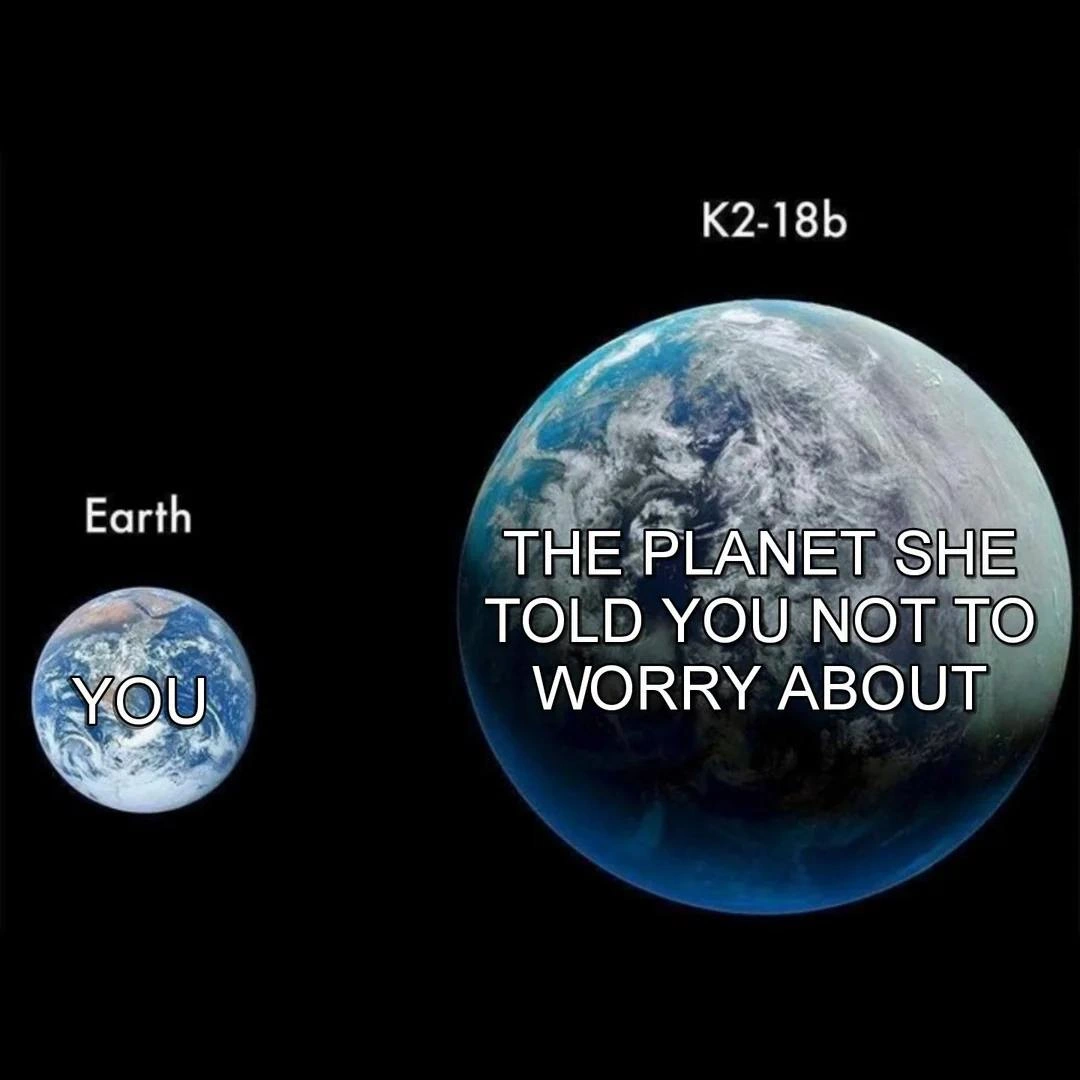
Tech Imposter Syndrome: You as Earth vs. The Exoplanet They Told You Not to Worry About
IndustryTrends Hype Post #6657, on Apr 18, 2025 in TG

Tech Imposter Syndrome: You as Earth vs. The Exoplanet They Told You Not to Worry About

Why is this IndustryTrends Hype meme funny?

Level 1: Little vs Big

Imagine you spend all day building a small sandcastle at the beach and you’re really proud of it. Your friend says, “Don’t worry about that other sandcastle down the beach, yours is great.” But when you look up, you see the other sandcastle is actually a gigantic sand fortress, with towers and walls towering over your little one. Suddenly, your sandcastle looks teeny-tiny by comparison! It’s funny and a bit humbling – you thought you were doing something huge, but next to the really big castle, yours is like a toy. That’s the joke here: your small thing (your sandcastle) versus the massive thing someone told you not to worry about. In tech terms, it’s saying the computer setup you develop on is small, and the real thing running for everyone to use is huge – and that contrast is both comical and eye-opening, just like the sandcastle comparison.

Level 2: Laptop vs Cloud

In this meme, the small Earth labeled “YOU” represents your development environment (like your personal laptop or desktop where you write and test code). The giant planet K2-18b on the right represents the production environment – basically the live system running on powerful servers in the cloud (think of services like AWS, Azure, or a big data center). The caption “the planet she told you not to worry about” is a play on a popular meme format meaning “the other guy (or thing) that is way out of your league.” Here, it implies someone (maybe your team lead or the documentation) said, “Don’t worry about production, your dev setup is fine for testing.” Yet clearly, production is massive compared to your tiny setup. It’s DevOps humor about scale shock – when you realize how much bigger and more complex the real deployment is.

To a junior developer, it might not be obvious why a program that runs well on a laptop could struggle in production. This meme highlights some key differences:

Aspect Dev Environment (You on Earth) Production Environment (K2-18b planet)
Hardware 1 laptop or PC (limited CPU/RAM) Dozens of servers or cloud instances (huge resources)
Scale of Users Just you or a few testers using it Thousands or millions of users simultaneously
Data Size Small test database or sample data (MBs) Full database with real data (GBs or TBs)
# of Services Maybe 1 app or a few services on one machine Many microservices, databases, caches across many machines
Network Everything on one machine (no real network delay) Services spread out – involves network calls, load balancers, etc.
Complexity Simple and under your control Complex, distributed system with unpredictable interactions
Cost Uses your existing laptop (no extra cost) Cloud bills can be huge (pay for many servers, bandwidth)

Looking at that comparison, it’s easy to see why production is “a different planet.” A dev environment is usually kept small and manageable so you can iterate quickly. For example, you might run your app with a lightweight SQLite database or an ephemeral in-memory database during development. In production, however, the app might connect to a large PostgreSQL or NoSQL cluster spread across data centers. The term “prod planet it orbits” in the title is apt: your little dev setup often depends on assumptions that orbit around a much larger production context.

Let’s define a few terms from the tags to clarify:

  • DevOps: A set of practices that combines software development (Dev) and IT operations (Ops). It aims to shorten the development lifecycle and ensure high software quality. In DevOps culture, you build it and you run it – meaning developers are encouraged to be aware of how their code runs in production (no tossing it over the wall to ops). This meme is a nod to DevOps because it reminds us why devs need to think about ops concerns like deployment and scaling.
  • SRE (Site Reliability Engineering): This is a job role/discipline at companies (originating from Google) focused on keeping production systems reliable and scalable. SREs often joke about how “production issues” are nothing like what you saw in testing. They create tools to monitor systems, automate fixes, and improve reliability so that prod (the big planet) stays up.
  • Cloud: This refers to servers and services running on remote infrastructure (like Amazon Web Services). When we say something runs “in the cloud,” it usually means on someone else’s computers in a data center. Your app in production might be deployed to dozens of cloud servers across regions. That’s why the meme’s big planet is used – cloud infrastructure can be planet-scale in terms of resources.
  • Scalability: This is the ability of a system to handle increased load (more users, more data) by adding resources. The meme highlights scalability issues: your code might work for 100 users on your laptop, but can it scale to 100,000 users on the cloud? If not, you’ll find out when you hit prod. Junior devs learn about scalability when a sudden rush of traffic (say your app gets featured somewhere) causes slowdowns or crashes – it’s a “welcome to production” moment.
  • Performance: How fast or efficiently the system runs. Often, things that are super fast on one machine (small data, one user) can slow down when the workload increases. For instance, a database query that took 0.01 seconds on your limited test data might take 5 seconds on millions of records in prod. Performance tuning and testing is about finding those bottlenecks before users feel them on that big planet.

A common junior-developer experience that relates to this meme is the first time you deploy your project and hear the dreaded phrase: “But it worked on my machine!” 😅. This happens when something wasn’t accounted for – maybe a dependency or environment variable is different in prod, or the code isn’t optimized for real load. For example, let’s say you wrote a simple image processing script. On your laptop, you processed 5 images and it was fine. In production, suddenly you have 5,000 images an hour, and your one script instance can’t keep up – images queue up, the server CPU is maxed out, and users are complaining. You realize you need to optimize the code or run it on multiple servers. That’s scalability and performance coming into play in a very real way.

The meme is basically a fun visual metaphor for “dev environment vs. production environment”. The labels “YOU” and “THE PLANET SHE TOLD YOU NOT TO WORRY ABOUT” personify the environments. In internet meme culture, “the guy she told you not to worry about” is a joke about jealousy or feeling inadequate – here it’s your dev setup feeling tiny compared to the prod setup that someone said is “no big deal.” It resonates with anyone who has deployed an app, because almost always production ends up being more complex or demanding than you initially assumed when coding on your personal machine. The categories like CloudHumor, Scalability, DevOpsCulture are attached because this joke is very much about the cloud era (where we deploy to large clusters) and the need for a DevOps mindset (being aware of deployment issues early). In short, the meme is telling new developers: “Don’t underestimate prod! It’s a whole different world out there.”

Level 3: Planet-Sized Production

Every seasoned engineer chuckles at this image because it nails the “works on my machine” problem in one glance. On the left, we have cozy little Earth labeled “YOU” – that’s your laptop-scale dev environment, running maybe one instance of the app with a sqlite database or a couple of Docker containers. On the right, looming huge, is K2-18b labeled “THE PLANET SHE TOLD YOU NOT TO WORRY ABOUT” – clearly the production environment with its colossal cloud infrastructure and galactic complexity. The humor comes from exaggeration, but every DevOps veteran knows it’s only barely an exaggeration. It’s poking fun at the gulf between what a developer tinkers with locally and what ops teams wrangle in production.

Why is this funny? Because we’ve all heard someone (maybe a manager or lead) downplay the differences: “If it runs on your machine, it’ll run in prod – don’t worry!” Famous last words. In reality, deploying to production can feel like sending your code to an entirely different planet with heavier gravity, strange weather, and alien bugs. A senior developer or SRE looks at that massive K2-18b and thinks of the runaway microservice counts, scaling nightmares, and the ever-growing AWS bill that come with it. The meme hits on capacity planning anxiety: your personal Earth (a 16 GB RAM MacBook) might handle a few hundred requests in testing, but production is handling millions of requests, thousands of users, dozens of services – it’s a whole ecosystem. It’s the difference between tending a backyard garden and managing a wild rainforest.

This speaks to real war stories. For example, perhaps you developed a feature on your laptop using a tiny dataset. All good. But when it went live, the service choked as it encountered terabytes of real data – caches overloaded, database queries that were fine with 100 rows started timing out with 100 million rows, and the server CPU spiked as if gravity suddenly increased. The meme’s larger planet could also represent that massive Kubernetes cluster running your app in production. You run maybe docker-compose up with 3 services locally, while prod spins up 300 pods across 50 nodes. No wonder issues appear out of orbit in prod that you’ve never seen at home. Seasoned DevOps folks have a saying: no test environment is quite like prod,” because user behavior, real traffic patterns, and sheer scale will expose edge cases you didn’t even know existed. Memory leaks that take a month to matter (never noticed during a 5-minute local test) suddenly bring down the giant after weeks of uptime. Race conditions that require high concurrency or specific timing might never occur on Earth (single-user), but on K2-18b (multi-threaded distributed chaos) they surface as intermittent, hellish bugs.

The “planet she told you not to worry about” line drips with irony. In the classic meme format, “she” (maybe representing management or a well-meaning colleague here) tells you not to fret about prod differences: “Oh, don’t worry about scaling issues, the cloud will handle it.” Meanwhile, the cloud environment turns out to be a behemoth that absolutely dwarfs your dev setup. It’s the other database cluster, caching layer, or microservice dependency that you were assured would be fine – but in hindsight, you definitely should have worried about it! Every senior dev can recall being blindsided by something that “wasn’t supposed to be a problem.” For instance, an innocuous config change or a tiny difference in library version between your laptop and the prod servers can become a day-long outage. That tiny Earth might have case-insensitive file paths (Windows dev machine), and the big planet is case-sensitive (Linux servers), and boom – nothing works. Or maybe your code depends on DEBUG=true in your .env file (set on Earth but not on K2-18b) leading to a meltdown in prod. The devil is in the details, and prod has a devil the size of a planet.

From an organizational standpoint, this meme underscores why DevOps culture emerged: to bridge that yawning gap between dev and ops. In a healthy DevOps/SRE culture, developers learn early that “prod is another world.” They use tools like Infrastructure as Code and containerization to make dev and prod as similar as possible. You might run a mini-Kubernetes locally (kind of like an Earth-bound moon of that planet) to catch issues early. But even with the best practices, you can’t perfectly clone planet K2-18b’s conditions on your MacBook Air. There’s simply too much gravity out there – too many users, too many nodes, too much chaos. So, senior teams also invest in things like staging environments or do chaos engineering experiments (literally testing in prod, carefully) to prepare for the unknown unknowns. They know that otherwise, you end up deploying Saturday night and meeting the planetary prod issues head-on, unprepared. And trust me, nothing grows a developer’s experience faster than a production incident that starkly shows how “your code on your laptop” is not the same as running on a planet-sized cluster under real load. This meme elicits a knowing groan because it’s a funny reminder: Never underestimate production – it’s in a different universe than your cozy dev box. After all, Earth orbits the sun, but your dev environment orbits the prod planet; ignore its gravity, and you’re in for a crash landing.

Level 4: Gravitational Scaling Laws

On the surface, this meme humorously compares two planets to dramatize environment scaling. But beneath the joke lies a truth grounded in distributed systems and physics. In the same way that the exoplanet K2-18b has a far stronger gravitational pull than Earth due to its mass, a production cloud cluster exerts forces on software that a laptop dev environment simply doesn’t. Scaling up is not linear; it triggers entirely new regimes of behavior. For example, your code’s time complexity might be $O(n^2)$ – it hums along fine with $n=1{,}000$ test records on your laptop, but at $n=1{,}000,000$ in prod, runtime skyrockets quadratically. This is akin to how adding a bit more mass eventually turns a rocky Earth-like planet into a crushing super-Earth with different atmospheric physics. The meme hints at these nonlinear realities of scalability.

In a single-node dev setup, there are effectively zero network partitions, negligible latency, and no contentious resource sharing. It’s a cozy little Earth where many of the fallacies of distributed computing (like “latency is zero” or “the network is reliable”) seem true. But prod is a planetary system of microservices orbiting each other, where speed of light latency and CAP theorem constraints become inescapable laws. For instance, on your laptop (Earth), a function call to a database is essentially instant. In production (K2-18b), that same call might cross data centers or availability zones – a journey of many milliseconds each way, limited by physics. Coordination that was trivial on one machine now invokes consensus algorithms (like Paxos/Raft for leader election in a cluster), introducing overhead akin to gravitational drag. Your Earth-sized dev environment doesn’t experience network partitions or replica consistency lag, but K2-18b’s production landscape sure does – think of how a larger planet’s atmosphere adds turbulence that simply doesn’t exist on a small one.

The “planet she told you not to worry about” line is a tongue-in-cheek reminder of environmental complexity developers often underestimate. It’s essentially calling out a fundamental engineering truth: system behavior changes with scale. At a theoretical level, more components and nodes mean more interactions (edges in a graph grow as n(n-1)/2). This combinatorial explosion leads to emergent behaviors, just as higher gravity can lead to a dense atmosphere that would crush an Earthling. No amount of wishful thinking (or being told “don’t worry about it”) overrides the math and physics: big systems are qualitatively different beasts. In short, the meme’s comedy is rooted in the sobering fact that the DevOps principle of environment parity is often an unattainable ideal – your local Earth can never fully simulate the storms of planet K2-18b. And every Site Reliability Engineer (SRE) who has been paged at 3 AM by a prod incident knows that feeling when theoretical limits turn into real-world outages. Production’s gravity always wins.

Description

This meme uses the popular 'the guy she told you not to worry about' format, adapted for a cosmic scale. Against a dark, star-filled background, two planets are shown for comparison. On the left is a small depiction of Earth, labeled 'Earth', with the word 'YOU' superimposed over it. On the right is a much larger, more impressive-looking planet labeled 'K2-18b', with the caption 'THE PLANET SHE TOLD YOU NOT TO WORRY ABOUT'. The visual joke is the immense and intimidating difference in size, creating a feeling of inadequacy. In the tech world, this meme is a powerful metaphor for imposter syndrome or the feeling of being overshadowed. It can represent a junior developer comparing their skills to a senior's, a simple script compared to a complex enterprise system, a small startup against a tech giant, or a legacy framework versus a new, hyped-up technology. It humorously captures the constant pressure to keep up and the feeling that your own work is insignificant in the face of larger, more complex systems
Comments

30
Anonymous ★ Top Pick One is a stable monolith with a predictable orbital period and years of uptime. The other is a hyped-up new framework with a 'potentially habitable' marketing page but unknown atmospheric dependency issues
  1. Anonymous ★ Top Pick

    One is a stable monolith with a predictable orbital period and years of uptime. The other is a hyped-up new framework with a 'potentially habitable' marketing page but unknown atmospheric dependency issues

  2. Anonymous

    Sure, it runs on my machine - my machine is Earth; the Kubernetes cluster is K2-18b and has its own weather system

  3. Anonymous

    Just like K2-18b is 8 times Earth's mass, your production traffic will always be 8x what your load tests predicted - and yes, the PM definitely said 'don't worry about scale, we'll never have that many users.'

  4. Anonymous

    When your production environment is Earth but the client keeps asking why you can't scale like K2-18b's infrastructure - sure, they've got 8.6x the mass and potentially habitable conditions, but have they considered our technical debt is literally holding continental plates together? Classic case of astronomical scope creep

  5. Anonymous

    My Earth is a t3.micro behind one ALB; her K2-18b is a multi-region, cell-based k8s cluster with global traffic management and five nines - yet both ship a single endpoint: GET /healthz

  6. Anonymous

    K2-18b is the “planet-scale” competitor; translation: BASE everywhere, cross-region writes, and a latency budget denominated in light-milliseconds - meanwhile your Earth monolith quietly keeps ACID and uptime

  7. Anonymous

    Like that 'tiny' npm dependency: 'Don't worry, zero transitive deps' - until your Docker image rivals a neutron star

  8. @kitbot256 1y

    Raymond Pierrehumbert, a planetary physics professor at Oxford University, has conducted separate research indicating K2-18b is too hot for life. If the planet did have water, it would be "hellishly hot" and uninhabitable, he told AFP, adding that oceans of lava were more plausible.

    1. dev_meme 1y

      Lava oceans is just another possible explanation for observed chemistry. Not the final conclusion (same as 3-sigma chance of DMS) This idea, published in The Astrophysical Journal Letters (not yet peer-reviewed at the time), suggests that a magma ocean could also produce the observed atmospheric composition, including the low ammonia levels, by dissolving certain gases. The study argues that the planet’s density (between Earth’s and Neptune’s) and high stellar radiation could support a molten surface rather than liquid water.

    2. @RiedleroD 1y

      uninhabitable for life from earth maybe. I'm sure this doesn't mean there can't be life at all on there

      1. @kitbot256 1y

        We have no indication that life is possible in non-protein forms. And for the proteins to exist an ocean of lava is not a suitable environment.

        1. @RiedleroD 1y

          we also have no indication that life is impossible without proteins, so

          1. @kitbot256 1y

            This is true. However so far what we could theorize or find, including samples from asteroid Bennu (OSIRIS-REx mission) indicate that life from other planets, if we find it, is going to be protein-based as well. Silicoid yet remain a fantasy.

            1. @RiedleroD 1y

              fair ig

            2. @ashit_axar 1y

              Yup, i agree too. Wherever Carbon is present, life will emerge sooner or later. The question is can silicone really form a life too? You know, it's a tween brother of carbon. Both can form long chains of molecules. 🤔🤔

    3. @ughhhhhhhhhhhhhhhhhhhhhhhhhhhhhh 1y

      @grok is this true

      1. @leandrofriedrich 1y

        @gork liżme jaja

      2. @SheepGod 1y

        Hmmm username links to some shady group instead

      3. @Broken_Cloud_1 1y

        The funnier is @grok links to a Chinese channel

        1. @qtsmolcat 1y

          @GrokAI is probably what they wanted

  9. @ZeusExMachina 1y

    The planet which smells shitty.

  10. @felixh02 1y

    K2-18b sounds like a LLM model name

  11. @ZgGPuo8dZef58K6hxxGVj3Z2 1y

    No audio?

    1. @TheFloofyFloof 1y

      https://youtu.be/Rvvsw21PgIk

      1. @ZgGPuo8dZef58K6hxxGVj3Z2 1y

        Perfect

  12. @Pancake2x2 1y

    Now thats what I call protein based

    1. @kitbot256 1y

      But Silicoid are not protein based.

      1. @Pancake2x2 1y

        I'm just saying they look swole as fuck smh get a hint autist

        1. @kitbot256 1y

          Not even close. Maybe my views are skewed by many hours spent in the throne of the Empreror (mostly Human, Psilon, or Sakkra)

  13. @CammyDeer 10mo

    SUPER EARTH THE SUPER EARTH IS REEEAAAALLL

Use J and K for navigation