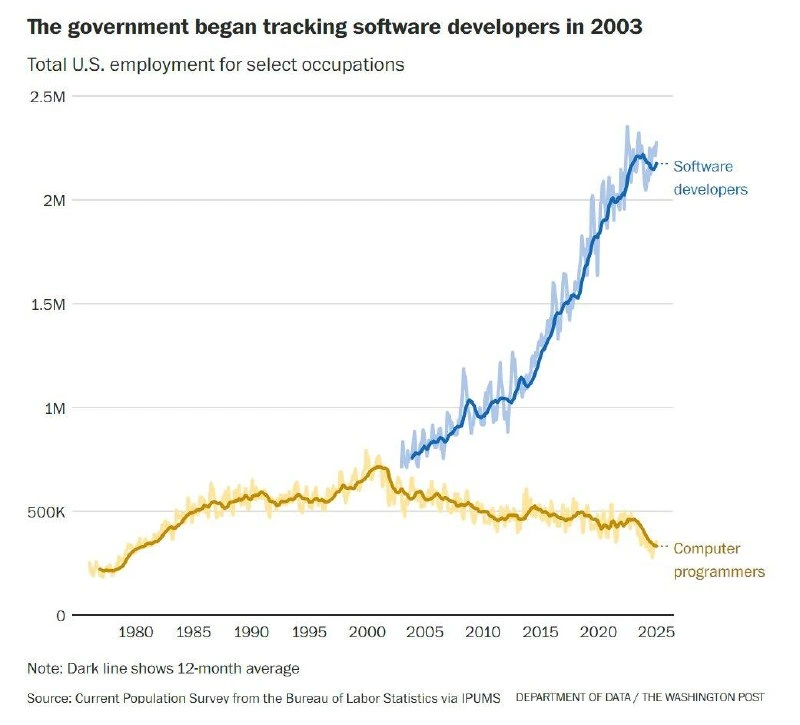
When ‘programmer’ got rebranded to ‘developer’ on the BLS dashboard
Why is this Career HR meme funny?
Level 1: New Name, Same Job
Imagine you have a toy that everyone used to call a “doll.” One day, the toy company decides to call it an “action figure” instead because it sounds cooler. Suddenly, if you looked at the toy store records, it would look like no one is buying dolls anymore and everyone is buying action figures. But in reality, kids are still buying the same kind of toy – only the name changed!
That’s exactly what happened in this funny chart. The people who write computer code for a living were once called “computer programmers,” and then folks started calling them “software developers” instead. So the chart’s yellow line (for programmers) goes down, and the blue line (for developers) goes up – just because of the name switch. It’s like renaming the same job with a fancier title. The joke is showing how a simple rename can trick you into thinking something huge changed, when really it’s the same work, just a new label.
In short, it’s as if all the cooks woke up one day and started calling themselves chefs. There are just as many people cooking as before, but the count of “cooks” would drop and “chefs” would rise. Nothing magical happened – they just prefer a new name. This meme makes us smile because it reminds us that sometimes changes in numbers are just changes in words!
Level 2: Programmer vs Developer
Let’s unpack this in simpler terms. The meme shows a graph of U.S. employment numbers for two job titles: “Computer Programmer” (yellow line) and “Software Developer” (blue line). The yellow line goes up from the 1980s to around 2000 and then goes down. The blue line starts around 2003 and goes way up to over 2 million by 2022. The big joke? They’re basically counting the same kind of job, just under different names!
Think of Computer Programmers and Software Developers as very closely related roles – in many companies, they might even be the same people, just labeled differently. Both write and debug code, build software, and solve problems with computers. Historically, “programmer” was the common term used for a person who writes computer programs. If you look at old job ads or talk to veterans, they might call themselves programmers or use titles like “systems analyst.” But starting in the 2000s, the industry trend shifted to calling coders “developers” or “software engineers.” Why? The work was getting more complex and creative, and the term developer suggests someone who develops solutions (not just types code). It became the buzzword on tech job postings – it sounded a bit more professional or upgraded. For example, a company might advertise for a “Java Software Developer” rather than a “Java Programmer.” It’s partly career branding: developer has a modern ring to it, and many felt it better reflected the broader duties of designing, implementing, and maintaining software.
Now, the Bureau of Labor Statistics (BLS) is the U.S. government agency that tracks employment data – basically counting how many people work in each type of job across the country. They have to define job categories to do that. In the past, they had a category for Computer Programmers and that covered most folks writing software. Around 2003, BLS introduced a separate category for Software Developers. So, in their surveys (like the Current Population Survey), when people described their occupation, some would now be classified under the new “software developer” code instead of the old “programmer” code. This is what the meme’s graph is illustrating: starting in 2003, a lot of people who might have been counted as programmers were now counted as developers. The title “The government began tracking software developers in 2003” literally means that before 2003 the government’s job stats didn’t explicitly list “software developers” – after that year, they did.
For a junior dev or someone new to the industry, the key insight is: “Programmer” and “Developer” aren’t two entirely different careers – the terminology shifted. The meme humorously points out how a simple change in naming can create a dramatic graph. Many of those steep blue-line software developer jobs are what used to be called programmer jobs in an earlier era. So the graph’s blue surge and yellow fall doesn’t mean everyone got fired and a whole new group was hired – it means the JobMarketTrends changed labels. It’s a bit of insider humor about CareerGrowth and titles: just calling yourself something new can make the old term look like it’s dying out.
Let’s define a few terms from the meme and tags for clarity:
- BLS (Bureau of Labor Statistics): The U.S. government agency that collects labor economics data. They produce reports on how many people work as teachers, doctors, software developers, etc. Here, they provided the data for that chart via a survey.
- Employment trend chart: A line chart showing how the number of people in certain jobs changes over time. In this case, one line is tracking “computer programmers” over decades, and another is tracking “software developers”.
- Title inflation: This is a fun term meaning giving a job a fancier title without changing its core duties. In tech, this happens a lot. For example, calling a helpdesk person a “IT Support Specialist” or a programmer a “Software craftsman”. It’s not negative per se – it often reflects evolving skill sets or just the desire to make roles sound important. The meme suggests that “programmer” simply got an inflated title – “developer.”
- Occupation taxonomy change: That’s a fancy way of saying the classification system for jobs was changed. The BLS reorganized how it classifies tech jobs. Imagine a library moving books to new shelves with new labels – the books (jobs) didn’t vanish, they’re just in a new section.
From a junior developer’s point of view, why does this matter or why is it funny? It’s partly reassuring and partly ironic. Reassuring because if you ever see headlines like “Computer programmers on the decline!” you should dig deeper – often it’s just that the field is now called something else. It’s not that coding jobs disappeared; they evolved and grew. This is also career humor because tech loves rebranding things. (We do it with job titles, and even with technologies – ever notice how often frameworks and jargon get new names?) The TechIndustrySatire here is pointing out that some trends are just semantic.
So, picture yourself as a new dev around that time: maybe your older colleague’s business card from 1995 says “Programmer”, but your 2005 business card says “Software Developer”. You both write code all day – your titles just lived through the era of role_rebranding. The meme essentially visualizes that transition. The subtitle “Total U.S. employment for select occupations” and the source info confirm these are real statistics, which adds to the irony – truth is sometimes stranger (and funnier) than fiction.
One extra note: the meme’s poster added a sarcastic comment about AI – “throw it to panickers saying that AI will fire both of you tomorrow.” This means if someone freaks out thinking “Oh no, AI is going to take all developer jobs!”, you might show them this chart as if to say: jobs change categorization more often than they vanish. In other words, don’t panic, today’s scary forecast might just be tomorrow’s new job title. (The poster is joking that even the AI replacing us will be replaced by a newer AI – a tongue-in-cheek way to say the hype cycle never ends.)
Bottom line for a junior dev: The meme is a lighthearted history lesson. Software developer vs. computer programmer is mostly a difference in naming and era. The work is similar, but around 2003 the official terminology (and many companies) shifted towards “developer.” The graph makes it look dramatic, and that’s the joke – it’s poking fun at how a bureaucratic change can create an IndustryTrend on paper. As you grow in your career, you’ll see that titles come and go, but coding is here to stay (even if tomorrow you’re called a “AI-assisted Full-Stack Experience Engineer” or something equally grand 😅).
Level 3: The Great Reclassification
In the early 2000s, an entire profession seemingly performed a magic trick on the Bureau of Labor Statistics (BLS) charts: “Computer Programmers” all but vanished, while “Software Developers” appeared and shot up like a rocket. This meme’s line chart (source: a Washington Post Department of Data piece) humorously visualizes that phenomenon. The blue line for Software developers (starting ~2003) climbs sharply past 2 million by 2022, while the yellow line for Computer programmers (tracked since ~1980) peaks around the dot-com bubble (just after 2000) then steadily declines. The title quips “When ‘programmer’ got rebranded to ‘developer’ on the BLS dashboard,” pointing out that many of those erstwhile programmers didn’t disappear at all – they just got relabeled. It’s a witty slice of TechHistory and IndustryTrends rolled into one graph.
Why is this funny to experienced tech folks? Because it exposes a classic case of title inflation and occupation taxonomy change. In the 80s and 90s, if you wrote code for a living, you were probably called a computer programmer. The government tracked you under that label, and for a while that yellow line rose steadily. But around the early 2000s, the tech world started favoring grander titles like software developer or software engineer. The BLS responded by introducing new occupational codes – effectively splitting out “Software Developers” as a separate category around 2003. Suddenly, the same coding jobs were counted under a different name. If you were looking only at “Computer Programmers” in the data, it looked like a mass extinction. Meanwhile, “Software Developers” appeared out of nowhere and took over. The meme cleverly implies that the programmers didn’t actually go extinct; they were simply rechristened as developers. It’s like a data sleight-of-hand that senior devs and tech historians find both amusing and telling.
Consider the context: around 2000 we had the Y2K frenzy and the dot-com boom, which had boosted programming jobs (hence that yellow line peak). Then came the dot-com crash and perhaps some offshoring of coding work – contributing to a real dip. But the steep divergence after 2003 is largely a classification artifact. The Current Population Survey and occupational classifications were updated. All those Java, C++, and web gurus who might have been “programmers” in 1998 were now being logged as “software developers” or “software engineers”. In fact, entire new sub-categories were born (think “Web developers”, “Database administrators”, etc., each with their own BLS code). The role_rebranding of “programmer” to “developer” was part of a broader IndustryTrends_Hype: as software ate the world, job titles evolved to sound more creative and full-lifecycle. A developer implied someone who not only writes code but also designs and builds software systems – a broader, more modern notion than the somewhat 90s-sounding programmer. Companies hiring in the 2000s wanted “Software Development” skillsets – it felt more up-to-date. This led to an occupation_taxonomy_change in official stats to keep up with what companies were calling these roles.
From a senior engineer’s perspective, the humor is also in how data can mislead without context. Imagine a naive business analyst looking at this chart: “Oh no, half a million programmers lost their jobs after 2001 and then an army of developers magically appeared!” But those of us in the field chuckle because we know it’s essentially the same army rebranded. The yellow line’s people didn’t vanish; many just got tracked under a new blue line. It’s a bit like how legacy systems get a new UI and suddenly management thinks it’s an entirely new product. On paper, everything changed; in reality, it’s old wine in a new bottle.
Let’s break down what really changed versus what stayed the same:
What changed:
- Job Title on Record: The official title in databases and resumes shifted. Yesterday you were a “Computer Programmer”, today you’re a “Software Developer” (or even fancier, a “Software Engineer”). It’s a classic case of role_rebranding making the job sound more influential.
- BLS Tracking Categories: The government’s spreadsheets literally split the column. Pre-2003, all coders were lumped under one occupation code; post-2003, a big chunk moved under a new code. It’s as if a database migration occurred, moving entries from table
Programmersto tableDevelopers.# Pseudocode illustrating the BLS category switch title = "Computer Programmer" if year >= 2003: title = "Software Developer" - Perception and Hype: In the TechIndustry, calling yourself a developer (or engineer) gained cachet. It signaled a more complete skill set during the rise of app development, web services, and software architecture. CareerGrowth culture embraced the new titles – they just sound more cutting-edge.
What didn’t change:
- The Actual Work: Day-to-day, a programmer vs. developer does very similar things – writing code, fixing bugs, building applications. The core Career hasn’t fundamentally changed just because of nomenclature. A 1995 “programmer” debugging a C++ loop and a 2025 “developer” wrestling a JavaScript promise share more than you’d think. They both still eventually mutter, “It works on my machine.”
- Combined Demand: If you add the yellow and blue lines, you’d see that overall coding jobs actually grew over time. The tech industry kept expanding (especially with Web 2.0, smartphones, and cloud in the 2010s). The apparent drop in programmers was offset by the rise in developers – indicating a healthy growth in total software developer_headcount_growth. So the JobMarketTrends were strong; the workforce just got redistributed across two labels.
- The Eternal Refrain of Panic: Every era has its boogeyman. In the 2000s, people feared outsourcing would kill US programming jobs; today it’s AI automation triggering panic. The meme’s poster wryly jokes that “AI will fire both of you (and even replace the previous AI) tomorrow.” In other words, relax – we’ve heard this story before. First they said “programmers are done for” (yet we just became developers), now they say “developers will be done for by AI”… and yet new job titles and roles will likely emerge again. The cycle of hype continues, and seasoned devs have the scars (and dark humor) to prove it. 🏷️
In sum, this meme resonates with experienced developers because it validates something we lived through: job titles in tech are movable goalposts. The divergence of those lines on the chart isn’t a tale of one profession dying and another being born out of thin air – it’s a satirical data visualization of a Career_HR rebranding exercise. It reminds us that sometimes, huge “trends” are just definitional changes. The TechIndustryIrony here is thick: as long as the code gets written, call us what you want – we’ll be here, continuing to toggle between tags and titles as the industry and the BLS dashboard see fit.
Description
Line chart with a white background compares two U.S. employment time-series: a yellow line labeled "Computer programmers" that rises from ~1980, peaks just after 2000, then steadily declines; and a blue line labeled "Software developers" that begins in 2003 and climbs sharply past 2 M by 2022. Heading reads "The government began tracking software developers in 2003" with a subtitle "Total U.S. employment for select occupations." A note under the x-axis says "Dark line shows 12-month average"; footer credits "Source: Current Population Survey from the Bureau of Labor Statistics via IPUMS" and "DEPARTMENT OF DATA / THE WASHINGTON POST." Visually, the diverging trajectories humorously imply that many "computer programmers" simply became "software developers" on paper, highlighting title inflation and shifting occupational taxonomy in tech

Comments
27Comment deleted
Apparently we didn’t automate programmers out of existence - we just pushed a PR that renamed the class to SoftwareDeveloper and HR merged it straight to prod
The graph perfectly captures the moment when HR discovered that 'Software Developer' sounds more impressive than 'Computer Programmer' - and suddenly everyone's LinkedIn title got a free upgrade while doing the exact same work debugging production at 3am
Ah yes, 2003 - the year the government discovered that calling someone a 'Computer Programmer' was like calling a Software Architect a 'Code Typist.' The chart perfectly captures the moment when we collectively realized that slapping 'Software Developer' on a business card justified a 40% salary bump for doing the exact same job. Notice how programmer numbers declined precisely as developer numbers exploded? That's not attrition - that's the greatest mass rebranding in tech history. Somewhere, a COBOL programmer is looking at this chart wondering why their title didn't get the memo, while their LinkedIn still says 'Computer Programmer' and their inbox remains suspiciously quiet from recruiters
2003: BLS ships a schema migration - rename 'computer_programmer' to 'software_developer' - and the headcount KPI hockey-sticks; always diff the metric definition before bragging to the board
Plot twist: programmers didn't disappear; they just updated their LinkedIn to 'Developer.'
Looks like the BLS did a massive refactor: Programmer deprecated, Developer aliased in 2003 - amazing how Rename Symbol can boost headcount without a hiring plan
Deep... ☕️ 🚬 Comment deleted
I thought you are thot bot, had to check profile, wtf Comment deleted
😅 I was trying to make an "I'm 14 and this is deep" joke sorry Comment deleted
How deep though? 😄 Comment deleted
oh crap. I wanted to comment on the previous post. Now I see why my comment doesn't make sense Comment deleted
Anon, why did you removed Einstein reference from comments? Comment deleted
Are you referring to me? I'm not sure I understand Comment deleted
Who knows which anon is the anon Comment deleted
Technically we are all anons but yeah Comment deleted
People that believe AI will replace programmers will definitely get replaced by AI. Imagine being so insecure in your skills.. Comment deleted
As unsecure as... programmers? Comment deleted
Programmers have imposter syndrome but they're not this insecure for sure Comment deleted
Programmers are so insecure that they doubt they have true impostor syndrome — that one that real programmers have. Comment deleted
How to stay sane: > learn/create useless tech > get hyped on god complex > repeat until AI goes brr (And when it does just become a cashier and live a happy life where you don't have to worry about your job anymore) Comment deleted
* a farmer 👨🌾 Comment deleted
cheese Comment deleted
Gotta have a house for that Comment deleted
Or they're are probably have absolutely no relation to the IT sphere at all, and just doing "fake education" by speculating on a hot topic, in this case, "AI is gonna replace <paste any profession, that doesn't require physical work>" Comment deleted
I've seen people talk about AI replacing physical jobs as well, they're seriously brain damaged from the AI hype. Comment deleted
Very nice. Now lets take a look at india population Comment deleted
I love that feeling when you start to read text but then image of the meme appears in the mind 😄 Comment deleted