AI Researcher Nostalgic for the Pre-Superintelligence Era
Why is this AI ML meme funny?
Level 1: Be Careful What You Wish For
Imagine you and your friends spent a long time trying to build the world’s coolest robot. At first, your robots were small and kind of silly – they could maybe roll around or say a few pre-programmed lines. It was fun and nobody worried about them doing anything bad because, well, they weren’t very smart. You all wished one day you could build a robot as smart as a human, or even smarter.
Now pretend one day you actually figure out a secret to make a really powerful robot. Suddenly, this robot can do almost anything – it learns super fast, it might even seem smarter than the people who made it! At first you’d be proud, right? Wow, we did it! But then you might also feel a bit nervous. A robot that smart might not listen to you if it doesn’t want to. It could do something unexpected that you can’t stop. It’s like realizing your cute little pet dragon (that you always wanted) has grown into a full-sized dragon. It’s awesome… until you think, “Uh oh, can I control this dragon?”
The meme is basically a researcher (one of the people building these super-smart AIs) joking, “I kind of miss when our AI was dumber and more harmless.” It’s a funny and slightly nervous feeling. Just like a kid might miss the days when their pretend play or tiny experiments couldn’t accidentally burn down the house, this AI expert misses the time when AI was too simple to cause big trouble. In simple terms: sometimes when you finally get what you’ve been asking for, you realize it comes with new worries – and that makes you nostalgic for when things were more innocent and safe.
Level 2: When AI Was Innocent
Let’s break down what this meme is saying in simpler terms. The tweet, written in a casual tone, comes from an AI researcher reflecting on how things have changed in their field. AI (Artificial Intelligence) research has evolved a lot, especially in the last few years. The poster says they “miss doing AI research back when we didn’t know how to create superintelligence.” What do they mean by that?
First, superintelligence refers to a theoretical AI that is much smarter than any human in practically every field – science, creativity, social skills, you name it. It’s a step beyond AGI, which stands for Artificial General Intelligence. AGI is an AI that can perform any intellectual task a human can (as opposed to today’s AI which are usually good at only specific tasks). Now, here’s the catch: as of early 2025, we haven’t literally built a true AGI or a superintelligence yet. But the feeling in the community (especially since systems like ChatGPT and its successors have been so impressive) is that we’re getting closer or at least figuring out the path to one. Think of it like explorers saying, “We haven’t reached the new continent, but we see signs that land might be nearby.”
The tweet’s author is likely a seasoned machine learning scientist or engineer. Machine Learning (often abbreviated ML) is a big part of modern AI research – it’s all about writing algorithms that let computers learn patterns from data. Over the last decade, ML has brought us huge breakthroughs: programs that can understand speech, recognize faces, translate languages, and even hold conversations. A lot of these advances came from a type of model called a Transformer (not the robots in disguise, but an AI architecture introduced in 2017 that’s really good with language). Transformers led to powerful large language models – for example, the technology behind ChatGPT – which can generate text that sounds remarkably human. These successes have set off a massive AI hype cycle. Hype cycle means everyone gets very excited (sometimes overly excited) about a technology’s potential. We saw a hype wave in the 2020s: companies rebranding to put “AI” in their name, media full of stories about AI doing magical things, investors throwing money at AI startups. AIHype was and is everywhere.
Now, with hype often comes anxiety when people realize the implications. The tweet hints at AI safety concerns – basically, worries about making sure advanced AIs do what we want and don’t cause harm. AI alignment is a term you’ll hear: it means aligning (or matching) an AI’s goals with human values and intentions. So, if you tell a super-smart AI to “make everyone happy,” you want to make sure it doesn’t, say, forcibly inject everyone with mood drugs (extreme example!) because it took the instruction too literally. That might sound wild, but AI researchers actually discuss these kinds of scenarios seriously, especially when talking about future superintelligent AI. Those discussions fall under AISafetyResearch – research aimed at preventing bad outcomes with powerful AI.
Back “when we didn’t know how to create superintelligence,” AI research felt safer and more straightforward. If you were a young researcher or engineer a few years ago, your daily work might involve training a model to improve ad targeting or to detect spam emails – important tasks but not exactly world-dominating stuff. The stakes were relatively low. If your model messed up, maybe some users saw irrelevant ads or a spam email got through. No one thought your code could, say, accidentally cause a global crisis. So, people in AI could focus on making things just a bit more accurate or efficient, and joke about AI taking over the world as a very far-fetched sci-fi scenario.
Fast-forward to today: now there’s talk (some serious, some hype) about Artificial General Intelligence emerging in our lifetimes. Key figures in the field, even those who helped create these technologies, have publicly expressed worry. An example: Dr. Geoffrey Hinton, a pioneer in deep learning, made headlines when he left Google and voiced concerns about AI’s rapid advancement, essentially saying he’s unsure if we can keep these powerful AIs under control. Imagine the mixed feelings: someone who dedicated their career to making AI smarter is now saying “Maybe we went too far, too fast.” That’s exactly the sentiment this tweet jokes about. It’s like the FutureOfAI is arriving faster than expected, and it’s both awesome and a little scary.
For someone newer to tech (maybe early-career devs or students), think of it this way: Have you ever had a moment where something you were working on became much bigger than you anticipated? For instance, you write a small program just for fun, and then it unexpectedly goes viral or becomes critical to your company. Suddenly there’s pressure and consequences you never considered. In AI, the scale of “going big” is enormous – from playing with a fun chatbot to possibly creating an intelligence that rivals humans. The tweet’s author is saying with a chuckle, “Life was easier when we didn’t have that looming over us.”
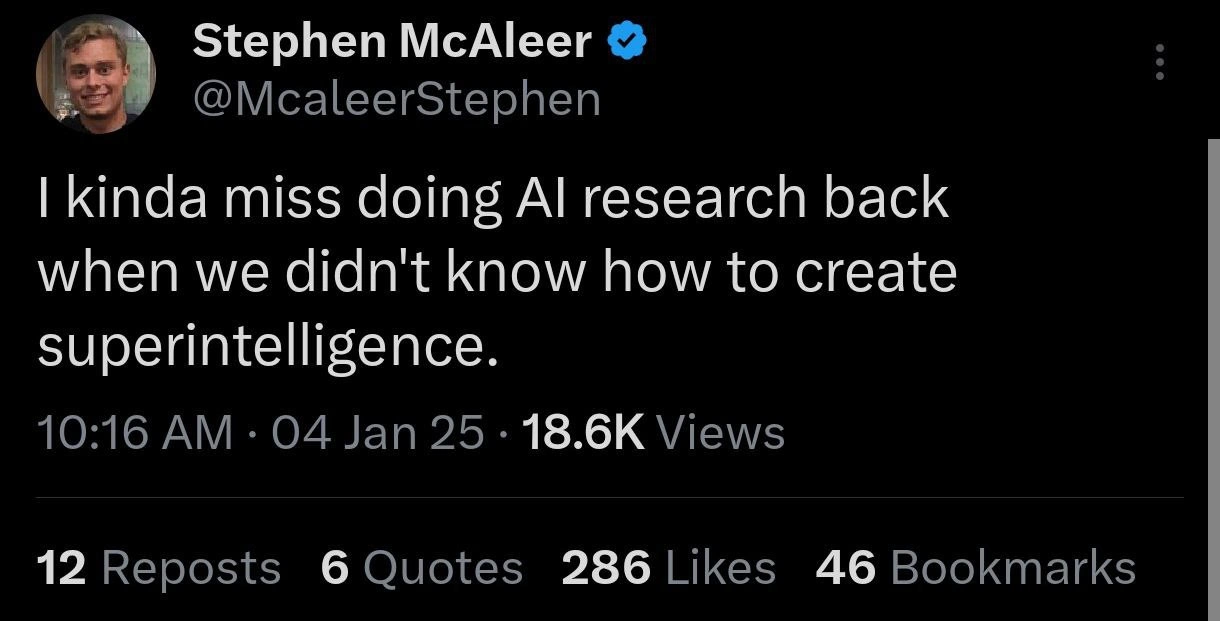
Also, notice this is presented as a screenshot of a post from X (formerly Twitter). In dev and research communities, it’s common to share tweets like this as memes or discussion starters. The post shows engagement metrics (reposts, likes) which indicates it resonated with a lot of people – over 18K views, nearly 300 likes. That suggests many in the AI research community feel this way or at least find the feeling relatable. It’s a bit of an AIResearch inside joke: only folks deeply involved in AI would say “remember the good old days when we hadn’t unlocked potential godlike AI? Ha ha… (nervous laughter).”
To a junior engineer or someone learning ML, here’s why it’s funny: it flips the script on what progress means. Usually, we celebrate progress without hesitation – more powerful tech is good, right? But here the “good old days” were when progress hadn’t yet crossed a certain line. It’s highlighting a paradox in AI: the closer we get to the big dream (machines as smart as humans and beyond), the more some experts worry about unintended consequences. It’s like building a fast car – you spend years working on faster engines and when you finally create a car that can really zoom, you suddenly go “Hmm, do we have good enough brakes for this thing?” That moment of realization can be funny in a “wow, didn’t think we’d get here so soon” way.
In summary, the meme is saying: back then, AI research was exciting but not scary. Now it’s exciting and a bit scary. It uses a nostalgic tone to emphasize that contrast. And people working in AI, even those who love it, are poking fun at themselves for feeling nostalgia for an era of ignorance (because ignorance was comfortable). If you’re new to AI, don’t worry – we haven’t actually summoned a rogue superintelligence 😅. But the joke is that some days it feels like we’re right on the brink, and it makes the old problems (like your model not training well) look adorably simple by comparison.
Level 3: Hype Meets Existential Dread
At a more practical level, this meme captures a senior researcher’s ambivalence in the current AI_ML boom. On one hand, there’s incredible AI hype: everyone’s talking about how transformer models and massive GPU clusters might lead to an AGI breakthrough. Conference keynotes boast about models that approach human-level performance on more and more tasks. Funding is pouring in for anything labeled “AI”. It’s an AIIndustryTrends whirlwind – new startups claiming superintelligent assistants, bold predictions that full human-level AI is just around the corner. If you’re a veteran in this field, part of you feels validated: all those years optimizing models, enduring AI winters and skeptics, and now finally the world believes in AI’s potential (maybe a bit too much!). There’s a pride in seeing transformer-driven breakthroughs push the envelope of what machines can do.
But then comes the dread: with all that hype comes the creeping fear that we’re moving too fast into unknown territory. The tweet’s author is voicing a sentiment that many seasoned ML researchers and AI safety folks know too well – a mix of excitement and anxiety. After the success of systems like ChatGPT (which kicked off this current post_ChatGPT_era of AI fascination), the community discourse shifted dramatically. Suddenly even mainstream AI labs began hosting AI alignment workshops and discussing how to keep a super-smart model from, say, manipulating humans or pursuing dangerous goals. This was stuff only niche AISafetyResearch folks were obsessing over a few years prior, often seen as overcautious or far-fetched. Now it’s coffee-break conversation at Google Brain or OpenAI. The meme winks at this whiplash.
Real-world scenario: think of a researcher who spent 2015-2020 improving deep learning models for image recognition or translation. They were driven by curiosity and a competitive spirit – could they get state-of-the-art on ImageNet or beat human accuracy in some niche task? Fast forward to 2025: that same researcher might be reading headlines about an AI passing Turing tests or being deputized to write its own code (with sometimes spooky results). Suddenly, the cutting-edge models they helped build are being discussed in the context of will this eventually try to take over the world? It’s a lot to take in! The tweet humorously conveys that some part of them longs for the simpler days, when the challenges were “Can we get this to converge?” or “Could this beat a grandmaster at chess?” rather than “Are we on the brink of creating a god-like intelligence and how do we make sure it’s benevolent?”.
The industry pattern being satirized here is the classic AI hype cycle flipping into existential worry. We’ve seen waves of AI hype before – expert systems in the 80s, virtual agents in the 90s – but those fizzled into AI winters when progress stalled. The difference now is that progress hasn’t stalled; it accelerated. The community went from celebrating a model that can write a decent essay to fretting that the next model might write its own objectives. It’s almost too real: the line between science fiction and product roadmap got very blurry around 2023-2024. The tweet implicitly pokes fun at how researchers who once laughed off Skynet jokes are now saying “Well, let’s maybe not connect this system to the internet just yet…”.
Why is this combination of pride and unease funny to insiders? Because it’s dripping with irony: we set out to create these powerful AIs – it was the goal of so much research – and now that success is on the horizon, we’re a bit unnerved. It’s like cheering on a rocket launch and then panicking when it actually reaches escape velocity. The phrase “we didn’t know how to create superintelligence” harkens back to a carefree ignorance. There’s underlying truth: not knowing kept things safer by default. There was no urgent need for AI behavior guardrails or discussions about “P(doom)” (the slangy probability our own creation goes awry). Now, knowing too much (or thinking we do) means confronting potential AILimitations and risk head-on.
In meetings and labs now, you’ll hear even senior engineers discuss model alignment strategies – like using RLHF (Reinforcement Learning from Human Feedback) to make ChatGPT behave, or sandboxing AIs to limit their power – with the same normalcy they once discussed hyperparameter tuning. The meme resonates because it acknowledges a psychological shift: progress in AI isn’t an unalloyed victory; it comes with heavy responsibility. We have folks who are basically living the plot of a sci-fi novel, grappling with AI ethics and AGI anxiety day-to-day.
There are also subtle digs at industry dynamics here. Tech companies are in an arms race to build more advanced AI systems – bigger models, more general capabilities. Internally, researchers might raise concerns (“Should we really deploy this chatbot that can persuade people of anything?”), but the external pressure and hype can drown that out. The tweet’s nostalgia hints at a time when research wasn’t so entangled with PR and peril. It’s a back-in-my-day sentiment: back in my day, we just tried to get our neural nets to not crash, and nobody worried one might upend civilization. Now every breakthrough demo comes with a side of “is this the end of the world or what?” – and that contrast is darkly comedic.
Furthermore, this post can be seen as poking fun at the AI research community’s own success. It’s a bit self-congratulatory (wow, we’re so good we made superintelligence, go us) while simultaneously self-deprecating (did we go too far? oops). Researchers who were around before the transformer era remember when getting an AI to understand a sentence or recognize a dog in an image was cause for celebration. Today, we have models writing code, acing standardized tests, and some folks seriously debating if an AI might gain consciousness or inherent agency. It’s like the field got exactly what it wished for from a genie, and now there’s a group whispering, “Next time, maybe read the fine print on those wishes…”
In summary, the meme speaks to anyone who’s been riding the AI wave and suddenly got hit by a cold splash of reality (or unreality). It acknowledges the collective nervous laughter in labs and on AI Twitter: “Heh, remember when our biggest issue was overfitting on MNIST? Good times… Now excuse me while I review this draft policy on AI model containment protocols.” It’s funny because it’s true – behind the joke is a very real tableau of pride, fear, and the sometimes absurd hype vs. reality of modern AI research.
Level 4: The Alignment Problem
The tweet wryly references the orthogonal leap from simply improving algorithms to confronting the core of the AI alignment problem. In earlier decades, AI research was largely about making systems a bit smarter at narrow tasks – optimizing a classifier here, tuning a neural net there. Back then, terms like AGI (Artificial General Intelligence) or superintelligence belonged to futurism and philosophy circles more than everyday lab meetings. Researchers could blissfully focus on beating benchmark scores without needing a precautionary lecture on existential risk. The post implies that now, by January 2025, things have changed: the community feels like it’s peering over the threshold of creating a superintelligent AI, and that shift carries profound theoretical baggage.
At this deep level, the humor hinges on the fact that achieving general intelligence was long considered a remote dream – something that, if it ever happened, would be in the distant future or only in theory. The “safer, pre-AGI era” refers to when our algorithms were too primitive to pose broad threats. We had narrow AI that could play chess or recognize cats in photos, but nothing that could autonomously out-think humans across the board. Importantly, if an AI can vastly outperform humans in any area of cognition, we enter the domain of superintelligence – a concept popularized by philosophers like Nick Bostrom. Such an entity could devise strategies and technologies we can't even imagine, which is both exhilarating and terrifying.
On the theoretical side, this touches on ideas like the intelligence explosion, where a sufficiently advanced AI could recursively improve itself, leading to a runaway increase in intelligence (often nicknamed FOOM in AI safety circles). Researchers used to debate this in a speculative sense; now they’re taking it seriously. Instrumental convergence theory says that a superintelligent agent, regardless of its final goal, might pursue certain sub-goals (like acquiring resources or self-preservation) that could conflict with human interests. The orthogonality thesis similarly posits that an AI’s level of intelligence is orthogonal (independent) to its goals – meaning a super-smart AI could just as easily be unfriendly or indifferent as benevolent. These are deep theoretical principles that were academic talking points in the pre-AGI era. Suddenly, with modern systems showing sparks of general reasoning, these principles feel less abstract.
In essence, the tweet is a winking nod to how theoretical AI safety problems have moved from whiteboards and workshops to front-page news. It’s as if overnight, arcane concepts like reward hacking, emergent goals, or the paperclip-maximizer thought experiment became pressing practical concerns. The author, likely a seasoned researcher, jokes that they miss the days when they didn’t have to lie awake pondering how to align a potential digital Übermind with human values. Back then, ignorance was bliss: you could work on AI without the weight of the world on your shoulders. Now, with the advent of giant Transformer models and LLMs (Large Language Models) that eerily mimic cognition, the field has to wrestle with the very real possibility of creating something we might not be able to control. The tweet’s humor is couched in a deep awareness: once you suspect you know the recipe (or at least the scaling laws) for superintelligence, every research result comes with a side of existential dread. It reflects a classic scholarly nostalgia – longing for a time when research was “pure” and the biggest failure was a paper rejection, not potentially launching Skynet creating an uncontrollable intelligence.
Description
A screenshot of a tweet from user Stephen McAleer (@McaleerStephen) on a black background. The tweet's text reads, 'I kinda miss doing AI research back when we didn't know how to create superintelligence.' The timestamp below indicates it was posted on '10:16 AM · 04 Jan 25'. This meme uses dry, satirical humor to comment on the rapid acceleration of AI development. The joke lies in the audacious and hyperbolic implication that researchers *now* know how to create superintelligence, a milestone still considered theoretical and distant. For a senior technical audience, it's a witty take on the current AI hype cycle, the dizzying pace of progress with models like LLMs, and the mix of excitement and existential unease that accompanies the pursuit of Artificial General Intelligence (AGI)
Comments
7Comment deleted
The good old days, when 'aligning the model' meant centering a div and not preventing a rogue AGI from turning the internet into a paperclip factory
Remember when our biggest worry was vanishing gradients, not vanishing control of the species?
Remember when our biggest AI concern was overfitting on MNIST? Now we're writing alignment papers that read like hostage negotiation strategies for our own code
Ah yes, the good old days of AI research - when 'gradient descent' was just our career trajectory, not the path to AGI. Now we've gone from 'can we make it learn XOR?' to 'should we be worried it's reading our Slack messages?' Turns out the real superintelligence was the existential dread we accumulated along the way. At least back then, our biggest fear was overfitting the training data, not the AI overfitting humanity's entire decision-making apparatus
Product now asks for an ETA on “alignment” like it’s a feature flag - back when risk meant “overfit,” not p(doom)
Pre-superintelligence days: vanishing gradients kept us up at night, not vanishing jobs
Superintelligence went from thought experiment to a Jira epic; the remaining blockers are compute, alignment, and convincing Legal that “emergent capabilities” isn’t a compliance category