Skip to content
DevMeme
5953 of 7435
O3-mini’s Chinese outputs spark claims of hasty OpenAI copy-paste release
AI ML Post #6520, on Feb 3, 2025 in TG

O3-mini’s Chinese outputs spark claims of hasty OpenAI copy-paste release

Why is this AI ML meme funny?

Level 1: The Ventriloquist’s Accidental Language Switch

Imagine you have a toy robot that’s supposed to help you with homework in English. You ask it, “How do I solve this math problem?” and the robot pauses, thinking. But then, instead of showing its thought process in English, a bunch of Chinese characters appear on its little screen before it gives you the answer! It’s as if your helpful robot friend suddenly started thinking out loud in Chinese, even though you don’t speak Chinese. That’s funny in a goofy way, right? It’s like watching a ventriloquist’s puppet accidentally speak the wrong language because the ventriloquist copied someone else’s script.

This meme is joking about a real company (OpenAI) possibly rushing and copying parts of another robot’s brain (from a project called DeepSeek) without checking everything. Think of it like copying your friend’s homework but forgetting to translate one answer that they wrote in another language. The end result makes everyone laugh and scratch their heads: “Why on earth is this English-speaking helper suddenly thinking in Chinese?” It’s both silly and a gentle reminder that even smart robots can mess up if their creators aren’t careful.

Level 2: When an AI Spills Its Secrets in Another Tongue

Let’s break down what’s happening for those newer to these concepts. OpenAI is a company that makes advanced AI models (like the famous ChatGPT). They apparently have a model or feature called “O3-mini” – think of it as a smaller or experimental AI brain they’re testing out. Now, DeepSeek is mentioned as another project that is open-source (meaning its code and data are openly available to the public). Open-source projects often allow anyone to inspect, use, or modify their code. Companies sometimes use these open materials to save time or leverage community expertise.

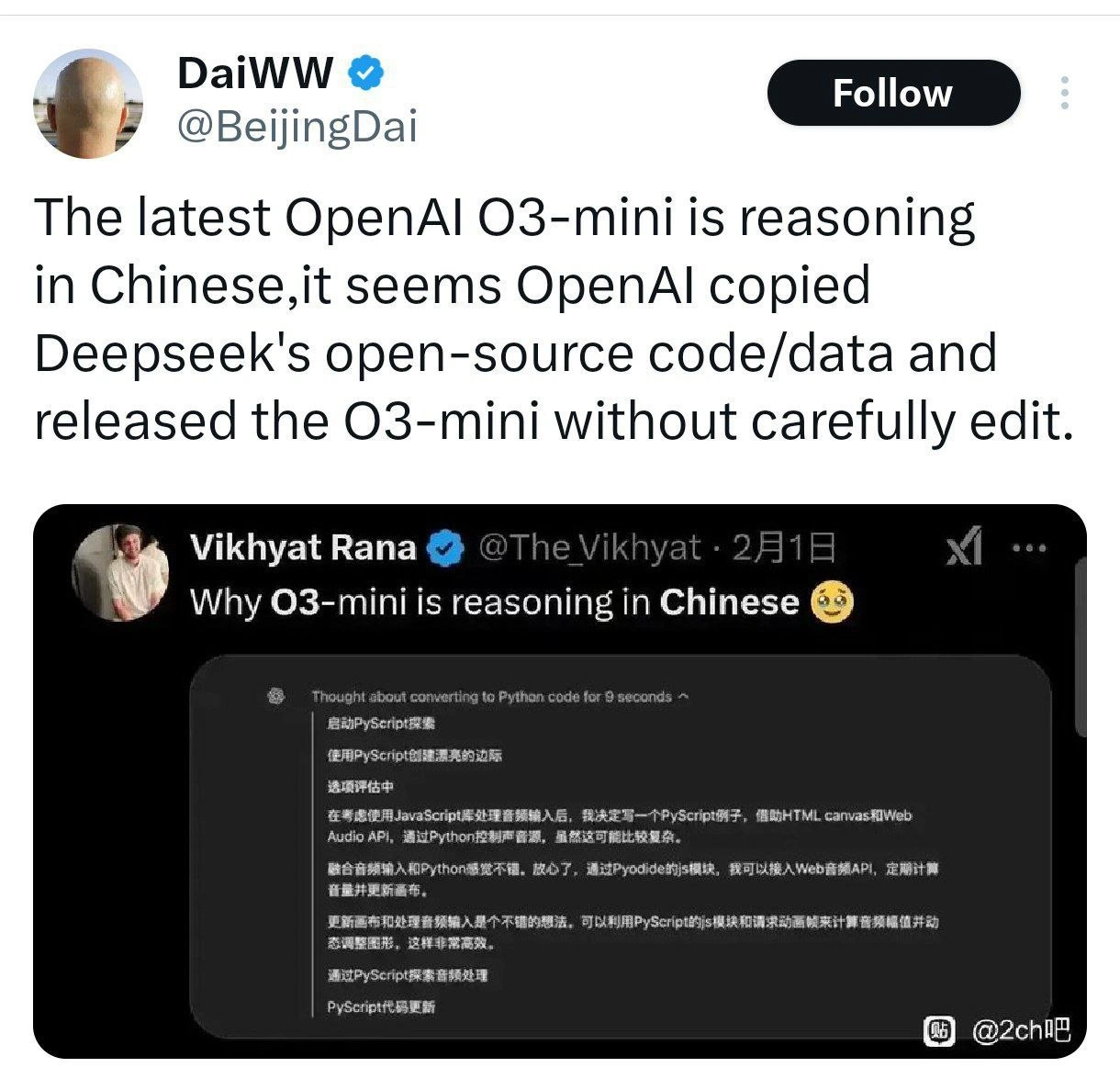
Now, the tweet is saying that the latest O3-mini model is “reasoning in Chinese.” What does that mean? Normally, if you ask an AI a question in English, you expect it to reason and answer in English. Here “reasoning” refers to the AI’s thinking steps or how it works out the answer. Advanced AI models sometimes have an ability to generate an explanation or chain-of-thought internally before giving the final answer – kind of like how a student might do calculations on scratch paper before writing the final answer. In this case, people noticed that O3-mini’s “scratch paper” was full of Chinese characters. The user’s question was in English (“Why is O3-mini doing this?”), but the AI’s thought process output showed Chinese text. It’s as if you asked a friend in English, and they did the intermediate thinking in Chinese before replying in English – pretty weird, right?

The tweet by @BeijingDai humorously suggests a reason: maybe OpenAI copied some code or data from DeepSeek’s open-source project and rushed this O3-mini out “without carefully edit.” In plain terms, it’s accusing OpenAI of a bit of sloppy reuse. Perhaps DeepSeek’s project was Chinese-based (implying a lot of the training data or debugging outputs were in Chinese). If OpenAI took that and didn’t thoroughly check, O3-mini might still have Chinese instructions or examples baked in. This would be like using a template you found online to build your app but forgetting to remove or translate parts of it – suddenly your app’s error messages might appear in the template’s language. That’s essentially the model_locale_bug here: a locale bug means a language setting issue. The model’s locale (language context) for its reasoning seems to be set to Chinese instead of English.

For a junior developer or someone new to AI, there are some key lessons and terms here:

  • Quality Assurance (QA): This is the testing phase before something is released. A thorough QA for O3-mini should have caught that it was spitting out Chinese in its reasoning. The joke implies QA might have been rushed or insufficient (hasty release).
  • AI limitations: Even big AI models can have unexpected issues. They don’t “think” like humans, so they can surprise us with weird outputs. Here it’s a language issue; other times it could be factual errors or strange biases. It’s part of AIHumor that these super-smart models can still do oddly silly things.
  • Open Source usage: Using open-source code or data is super common in development (it’s efficient and builds on community knowledge). But you have to adapt it to your project. If you grab an open-source AI model that was trained in Chinese and integrate it, you better ensure it doesn’t stay Chinese in parts you don’t want. This situation is a fun example of OpenSource integration mishap – something any developer copying code from Stack Overflow or GitHub might relate to. Forget to change a variable name or a language setting, and your program might behave in confusing ways.
  • Unusual Bugs: This definitely counts as one. An unusual bug is a software problem that’s not common or expected. Most people wouldn’t even imagine “AI thinks in one language but responds in another” as a bug until they see it. It shows how debugging AI is a new frontier. In regular software, you might debug line by line. In AI, you sometimes debug by example cases (why did it say this?). Here the example case is a straightforward English question that yielded a Chinese reasoning chain – a head-scratcher at first!

So, essentially, the meme is pointing out in a jokey way: “Look, it seems like OpenAI may have been a bit lazy or rushed by taking an open project’s work (possibly DeepSeek’s) and not fully customizing it. And now their AI is accidentally showing its thoughts in Chinese. Oops!” For a newcomer, it’s a lighthearted intro to the importance of polishing and testing your code or models, especially when mixing sources. It’s also a peek into how complex these AI systems are under the hood – they can have hidden behaviors that only pop up in certain conditions (like a hidden language setting).

Level 3: Localization Leak in OpenAI’s Kitchen

From a senior developer’s angle, this meme hits on a painfully familiar scenario: copy-paste gone wrong. The tweet suggests OpenAI’s O3-mini release might have been a hasty mashup of their code with some open-source recipe from a project called DeepSeek, without thoroughly scrubbing the comments and defaults. The humorous result? The AI’s thought process (which normally should be hidden or at least in the user’s language) is spilling out in Chinese. This is a classic model_locale_bug – the AI equivalent of shipping an application where half the interface is suddenly in another language because a developer hard-coded some strings from a borrowed library. Seasoned engineers have seen parallels many times: maybe you integrated a great open-source module to save time, but oops! you left the println("测试") (Chinese for "test") in the logs. Here it’s more sophisticated: OpenAI’s mini-model was presumably fine-tuned or built using open-source data/code from DeepSeek (likely a Chinese project or dataset). In doing so, it seems they didn’t fully localize the AI’s internal monologue back to English. The chain-of-thought that O3-mini uses to reason through a prompt remained in the language of the borrowed code – Chinese – leading to a reasoning language mismatch.

For veteran AI developers, this raises an eyebrow and a chuckle. It highlights how even big players like OpenAI aren’t immune to the pitfalls of integrating open-source components. We often quip in software engineering that “borrowing code is faster, but debugging it is slower.” In AI terms, OpenSource pretrained models can supercharge development, but they can also introduce quirky behavior if not vetted. The humor here also has a tinge of AIHumor irony: OpenAI, known for guarding its own model weights, might have quietly dipped into the open-source well, essentially making a copy_paste_release. If true, it’s like a top chef secretly using a canned sauce and then getting caught because the dish came out with an unexpected spice. The phrase “without carefully edit” in the tweet is a bit tongue-in-cheek—implying someone at OpenAI forgot to flip a switch or run a final check. This could be as simple as neglecting to translate prompt templates, or as deep as not retraining certain layers that handle the chain-of-thought language.

The meme resonates with the engineering community because it underscores a core challenge in AI product deployment: quality assurance for AI systems is really hard. Unlike traditional software bugs that are reproducible and fixable with an if condition, AI bugs are stochastic and data-driven. You can’t unit-test an AI model for “Does it ever think in Chinese when it’s supposed to think in English?” without massive foresight or exhaustive multilingual testing. Experienced developers know the perennial challenge: you run as many tests as you can, but some weird edge case still pops up after release — in this case, the AI effectively talking to itself in Chinese. There’s also a subtle nod to AIGeneratedContent provenance concerns. If O3-mini’s reasoning is in Chinese, skeptics might wonder: Was part of this model trained on Chinese content? Did OpenAI borrow more than they admit? In the open-source community, credit and provenance are huge; failing to acknowledge using DeepSeek’s data would be a faux pas, so a bug like this is almost a smoking gun evidence of that borrowing. It’s both a joke and a gotcha: the kind of unusual bug that seems absurd (why would a polished OpenAI model blurt out Chinese logic?), yet it’s technically plausible if someone rushed a release. A senior dev might dryly quip, “Internationalization (i18n) strikes again!” – the classic tale of software not fully translated or culturally adapted, now reincarnated as an AI glitch. The situation combines AI_ML complexity, the openness of OpenSource collaboration, and the embarrassment of Bugs all into one screenshot. In short, the meme uses this specific incident to joke about broader truths: reuse code without fully understanding it, and you might get burned (or at least, bilingual outputs at 3 AM).

Level 4: Chain-of-Thought Babel

In the esoteric underbelly of large language model design, there's a fascinating concept: chain-of-thought reasoning. This is where an AI essentially produces hidden intermediate steps (like a scratchpad) to reason through a problem. Ideally, these steps remain invisible to end-users, guiding the AI internally to a better answer. In advanced AI/ML research, developers sometimes fine-tune models to articulate these reasoning steps in a particular language for efficiency or consistency. For example, an open-source project might choose Chinese for internal reasoning if the training data or developer team is largely Chinese, or simply because Chinese characters can convey meaning with fewer tokens (a form of reasoning compression). Now, if the OpenAI O3-mini truly copied DeepSeek's open-source code or weights, it might have inadvertently inherited a multilingual mind. Essentially, the model’s “thinking voice” (the chain-of-thought) could still be set to Chinese because that’s how it was trained to reason. This creates a Babel effect: the model is prompted in English, but under the hood its thoughts are encoded in Chinese, like a bilingual savant that forgot to switch languages when showing its work.

From a model architecture standpoint, this hints that O3-mini’s developers might have merged weights or reused prompts from a Chinese-trained system without fully retraining or localizing the internal reasoning process. It’s a bit like performing a brain transplant between two AI systems: if the donor brain “thinks” in Chinese, the new hybrid might start blurting out Chinese logic. Under the hood, each language model has learned linguistic patterns and reasoning heuristics from its data. If DeepSeek’s open-source data taught it that 思考 (thinking) should be done in Chinese, those weights don’t just vanish. They live on in O3-mini, causing a reasoning_language_mismatch. The truly complex part here is quality gating such an AI: it’s incredibly hard to enumerate every possible quirk a merged model might have. The space of inputs (English prompts, Chinese thoughts, code outputs, etc.) is astronomically large, so testing all scenarios is theoretically impossible (insert a nod to the halting problem of exhaustive QA). This is where formal verification meets its match in AI: we’re juggling probabilistic weights, not deterministic code, so guarantees are hard. The result? An unusual bug that seems funny but points to deep issues in how AI models are developed and deployed. It’s a real AI limitation scenario — an academic would note that if two models' latent spaces aren't perfectly aligned, you get these cracks where the model’s true thoughts leak out in the wrong language. It’s both a technical curiosity and a reminder that even cutting-edge AI can have the equivalent of multi-lingual sleep-talking if not properly supervised.

Description

The image is a dark-mode screenshot of two stacked tweets inside the X (formerly Twitter) UI. The first tweet from “DaiWW @BeijingDai” reads: “The latest OpenAI O3-mini is reasoning in Chinese,it seems OpenAI copied Deepseek's open-source code/data and released the O3-mini without carefully edit.” Below it is an embedded tweet from “Vikhyat Rana @The_Vikhyat” saying “Why O3-mini is reasoning in Chinese 🥺”, accompanied by a cropped chat window where the assistant’s entire chain-of-thought appears in Chinese characters even though the original prompt was in English. The juxtaposition humorously implies that OpenAI accidentally shipped a model with DeepSeek’s Chinese system prompts or datasets still intact, highlighting the risks of re-using open-source weights and insufficient internal QA. For seasoned engineers, it illustrates how AI model releases can exhibit surprising localization bugs, provenance concerns, and the perennial challenge of quality‐gating large language models before production deployment

Comments

59
Anonymous ★ Top Pick OpenAI’s O3-mini launch plan: `git clone deepseek && sed -e 's/公司/OpenAI/g' | kubectl apply -f -` - English localization penciled in for the next sprint
  1. Anonymous ★ Top Pick

    OpenAI’s O3-mini launch plan: `git clone deepseek && sed -e 's/公司/OpenAI/g' | kubectl apply -f -` - English localization penciled in for the next sprint

  2. Anonymous

    Nothing says 'we built this from scratch' quite like your cutting-edge reasoning model suddenly channeling its inner Deepseek and explaining PyScript in Mandarin - it's like finding //TODO: remove before production comments, except the comment is an entire training dataset's linguistic fingerprint

  3. Anonymous

    When your 'novel reasoning architecture' accidentally ships with the original developer's debug logs in Mandarin - turns out the real O(1) complexity was in the copy-paste operation. Nothing says 'we trained from scratch' quite like your model thinking out loud in someone else's native language

  4. Anonymous

    i18n is hard: the UI speaks English, but O3‑mini’s chain‑of‑thought shipped in zh_CN - classic “we rebased a fork, changed the logo, and forgot LANG=…” supply‑chain tell

  5. Anonymous

    Distilling OSS without sanitizing comments: Your CoT now leaks provenance in every dialect

  6. Anonymous

    When your model starts reasoning in Chinese, that’s not AGI; it’s a leaky preprocessing pipeline, a missing LANG unit test, and a ‘borrowed’ repo that slipped through code review

  7. @TERASKULL 1y

    yea it randomly starts reasoning in german mid-thought sometimes

    1. @RiedleroD 1y

      🔫 translate all of that or perish /j

    2. @RiedleroD 1y

      jokes aside, I wonder why it does that

      1. @TERASKULL 1y

        black box problem, we might never know😔

        1. @RiedleroD 1y

          yeah. imo closed-source AIs shouldn't exist

          1. @TERASKULL 1y

            not only that, but you can't really check on the individual neurons to know why exactly that output was produced

            1. @RiedleroD 1y

              that too I guess, but there's been some advancements in that field from what I've seen. I try to keep my distance from AI though

              1. @TERASKULL 1y

                who isn't, really? all you can hear now is ai. blockchain 2.0

              2. Женя 1y

                You keep distance from AI, keep distance from blockchain but why?

                1. @RiedleroD 1y

                  as for blockchain - nah that one's just gonna quietly disappear. I don't think that tech is useful for anything

                  1. @sylfn 1y

                    ...or loudly as quantum computers start breaking ECC

                    1. @RiedleroD 1y

                      eh, I think there's larger concerns once that happens. Regardless, I think there's a lot of time to prepare quantum-resistant algorithms

                      1. @sylfn 1y

                        less than a decade according to NIST

                        1. @RiedleroD 1y

                          oh, it's always less than a decade away. I don't believe them

                          1. @sylfn 1y

                            2030 is nearer than you think

                  2. Женя 1y

                    Nah, there’s no way It gonna be standard for all govs going through transformation in coming two decades, theres no way to fight corruption on modern level while public spending is hidden in the same way as private spendings

                    1. @RiedleroD 1y

                      austria doesn't hide public spending. will post a link to the statistics later

                      1. Женя 1y

                        That’s really cool and Austria is cool But it’s a very small state. Bigger the state, higher amount of spending and also easier to hide some of them

                        1. @RiedleroD 1y

                          would you rather we try to expand?

                          1. @viktorrozenko 1y

                            Yes

                            1. @RiedleroD 1y

                              something something hitler idk

                              1. @RiedleroD 1y

                                'twas a joke

                                1. @viktorrozenko 1y

                                  I know

              3. Женя 1y

                It’s not like any of them are going to disappear in 5, 10 or 20y from now

                1. @RiedleroD 1y

                  no, but the economic bubble will burst at some point and I'm not sure what'll come out of it, but I think it's a good idea to wait with picking AI up again until the fog has cleared

                  1. Женя 1y

                    The biggest economic bubble is fiat system which allows governments to print money indefinitely and spend them on things which either not needed by almost anyone or costing gov x10-x100 of fair price :/ Just check how bigly grew the gap in between real prices (eg real estate) and real income of people. And taxes were much lower around the globe back in 70s

                    1. @RiedleroD 1y

                      bro I can rent an affordable place here in vienna no problem. rent prices are that high in other places because people are free to speculate with real estate. in vienna, there's a lot of government-regulated housing, as well as strong consumer laws, keeping the prices competitive.

          2. @viktorrozenko 1y

            how would one make money from it then? if you remove intellectual property from the equation, OpenAI is just a server farm.

            1. @RiedleroD 1y

              that's all they are anyway

            2. @qtsmolcat 1y

              Most people won't want the hassle of setting up and running an LLM locally

              1. @viktorrozenko 1y

                Right, but that doesn’t mean that OpenAI is a server farm. They still did research, engineering, and other things before the LLM was there. Of course, when the product already exists it becomes a matter of hosting it somewhere, but it’d be a huge oversimplification to say that that’s all that is to it.

                1. @RiedleroD 1y

                  they mostly did marketing and throwing a bunch of brute force compute power at the problem yknow, a few years before OpenAI was founded, the big strides in AI research was done by singular people just fucking around. I don't think the small advancements OpenAI has done required much effort at all. the biggest effort was just training the models, and that's server farm -ass activity

            3. @loomingsorrowdescent 1y

              But they don't, OpenAI hasn't turned a profit yet

              1. @viktorrozenko 1y

                I’m saying that if you prohibit closed source models they won’t be able to

                1. @RiedleroD 1y

                  good

                  1. @viktorrozenko 1y

                    Why is that good? People need money to do what they do

                    1. @RiedleroD 1y

                      womp womp, I need money too. let them work for it

                      1. @viktorrozenko 1y

                        And they did. People pay them money because they did. Money talks

                        1. @RiedleroD 1y

                          sweetie, people also gave russia's oligarchs a lot of money. you don't get rich by doing honest work, you get rich by deceiving people. which OpenAI is in the business of

                          1. @viktorrozenko 1y

                            People don’t choose to give them money. They get money because they play well with the government. This comparison is invalid unless you can prove that OpenAI uses the government to coerce people into paying them their monthly subscription 🤣

                            1. @RiedleroD 1y

                              and OpenAI gets money because they manipulate other companies into integrating their AI into their products. do you know how annoying it is to see some bullshit AI everywhere and know that the company hosting that is paying OpenAI through the nose for that?

                              1. @viktorrozenko 1y

                                that's not manipulation -- that's just business

                                1. @RiedleroD 1y

                                  "just business" often just boils down to manipulation

                                  1. @hy60koshk 1y

                                    It's barely a manipulation. People are stupid enough to just pick up any shitty ideas on the market. Especially when they see some "free money" or "great budget cuts" opportunities. As for the economic bubble - well, there's a chance it'll never pop and we just enter the dark cyberpunk future... or wokepunk, with wooden PC cases and zero-SLS shit everywhere. Anyway, the idea is that big corporations would trick the majority into thinking that everything's great and goes as it should be, while in fact we would live in shit.

                              2. @RiedleroD 1y

                                I never gave them a cent directly, and yet they profit from me simply using e.g. github

                2. @Le_o_R 1y

                  This is not correct. They'd sell you the service. Would you rather spend thousands of dollars building your own infra, paying for the electricity, etc, just to ask "why sky blue?" or pay for a $20 monthly subscription to an opensource LLM? It's a scaling thing.

                  1. @viktorrozenko 1y

                    right, but that means that any other company that has enough money to create such infra would compete with them and have an identical product, which would drive the costs down. if I was the CEO, I wouldn't want that to happen, especially if this model wasn't open source to begin with and required billions of dollars in investor money to develop

                  2. @echedelle 1y

                    In fact TogetherAI sells you the service for FLOSS models

            4. @Protomax 1y

              ...you would remove 95% of OpenAI dataset 💃💃

              1. @Protomax 1y

                Any large player in Ai field is built upon tons of scraped content from internet

      2. @qtsmolcat 1y

        Because it's a really fancy text predictor lol

  8. @chenxuuu 1y

    its name is deepseek if ask Chinese (obviously just a joke lol)

  9. @Insidekitty 1y

    The ad I got for this 💀

Use J and K for navigation