Skip to content
DevMeme
5952 of 7435
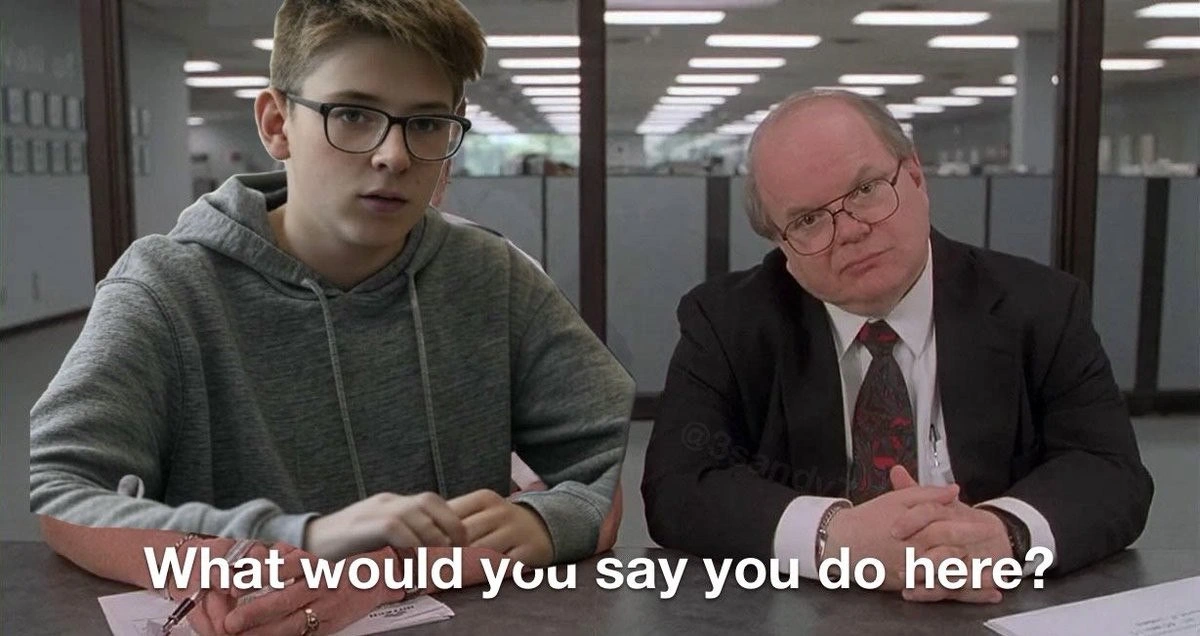
When managers demand: 'So, what would you say you actually do?'
CorporateCulture Post #6519, on Feb 3, 2025 in TG

When managers demand: 'So, what would you say you actually do?'

Why is this CorporateCulture meme funny?

Level 1: Hidden Helper

Imagine you have a helper who secretly cleans up your room every night. You wake up and the room is always tidy, but you never see them doing the work. Since you never witness the mess or the cleaning, you might wonder, “What does this helper actually do?” This meme is funny for a similar reason: the developer is like that hidden helper who fixes and maintains the software so that everything runs smoothly. The manager in the picture is like someone who only notices things when they change or break. Because the developer’s work keeps problems from happening in the first place, the manager doesn’t see any “mess.” So the manager asks, essentially, “Do you even do anything?” It’s a silly situation – the developer has been working hard behind the scenes (just like cleaning a room or keeping a car well-tuned), but from the outside it looks like nothing changed. The humor comes from that misunderstanding, and anyone who’s ever had their hard work go unnoticed can laugh at how true-to-life it feels.

Level 2: Invisible Workload

For a less experienced engineer (or someone new to tech), this meme shows a frustratingly common situation: a manager or PM (project manager) in a formal meeting asking a developer to explain their job in plain terms. The image itself is referencing a scene from the comedy movie Office Space. In that film, two consultants (nicknamed “the Bobs”) ask employees questions like “What would you say you do here?” to figure out who’s expendable. It’s a famous bit of office humor. Here, the meme replaces one of the employees with a young developer in a hoodie. The setting—a bland cubicle-filled office with fluorescent lighting—screams old-school corporate environment, the kind where formal performance reviews and awkward meetings happen regularly. The manager in the suit, with a skeptical look, represents someone from upper management or HR who doesn’t really understand programming work but is evaluating the engineer. The joke is that the engineer’s contributions are hard to see or measure in the way management usually measures work.

Let’s break down what the developer likely does versus what the manager expects to hear:

  • Performance review – This is a formal process (often yearly or quarterly) where an employee sits down with their manager to go over what they’ve accomplished. It can feel stressful, especially if your work doesn’t produce easily countable results. The manager’s question “So, what do you actually do?” is the kind of blunt demand you might fear in a performance review if your duties are not clearly understood.

  • Refactoring – This means cleaning up and improving the code without adding new features. For example, if the codebase was a messy room, refactoring is like organizing and tidying it. The software behaves the same to users after refactoring, but the code is neater, easier to maintain, and less likely to break later. A junior developer might spend a week refactoring ugly code to make future development smoother. However, to a manager, nothing visibly “new” came out of that week, because the product looks the same. This is essential work (it reduces technical debt, which is the accumulated “mess” in code that grows over time), but it’s invisible to anyone not looking at the code.

  • Code review – This is when developers check each other’s code before it’s merged into the main project. It’s like proofreading a teammate’s work or doing a quality inspection. In code review, you might catch bugs, suggest better solutions, or ensure consistency. It improves code quality and prevents future problems. From a high-level view, though, code reviewing doesn’t produce a new artifact the manager can see; it’s a preventive measure. Many junior devs quickly learn that doing thorough code reviews is part of the job, but it’s the kind of effort that, if done well, results in nothing bad happening – which again can look like “no activity” to someone not aware.

  • Keeping the build green – “Build” refers to the process of compiling the code and running automated tests, often on a continuous integration (CI) server every time changes are made. When all tests pass successfully, the build is marked green (often with a green indicator), meaning everything is working. If a test fails or the code doesn’t compile, the build turns red. Developers aim to “keep the build green,” i.e. fix problems quickly so that the software is always in a deployable, working state. This could involve fixing flaky tests, adjusting configurations, or rewriting parts of code that cause errors. It’s crucial for a healthy development workflow. However, keeping the build green is maintenance work—when you succeed, it just looks like normal smooth progress. A non-technical manager might not realize how much effort goes into making sure the whole team’s code integrates without issues every day.

  • Undefined job description – Sometimes a developer’s role isn’t clearly defined in terms that non-tech people understand. For instance, your job title might be “Software Engineer,” but in practice you do a mix of backend coding, devops (managing servers and deployment), mentoring interns, and firefighting urgent bugs. If your boss or a new manager doesn’t understand all those subtle responsibilities, they might literally not know what your day consists of. That’s an “undefined job description” problem: your actual work goes beyond the simple title. In the meme, the manager asking “What do you do here?” hints that either the manager hasn’t been keeping track of the engineer’s contributions, or the engineer’s work is so behind-the-scenes that it’s not obvious from the outside.

All these terms boil down to one idea: developers do a lot of behind-the-scenes work to ensure the software is reliable, secure, and maintainable. A junior dev might be surprised how much time is spent on things other than directly writing new features. But those tasks (refactoring, reviewing, testing, updating code) are like the plumbing and foundation of a house. If you do them well, the house (software product) stands strong, and users have no complaints. Yet, to someone walking by, it doesn’t look like anything changed because a lot of that work is preventive or internal. This meme is relatable because many of us in tech have had to explain these kinds of tasks to a manager or a colleague at some point. It highlights the communication gap: engineers need to translate their invisible work into visible value. When the manager in the meme asks the question, it’s poking fun at that gap — the manager isn’t trying to be mean (in theory), they just genuinely don’t see the work, much like how others might not see what a sysadmin or QA engineer does until something goes wrong.

Lastly, the contrast in the image (young hoodie-wearing dev vs. older suited manager in a gray cubicle office) also plays on stereotypes. Corporate life often has formality and bureaucracy, whereas tech folks are seen as casual and focused on the technical details. The meme captures that moment where these two worlds meet and stare at each other across a table, each not entirely understanding the other. For a junior developer, it’s a cautionary laugh: you might one day find yourself in this exact meeting, so it helps to learn how to communicate your work in terms non-developers understand. And for anyone watching from outside tech, it’s a comedic reminder that a lot of important work in software is invisible – until it isn’t.

Level 3: The Bobs Are Back

In this classic Office Space-style scenario, a stone-faced manager asks a developer the infamous question: “What would you say you do here?” This meme perfectly skewers CorporateCulture and Management misunderstandings. It’s playing on a piece of ManagementHumor that every engineer finds painfully familiar: the moment when a non-technical boss or a pair of consultants (like The Bobs from Office Space) demand you justify your existence at the company. The drab 90s cubicle backdrop under harsh fluorescent lights accentuates the CorporateLife vibe. On one side, we have the hoodie-clad engineer nervously clutching a pen—our proxy for every developer who’s been in a performance review hot seat. On the other, the older manager in a suit-and-tie sits with fingers interlaced, head tilted skeptically, the epitome of ManagerExpectations looming over the table. The whole image screams “formal review meets techie anxiety.”

The humor here comes from a relatable developer experience: a disconnect between what engineers actually do all day and what managers think they do (or should do). The subtitle text, “What would you say you do here?”, is a direct quote from Office Space—a line uttered when consultants can’t figure out an employee’s contribution. In a dev’s world, this question is both hilarious and terrifying. It satirizes how managers often value tangible outputs (new features shipped, visible bug fixes, flashy deliverables) and can be oblivious to the intangible but crucial work that developers grind on daily. The meme exaggerates this corporate ritual: the engineer must justify refactoring code, doing code reviews, updating dependencies, writing tests, and generally “keeping the build green”—tasks that don’t show up in glossy quarterly reports but literally keep the product from collapsing. It’s like being called out by the boss because nothing went wrong, which ironically is proof you were doing an excellent job quietly behind the scenes.

Every seasoned engineer knows the performance_review (or surprise meeting with upper management) where you brace yourself to translate your nerdy toil into business-speak. Why is that hard? Because a lot of our work is preventative and invisible when done right. We spend weeks paying down technical debt (cleaning up messy legacy code) so that future feature development is smoother. We scrutinize colleagues’ merge requests in code reviews to catch bugs early so customers never see them. We continuously tweak and monitor the CI/CD pipeline to ensure every build stays green (meaning all tests pass) so the team isn’t stuck with a broken build at 5 PM. When these efforts succeed, nothing dramatic happens—no outages, no angry support tickets, no spaghetti code disasters. But to a results-driven manager scanning this week’s sprint report, it might look like the developer “didn’t deliver anything new.” The meme nails this irony: the developer’s vital contributions are, by their nature, hard to quantify in bullet points, leaving them vulnerable to the dreaded question.

This tension is a well-known anti-pattern in tech management: focusing only on immediately visible outcomes while ignoring foundational work. The image references the generational and attire contrast—hoodie vs. suit—to underscore a culture gap. The young engineer in casual garb represents modern dev culture that values flexibility and continuous improvement; the suited manager represents old-school corporate formality that values clear-cut job descriptions and direct ROI on every hour. The older manager’s expression practically says, “Cut the tech jargon and give me a simple answer.” Meanwhile, the developer is internally scrambling: “How do I explain that I spent two weeks refactoring the data access layer so that our app won’t crash under load next month?” It’s a comedic mismatch in language and priorities. The manager might as well be asking for an elevator pitch of the developer’s job, expecting something like “I write code that increases revenue by X%.” But the developer’s reality is more nuanced: “I removed 1,000 lines of useless code, updated our frameworks, and prevented at least 5 future production outages… which is why you didn’t hear about any problems.”

By invoking Office Space, the meme taps into tech history and ongoing reality. That film came out in 1999, yet here in the 2020s, many tech professionals still encounter the “So, what do you do?” interrogation whenever reorgs or budget cuts loom. It’s a bit tragicomic that decades of industry evolution (Agile methodologies, DevOps culture, etc.) haven’t eradicated this scenario. Even with all our modern CorporateLife talk of cross-functional understanding, engineers can still feel like Tom Smykowski from Office Space, on the verge of shouting “I have people skills!” to defend their job. The undefined_job_description tag from the context hints at another layer: tech roles are often fluid and not easily summarized. A developer might also act as a part-time troubleshooter, automation engineer, mentor, and so on. When confronted by someone who expects a one-line job description, the developer’s multifaceted role seems undefined, further fueling the awkwardness.

Ultimately, this meme is funny because it’s true. It exaggerates a real communication gap for effect. Engineers laugh (maybe a little darkly) because we’ve all been there: sitting across from a well-meaning (or sometimes downsizing-minded) manager who genuinely doesn’t get how our behind-the-scenes work translates to business value. It’s CorporateHumor at its finest—highlighting through sarcasm and a movie reference how absurd these corporate rituals can feel. The next time someone non-technical asks, “What do you actually do as a developer?”, you might just smirk and think of this meme. The manager expects a tidy answer like “I build features,” but the seasoned dev inside you is groaning sarcastically, “Oh, you know… I just keep the entire product from imploding while no one notices.”

Description

The image shows a drab, gray-walled cubicle farm straight out of the 1990s. Two people with blurred faces sit side-by-side at a conference table: on the left, a younger person in a light-gray hoodie clutching a pen and notepad; on the right, an older, suit-and-tie manager with folded hands. Fluorescent office lights and endless cubicles stretch out behind them. Bold white subtitle text at the bottom reads, "What would you say you do here?" The scene parodies a performance-review interview - famously from the movie Office Space - capturing the corporate ritual where management asks engineers to justify intangible work like refactoring, code reviews, or keeping the build green, a situation every seasoned developer can relate to

Comments

9
Anonymous ★ Top Pick I turn Sales’ vaporware into a cloud-native Rube Goldberg machine that keeps the 40-year-old COBOL alive behind a GraphQL façade and only pages me during executive off-sites - so basically “nothing.”
  1. Anonymous ★ Top Pick

    I turn Sales’ vaporware into a cloud-native Rube Goldberg machine that keeps the 40-year-old COBOL alive behind a GraphQL façade and only pages me during executive off-sites - so basically “nothing.”

  2. Anonymous

    After 20 years in tech, I've realized the hardest distributed systems problem isn't CAP theorem or consensus algorithms - it's achieving consensus on what anyone's job title actually means when 'Staff Engineer' at one company debugs CSS and at another designs planetary-scale infrastructure

  3. Anonymous

    Every senior engineer has faced this question at least once - usually right after spending three months refactoring a critical system that now 'just works' so well that nobody notices it anymore. The irony is that the best engineering work is often invisible: the incident that never happened, the outage that was prevented, the technical debt that was quietly eliminated. Try explaining to non-technical stakeholders that you spent Q3 reducing deployment time from 4 hours to 12 minutes while improving reliability from three-nines to five-nines - they'll still ask 'but what features did you ship?' The most valuable contributions are often the hardest to articulate in a performance review, which is why experienced engineers learn to keep a 'brag document' of their architectural decisions, system improvements, and the fires they prevented before anyone knew there was smoke

  4. Anonymous

    I balance CAP theorem impossibilities while herding microservices through zero-downtime deploys - coffee-fueled

  5. Anonymous

    I run the alignment microservice: convert executive OKRs into Jira epics and quarterly slide decks with strong eventual consistency and zero impact on p99

  6. Anonymous

    What do I do here? I’m the API between Product and Git: validate “can we just” payloads, rate-limit them with ADRs, and return “it depends” with a 429

  7. @Algoinde 1y

    Who?

    1. @gmayv 1y

      Musk's Teen Titans

  8. @Alepaff 1y

    I would say they do something related to AI because the hands look like they were poorly made 😁

Use J and K for navigation