Skip to content
DevMeme
5199 of 7435
The Real Reason for the OpenAI Coup: A 2008 Fashion Crime
AI ML Post #5693, on Nov 24, 2023 in TG

The Real Reason for the OpenAI Coup: A 2008 Fashion Crime

Why is this AI ML meme funny?

Level 1: The Past Comes Back to Bite

Imagine you wore a really silly outfit to a big school event years ago – let’s say two bright shirts at once, trying to look cool. There’s a photo of you doing this, stored somewhere. Now, today, you’re the captain of your school team, and suddenly the teachers find that old photo. They decide, “Oh no, this is so embarrassing – you can’t be captain anymore because of this!” Sounds unfair and pretty funny, right? They’re treating a goofy old mistake as if it’s a huge deal.

This meme is joking about a similar situation in the grown-up tech world. A big company’s leaders supposedly found a picture of their boss from long ago wearing a funny, outdated outfit, and they reacted by firing him – like undoing everything he’s done just because of that old slip-up. It’s an obviously silly reason, which is why it’s humorous. We all have things from our past that are a bit embarrassing (an old hairstyle or a weird fashion choice), but it would be crazy if someone in charge kicked you out for it now. The joke makes us laugh because it’s taking a very serious action (firing a CEO) and pairing it with a ridiculously trivial cause (wearing two collars on a shirt many years ago). It’s like punishing someone today for a goofy thing they did as a kid – totally over-the-top and that’s exactly the point. It reminds us that sometimes big decisions can seem really absurd if the reasons are too petty, and seeing that contrast is what makes it funny.

Level 2: Commit, Blame, and Double Collars Explained

Let’s break down the meme’s references in simpler terms, especially if you’re a newer dev or not steeped in this saga:

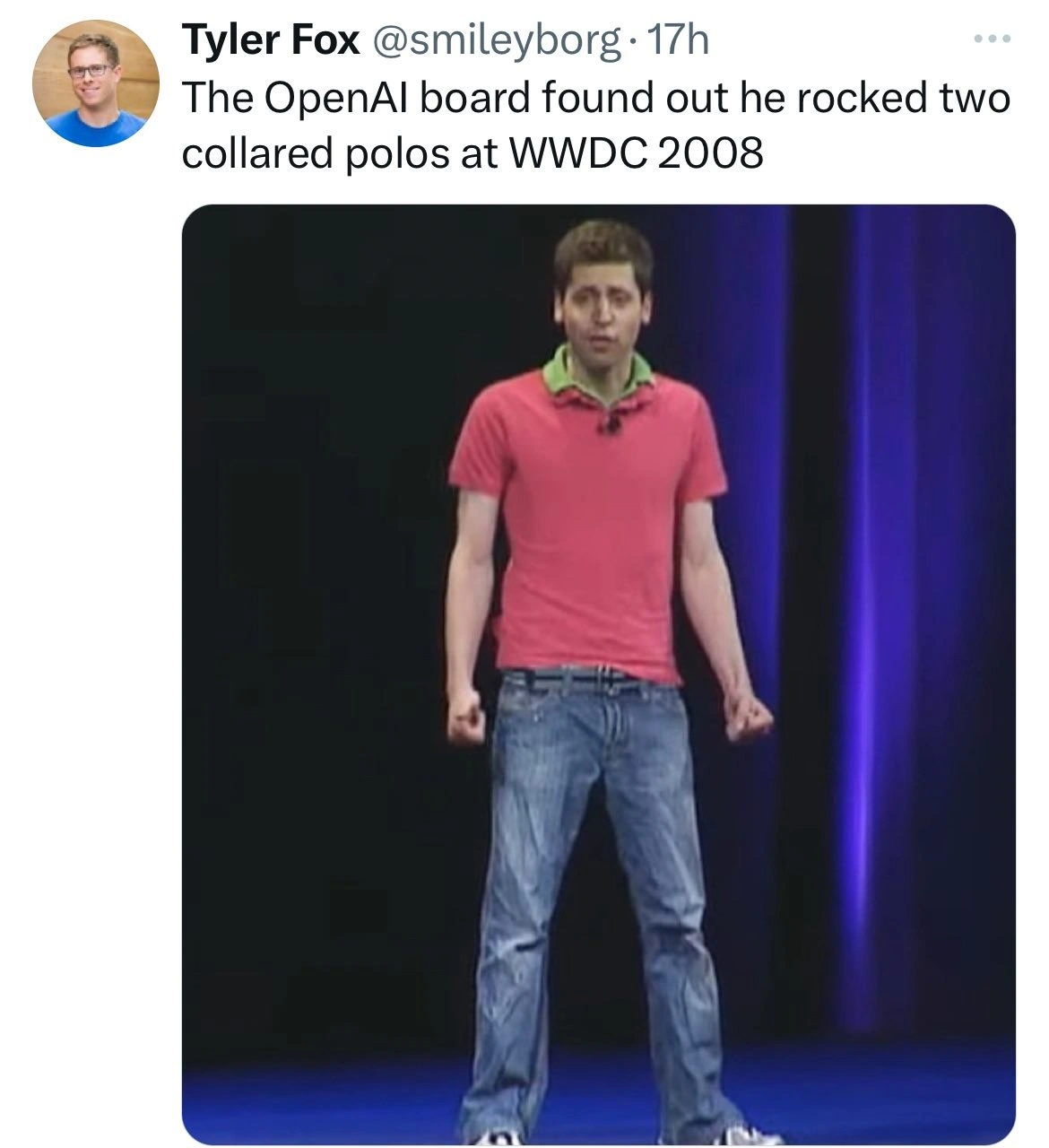
  • WWDC 2008 (Apple’s Worldwide Developers Conference) – This is a big annual event where Apple showcases new products and software to developers. In 2008, WWDC was extra special: Apple introduced the App Store and the iPhone 3G. They even invited some young developers on stage to demo their apps. The photo in the meme is from one of those presentations. The guy on stage, believed to be a young Sam Altman (who later co-founded and led OpenAI), is wearing two polo shirts layered on top of each other. Yes, that was actually a thing some people did then – a sort of quirky mid-2000s style. The bright pink-over-green double collar look in that image is a real throwback to vintage developer fashion (or perhaps lack of fashion!). It instantly dates the picture and makes it obvious it’s from an earlier era of tech.

  • OpenAI Board – OpenAI is the company behind ChatGPT and other AI tech. Like many companies, it has a board of directors (a small group of people, including investors and experts, who oversee the big decisions). In November 2023, the OpenAI board suddenly removed (fired) the CEO, Sam Altman, which was huge news in the tech industry. Nobody outside the board knew exactly why they did it, and this uncertainty led to a lot of speculation and, of course, internet jokes. The meme jokingly “explains” that the board found an old photo of Sam’s double-collared outfit and that, of all things, was the final straw for them. It’s a satirical way to poke fun at the board’s mysterious decision – suggesting humorously that they had a very silly reason.

  • Double-Collared Polos – This just means wearing two polo shirts at the same time, with both collars visible (and sometimes even both collars popped up). Styles come and go, and while it might sound odd now, layering two polos was a short-lived fashion fad especially in the mid-2000s, associated with a “preppy” look. In the photo, Sam’s lime green collar peeks out under the pink polo. At the time, maybe it seemed cool or at least normal enough for a 23-year-old on stage. Today, it mostly looks odd and a bit funny – the kind of goofy past style you might chuckle about. It’s the sartorial (clothing-related) equivalent of an old trend that didn’t age well. Think of it like finding your dad’s high school yearbook and seeing an embarrassing hairstyle; double collars are like the tech-bro version of that.

  • Commit – In programming and version control, a commit is when you save a set of changes to the code repository. It’s like taking a snapshot of your project at a certain point in time, with a message describing what changed. Each commit is recorded in the project’s history. In the meme’s text, they jokingly call Sam’s 2008 wardrobe choice a “commit” – as if him putting on those shirts was a recorded change to some kind of life repository. It’s a metaphor: the internet has a record (photo) of that moment, just like a codebase has a record of every commit. The phrase “double-collar WWDC 2008 commit” is phrased like a commit message description of that embarrassing snapshot. It makes it sound technical, as if Sam’s outfit was a code change checked in during WWDC 2008.

  • Rollback – In tech, a rollback means undoing recent changes to go back to a previous stable state. Imagine you deploy new code and it causes errors; you might roll back to the older version that was working. Here the “rollback” refers to the OpenAI board ousting the CEO – essentially undoing the “Sam Altman as CEO” state of the company. The tweet says “triggers rollback” to humorously frame the board’s decision in tech terms, as if Sam’s leadership was a bad code change that needed to be reverted. It exaggerates the situation: the board discovers that old “commit” (the double polo) and immediately acts as if it were a bug in need of fixing by rolling the company back to a time before that person was in charge.

  • git blame (blame history) – Developers have a tool called git blame which shows who last modified each line of code and when. It’s literally used to identify who to “blame” for a piece of code (often to track down who wrote a bug, though in practice it’s more about understanding history than shaming colleagues!). The meme alludes to the idea that the internet has a similar capability: finding old posts, photos, or tweets and pinning them on the person who created them. When the description mentions “the internet’s version-control-style ‘blame’”, it means that the internet never forgets – just like a Git repo, it has an archive of our past “commits” and will readily show them if someone goes looking. In this case, someone found this 2008 photo (the “blame” points to Sam’s past fashion choice), and the joke is that the OpenAI board acted on it. It’s playing with the notion that in tech culture, we treat everything like code, even someone’s personal history can be combed through as if running git blame on their life.

  • Why it’s funny to devs: It’s an inside joke cocktail. You combine a current tech industry uproar (OpenAI’s boardroom shuffle) with a deep-cut reference to a 2008 Apple event and wrap it in software version control terminology. If you’re early in your career, picture this scenario: your coworker gets called out in a meeting because someone dug up a years-old commit they wrote that introduced a bug. Now translate that feeling to real life – an exec gets “called out” because someone dug up an years-old photo of a silly outfit. It’s the same mix of embarrassment and “uh-oh, caught in 4K”, but applied in a totally inappropriate way. Devs find it funny because we’re so used to thinking in terms of commit logs and blame that extending those concepts to real life situations is ridiculously comical. And there’s a grain of truth: tech folks know that the internet is like a giant, permanent database – whether it’s an old source code commit or an old Instagram photo, it can resurface. This meme exaggerates that to the extreme: relatable humor for anyone who worries about their old Facebook photos the way they worry about legacy code they wrote.

Level 3: Sartorial Tech Debt

In true TechHistory fashion (pun intended), this meme dredges up a moment from WWDC 2008 – Apple’s Worldwide Developers Conference circa 15 years ago – and merges it with a modern CorporateCulture drama. The photo shows a young tech presenter on an Apple stage rocking two collared polo shirts (a lime green one under a hot-pink one) with unabashed 2008 confidence. If you squint through the blur, that presenter is very likely Sam Altman, long before his OpenAI fame, demoing his startup’s app to the Apple crowd. The stage’s dark backdrop and signature vertical blue lighting scream “Apple keynote” – a historic scene forever stored in the internet’s memory. Fast-forward to November 2023: Sam, now CEO of OpenAI, gets abruptly ousted by his board of directors in a high-profile corporate coup. The tweet in the meme jokes that the board’s “rollback” of Sam was triggered by discovering this old double-collar “commit” in his past. It’s hilariously absurd – imagine a board meeting combing through a commit history of someone’s life and gasping, “He committed what in 2008? Two polo shirts at once? This won’t stand – revert him immediately!”

On a deeper level, the humor riffs on the idea of version control for one’s personal history. Developers use tools like Git to track every change (or commit) in code, and they can use git blame to see who wrote what, even years later. Here, the internet plays the part of the version control system, digging up a “blame” from 2008 to identify who was responsible for the crime fashion choice of layering polos. In coding, a commit from 15 years ago might introduce a bug that only now causes a production issue, prompting a frantic rollback. Likewise, the meme tongue-in-cheek implies that Sam’s double-collared polo was a latent bug in his personal image, one so egregious that when the board “found out,” they treated it like discovering a critical flaw and hit the emergency rollback button on his tenure. It’s a perfect storm of TechHumor and InsideJokes – treating an old photo like bad code that slipped through code review.

This is also a nod to “sartorial tech debt.” In software, technical debt means you took a shortcut or made a questionable decision that seemed fine at the time, but later it causes trouble and demands repayment. Here the “debt” is an embarrassing style decision from 2008. Back then, popping two collars might have been a quirky flex or simply a 20-something startup CEO’s idea of looking sharp on the big stage. (The late 2000s had some questionable geek fashion trends – you might say the era’s style hasn’t aged as well as the iPhone did.) But now, that old decision became a liability – a fashionable bug coming due. The board discovering it is like a rigorous code audit uncovering a long-forgotten hacky workaround. They’re humorously portrayed as overzealous maintainers who can’t tolerate that commit in the project history, so they “roll back” the entire feature (Sam as CEO) to a previous state.

This hits home for experienced devs because it satirizes both corporate politics and our obsession with permanent records. In real corporate life, boards don’t actually fire CEOs for bad fashion from years ago – but the joke lands because the real reasons for Sam’s surprise firing were opaque and baffling. Tech insiders were speculating everything from conflicts over company direction to personal clashes. The meme hyperbolically reduces it to the most trivial reason possible to highlight how ridiculous the whole saga felt. It’s a classic TechSatire move: take a serious industry incident and add an absurd twist that only those in the know would concoct. The image of a boardroom solemnly reviewing old WWDC footage for “evidence” is both ludicrous and layered with inside humor. It also pokes fun at how the tech community has a long collective memory – nothing truly gets forgotten. Just like an embarrassing old commit in a codebase, an embarrassing old photo from a developer conference can resurface at the worst time. As developers, we’ve all used tools like git log or git blame to trace the origin of a bug; here we’re imagining the OpenAI board doing the same on Sam’s life. Apple fans recognize the keynote scene, AI folks recognize the board drama, and coders recognize the GitHub-style phrasing of the joke. It’s a triple-threat of niche references that come together as a perfectly relatable punchline. And yes, we’re laughing with a slight cringe, because who among us doesn’t have a few old “commits” we pray never make it to production?

Description

A screenshot of a tweet from user Tyler Fox (@smileyborg). The tweet's text reads, 'The OpenAI board found out he rocked two collared polos at WWDC 2008'. Below the text is a photograph of a much younger Sam Altman, CEO of OpenAI, on stage at an Apple WWDC event in 2008. In the photo, he is wearing a bright pink polo shirt over a green polo shirt, with both collars popped up. He has a slightly awkward stance with clenched fists. This meme humorously capitalizes on the intense speculation surrounding the sudden and controversial firing of Sam Altman by the OpenAI board in November 2023. Instead of citing complex corporate governance issues, the tweet ironically proposes that this past fashion faux pas - the quintessentially 2000s trend of wearing two popped-collar polos - was the true, unforgivable offense that led to his ouster. It's an inside joke for the tech community, contrasting a trivial, decade-old style choice with a major crisis at one of the world's leading AI companies
Comments

7
Anonymous ★ Top Pick The board was concerned he might try to build an AGI with the same layered, redundant architecture as his 2008 polo shirts
  1. Anonymous ★ Top Pick

    The board was concerned he might try to build an AGI with the same layered, redundant architecture as his 2008 polo shirts

  2. Anonymous

    Proof that `git blame` works on wardrobes too - someone finally traced the “double-popped collar” bug back to a 2008 WWDC commit and opened a P0 incident with the board

  3. Anonymous

    The only architectural pattern more redundant than layering two polos is the three-tier monolith your company insists is "service-oriented" because it has REST endpoints

  4. Anonymous

    Turns out the OpenAI board's alignment problem wasn't about AGI safety - it was about collar alignment. When your technical debt includes fashion choices from WWDC 2008, even the most sophisticated neural networks can't predict the consequences. The real existential risk? Someone discovering you thought layering two polos was a power move during the iPhone SDK launch era

  5. Anonymous

    Apparently governance tolerates eventual consistency in safety docs, but not in collars - the 2008 nested‑collar pattern triggered a two‑phase rollback to a monolithic shirt

  6. Anonymous

    Governance shifted left: OPA denied the deploy - rule collars.count <= 1. Turns out you can rollback prod, but not a 2008 keynote audit log

  7. Anonymous

    Layered polos like Onion Architecture: solid domain isolation, but the board stripped every layer straight to termination

Use J and K for navigation